
Solar Energy Concepts earns commission from qualifying purchases via links on this page.
This article is my own opinion based on my experience using the battery, the research I did and the constraints I solved for in my system.
I bought the Fogstar Energy 15kWh rack battery in May 2023, and it has worked every day since. After three years, my two original packs report 89.1Ah and 89.3Ah on their BMS screens, against a rated 100Ah. The third pack reports 87.5Ah. It spent its first year working alone in another home, and that year still shows.
This review gives you the BMS readings from three dates, what they show about wear, and what I would check before you buy or expand a rack.
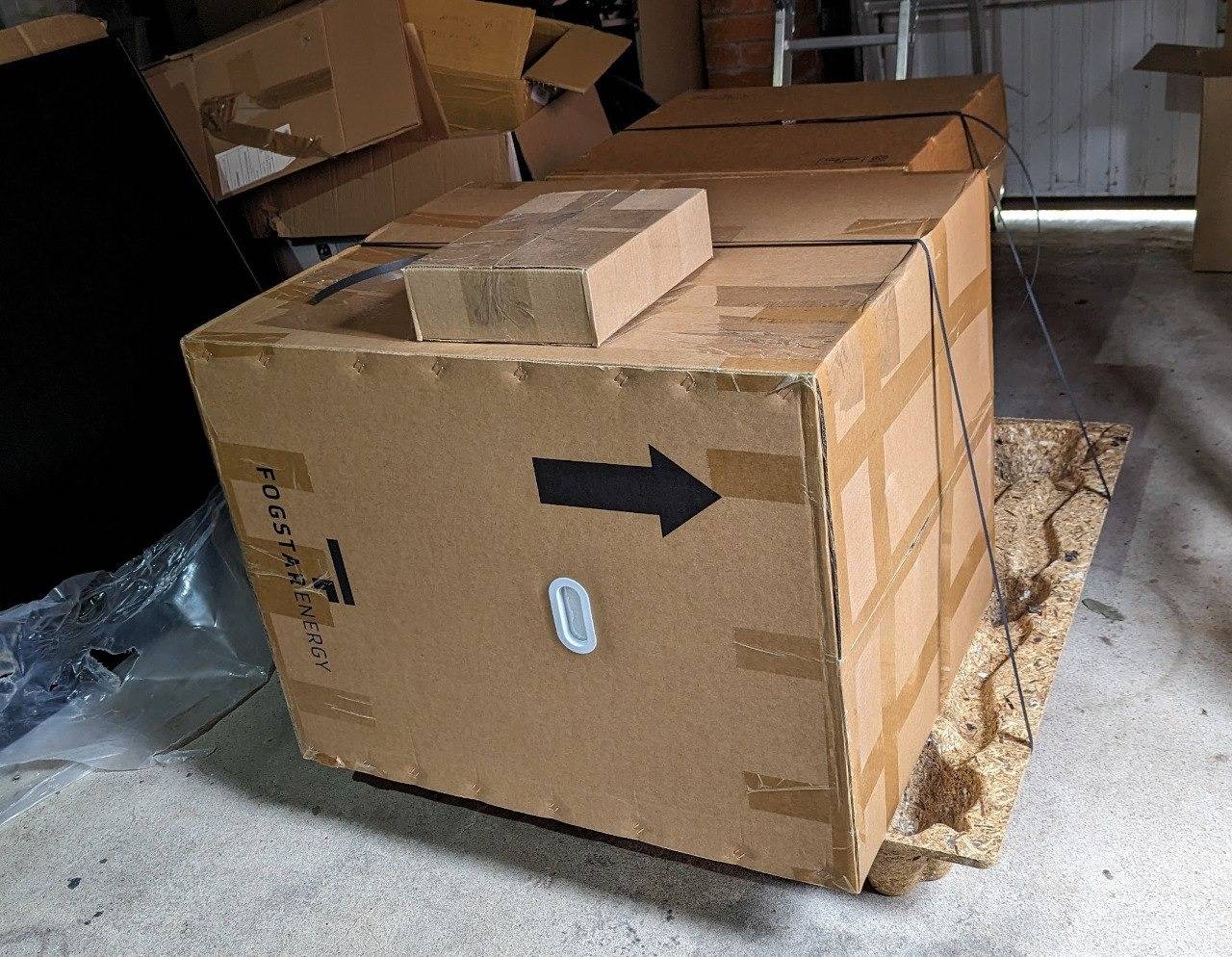
Fogstar Energy 15.3kWh 48V Battery and Rack
| Capacity | 15kWh or (3x 100Ah) |
| Cycle Life | 4000 Cycles |
| Design life | 15 years |
| Peak power | 15kW |
| Rated voltage | 51.2V |
How Much Have My Fogstar Packs Worn After 3 Years?
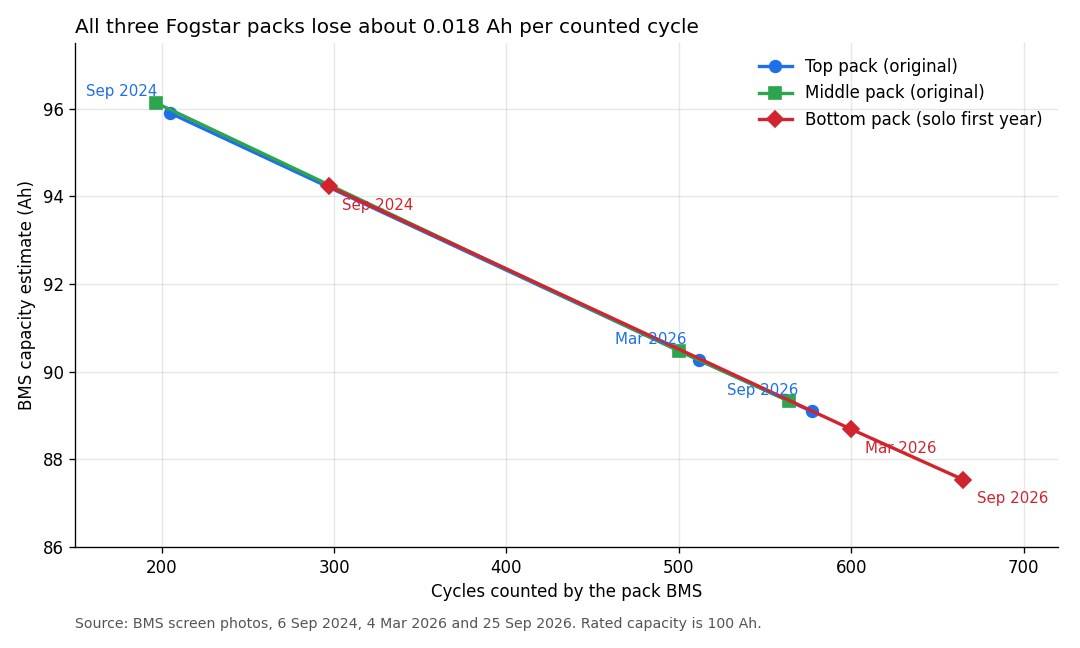
On 25 September 2026, my three packs reported 89.10Ah, 89.33Ah and 87.54Ah, against a rated 100Ah. The two original packs have counted about 570 cycles each. The third pack has counted 665. All three lose about 0.018Ah for each cycle they count, so the pack with the most cycles has the least capacity.
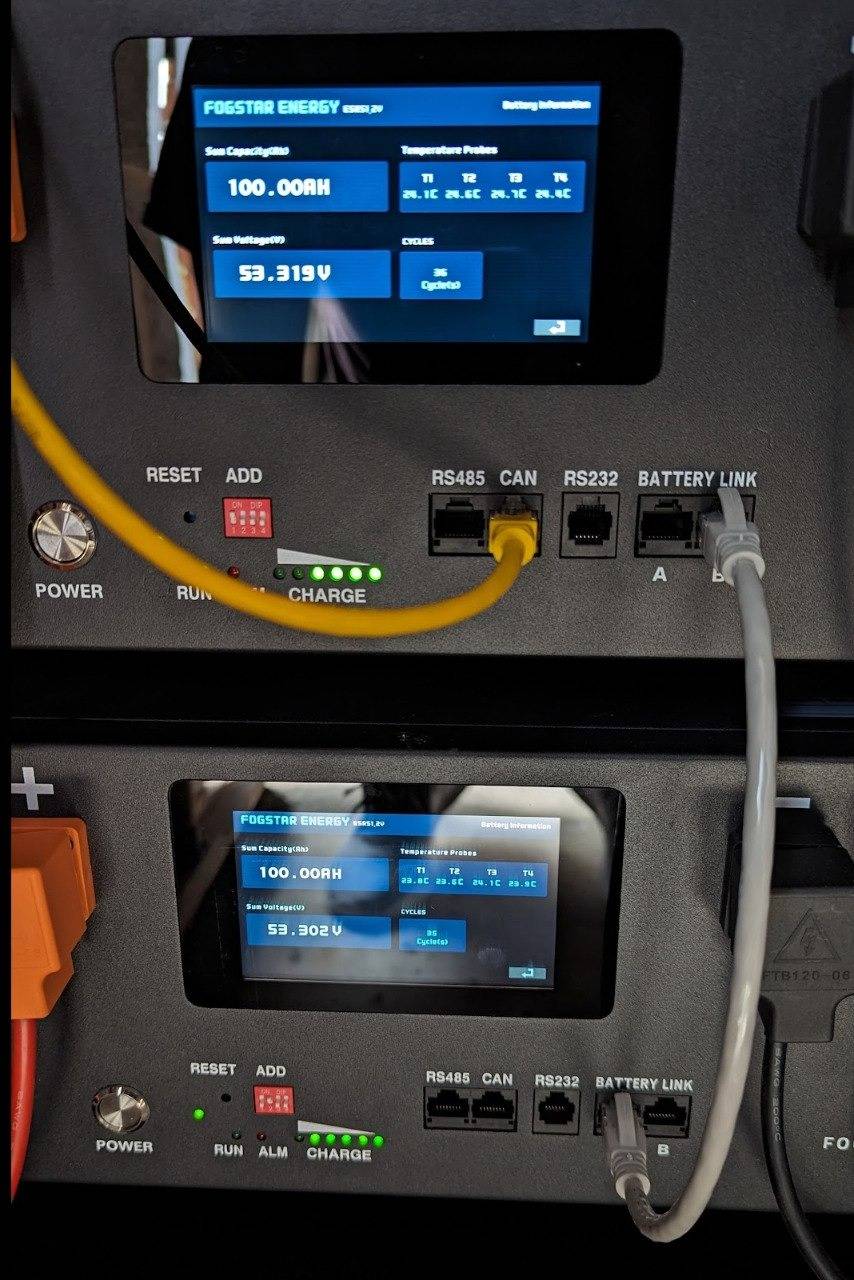
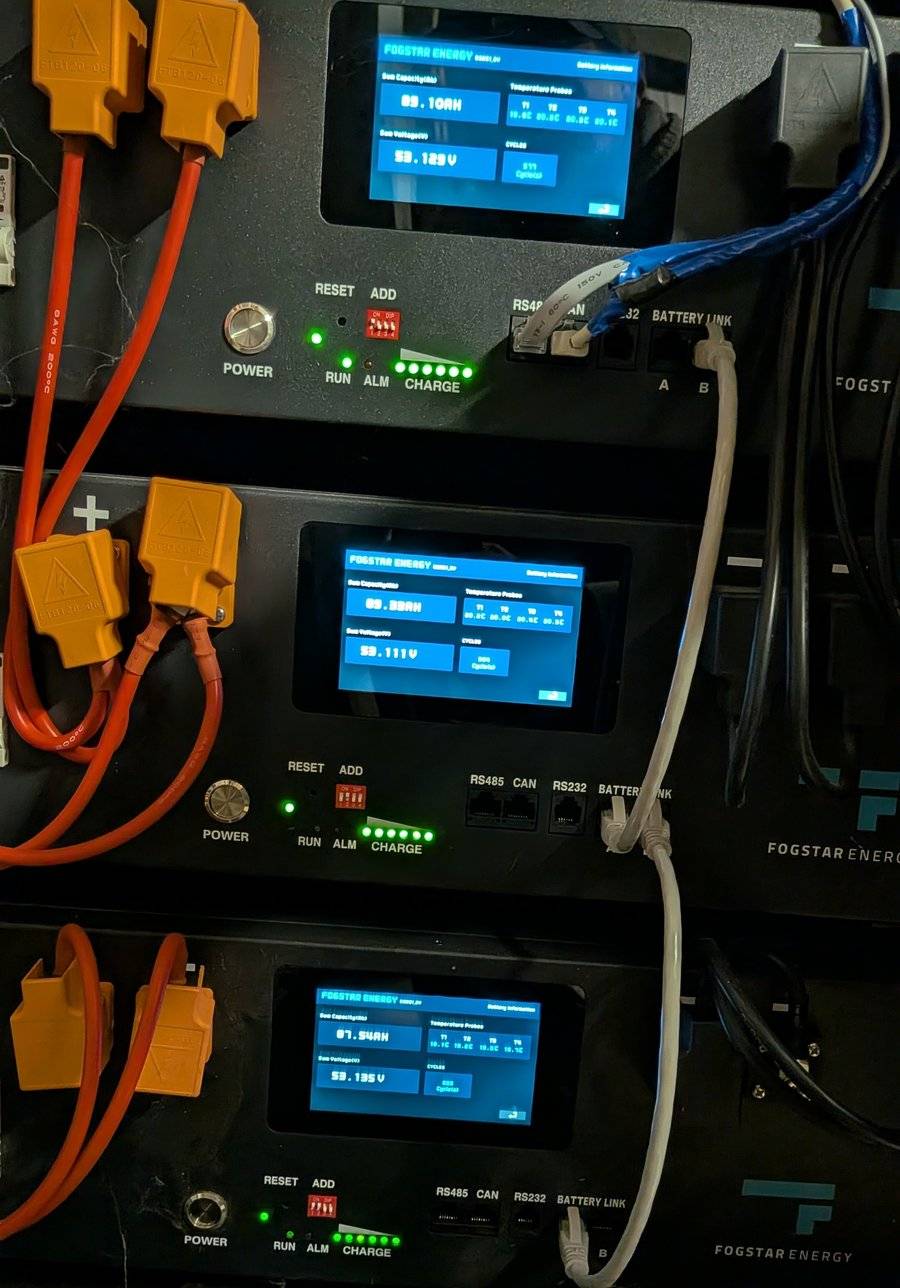
These are the BMS estimates, not a lab capacity test. The BMS calculates the figure itself, and I have not run a full discharge test. The readings are still useful for comparison, because the same type of BMS measured every pack in the same way on each date.
My usage also changed over the three years. At first, the packs stored only my spare solar. Since late 2024, I have charged the home battery storage from the grid every night and exported my solar during the day. So the solar battery now works harder than it did in its first year.
Pack-by-Pack Readings Since September 2024
The third pack joined my rack in September 2024. Since then, I have photographed the BMS screens three times:
| Date | Top pack (original) | Middle pack (original) | Bottom pack (solo first year) |
|---|---|---|---|
| 6 September 2024 | 95.90Ah, 205 cycles | 96.13Ah, 197 cycles | 94.23Ah, 297 cycles |
| 4 March 2026 | 90.26Ah, 512 cycles | 90.48Ah, 500 cycles | 88.69Ah, 600 cycles |
| 25 September 2026 | 89.10Ah, 577 cycles | 89.33Ah, 564 cycles | 87.54Ah, 665 cycles |
| Change in two years | -6.80Ah over 372 cycles | -6.80Ah over 367 cycles | -6.69Ah over 368 cycles |
The bottom row is the important one. In two years, each pack counted 367 to 372 cycles and lost 6.7Ah to 6.8Ah. So in my rack, the three packs share the work evenly and wear at the same rate.
The cells inside each pack also stay close together. On 25 September 2026, the 16 cells in each pack read within 2mV of each other. That is a weak test, though: at mid charge, LiFePO4 cells read close together even when they are out of balance.
The inverter’s totals show how much work the bank has done. Since May 2023, my Sunsynk has put 8,054.7kWh into the batteries and taken 7,050.9kWh back out. That is about 87.5kWh back for every 100kWh in, measured at the inverter.
What a Year Working Alone Did to the Third Pack
The three packs came in one bundle in May 2023. I kept two. The third went to another home, where it worked on its own for about a year. That home has similar energy needs and a similar solar array to mine. I have no records of its daily use, so treat this as a rough comparison, not a test.
When the pack joined my rack in September 2024, it had counted 297 cycles. My two packs had counted about 200. It was also 1.8Ah behind them: 94.23Ah, against about 96Ah for my packs.
Two years later, the gap is 1.7Ah. The pack did not wear faster once it shared the load with the other two. Its extra wear came from the solo year.
The chart above shows why. The solo pack sits on the same wear line as my two packs, about 95 cycles further along. At 0.018Ah a cycle, 95 extra cycles account for about 1.7Ah. So working alone did not damage the pack. It made the pack do more cycles, and each cycle cost the usual amount.
The mechanism is simple. A single pack carries the whole daily load of a home, so it counts full cycles quickly. When two or three packs share a similar load, each pack does a smaller part of each day’s work and counts fewer cycles. For the same home, a bigger bank wears each pack more slowly.
One caveat applies to all these counts. BMS firmware updates can reset the cycle counter, so a count may not cover a pack’s whole life. My photos show no reset after August 2024, but I cannot confirm the earlier history of each pack.
My experience does not show that every same-model addition is supported. Fogstar lists different BMS versions across rack generations on its firmware page. Pack condition, inverter support, firmware, protection, and the installation design also matter. I observed the displayed state-of-charge values diverge and later converge. That observation does not prove inter-pack balancing or identify its mechanism.
Before buying another pack, ask Fogstar or your responsible installer to confirm the exact proposed combination. The rack busbar provides a physical connection point. It does not establish compatibility or make the system change safe.
How I Charge: Solar Assistant and Sunsynk Settings
A note on Solar Assistant capacity readings: Solar Assistant reports 18Ah for each pack, while the BMS screens report about 89Ah. The Solar Assistant figure is clearly wrong for these packs. I read capacity and cycles from the BMS screens, and I use Solar Assistant for automation and monitoring trends.
The battery hardware is only half the story. How you charge and discharge makes a bigger difference to your savings than the battery spec sheet. Here is my actual setup:
Tariff: Octopus Go – 8.5p/kWh overnight (00:30 to 05:30), 29.62p/kWh during the day. Standing charge 52.49p/day.
Sunsynk inverter settings:
- Timer Slot 1: 00:30 to 05:30 – grid charge to 90% SOC for most of the year, and to 100% in winter
- Timer Slot 2: 05:30 – stop charge, switch to solar priority
- Work mode: Let Discharge (daytime solar charges battery, grid tops up if needed)
- Max charge current: set via Solar Assistant automation based on solar forecast
Solar Assistant automation: I use Solar Assistant rules to dynamically adjust the charge current based on conditions. During the overnight charge window, the discharge current is capped to 1A to prevent one pack draining while the others fill. Since then, the displayed charge levels of the packs have stayed close together. During the day, Solar Assistant adjusts the max charge current based on the PV forecast – if tomorrow looks sunny, it charges less from the grid overnight.
In 2025, this setup saved £1,668 in total. That breaks down into £587 in export revenue (at the then rate of 15p/kWh) and £1,081 in avoided import costs. The avoided costs come from three sources: direct solar powering the house (£601), grid-to-battery arbitrage shifting 10kWh per day from 8.5p overnight to displace 29.62p daytime usage (£447), and a smaller contribution from solar stored in the battery (£33). For 2026, with the export rate now cut to 12p/kWh, I project a total benefit closer to £1,572. That keeps the full £9,000 system on track for a 5.5-year payback. The full ROI breakdown with year-by-year projections is in my are solar panels worth it article.
What Works Well After 3 Years
With the hard numbers out of the way, here is a closer look at the practical aspects that have impressed me over three years of daily use.
Sizing It for My Home
The average electricity consumption of a UK home is around 8kWh a day. I need around 10kWh a day, so the battery I chose needed to cover most of that energy. I also needed the battery and inverter power limits to cover an estimated 4kW peak load. The current calculator screens energy capacity, not that power constraint.
Handling Peak Loads
The 15kWh bundle is built up from 3 x 5.12kWh server rack batteries. Each of the individual server rack batteries can output 5.12kW. This is enough to cover the estimated peak consumption.
The three batteries can output 15kW peak power if your inverter can handle it and the load demands it. This is easily done within the server rack cabinet, which includes a busbar for the parallel connection of batteries inside it.
Check Compatibility Before Expanding
Fogstar sells rack batteries separately, but stock and product generations can change. A same-name battery is not automatically compatible with an older rack. Check the exact models, hardware generations, firmware, BMS arrangement, inverter support, pack condition, protection, and installation design. Get written confirmation from Fogstar or the responsible installer before buying. I have not verified a current expansion route for my exact installed hardware.
The Server Rack Cabinet
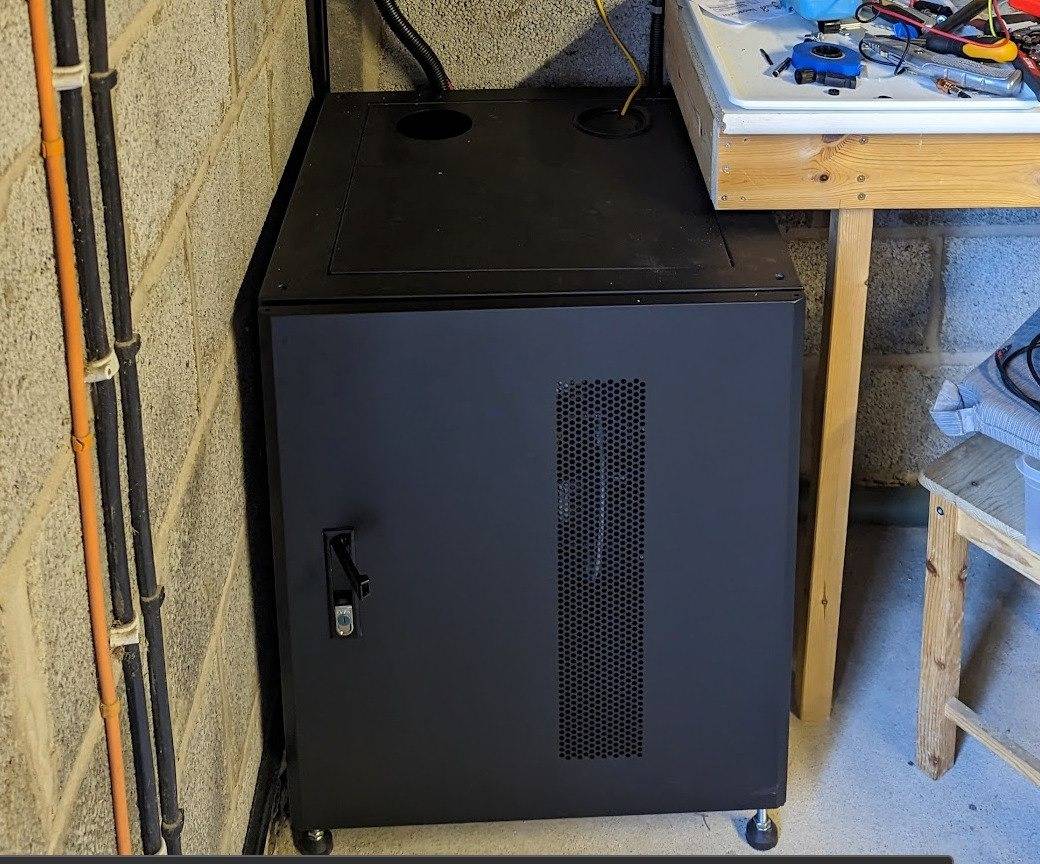
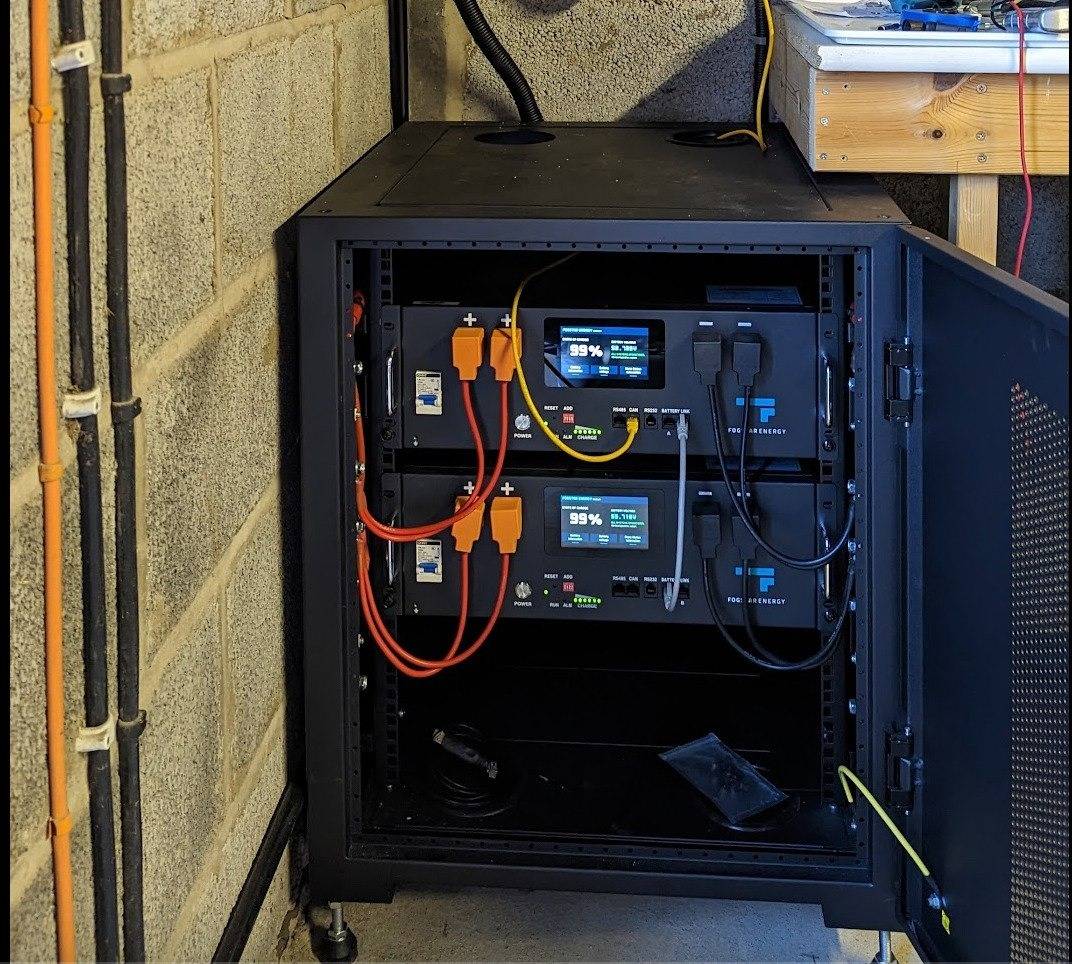
The rack is sturdy and safe; it comes assembled and has wheels for easy manoeuvring into place. It includes a door with a handle lock and comes with two keys, which is useful if you have pets or small children. One honest gripe: the lock mechanism is plastic, and mine broke after about two years of regular use. The door still closes securely without it, but if security matters to you, consider fitting a small padlock hasp as a backup. Beyond that, there are nice touches: the busbar is isolated with only the terminal connectors bare, and wide openings at the top and bottom with flexible glands let you run thick battery cables easily and keep them neat.
A Quick Note on the Included Rack
I bought the bundle and gave one of the batteries to someone else for a different project. I kept the server rack for my two batteries. The third pack came back and joined them in September 2024.
UK-Specific Design Features
The design of the battery caters for the local climate conditions of the UK. This manifests in details such as a built-in heater. The batteries heat themselves when a temperature of <5°C is detected, enabling charging in temperatures of -20C. The batteries also come with built-in support for the protocols used by the most common inverters. The build quality and overall finish are solid.
Cost vs. Value Over Time
The price and quality of Fogstar has held up well over my three years of ownership. There is plenty of competition, and prices keep sliding on various new models. However, considering the reliable performance and the build quality discussed above, I still regard this as a highly cost-effective purchase for my home.
My Experience with Customer Support
Fogstar is headquartered in the UK, and their support and design are there too. I turned to them twice, first asking for some advice in the early stages and later with a more concrete question, and in both cases, my experience has been positive.
Support was an important factor in my decision-making on batteries. They are simply too expensive to risk being out of support or warranty.
The Fogstar Owner Community
Before buying, I read some of Fogstar’s blog posts on LiFePO4 batteries and naturally turned to the online community. I found that Fogstar batteries had strong positive reviews in the social media solar energy groups I researched. Years later, those communities are still full of knowledgeable professionals and hobbyists sharing valuable first-hand advice on making the most of these specific units.
What Could Be Better (The Drawbacks)
No product is perfect. After three years of ownership, here are the points I think any prospective buyer should weigh up.
Price Evolution vs. DIY Alternatives
📆 In January 2024 this battery was reduced to £2999.99, where it has stayed.
At £2999.99 for 15kWh, this battery seems to be falling behind on value for money compared to Fogstar’s Seplos DIY kits which offer more capacity per pound for the hands-on installer.
Both batteries are modular and can be connected in parallel to add extra capacity. Both come in a neat box or server rack. The big difference is that the Seplos Mason is a DIY kit. This will probably discourage some less experienced DIY-ers.
The Seplos Mason kit requires assembling all the cells, the BMS and the busbars that connect them. It is not a simple job. On the other hand, the 15kWh server rack battery requires a relatively lower amount of work, even if you do DIY.
What I Observed in the Charge Readings
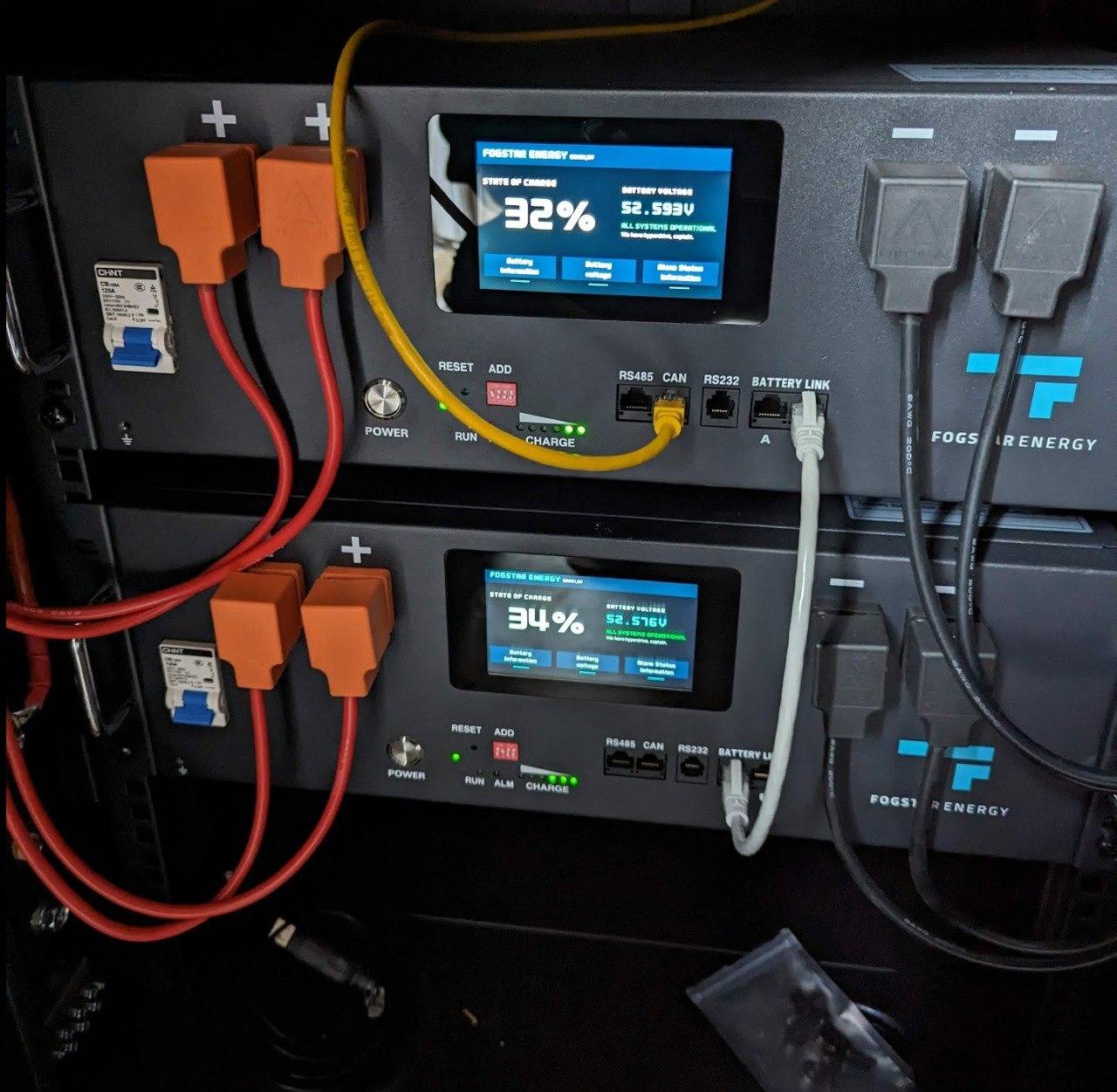
In late autumn, I saw the packs report different state-of-charge values. The displayed values did not regularly reach 100% during that period.
After a Fogstar-recommended BMS firmware update, the displayed values stayed closer together. I later changed my tariff and used Solar Assistant to limit discharge during my overnight charging window. The displayed values then converged more consistently in my system.
Fogstar’s changelog describes a similar problem. Its 28 September 2024 release fixed a fault where a battery on a Sunsynk inverter “would not consistently reach 100 percent SOC”. An earlier release improved the charge estimate with curves for EVE LF100A cells, the cell family in these packs.
These observations do not establish the cause or prove inter-pack balancing. They also do not show that the same settings suit another installation. A displayed 100% charge level does not independently verify usable capacity or cell balance.
To check your firmware, connect Fogstar’s PBMS Tools software to the pack. The version shows in the bottom left corner. The update needs an RS232 cable and Fogstar’s upgrade tool, and the firmware file must match your BMS model. Photograph every BMS screen before you update. If the update resets the cycle counter, your photos keep the record.
Fogstar also offers beta firmware for the rack packs. It lets the inverter use the battery down to 5% instead of 15%. Fogstar says this “can expose around 10 percent more capacity”, mostly on Sunsynk and Luxpower inverters. It also says the beta builds “may not suit all users”.
Ask Fogstar or the responsible installer for the current firmware and commissioning guidance for your exact packs and inverter. Do not change protection settings or copy another system’s charging settings to make an extra pack work.
Why I Chose the Fogstar 15kWh Rack
Before diving into alternatives, it helps to understand why I picked this specific battery out of a crowded market.
There are many options out there, but I ultimately purchased the Fogstar Energy 15kWh 48V Rack Battery Bundle, which conveniently came with a server rack included.
What I Would Buy Today
I am a DIYer, and the price of components is an important factor for me. Since I bought my first battery, there has been an increasing variety of options on the market.
Fogstar, the brand I would go for, have been adding attractive SEPLOS kits.
Here are my top three picks:
- This is the best SEPLOS kit I’ve seen; it’s a new generation SEPLOS V4 Kit and x16 MB31 314Ah Grade A Bundle. I like the compactness and the adjustable legs. These also come in different colours, which is a nice touch. Check the full SEPLOS range for current cell options.
- Best value for money – the horizontal SEPLOS Mason format. Check the current SEPLOS DIY kit range for the latest bundles (Fogstar regularly updates stock with new cell options). The horizontal form factor requires a prepared space and is more involved to move and handle.
Is It Worth the Investment?
After weighing up the positives and negatives, the practical question remains: does a battery actually pay for itself? Not only does it keep your home supplied with energy during dark hours, but it also supplements your solar power during peak demand during the day. People often overlook the second part. The battery covers the dips in solar production, so a smaller solar panel array can do the same job. Even when solar energy is not present, or not enough, batteries can still help when coupled with a flexible electricity tariff .
With the added efficiency batteries bring to your home energy system, they can pay for themselves, save you money or even potentially earn you a small income.
Final Thoughts After 3 Years
Batteries are likely the single most expensive item in your home solar installation. Choosing the right one early in your project is crucial. Three years in, the packs report about 89% of their rated capacity and share the work evenly. The modular Fogstar rack has paid off for me. The local support, the specific design features for the UK climate, and the active community of owners are what make this a solid long-term investment, not just a spec sheet comparison.
