
Safety first: home battery DC can deliver high current. A wrong design can cause fire, arcing, or equipment damage. This page explains series and parallel as electrical concepts. It does not give an installation or commissioning procedure.
Series and parallel arithmetic does not tell you whether a manufacturer permits an arrangement. A bare cell has voltage, current, and amp-hour ratings. A complete battery pack also has a battery management system (BMS), protection, communications, and product-specific limits. Check the exact battery and inverter manuals before buying another module. For sizing context, see the battery overview and DIY home battery boundary.
Where does the battery bank fit?
panels / strings
MPPT + charger
BMS + modules
consumer unit
Concept only. The exact battery bank, protection, isolators, earthing, and cable routes form one product-specific installation design.
What can you check before asking an installer?
You can define the storage goal and collect product information. The manufacturer or installer must confirm the supported arrangement and complete design.
| Question | What the concepts can show | What the exact product evidence must show |
|---|---|---|
| How much energy could the bank store? | Nominal kWh from voltage × amp-hours | Usable energy, reserve, and allowed module count |
| How might voltage and current change? | Series and parallel arithmetic | Permitted arrangement and battery input limits |
| Can you add another complete pack? | Nothing about compatibility | Supported models, revisions, BMS, firmware, and expansion conditions |
| Does the installation need changes? | Nothing about the final design | Equipment ratings, protection, location, cables, and commissioning requirements |
What do series and parallel change?
For bare cells, series adds voltage while amp-hours stay constant. Parallel keeps voltage constant while amp-hours and theoretical current capability add. Complete packs follow the same arithmetic only when their manufacturer approves the arrangement.
| Illustrative configuration | Nominal voltage | Arithmetic current ceiling | Amp-hours | Nominal energy | Theoretical DC power ceiling |
|---|---|---|---|---|---|
| One module | 50V | 100A | 100Ah | 5kWh | 5kW |
| Two in approved series | 100V | 100A | 100Ah | 10kWh | 10kW |
| Two in approved parallel | 50V | 200A | 200Ah | 10kWh | 10kW |
| Four in an approved series-parallel arrangement | 100V | 200A | 200Ah | 20kWh | 20kW |
Nominal energy is voltage × amp-hours. The power column multiplies voltage by the arithmetic current ceiling. It is a theoretical battery-side figure, not the power available to your home. The BMS, inverter, temperature, state of charge, and other limits can reduce actual power and usable energy.
A product rule can override an arithmetically possible arrangement. The US5000 V1.0 operation manual on Pylontech’s official download page prohibits series connection for US5000 and US5000-B packs. It permits specified capacity expansion in parallel and sets separate conditions.
Why can’t this arithmetic size cables?
The table cannot choose cables, fuses, busbars, isolators, or connection points. A designer needs the actual continuous and peak currents. They also need the equipment ratings, route, temperature, protection, and manufacturer instructions.
A battery calculation can show a 10kW theoretical ceiling while a 3.6kW inverter limits AC output below it. The inverter battery input and BMS can set lower limits. This inverter limit example explains why battery power and appliance power differ.
What changes in an approved series arrangement?
Series arithmetic adds the module voltages. The same current passes through each module, so the arithmetic current ceiling follows the lowest module rating. Amp-hours stay constant, but nominal energy increases because total voltage increases.
The table’s two hypothetical modules become 100V, 100Ah, and 10kWh in series. Their theoretical DC power ceiling is 10kW. The connected inverter can use only the voltage and current range that its design permits.
Complete packs can prohibit series even when the arithmetic works. Pylontech’s US5000 rule provides the direct counterexample. Its 48V packs must not connect in series.
What changes in an approved parallel arrangement?
Parallel arithmetic keeps nominal voltage constant. Amp-hours add, and theoretical current capability can add when the approved system supports it. The table’s two hypothetical modules become 50V, 200Ah, and 10kWh.
Parallel operation can add nominal energy without raising the inverter’s AC output limit. The inverter and BMS still control the usable power. Adding a pack also requires checks for product generation, firmware, condition, protection, and commissioning.
The Pylontech US5000 manual permits parallel capacity expansion for its named packs. That narrow permission does not apply to another model, brand, or BMS.
What do rack layout and charge readings tell you?
Some manufacturers offer server racks with an enclosure and specified connection hardware. The rack does not make an additional battery compatible.
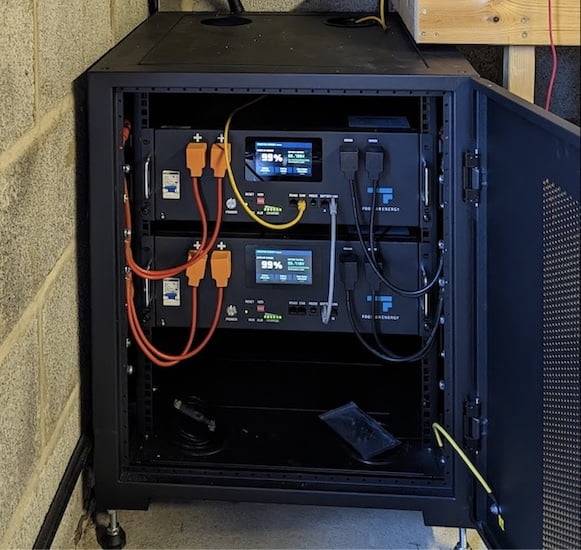
Parallel packs can report different states of charge. Different displayed values do not identify their cause. They also do not prove a specific balancing mechanism.
I recorded state-of-charge differences in my rack. That is an operating observation, not a general connection rule. Use the exact manufacturer procedure and installer assessment. Do not infer a connection change or charging procedure from those readings.
What does series-parallel mean?
Series-parallel arithmetic can increase voltage and amp-hours together. In the hypothetical table, four modules give 100V, 200Ah, and 20kWh. The 20kW figure is only the theoretical DC ceiling from the stated ratings.
A complete battery system must follow its manufacturer’s exact module, string, controller, BMS, inverter, and protection rules. The arithmetic does not show how to connect it. It also does not prove that the inverter accepts the resulting voltage or current.
Before you expand a bank, record each exact product model and hardware revision. Also record the BMS, firmware, inverter model, and current module count. Ask the manufacturer or installer to confirm the supported arrangement and complete installation design in writing.
