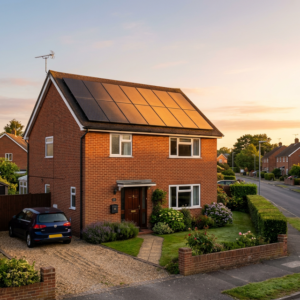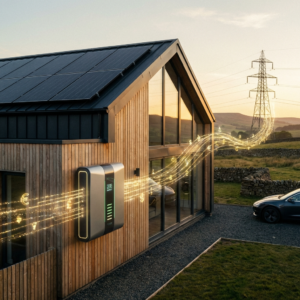
You have a 4-bedroom house with a NW/SE split roof. The SE face catches morning and midday sun; the NW face gets late afternoon light in summer and very little in winter. This is not ideal for solar, but it is far from hopeless.
With a SE/NW split, you are looking at around 75% of the output an equivalent string facing true south would produce. The comparison is less straightforward than that figure suggests, and for UK homeowners the real-world gap is smaller. A good share of our annual solar generation comes from diffuse light on overcast days, and on a cloudy day orientation barely moves the needle. Factor that in alongside the SE face’s natural alignment with morning and midday demand, and this roof type performs better in practice than the headline number implies.
What This Roof Must Optimise For
- Self-consumption over export. You generate less than a south-facing home. Every kWh you use directly saves 27.69p. Every kWh you export earns 5p. The gap is massive. Size the system so you consume as much as possible.
- Dual MPPT inverter. The two roof faces produce at different levels throughout the day. You need an inverter with two independent Maximum Power Point Trackers so each string operates at its own optimal voltage. A single-MPPT inverter would drag both strings down to the weaker face.
- Load more panels on the SE face. Put more of your panel budget on the stronger face. The NW panels are supporting actors.
- Battery storage is essential, not optional. With a NW/SE split, your generation peaks while you may not be home to use it. A battery captures that midday SE surplus and shifts it to your evening demand. Without one, you are exporting at 5p what you will buy back at 28p. The only roof orientation where going without a battery is less painful is an east/west split, because the generation spread naturally covers morning and evening demand peaks. On a NW/SE roof, you do not have that luxury.
Opportunities
The SE face generates power from early morning through early afternoon. If anyone is home during the day, works from home, or runs a heat pump, this generation profile matches your demand curve well. The NW face adds a small afternoon contribution in summer that extends your generation window. With a battery, the combination works surprisingly well because the spread of generation across the day means less clipping and a more even charge profile.
Your 4-Bed Consumption Profile
Low to Mid Consumption: 3,500 kWh/year
A 4-bed household using gas central heating and no electric vehicle typically consumes around 3,500 kWh of electricity per year. That is roughly £970 at current rates. Your base loads are lighting, fridge/freezer, cooking, washing, and entertainment. Most demand concentrates in the morning (7-9am) and evening (5-9pm), with a dip during the day unless someone works from home.
High Consumption: 7,500+ kWh/year
If you run a heat pump, charge an EV at home, or have an electric oven alongside other high-draw appliances, you are in this bracket. A heat pump alone adds 3,000-5,000 kWh/year depending on your home’s insulation. An EV adds 2,000-3,500 kWh/year depending on mileage. Your annual bill could hit £2,100+.
At this consumption level, your base load during daytime is significant. The heat pump cycles throughout the day, the hot water tank heats, and these loads overlap with SE face generation. This is actually good news for solar because you will self-consume a much higher proportion of what you generate. Your inverter needs to be at least 5kW to handle the base loads.
Budget Option
Solar Energy Concepts System Rating
| Metric | Score | Why |
|---|---|---|
| Cost | 4/10 | Accessible. DIY with battery around £3,000. Installed under £6,500. |
| Consumption Fit | Mid | Good match for 3,500 kWh homes. Undersized for heat pump households. |
| Tariff Exposure | 2/10 | Battery boosts self-consumption to 72%+. Very little depends on export rates. |
System Specification
Inverter: Solis 3.6kW 5G Hybrid EH1 (£575-653)
- AC output: 3.6kW (G98 compliant, notification only)
- 2 independent MPPTs, 1 string each
- Max DC input: 600V / 15A per MPPT / 5.7kW total
- MPPT range: 90-520V
- Hybrid design allows battery addition later without replacing the inverter
Overpanelling target: 140-150% of the 3.6kW AC rating = 5,040-5,400W DC. In UK conditions with a NW/SE roof, you will rarely clip. The extra panels pay for themselves in shoulder-hour generation (early morning, late afternoon, winter).
Panel Options
| Strategy | Panel | Count | Total DC | Overpanel % | String Check |
|---|---|---|---|---|---|
| Best value | LONGi Hi-MO X6 455W (£73/panel) | 12 (7 SE + 5 NW) | 5,460W | 152% | SE string Voc: 7 x 39.15V = 274V. NW string: 5 x 39.15V = 196V. Both within 90-520V MPPT range and under 600V max. Isc 14.79A under 15A limit. |
| Smallest footprint | Aiko Neostar 490W (24.5% eff) | 11 (7 SE + 4 NW) | 5,390W | 150% | SE: 7 x 40.98V = 287V. NW: 4 x 40.98V = 164V. Isc 14.93A under 15A limit. Saves one roof position. |
| Max overpanel | DMEGC 450W (Voc 35.5V, Isc 15.4A) | 12 (7 SE + 5 NW) | 5,400W | 150% | SE: 7 x 35.5V = 249V. NW: 5 x 35.5V = 178V. Low Voc allows long strings. BUT Isc 15.4A exceeds Solis 15A limit. Pair with Fox ESS H1-3.7 (16A) or SolaX X1 G4 3.7kW (16A) instead if using DMEGC. |
Battery: Pylontech US3000C 3.55kWh (£600-900). We recommend including a battery from day one, even on a budget system. On a NW/SE roof the generation window is compressed, and without storage you will export most of your SE face output at 5p/kWh then buy it back at 28p in the evening. A modest 3.5kWh battery captures enough surplus to cover a typical evening. If budget is genuinely tight, the Solis EH1 is a hybrid inverter so you can add a battery within weeks of installation without replacing any hardware, but treat this as a stopgap, not a plan. See the battery storage directory for compatible options.
Total system cost:
- DIY: £2,700-3,400 (panels £880 + inverter £615 + battery £600-900 + mounting/cables £500-1,000)
- Installed: £5,200-6,500
DIY Feasibility
A 3.6kW system is one of the most DIY-friendly setups. At 3.6kW AC output, it falls under the G98 threshold (3.68kW), which means you only need to notify your DNO, not apply for permission. The notification is a simple online form and takes 5 minutes. Most DNOs process it automatically.
You can mount the panels, run the DC cabling, and install the inverter yourself. You will need a qualified electrician to make the final AC connection to your consumer unit (Part P of building regulations). Budget £150-300 for this. No MCS certification is needed for the install itself, though you will not be eligible for SEG export payments without MCS. For a system sized for self-consumption, losing SEG income of £60/year is negligible.
Expected Performance
| Metric | Low-Mid (3,500 kWh) | High (7,500 kWh) |
|---|---|---|
| Annual yield | ~3,100 kWh | |
| Self-consumption (with 3.5kWh battery) | 72% (2,230 kWh) | 85% (2,640 kWh) |
| Export | 28% (870 kWh) | 15% (460 kWh) |
| Grid savings | £617/year | £731/year |
| Export income (SEG 5p) | £44/year | £23/year |
| Total annual saving | £661/year | £754/year |
Premium Option
Solar Energy Concepts System Rating
| Metric | Score | Why |
|---|---|---|
| Cost | 6/10 | Meaningful investment. Battery and MCS install add to the bill. |
| Consumption Fit | High | 5kW inverter + battery handles heat pump and EV households comfortably. |
| Tariff Exposure | 2/10 | Battery maximises self-consumption. Very little ROI depends on export or tariff games. |
System Specification
Inverter: Solis 5.0kW S5 Smart Hybrid (£707-770)
- AC output: 5.0kW (requires G99 application, not just notification)
- 2 independent MPPTs, 1 string each
- Max DC input: 600V / 15A per MPPT / 8.0kW total
- MPPT range: 90-520V
- 8kW DC headroom gives excellent overpanelling potential
Overpanelling target: 140-150% of 5.0kW = 7,000-7,500W DC. The Solis 5kW accepts up to 8kW DC input, so you have headroom.
Panel Options
| Strategy | Panel | Count | Total DC | Overpanel % | String Check |
|---|---|---|---|---|---|
| Best value | LONGi Hi-MO X6 455W (£73/panel) | 16 (9 SE + 7 NW) | 7,280W | 146% | SE: 9 x 39.15V = 352V. NW: 7 x 39.15V = 274V. Both within range. Isc 14.79A under 15A. |
| Smallest footprint | Aiko Neostar 490W (24.5% eff) | 15 (9 SE + 6 NW) | 7,350W | 147% | SE: 9 x 40.98V = 369V. NW: 6 x 40.98V = 246V. Isc 14.93A OK. One fewer panel saves ~1.7m2 roof space. |
| Max overpanel | DMEGC 450W (Voc 35.5V) | 16 (9 SE + 7 NW) | 7,200W | 144% | SE: 9 x 35.5V = 320V. NW: 7 x 35.5V = 249V. Low Voc maximises string length. Isc 15.4A exceeds Solis 15A. Use GivEnergy 5kW (15A but higher headroom at 580V) or Fox ESS H1-5.0 (16A). |
Battery
Target: at least 14.4kWh usable (150% of average daily consumption for a 4-bed low-mid household). For high-consumption homes with a heat pump, the bar is higher.
Fogstar Energy 48V 32kWh (£3,299) is the standout option here. It is a 32kWh LFP battery with built-in heating (charges down to -10 degrees C) and an automatic fire suppression system. At £103/kWh it is cheaper than most 10-15kWh alternatives. Solis-compatible via CAN bus. At 233kg it needs a solid floor position — not a wall mount — but for a garage or utility room it is hard to beat. If your annual consumption is 7,500+ kWh, this battery covers multiple days of autonomy and makes Octopus Go arbitrage genuinely powerful.
If 32kWh is more than you need, the Pylontech Force H2 14.3kWh (~£3,500-4,200) hits the 14.4kWh target with a smaller footprint and pairs natively with the Solis S5 via CAN bus. The Tesla Powerwall 3 (13.5kWh, ~£8,000-9,000 installed) and GivEnergy All-in-One 2 (13.5kWh, £5,500-6,500) are also strong options — both are 0.9kWh short of the target but negligible in practice. Full specs and pricing in the battery storage directory.
Total system cost (with Fogstar 32kWh):
- DIY: £5,200-5,900 (panels £1,168 + inverter £740 + Fogstar £3,299)
- MCS installed: £9,000-12,000
G99 and MCS
At 5kW AC output, this system exceeds the G98 threshold of 3.68kW. You must apply for G99 permission from your DNO before connecting. This is a formal application, not a notification. Most DNOs approve residential G99 within 45 days, but some regions (notably SSEN in Scotland and parts of Southern England) can take longer if the local grid is constrained.
MCS certification is recommended for the premium option because: (a) you qualify for SEG export payments, which become meaningful at this generation level, (b) the battery enables time-of-use tariff strategies that require a certified installation for some suppliers, and (c) it protects your home insurance and property value.
When This Makes Sense vs Overkill
Worth it if: you have a heat pump, charge an EV at home, or your annual consumption exceeds 5,000 kWh. The battery earns its keep by time-shifting generation to match your evening demand peak. At 7,500 kWh consumption, the premium system pays for itself in 7-8 years and delivers £12,000+ over 25 years.
Overkill if: your consumption is under 3,500 kWh and you have no plans to add a heat pump or EV. In that case, the budget option covers most of your demand and the extra spend on battery and larger inverter does not earn a proportional return. Start with the budget system and upgrade when your consumption justifies it.
Expected Performance
| Metric | Low-Mid (3,500 kWh) | High (7,500 kWh) |
|---|---|---|
| Annual yield | ~4,200 kWh | |
| Self-consumption (with battery) | 75% (3,150 kWh) | 85% (3,570 kWh) |
| Export | 25% (1,050 kWh) | 15% (630 kWh) |
| Grid savings | £872/year | £988/year |
| Export income (SEG 5p) | £53/year | £32/year |
| Total annual saving | £925/year | £1,020/year |
Tariff Strategy and DNO Notes
Budget option: A flat-rate tariff is simplest. Your savings come from self-consumption, not clever tariff timing. If you want to optimise, Octopus Flux offers a reasonable export rate (~15p during peak hours) without requiring complex automation. Avoid Agile unless you enjoy monitoring half-hourly rates.
Premium option: Octopus Go or Intelligent Go is the natural fit. Charge your battery overnight at 7.5p/kWh, use it during the morning, then let solar take over from mid-morning through afternoon. The battery handles the evening peak. If your consumption is very high (EV + heat pump), Octopus Flux gives you better export rates during 4-7pm when the grid pays a premium.
DNO Region Considerations
G98 (budget, 3.6kW): Notification-only. All DNOs process this within days. No practical regional variation.
G99 (premium, 5kW): Application required. Turnaround varies by DNO:
- UKPN (London, South East, East): Generally fast, 20-30 working days
- WPD / National Grid ED (Midlands, South West, Wales): Moderate, 30-45 days
- NPG (North East, Yorkshire): Generally fast, 20-30 days
- SSEN (Scotland, parts of South): Can be slow, 45-60+ days. Known for grid constraint issues in rural areas
- ENW (North West): Moderate, 30-45 days
If you are in an SSEN area and planning a 5kW system, submit your G99 application early. Do not wait until the panels arrive.
ROI Comparison
| Budget DIY | Budget Installed | Premium DIY | Premium MCS | |
|---|---|---|---|---|
| Low-Mid Consumption (3,500 kWh/year) | ||||
| Upfront cost | £3,050 | £5,800 | £3,700 | £7,500 |
| Annual saving | £661 | £661 | £925 | £925 |
| Payback | 4.6 years | 8.8 years | 4.0 years | 8.1 years |
| 25-year return | £13,475 | £10,725 | £19,425 | £15,625 |
| High Consumption (7,500 kWh/year) | ||||
| Upfront cost | £3,050 | £5,800 | £3,700 | £7,500 |
| Annual saving | £754 | £754 | £1,020 | £1,020 |
| Payback | 4.0 years | 7.7 years | 3.6 years | 7.4 years |
| 25-year return | £15,800 | £13,050 | £21,800 | £18,000 |
Assumes flat electricity rate of 27.69p/kWh, SEG at 5p/kWh, no energy inflation, and 0.5% annual panel degradation. Real returns are likely higher as energy prices tend to rise over 25 years.
Related Guides
- Home Solar System Guide UK – Compare all roof orientations and house sizes
- Solar Panel Directory – Full specs and pricing for UK-available panels
- Are Solar Panels Worth It in 2026? – The complete ROI breakdown
- Choosing the Right Inverter – String vs hybrid vs micro
- Battery Storage Guide – Sizing, chemistry, and economics
- DIY Solar Installation Guide – Step by step