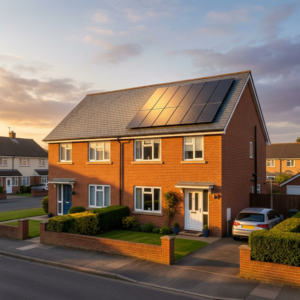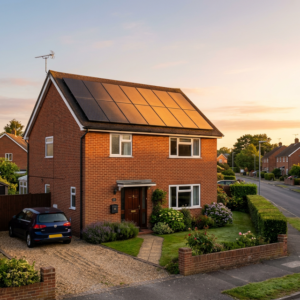
A 2-bedroom house with a south-facing roof is the sweet spot for DIY solar in the UK. You get the highest yield per panel of any orientation, but the lower consumption of a smaller home means you will export more than you use unless you size the system carefully.
Key Takeaways
- A south-facing 2-bed roof yields 978 kWh/kWp/year (PVGIS data for central England at 28° tilt), the highest of any orientation.
- The budget system (Solis 3.6kW hybrid + 10 panels, no battery) costs £1,400-1,800 DIY or £3,100-4,000 installed, with payback in 2-5 years.
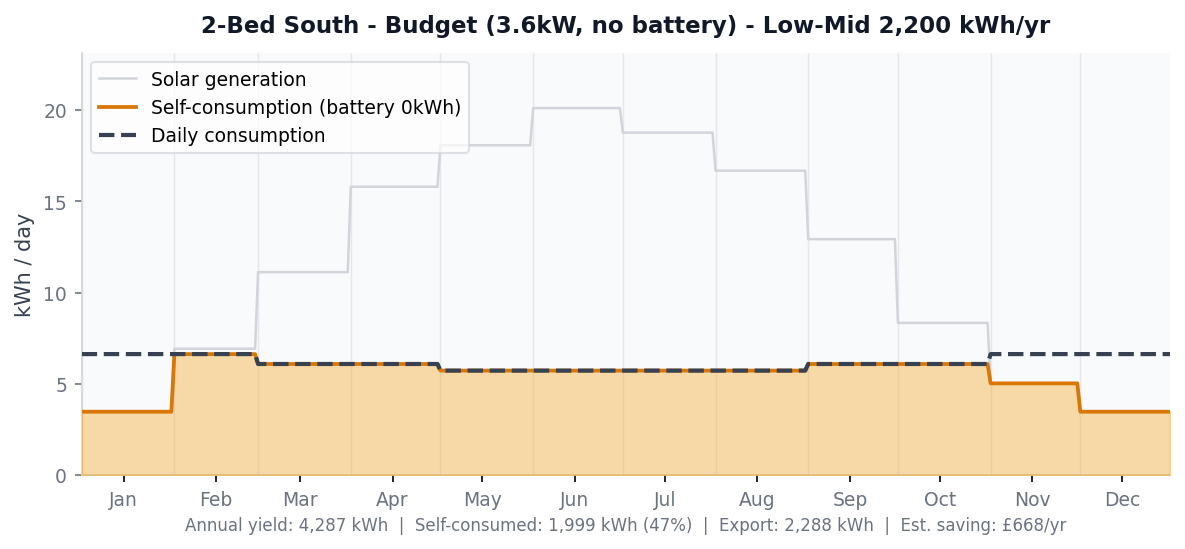
- Without a battery, the budget system exports 40-50% of generation at low-mid consumption. Adding a battery later via the hybrid inverter fixes this.
- The premium system (£4,900-5,500 DIY) adds a 9.5kWh battery and 16 panels, cutting export waste and achieving £1,366/year savings even at low consumption.
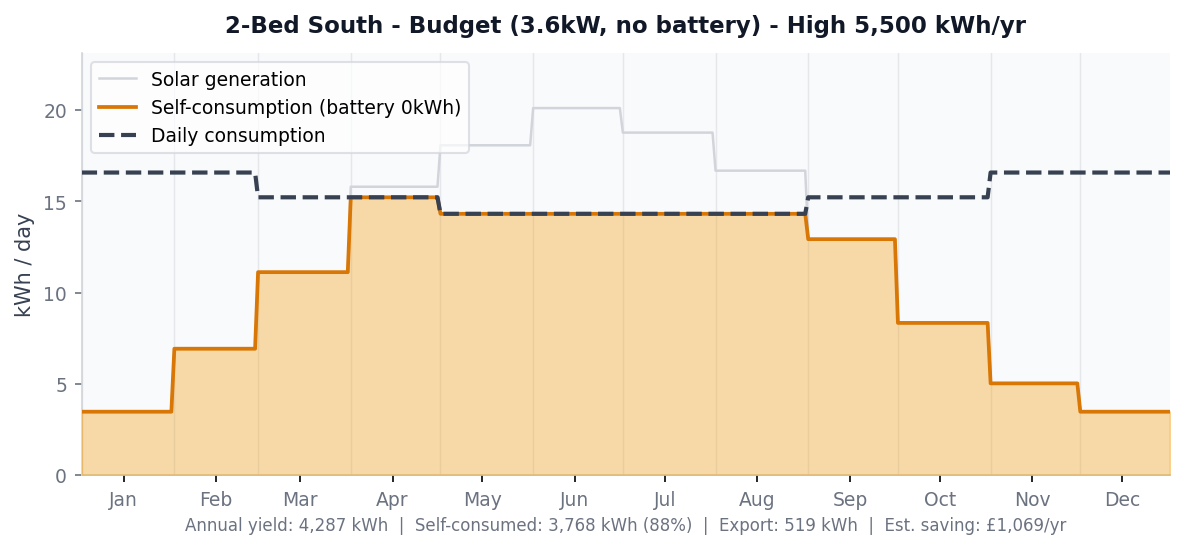
- High-consumption households (heat pump + EV at 5,500 kWh/year) self-consume almost everything and see the fastest payback on both systems.
Home solar energy systems can be a worthwhile investment, but they are not all made equal. Factors like panel orientation and the angle at which they meet the sun make a real difference. In this series I will explore the advantages and disadvantages of each roof direction and help you select the right system for a South-Facing roof.
South-facing is the benchmark every other orientation is measured against – but that does not mean bigger is always better.
What This Roof Must Optimise For
- Self-consumption over export. South-facing panels produce the most power, but a 2-bed household uses less than larger homes. Every kWh you use directly saves 27.69p. Every kWh you export earns 5p. Size the system so daytime generation matches your actual daytime load, not your annual consumption.
- Moderate overpanelling. Target 125-140% of inverter AC rating. South-facing panels will clip more than other orientations in peak summer, so the returns on aggressive overpanelling diminish. The sweet spot is enough extra DC to boost spring and autumn output without excessive summer clipping.
- Battery timing. A hybrid inverter now (even without a battery) costs only £200-300 more than a string inverter. If your consumption is low-mid, skip the battery on day one and add one when electricity prices rise or your usage increases.
Opportunities
South-facing is the best case for solar in the UK. At 978 kWh/kWp/year, you generate more per panel than any other orientation. Midday generation peaks align with daytime loads: heat pumps cycling, hot water heating, and any work-from-home consumption. Even at the modest scale of a 2-bed system, the economics are strong.
The challenge is not yield but utilisation. A smaller household has fewer base loads to absorb midday generation. Without a battery or deliberate load-shifting (running the dishwasher and washing machine during peak sun), you will export 40-50% of summer output at just 5p/kWh. The system designs below address this by keeping DC capacity modest on the budget option and pairing the premium option with a battery sized to capture the surplus.
Your 2-Bed Consumption Profile
Low to Mid Consumption: 2,200 kWh/year
A 2-bedroom household on gas central heating with standard appliances uses around 2,200 kWh of electricity per year, based on Ofgem Typical Domestic Consumption Values. That is roughly £609 at the current price cap rate of 27.69p/kWh. Your base loads are lighting, fridge/freezer, cooking, washing, and entertainment. Most demand concentrates in the morning (7-9am) and evening (5-9pm), with a dip during the day unless someone works from home.
At this consumption level with a south-facing roof, your main concern is export waste. Daytime generation will exceed your base load for 6-7 months of the year. A battery makes a material difference here, but even without one, the savings from direct self-consumption justify the investment.
High Consumption: 5,500+ kWh/year
If you run a heat pump, charge an EV at home, or both, your annual consumption jumps to 5,500 kWh or more. A heat pump adds 3,000-5,000 kWh/year depending on your home’s insulation. An EV adds 2,000-3,500 kWh depending on mileage. Your annual bill could hit £1523+.
At this consumption level, your daytime base load is substantial. The heat pump cycles throughout the day, the hot water tank heats, and these loads overlap with whatever generation your south panels produce. This is actually good news for solar because you will self-consume a much higher proportion of what you generate.
With south-facing panels and high consumption, self-consumption rates climb above 80% even without a battery. The economics are compelling: your system offsets expensive grid imports at 27.69p/kWh rather than earning 5p/kWh from exports.
Budget Option
Solar Energy Concepts System Rating
System Specification
Inverter: Solis 3.6kW 5G Hybrid EH1 (£575)
- AC output: 3.6kW (G98 compliant, notification only)
- 2 independent MPPTs, 1 string each
- Max DC input: 600V / 15A per MPPT / 5.7kW total
- MPPT range: 90-520V
- Hybrid design allows battery addition later without replacing the inverter
Overpanelling target: 125% of the 3.6kW AC rating = 4450W DC. On a south-facing roof, moderate overpanelling is the right call. You will clip slightly in peak summer, but the extra panels boost spring and autumn output where self-consumption is highest.
Panel Options
| Strategy | Panels | Total DC | Overpanel % | String Check |
|---|---|---|---|---|
| Best value | JA Solar JAM54D40 445W × 10 (5 + 5) | 4450W | 124% | 5 × 39.1V = 195.5V < 600V. Isc 14.43A < 15A. Vmp 163.25V in 90-520V. |
| Smallest footprint | LONGi Hi-MO X6 455W × 10 (5 + 5) | 4550W | 126% | 5 × 39.15V = 195.75V < 600V. Isc 14.79A < 15A. Vmp 164.9V in 90-520V. |
Battery
No battery on the budget system. At low-mid consumption, summer export is around 53% of generation. That sounds like waste, but the maths still works: the system pays for itself in under 5 years DIY even with that export. The hybrid inverter lets you add a Fogstar 5.12kWh (£730-900) or Pylontech US5000 (£715) later when your consumption changes or electricity prices rise.
Total system cost:
- DIY: £1,414-1,814
- Installed: £3,142-4,031
DIY Feasibility
This setup is straightforward to DIY. Two strings of 5 panels into a hybrid inverter with no battery to wire. The Solis 3.6kW EH1 is well-documented in the UK DIY solar community with straightforward commissioning.
You can mount the panels, run the DC cabling, and install the inverter yourself. You will need a qualified electrician to make the final AC connection to your consumer unit (Part P of building regulations). Budget £150-300 for this. No MCS certification is needed for the install itself, though you will not be eligible for SEG export payments without MCS. For a system sized for self-consumption, losing SEG income is negligible.
Expected Performance
| Metric | Low-Mid (2,200 kWh) | High (5,500 kWh) |
|---|---|---|
| Annual yield | 4,309 kWh | |
| Self-consumption (no battery) | 46% (1,983 kWh) | 87% (3,749 kWh) |
| Export | 54% (2,326 kWh) | 13% (560 kWh) |
| Grid savings | £549/year | £1,038/year |
| Export income (SEG 5p) | £116/year | £28/year |
| Total annual saving | £665/year | £1,066/year |
Premium Option
Solar Energy Concepts System Rating
System Specification
Inverter: Solis 5.0kW S5 Smart Hybrid (£770)
- AC output: 5.0kW (requires G99 application)
- 2 independent MPPTs, 1 string each
- Max DC input: 600V / 15A per MPPT / 8.0kW total
- MPPT range: 90-520V
- Hybrid design with native battery support
Overpanelling target: 142% of the 5.0kW AC rating = 7120W DC. The higher DC capacity squeezes more from the shorter winter days and shoulder months where every extra kWh is self-consumed rather than exported.
Panel Options
| Strategy | Panels | Total DC | Overpanel % | String Check |
|---|---|---|---|---|
| Best value | JA Solar JAM54D40 445W × 16 (8 + 8) | 7120W | 142% | 8 × 39.1V = 312.8V < 600V. Isc 14.43A < 15A. Vmp 261.2V in 90-520V. |
| Smallest footprint | Aiko Neostar 490W × 14 (7 + 7) | 6860W | 137% | 7 × 40.98V = 286.9V < 600V. Isc 14.93A < 15A. Vmp 240.8V in 90-520V. |
Battery
GivEnergy 9.5kWh Gen 3 (9.5 kWh usable, £2,580-3,104)
The battery target for a 2-bed premium system is at least 150% of daily low-mid consumption (6.0 kWh/day × 1.5 = 9.0 kWh). The GivEnergy 9.5kWh Gen 3 exceeds this at a competitive price point. It captures summer midday surplus for evening use and enables winter tariff arbitrage on time-of-use tariffs like Octopus Go.
Total system cost:
- DIY: £4,892-5,492
- MCS installed: £11,648-13,076
G99 and MCS
At 5.0kW AC output, this system exceeds the G98 threshold of 3.68kW. You must apply for G99 permission from your DNO before connecting. This is a formal application, not a notification. Most DNOs approve residential G99 within 45 days, but some regions (notably SSEN in Scotland and parts of Southern England) can take longer if the local grid is constrained.
MCS certification is recommended for the premium option because: (a) you qualify for SEG export payments, which become meaningful at this generation level, (b) the battery enables time-of-use tariff strategies that require a certified installation for some suppliers, and (c) it protects your home insurance and property value.
When This Makes Sense vs Overkill
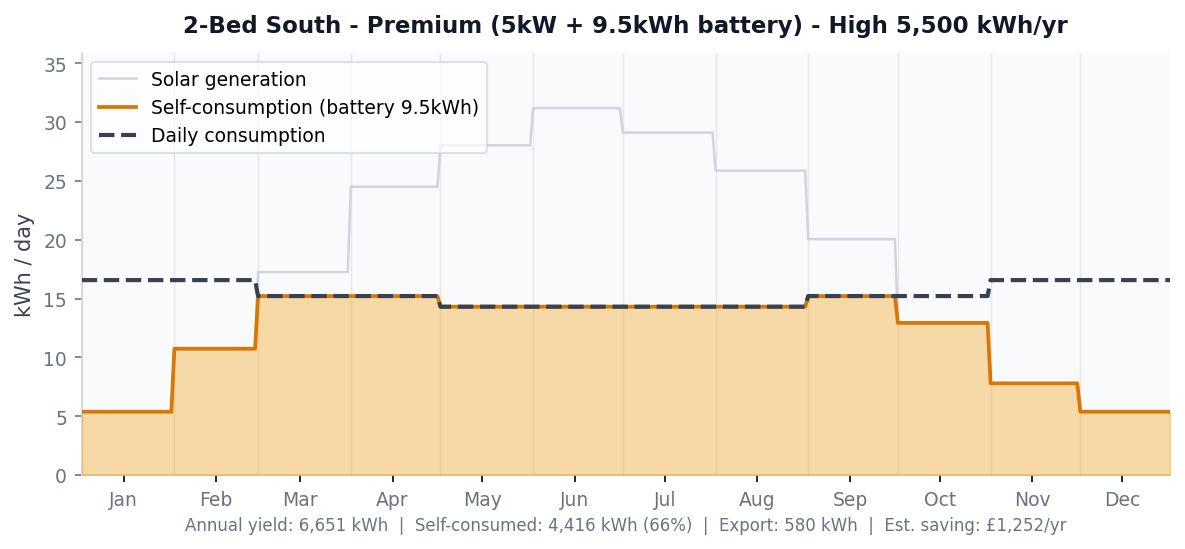
Worth it if: You have a heat pump or EV charging at home, or you plan to add one within 2-3 years. At high consumption, the premium system self-consumes 66% of its output and the battery earns its keep through avoided grid imports. The 9.5kWh battery also enables Octopus Go arbitrage in winter when solar output drops.
Overkill if: You are a low-consumption household with no plans to electrify heating or transport. The budget system without a battery already delivers a strong return. The extra £3,000-4,000 for the premium setup takes 8-10 years to pay back at low consumption, and battery degradation becomes a factor over that timeframe.
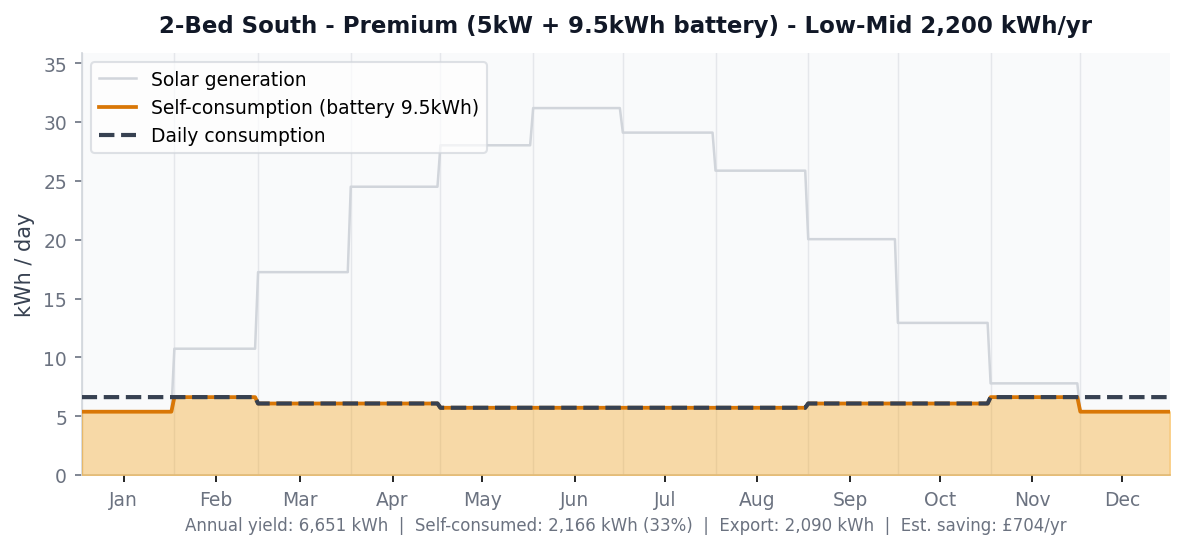
Expected Performance
| Metric | Low-Mid (2,200 kWh) | High (5,500 kWh) |
|---|---|---|
| Annual yield | 6,685 kWh | |
| Self-consumption (with 9.5 kWh battery) | 68% (4,546 kWh) | 91% (6,083 kWh) |
| Export | 32% (2,139 kWh) | 9% (602 kWh) |
| Grid savings | £1,259/year | £1,684/year |
| Export income (SEG 5p) | £107/year | £30/year |
| Total annual saving | £1,366/year | £1,714/year |
Tariff Strategy and DNO Notes
Budget option: A flat-rate tariff works fine when self-consumption is high. If you find yourself exporting consistently (visible on your inverter app), consider Octopus Agile to capture occasional price spikes on export. The main savings come from avoided grid import at 27.69p/kWh, not clever tariff games.
Premium option: Octopus Go is the natural fit. Charge your 9.5kWh battery overnight at 7.5p/kWh and discharge during the evening peak at 27.69p. In summer, solar handles the charging. In winter, cheap off-peak grid power fills the battery instead. The spread of 20p/kWh on 9.5kWh is worth £1.90/night in winter.
DNO Region Considerations
South-facing systems export more than other orientations, particularly in summer. At the budget 3.6kW level this is well within grid tolerances everywhere. At the premium 5.0kW level, DNO approval is required but rarely problematic for a residential single-phase connection.
G98 (budget, 3.6kW): Notification-only. All DNOs process this within days. No practical regional variation.
G99 (premium, 5.0kW): Application required. Turnaround varies by DNO:
- UKPN (London, South East, East): Generally fast, 20-30 working days
- WPD / National Grid ED (Midlands, South West, Wales): Moderate, 30-45 days
- NPG (North East, Yorkshire): Generally fast, 20-30 days
- SSEN (Scotland, parts of South): Can be slow, 45-60+ days. Known for grid constraint issues in rural areas
- ENW (North West): Moderate, 30-45 days
If you are in an SSEN area and planning a 5kW system, submit your G99 application early. Do not wait until the panels arrive.
ROI Comparison
| Budget DIY | Budget Installed | Premium DIY | Premium MCS | |
|---|---|---|---|---|
| Low-Mid Consumption (2,200 kWh/year) | ||||
| Upfront cost | £1,614 | £3,586 | £5,192 | £12,362 |
| Annual saving | £665 | £665 | £1,366 | £1,366 |
| Payback | 2.4 years | 5.4 years | 3.8 years | 9.0 years |
| 25-year return | £16,625 | £16,625 | £34,150 | £34,150 |
| High Consumption (5,500 kWh/year) | ||||
| Upfront cost | £1,614 | £3,586 | £5,192 | £12,362 |
| Annual saving | £1,066 | £1,066 | £1,714 | £1,714 |
| Payback | 1.5 years | 3.4 years | 3.0 years | 7.2 years |
| 25-year return | £26,650 | £26,650 | £42,850 | £42,850 |
Assumes flat electricity rate of 27.69p/kWh, SEG at 5p/kWh, no energy inflation, and 0.5% annual panel degradation. Real returns are likely higher as energy prices tend to rise over 25 years.
Generation Yield Source
All yield estimates in this guide are derived from PVGIS (Photovoltaic Geographical Information System), the European Commission’s free solar radiation database. PVGIS uses satellite-measured irradiance data and is the standard reference for solar yield calculations across Europe.
Simulation Parameters
| Parameter | Value |
|---|---|
| Location | 52.308°N, -0.717°W (Central England reference) |
| Roof slope | 28° |
| System loss | 14% |
| Database | PVGIS-SARAH3 |
Yield by Roof Face
| System | Face | PVGIS Aspect | E_y (kWh/kWp/yr) | DC Capacity | Annual Yield |
|---|---|---|---|---|---|
| Budget | South | 0° | 978.0 kWh/kWp | 4.45 kWp | 4,309 kWh |
| Premium | South | 0° | 978.0 kWh/kWp | 7.12 kWp | 6,685 kWh |
Clipping factor applied: 0.99 (budget, 124% overpanel) and 0.96 (premium, 142% overpanel). Accounts for inverter limiting when DC input exceeds AC capacity.
Budget total annual yield after clipping: 4,309 kWh
Premium total annual yield after clipping: 6,685 kWh
You can verify these figures yourself using the PVGIS interactive tool. Enter your postcode for location-specific results.
Related Guides
- All System Guides – Compare all roof orientations and house sizes
- Solar Panel Directory – Full specs and pricing for UK-available panels
- 3-Bed South-Facing Roof Guide
- 3-Bed East-West Roof Guide
- 3-Bed Flat Roof Guide
- 3-Bed North-Facing Roof Guide