
Low-yield honesty first: a north-facing pitched roof in the UK is the weak orientation. PVGIS for a central England reference at 28° tilt puts north at about 588 kWh/kWp/year, roughly 63% of a south-facing equivalent (~978 kWh/kWp/year). That is not a rounding error. It is why many installers push back. Solar can still make sense, but only with high self-consumption, a battery, and eyes open on the kWh gap. Check your own tilt and direction with the solar panel angle calculator.
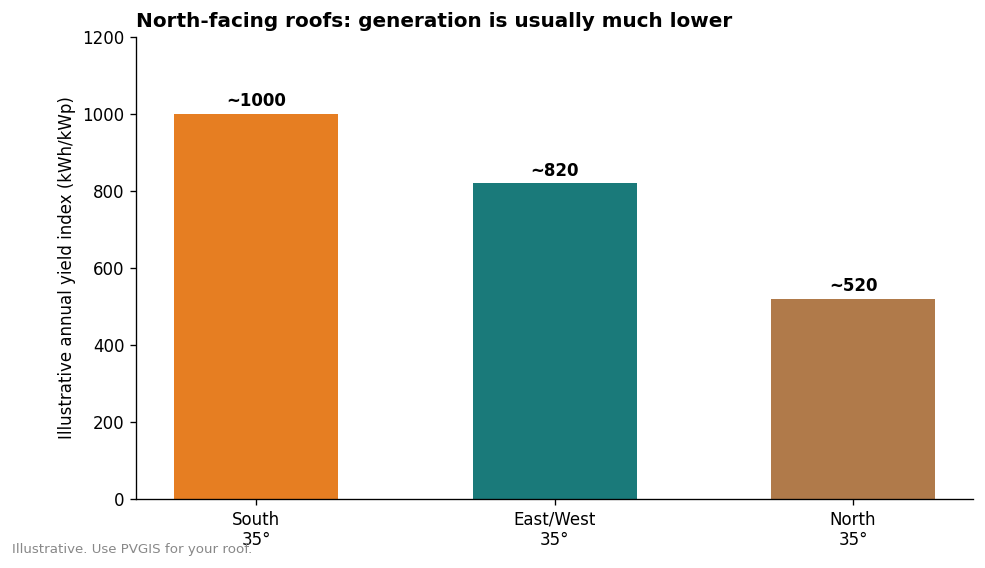
I’ve got solar at home and one of my strings faces NW. On overcast days, which the UK has a lot of, the NW string produces almost the same as my SE string because diffuse light is mostly direction-agnostic. On sunny summer days, north is worse. Over a full year you lose roughly 37% of yield per panel compared to south-facing, not the 45% you’d get from pure geometric angle-of-incidence maths.
Compared with south, qualitatively: south piles generation into a taller midday peak; north is flatter and smaller. On overcast days the gap shrinks because diffuse light is less directional. On clear summer days the gap is obvious. South systems can sometimes live with weak batteries for longer; north systems lean harder on storage and daytime loads (heat pump, EV, WFH) to keep exported kWh from carrying the economics.
What makes a north-facing system work or not work is self-consumption. Every kWh used directly in the house saves 26.11p, the Ofgem cap for 1 July to 30 September 2026. Every kWh exported earns 5p on statutory SEG or 12p on Octopus Outgoing Fixed. On a north roof the total yield is smaller, so a higher share needs to stay inside the house. That means a battery, and it means sizing the array for your consumption rather than chasing exported kWh.
Is a North-Facing Roof Worth Solar in the UK?
Short answer: yes if you’re over about 4,500 kWh/year on consumption, no if you’re under 2,500 kWh/year. The middle is a judgement call that depends on how much you expect consumption to grow (heat pump, EV, more WFH).
Three design principles to stick to:
- Self-consumption over export. Import displacement at 26.11p, the Ofgem cap for 1 July to 30 September 2026, is 2-6x more valuable than export at 5-12p. Size the array to cover your house, not to maximise generation.
- Overpanel to 140-150% of inverter AC. On a north roof you basically never clip. Extra panels recover yield in the shoulder hours (early morning, late afternoon, winter) where you actually need it.
- Battery from day one. On a south roof you can get away without a battery for a while. On a north roof the summer surplus window is narrower and the winter deficit is bigger, so storage carries more of the economic weight. I would not fit solar on a north roof without a battery.
What a 3-Bed Actually Uses
Low to Mid: ~2,900 kWh/year
Gas central heating, standard appliances, no EV. About £757/year on electricity at the 26.11p/kWh cap running from 1 July to 30 September 2026. On a north roof this is the marginal case. Generation lands mostly in summer midday when the house is empty. Without a battery, you export most of that at 5-12p. With a battery, self-consumption moves from 40% to around 60%.
If your consumption is under 2,500 kWh, honestly consider whether you want solar on a north roof at all. The payback gets long and the absolute savings are modest. A battery-only setup on Octopus Go can sometimes deliver a better return.
High: 6,500+ kWh/year
Heat pump, EV, or both. A heat pump adds 3,000-5,000 kWh/year depending on insulation. An EV adds 2,000-3,500 kWh. This is where a north roof quietly earns out. Daytime baseload is high, the heat pump cycles through the day, and a scheduled EV charge slides into the midday window. Almost everything you generate, you consume. Self-consumption on the budget system runs 90%+ at this tier. Export shrinks to near-zero, which removes the statutory SEG vs Octopus 12p debate entirely.
Budget Option: 3.6kW Hybrid, 12 Panels, 5.12kWh Battery
Solar Energy Concepts System Rating
System Specification
Inverter: Solis 3.6kW 5G Hybrid EH1. 3.6kW AC stays under G98 (notification only). Dual MPPT, 90-520V, 15A per MPPT, accepts up to 5.7kW DC.
Overpanel target: 150% of 3.6kW = 5,460W DC. On a north roof, clipping essentially does not happen. Every extra watt earns out in the shoulder hours.
Panel Options
| Strategy | Panels | Total DC | Overpanel % | String Check |
|---|---|---|---|---|
| Best value | LONGi Hi-MO X6 455W × 12 (split 6+6 across two MPPTs) | 5,460W | 150% | 6 × 39.15V = 235V in 90-520V. Isc 14.79A < 15A. OK. |
| Smallest footprint | Aiko Neostar 490W × 11 (6+5) | 5,390W | 150% | 6 × 40.98V = 246V. 5 × 40.98V = 205V. Both in range. Isc 14.93A < 15A. OK. |
| Max overpanel | DMEGC 450W × 12 (6+6) | 5,400W | 150% | 6 × 35.5V = 213V. Low Voc, long strings. Warning: Isc 15.4A over Solis 15A. Use Fox ESS H1-3.7 (16A) or SolaX X1 G4 (16A) instead with DMEGC. |
Splitting across both MPPTs lets you run two shorter strings, which gives more flexibility around shading and around any pitch variation along the roof face.
Allow £575-653 for the inverter in the costings below. That is a budgeting allowance, not a price I can stand behind: Solis publishes no UK list price, and when I went looking on 24 July 2026 every figure I found came from a reseller listing rather than the manufacturer. The Sunsynk figure in the premium build is different, and comes from our own inverters directory with the date it was last refreshed. Get a quote before you commit.
Battery
Fogstar 5.12kWh Server Rack (£730-900). This is not optional on a north roof. The 5.12kWh target is about two-thirds of average 3-bed daily consumption (7.9kWh/day). It captures summer midday surplus and covers evening loads. Without it, self-consumption stays around 40% at low-mid consumption and the economics fall apart. With it, self-consumption moves to about 60% at low-mid and 90%+ at high consumption. The Solis EH1 is hybrid, so if you absolutely must stagger costs, fit the panels first and the battery within a few weeks. Anything longer and the exports are costing you actual money.
Total System Cost
- DIY hardware: £2,573-3,429 (12 panels £768-876 + inverter allowance £575-653 + battery £730-900 + mounting and cables £500-1,000). Retail prices, VAT included, because components you buy yourself are not zero-rated.
- Electrician for the final AC tie-in under Part P: £150-300.
- DIY total: £2,723-3,729, midpoint £3,226. That midpoint is what the ROI table below uses.
- Installed: £4,900-5,900. An installer-quoted range for the finished job rather than the component list plus labour, and zero-rated for VAT as a qualifying supply-and-fit installation.
DIY Feasibility
One of the more DIY-friendly builds. At 3.6kW AC you notify the DNO under G98, not apply. 5-minute online form. You can mount panels and run the DC side yourself. An electrician does the final AC tie-in (£150-300, Part P). MCS is not required for the install, but without it you cannot claim SEG. On a self-consumption-first north-roof build, foregoing the export income is an easy trade for the DIY cost saving: it is about £61 a year at low-mid consumption on the 5p statutory rate, and near enough nothing at high consumption, where you export almost nothing anyway.
Expected Performance
| Metric | Low-Mid (2,900 kWh) | High (6,500 kWh) |
|---|---|---|
| Annual yield | 3,067 kWh | |
| Self-consumption (with 5.12kWh battery) | 60% (1,840 kWh) | 95% (2,914 kWh) |
| Export | 40% (1,227 kWh) | 5% (153 kWh) |
| Grid savings (at 26.11p) | £480/year | £761/year |
| Export income (SEG 5p) | £61/year | £8/year |
| Total annual saving | £541/year | £769/year |
Grid savings are the self-consumed kWh at 26.11p/kWh, the Ofgem cap for 1 July to 30 September 2026. Moving from statutory SEG 5p to Octopus Outgoing Fixed 12p adds roughly £86/year at low-mid consumption. High consumption barely moves because exports are already near zero.
Premium Option: 5kW Hybrid, 16 Panels, 16kWh Battery
Solar Energy Concepts System Rating
System Specification
Inverter: Sunsynk 5.0kW Hybrid ECCO (£938-1,153 in the inverters directory, prices last refreshed 13 July 2026). 5kW AC crosses G98, so it needs a G99 application. Dual MPPT. I run the 3.6kW ECCO from the same family at home, so the timer settings and the app are familiar ground here rather than a guess.
Read your exact model’s datasheet before you order panels. The string options below need an MPPT window covering roughly 290 to 330V and 15A per string, and that envelope moves between hybrid models even inside one brand.
This spec named the GivEnergy 5.0kW Hybrid Gen3 at £1,164 until July 2026, and it should not any more. GivEnergy Ltd entered administration in April 2026, ceased trading, and its administrator has stated that no further hardware warranties or app support will be honoured. The hardware still runs, and stock still sells at the old price. But a hybrid inverter is the part of this system carrying firmware, a cloud app and a G99 approval tied to a specific model, so it is the worst component to own with nobody behind it. If you already have one, the orphaned-system guide covers where that leaves you.
Overpanel target: 146% of 5kW = 7,280W DC.
Panel Options
| Strategy | Panels | Total DC | Overpanel % | String Check |
|---|---|---|---|---|
| Best value | LONGi Hi-MO X6 455W × 16 (8+8) | 7,280W | 146% | 8 × 39.15V = 313V string voltage. Isc 14.79A. Needs a 120-550V, 15A MPPT. |
| Smallest footprint | Aiko Neostar 490W × 15 (8+7) | 7,350W | 147% | 8 × 40.98V = 328V and 7 × 40.98V = 287V. Isc 14.93A. Both need a 120-550V, 15A MPPT. |
Battery
Fogstar FE48-16 (16kWh) (£1,999). A big battery matters more on a north roof than on a south roof. North generation is smaller and more summer-weighted, so a large store lets you bank the summer surplus for longer and enables overnight Octopus Go arbitrage through winter when solar is doing very little. 16kWh also gives genuine multi-day resilience for heat-pump households in cold snaps.
Total System Cost
- DIY hardware: £4,661-5,720 (16 panels £1,024-1,168 + Sunsynk 5kW ECCO £938-1,153 + Fogstar 16kWh £1,999 + mounting and cables £700-1,400). Retail prices, VAT included.
- Electrician for the final AC tie-in: £150-300.
- DIY total: £4,811-6,020, midpoint £5,416.
- MCS installed: £8,500-10,500. An installer-quoted range for the whole job including the G99 application and certification.
G99 and MCS
At 5kW AC you are above G98 (3.68kW) and need a G99 application. Formal application, most DNOs approve residential G99 in 45 days, SSEN can take 60+. Submit before the panels arrive if you’re in an SSEN area. North-facing systems almost never get flagged for grid-constraint issues because their peak export is small.
MCS certification earns its £1,500+ cost back on this tier because you get SEG and access to tariffs like Octopus Go/Flux that some suppliers restrict to certified installs.
When a Premium System Earns Out vs When It Doesn’t
Worth it if your annual consumption is over 5,000 kWh (heat pump, EV, or both). At 6,500 kWh the premium system pays back in 5.2 years DIY. The 16kWh battery adds real value in winter via standard Octopus Go arbitrage: charge between 00:30 and 05:30 at 9.5p, then cover the morning and evening peaks from the battery instead of importing at 26.11p. Both rates checked 24 July 2026.
Overkill if your consumption is under 3,500 kWh with no heat pump or EV. The incremental £2,190 for the premium build adds £182/year of saving over the budget build at low-mid consumption. That is a 12-year payback on the incremental spend, which is most of the battery warranty. Go budget, revisit when your consumption changes.
Expected Performance
| Metric | Low-Mid (2,900 kWh) | High (6,500 kWh) |
|---|---|---|
| Annual yield | 4,090 kWh | |
| Self-consumption (with 16 kWh battery) | 60% (2,454 kWh) | 97% (3,967 kWh) |
| Export | 40% (1,636 kWh) | 3% (123 kWh) |
| Grid savings (at 26.11p) | £641/year | £1,036/year |
| Export income (SEG 5p) | £82/year | £6/year |
| Total annual saving | £723/year | £1,042/year |
Both columns use the same 26.11p import price as the budget table, so the two are directly comparable. The low-mid column is the one to look at hard before you spend the extra: a bigger array on a north roof cannot beat the ceiling set by what the house actually uses, so almost all of the additional generation leaves the property at 5p.
The Battery Is Non-Negotiable on This Roof
South-facing homes can bootstrap a cheap system without a battery and still see a reasonable payback. North-facing cannot. The summer midday surplus is your one major revenue stream, and dumping it at 5-12p export when you’ll buy back at 26.11p, the Ofgem cap for 1 July to 30 September 2026, turns a marginal roof into an actively bad investment.
A battery does two jobs on a north roof. It shifts summer surplus to evenings. And through winter it enables overnight Octopus Go arbitrage, which is how many north-roof owners keep their system productive when generation drops to a few kWh per day. The UK saw 400% energy price hikes in 2022. A home battery is a genuine hedge against that happening again, regardless of your roof orientation.
Tariff Strategy
Budget option: A flat-rate tariff is fine if your consumption is average. Moving to Octopus Outgoing Fixed at 12p roughly doubles SEG without any extra complexity. With the battery in place, standard Octopus Go becomes worthwhile. Charge between 00:30 and 05:30 at 9.5p, then run the morning peak off the battery.
Premium option: the same overnight cycle, with a choice of two tariffs that are easy to confuse. Standard Octopus Go charges at 9.5p/kWh between 00:30 and 05:30 and anyone can sign up. Intelligent Octopus Go is cheaper at 8p and opens earlier at 23:30, but eligibility is tied to an electric vehicle or a compatible charger, so it is only on the table if you have one. Either way the battery covers the morning peak, solar fills the middle of the day, and the battery covers the evening peak. In winter that cycle is what carries the system. Rates checked 24 July 2026, and both are the same nationally.
DNO Region Notes
North-facing systems rarely export hard enough to trip any grid constraints. DNO approval is straightforward in all regions.
- G98 (budget, 3.6kW): notification only. Days.
- G99 (premium, 5kW): application. UKPN/NPG 20-30 days; WPD/ENW 30-45; SSEN 45-60+.
Timeframes per ENA Engineering Recommendation G99 (statutory 45 working-day limit) and each DNO’s published connections SLA. Actual turnaround varies by local grid capacity.
ROI Comparison
| Budget DIY | Budget Installed | Premium DIY | Premium MCS | |
|---|---|---|---|---|
| Low-Mid Consumption (2,900 kWh/year) | ||||
| Upfront cost | £3,226 | £5,400 | £5,416 | £9,500 |
| Annual saving | £541 | £541 | £723 | £723 |
| Payback | 6.0 years | 10.0 years | 7.5 years | 13.1 years |
| 25-year return | £13,525 | £13,525 | £18,075 | £18,075 |
| High Consumption (6,500 kWh/year) | ||||
| Upfront cost | £3,226 | £5,400 | £5,416 | £9,500 |
| Annual saving | £769 | £769 | £1,042 | £1,042 |
| Payback | 4.2 years | 7.0 years | 5.2 years | 9.1 years |
| 25-year return | £19,225 | £19,225 | £26,050 | £26,050 |
One model throughout, rebuilt on 25 July 2026, and the annual savings here are the same numbers as the performance tables above rather than a second set. Import is 26.11p/kWh, the Ofgem cap for 1 July to 30 September 2026, against a 5p/kWh statutory SEG baseline. No energy inflation and no panel degradation are assumed either way, so the 25-year column is simply the annual figure times 25 and should be read as a rough order of magnitude. DIY upfront costs are the midpoints of the £2,723-3,729 (budget) and £4,811-6,020 (premium) totals above, hardware plus the electrician; the fast end of either range assumes you buy at the bottom of it, so plan around the midpoint. The installed columns are installer-quoted ranges. Both DIY columns include export income, which a system without MCS certification will not receive: strip it out and budget DIY payback at low-mid consumption moves from 6.0 to 6.7 years. The premium upfront cost changed in July 2026 when the inverter moved from the GivEnergy Gen3 to the Sunsynk ECCO. Moving export to Octopus Outgoing Fixed at 12p, or charging on standard Octopus Go at 9.5p and covering the peaks from the battery, both improve these figures. Ofgem publishes the October to December cap by 26 August 2026, at which point every import figure on this page needs rechecking.
Generation Yield Source
All yield estimates are derived from PVGIS, the European Commission’s free solar radiation database.
| Parameter | Value |
|---|---|
| Location | 52.308°N, -0.717°W (Central England reference) |
| Roof slope | 28° |
| System loss | 14% |
| Database | PVGIS-SARAH3 |
| North aspect | 180° → 588.12 kWh/kWp/yr (63% of south-facing) |
| Clipping factor | 0.96 (applied to both systems) |
Verify for your postcode using the PVGIS interactive tool (north aspect 180°).
Key Takeaways
- North-facing roofs produce about 63% of south-facing yield per kWp, per PVGIS. Not dead, but you have to pick your spots.
- Worth it above 4,500 kWh/year consumption. Marginal below 3,000 kWh. Skip it under 2,500.
- Battery is non-negotiable. Without it the economics collapse because exports are too small to carry the system.
- Budget 3.6kW + 12 panels + 5.12kWh battery (£3,226 DIY midpoint, hardware plus electrician) pays back in 6.0 years at typical consumption, 4.2 years with a heat pump or EV.
- Premium 5kW + 16 panels + 16kWh battery only makes sense above 5,000 kWh/year.
Related Guides
- Solar panel angle calculator and tilt ROI guide. Three years of metered data on SE, NW, flat, and wall mounts.
- Start here: your guide to home solar. Read this first if you’re still deciding whether to go solar at all.
- Battery overview. Sizing, chemistry, and why storage is the ROI lever on most UK roofs. Doubly true for north-facing.
- Seven solar myths. Includes the diffuse-light myth that specifically matters for non-south orientations.
- Are solar panels worth it in 2026?. Full ROI breakdown.
- 3-bed east/west roof. If your “north” roof actually skews NW or NE, the E/W guide often maps better.
- 2-bed south-facing roof. The easy-mode contrast, for comparison.
