
Plug-in solar is legal in Great Britain, and has been since 27 August 2026. A kit listed Compliant on the ENA plug-in solar register, rated up to 800W AC output and with no battery, may plug into an ordinary wall socket. One device per household. On 22 September 2026 the register lists 70 compliant kits from 19 brands, and Screwfix, City Plumbing and Argos all range them. The cheapest is a one-panel kit at £336, and the cheapest two-panel kit is £444.
Three catches come with that. The Argos kits still show no delivery date, and Octopus has pushed its estimate for new orders back to between the end of October and mid November. Most kits that look the part on Amazon are either absent from the register or marked Non-compliant, and the battery kits are outside the law entirely. And the electrical safety bodies now say not every home is suitable: the RCD in your consumer unit decides that. This page tracks the law, the register, the products and the traps. For the technology itself, read how plug-in solar panels work, and for kit-by-kit checks read the plug-in solar buying guide.
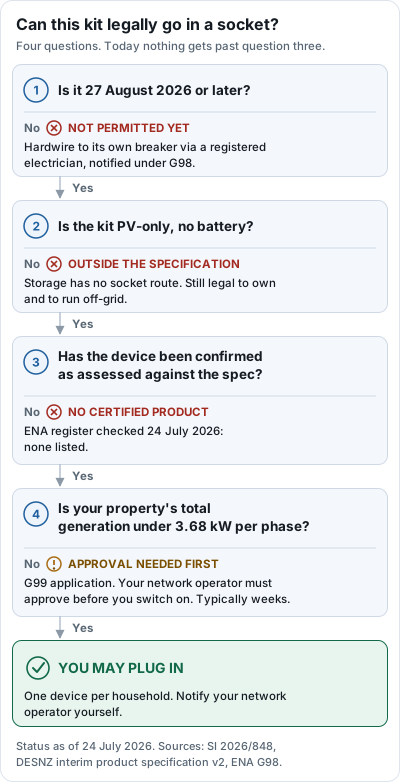
Where things stand right now
Where this stands on 22 September 2026
The law is in force and the shops are no longer empty. SI 2026/848 came into force on 27 August 2026 exactly as made, with no corrections. It defines a “plug-in microgenerator” in law: a device that generates from sunlight, has a maximum AC output of 800 watts, is intended for a standard plug and socket, and is not designed to import electricity to store it. A device that meets that definition and complies with the government’s interim product specification may lawfully connect to a socket. The specification is written into the law by name and version, so version 2 of 16 July 2026 is the legal test, not whatever version comes next.
The product gap closed before the date did. UKSOL had seven kits listed Compliant on the ENA Type Test Register on 18 and 19 August, nine days before the law changed. When I read the register on 22 September 2026, its plug-in solar category held 85 entries: 70 listed Compliant and 15 listed Non-compliant. Ten days earlier it held 48 Compliant entries and one Non-compliant entry, so both sides grew fast. The compliant names are now City Plumbing, Perlight Solar, UKSOL, PatioSun, Zendure, Modular Solar Technologies, TSUNESS, EcoFlow, InstaGroup, The Solar Centre, Thunder Energy, HDM Solar, APsystems, Skyworth, PowerXpress, Octopus Energy, The Impact Crowd, Segen and VALE. EcoFlow, TSUNESS and Segen dropped out in early September and have come back with Compliant entries. Anker and Fox ESS are still absent. Leaving the register, or failing it, is a record-keeping outcome and not a safety verdict, but it does mean those kits have no socket route today. For the full list, and which brands actually sell anything, see below.
You can buy one today, and from a high-street name. Screwfix lists a PowerXpress 800W kit at £669. City Plumbing has the cheapest listed kits I have found: a one-panel DMEGC 465W kit at £336 and a two-panel DMEGC 930W kit at £444. Argos ranges six UKSOL bundles from £599 to £999 in its Plug in solar category, at the same prices as on 12 September. On 22 September PatioSun started at £449 and Thunder Energy at £549.99, up from £499.99. On 23 September Modular Solar started at £465 and Plug In Solar sold the Perlight range from £588, both unchanged since 12 September. Octopus Energy is taking orders at £450 for a one-panel bundle and £650 for two, the prices I saw on 12 September after entering an address. Its delivery estimate has slipped: orders placed from 11 September are now due between the end of October and mid November.
The industry bodies have moved from “do not rush” to “check your home first”. On 27 August the IET said not all homes will be suitable, and Electrical Safety First published a consumer guide that names the part that decides it: the RCD in your consumer unit. A Type AC RCD is unsuitable for a plug-in kit. You need Type A, F or B, and one confirmed to work with power flowing both ways. One home, one device. I walk through the check in a separate guide: is your home suitable for plug-in solar?
One limit almost nobody has printed. The part of SI 2026/848 that legalises the connection, regulation 3, extends to England, Wales and Scotland only. Northern Ireland runs its own network regulations and its own version of G98, and neither has changed. If you live in Northern Ireland, plugging a kit in is not yet lawful, and no timetable has been published.
Which kits are covered, and which only look the part
Seventy kits have a socket route on 22 September 2026. Everything else does not, however it is marketed. The register is the only thing that separates them, so check the exact model number, not the brand. InstaGroup and Perlight each have models listed Compliant and one model listed Non-compliant. Statuses move both ways. EcoFlow, TSUNESS and Segen left the category in early September and came back with Compliant entries between 9 and 22 September. Octopus Energy did the same a week earlier. Anker and Fox ESS are still absent. The Non-compliant list grew from one entry to 15 in ten days. Six of those are Worldwide Solar kits built on the VaySunic VM800WE-P2 microinverter, and three are Sigenergy Plug-in PV models.
| Brand | Listed Compliant | Where you buy it | Price seen 22 Sep 2026 |
|---|---|---|---|
| City Plumbing | One- and two-panel DMEGC and Jinko sets with Hoymiles microinverters (13 kits) | cityplumbing.co.uk | £336 to £468 |
| Perlight Solar | PowerPlug MAX and FLEX+ at 465, 500, 930 and 1000 W (12 kits) | pluginsolar.co.uk | £588 to £810 |
| UKSOL | Pro Compact, Pro Duo, Pro Advanced, Pro Plus, Pro Max (7 kits) | Argos, uksol.uk, City Plumbing | £599 to £999 at Argos |
| PatioSun | Lite, Lite+, Duo, Duo+, Max, Max+ (6 kits) | patiosun.myshopify.com | £449 to £779 |
| Zendure | SolarFlow 800 with two panels, no battery (6 kits, listed 21 Sep) | Not on zendure.co.uk | Not seen |
| Modular Solar Technologies | 340W and 475W Solar Units, with an 800W or a 400W inverter (4 kits) | modular.solar | £465 and £650 |
| TSUNESS | TSOL-ESK800-U, TSOL-ESK800, TSOL-ESK800-Air(V) | Not checked | Not seen |
| EcoFlow | STREAM plug-in solar kit UK (flat roof, facade, pitched roof) and EF-PS-800 panel kit | Check the exact kit name | Not seen |
| InstaGroup | INS-PPG-800, INS-PPG-435 | Page said coming soon (23 Sep) | Not seen |
| The Solar Centre | One-panel and two-panel kits | Not checked | Not seen |
| Thunder Energy | Thunder Bolt 460W and 920W | thunderenergy.co.uk | £549.99 and £749.99 |
| HDM Solar | PSK1000, PSK2000 | No listing found | Not seen |
| APsystems | Premium Set Single-510W and Dual-1020W | No listing found | Not seen |
| Skyworth | SVBS-T900-800, SWBS-T900-800 | No listing found | Not seen |
| PowerXpress | 920W two-panel kit with mounting | Screwfix | £669 |
| Octopus Energy | M1-800-E microinverter | octopus.energy | £450 and £650 (12 Sep) |
| The Impact Crowd | Impact Plug-in Solar V1 | No listing found | Not seen |
| Segen | PIS-FE-SO-66H-470 | Trade supplier | Not seen |
| VALE | 900Wp kit on the EcoFlow EF-PS-800 | Not checked | Not seen |
One entry is Non-compliant: the InstaGroup INS-PPG2-800. Non-compliant is a register status, not a safety verdict. It means the submission was not accepted as demonstrating compliance. Either way, that model has no socket route.
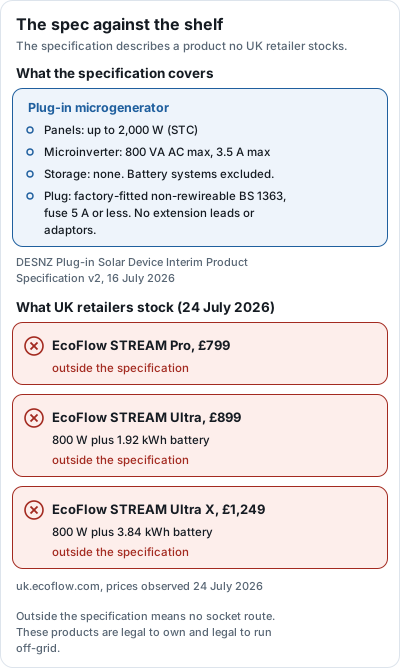
The trap is on Amazon, and it now carries familiar brand names. When I searched “plug in solar kit” there, the results were an EcoFlow STREAM 800W microinverter with two 500W panels, a 960W flexible panel set with an 800W inverter at £399.99, and a £139.99 microinverter kit sold with a UK 13 A plug already fitted. EcoFlow now has two kits listed Compliant, but that STREAM microinverter kit is not one of them. EcoFlow’s own UK page for it, at £549, still said “DO NOT BUY FOR UK PLUG-IN SOLAR” on 22 September. The generic kits look like the Argos kit and cost less, but they have no legal route into a socket. Electrical Safety First makes a point worth repeating: online marketplaces are not legally responsible for the safety of goods sold through them, so the retailer that actually stocks a listed kit is the safer place to buy.
Battery kits are still outside, and now at the level of the law rather than the specification. The definition in SI 2026/848 excludes any device designed to import electricity for storage. The kits with a battery built in, such as the EcoFlow STREAM Ultra at £899 with 1.92 kWh, are legal to own and legal to run off-grid or through an electrician-installed connection. They cannot use the socket route. The same goes for a listed kit once you add a battery. Zendure’s SolarFlow 800 can take one elsewhere in Europe, but the six UK kits on the register have none, and adding one takes the kit outside the legal definition. Thunder Energy also sells battery bundles from £1,499.99 next to its listed Bolt kits, so read the model name before you pay. Electrical Safety First goes further and tells people not to install plug-in battery systems at all. One wrinkle to know about: the new G98 wording mentions “plug-in Electricity Storage” alongside plug-in solar. That is the network standard leaving room for a future case. The law has not caught up with it, and until it does a plug-in battery has no socket route.
The June 2026 DESNZ safety study still matters here. It tested six plug-in devices bought on the open market: all six showed the core characteristics of safe operation, and all six exceeded the Class B conducted-emissions limit at full power. That is the conformity problem the listed kits have now had to answer, and the unlisted kits have not.
Where can you buy a compliant kit? Screwfix, City Plumbing and Argos yes, Lidl and Aldi no
Three retailers range listed kits now, and several brands sell direct. Screwfix lists the PowerXpress 800W bifacial kit at £669, fulfilled by an approved supplier. City Plumbing runs a Plug-In Solar PV category that now starts at £336 for a one-panel DMEGC 465W kit with a Hoymiles microinverter. Its cheapest two-panel kit is the DMEGC 930W at £444. The 940W Jinko bundle at £432 no longer comes up in its search. Argos keeps its six UKSOL bundles in a dedicated Plug in solar category, at the same prices as on 12 September. Those product pages are honest about what you get: one or two panels, an 800W microinverter, a mounting frame and 4 m of cable, to be plugged into “a suitable outdoor socket”, not through an extension lead or a cable reel.
| Argos listing (UKSOL) | Panels | Mount | Price 22 Sep 2026 |
|---|---|---|---|
| Pro Compact 515W | 1 panel, 515W | Hybrid | £599 |
| Pro Compact 460W | 1 panel, 460W | Ground | £679 |
| Pro Duo 890W | 2 panels, 890W | Hybrid | £849 |
| Pro Plus 1030W | 2 panels, 1,030W | Hybrid | £899 |
| Pro Max 1260W | 2 panels, 1,260W | Ground | £989 |
| Pro Duo 890W | 2 panels, 890W | Ground | £999 |
Two lines in the small print matter more than the price. Ground-mount kits need ballast that is not included, and both Argos and UKSOL say the kits are “not suitable for balconies”. The product that was sold to the public as balcony solar is, in its first UK compliant form, a garden or solid-wall product. Wind loading on a rail is the reason, and it is a fair one.
Beyond the three retailers, several brands sell direct. Thunder Energy sells the listed Thunder Bolt 460W at £549.99, up from £499.99, and the Bolt 920W at £749.99. It also sells Storm flexible kits from £499.99, which are not the listed Bolt models, so check the name before you pay. On 23 September it also offered a paid installation and network-notification service at £399.99 in Greater London. It now also sells Bolt Plus kits, the listed Bolt solar kit with a 1.92 kWh battery, from £1,549.99. The law gives a kit with storage no socket route, so treat Bolt Plus as a job for an electrician. PatioSun sells six kits from £449 to £779, though its shop still sits on a myshopify.com address. On 23 September Modular Solar sold a 340W unit at £465 and a 475W unit at £650, delivery and cables included. It has since listed two versions with a 400W inverter, and it now sells its units on Amazon, at the same prices, through its own seller account. That is a listed product on a marketplace page, so the model name, not the website, is the thing to check. Plug In Solar carried the Perlight PowerPlug MAX range from £588 on the same date. UKSOL’s own store cut its prices in early September: the Compact 460W was £599 collected or £699 delivered, and the Duo 890W £899 collected or £999 delivered, roughly £100 to £150 off each kit. That undercuts Argos on the same hardware, so it is worth comparing the maker’s own store against the shop. On 22 September UKSOL’s store took advance orders only for its four hybrid-mount kits, marked available from 1 November, so ask about delivery before you order a hybrid kit anywhere. Very now ranges the same six UKSOL bundles at the Argos prices. Octopus Energy sells £450 for a 460W JA Solar panel with a Fox ESS microinverter, a 5 m cable with a three-pin plug and a wall-or-floor mount, and £650 for two panels. The register entry caught up on 8 September: the M1-800-E now shows as Compliant, after five rounds of amendment from the Non-compliant listing it carried on 25 August. So the kit has a lawful socket route, but City Plumbing now undercuts it by £114 for one panel. The price still appears only after you enter a postcode. Delivery has slipped too. Octopus now expects orders placed before 11 September to arrive between the end of September and mid October, and later orders between the end of October and mid November.
Lidl and Aldi sell nothing in Britain as of 22 September 2026, six months after the government named Lidl, Amazon and Iceland as retailers preparing UK launches. Amazon has plenty of kits, and apart from Modular Solar’s own units the ones I found are not listed Compliant for plug-in solar. But the supply story has turned around fast. At the start of September Argos was the only mainstream retailer ranging a listed kit, and most compliant kits had nowhere to buy them. Now Screwfix and City Plumbing both stock them, and the cheapest listed kit costs £336 for one panel or £444 for two, rather than £549.99. The buying guide has the checklist to run against any kit you find.
Should you buy a plug-in solar panel now?
Yes, if four things are true, and no if you have a usable roof. A plug-in kit makes sense when you cannot fit a roof system: you rent, you live in a flat, your roof faces north, or the building is listed. Then it comes down to four checks that take an evening, not a month.
- The exact model is listed Compliant on the ENA register on the day you order. Brand is not enough.
- Your consumer unit is suitable. A Type A, F or B RCD confirmed to work in both directions, or a fuse board with a pre-purchase inspection. A Type AC RCD means stop and call an electrician first. The home check shows you how to read the label.
- It will be the only plug-in device in the home, and your total generation stays under 3.68 kW per phase. Both are G98 rules, and both still apply.
- You have written permission from any landlord, freeholder or managing agent, and you have told your insurer.
If all four are true, the £599 Argos kit is a reasonable buy for someone who is home in daylight, with an honest payback of seven to fourteen years on the numbers below. If you are out from 9 to 5 with nothing running but a fridge, it is a weaker case, and the saving sits at the bottom of that range. And if you have a roof, a full system still makes roughly five times the electricity per pound spent, so plug-in is not your product.
The risk now is insurance and wiring, not prosecution
Legalisation removed the “non-compliant connection” problem for a listed kit on a suitable circuit. It did not remove insurance as the thing to think about, and insurers do not all say the same thing yet. Zurich UK’s head of large property claims, Megan Dunford, said on 26 August that plug-in solar “shouldn’t be treated like a plug-and-play gadget”. The Property Institute warned that leaseholder installations can go unnoticed by freeholders and managing agents. Neither is saying do not buy. Both are saying tell people. Admiral takes the other side: its guide of 17 September puts freestanding plug-in panels under contents cover and says its customers do not need to tell it before they get one.
Your policy decides which of those applies to you, so ask your insurer in writing before you plug in, and keep three things on file: the register listing for your model, your network-operator notification, and your landlord or freeholder consent if you need one. A fire investigator who finds a listed kit on a notified, suitable circuit has nothing to argue with. One who finds an unlisted Amazon kit on a Type AC RCD does, and that is the case the insurer will look at hardest. Our guide covers how a non-compliant installation can affect a claim.
If you would rather generate now than wait weeks for a delivery, the hardwired route is still there and always was. A registered electrician wires an 800W system to its own breaker and notifies your network operator as part of the job. The buying guide prices that build from components you can order today.
How much does plug-in solar cost, and what does it save?
A listed kit costs £336 to £999 with panels included, and a two-panel kit saves £43 to £84 a year without a battery. In UK conditions an 800W inverter behind 890W to 1,260W of panels generates roughly 650 to 800 kWh a year. Without a battery you use about 25 to 40% of what it generates, worth £43 to £84 at 26.11p/kWh, the price cap rate to 30 September 2026. From 1 October the rate is 26.32p, which moves the range by less than a pound. Payback on the cheapest two-panel kit, £444, is 5 to 10 years, and 7 to 14 on a £599 Argos kit. On the £999 kits it is longer again, because the extra panel wattage adds daytime output a household out all day cannot use. The £336 kit has one 465W panel, so it makes a little over half as much energy and saves less. You use a bigger share of a smaller output, so I would not quote it a shorter payback until I have measured one.
The government’s 26 August press release says households “could save up to £110 a year” and that a kit provides “up to 20% of average home electricity use”. It publishes no basis for either figure: no self-consumption rate, no unit rate, no generation figure, no orientation. Both are “up to” numbers. Treat them as the ceiling for a household that is home all day with a south-facing kit, not as a forecast.
Two assumptions do all the work in my number, so state them plainly. The first is self-consumption: a plug-in kit only pays you back for the electricity you happen to be using while the sun is on the panels. A household out from 9 to 5 with no storage captures 25 to 40% of generation, and the rest leaves the property for nothing.
The second is export. Assume none, for now, unless you buy from Octopus. Smart Export Guarantee tariffs generally require an MCS-certified installation, and a self-installed plug-in kit does not have one, so every kWh you do not use yourself is worth nothing to you (the export rules for DIY systems). Ofgem’s Smart Export Guarantee rules ask for a certified installer as well as a certified product, and a supplier can pay without that only at its own discretion. Octopus is the first supplier to use that discretion. On 22 September its plug-in page said buyers of its own kit can join one of its export tariffs if Octopus also supplies their electricity and they have a working smart meter. You register the kit with your network operator first. Kits bought anywhere else are excluded, the page names no plug-in rate, and no kit had been delivered to test it. British Gas ran a prize draw for 30 kits that closed on 16 September, but its own explainer still says plug-in systems are not yet eligible for its export tariff. Export would matter if it arrived. The 60 to 75% of output a working household gives away is worth £50 to £70 a year at a 12p export rate, which would roughly double the value of a kit. For any kit outside the Octopus route, it is worth £0 today.
Generation depends heavily on where you put the panels. South-facing at a 30 to 35 degree tilt in central England gives around 650 to 700 kWh a year per PVGIS. East-facing or near-vertical drops that to 400 to 500 kWh. Our guide to solar panel tilt and orientation has the full picture, and what an 800W solar kit can actually power converts the kWh into appliances.
Plug-in Solar Savings Calculator
Estimate annual savings for panel configurations up to 800W, using PVGIS yield data for central England. The default is a no-battery kit, because the UK specification covers panels and a microinverter only. The default rate, 26.11p/kWh, is the price cap unit rate valid to 30 September 2026; it becomes 26.32p from 1 October. The default kit cost, £599, is the cheapest listed kit at Argos on 22 September 2026. City Plumbing sells a two-panel kit for £444 and a one-panel kit for £336.
The comparison people ask for is against a roof system, and a roof system wins on every pound spent: a 3.6kW DIY array costs £2,000 to £5,000, makes around 3,500 kWh a year, and pays back in 3 to 5 years. That is the right choice if you own the roof. For someone renting a flat with a balcony, the comparison is not plug-in solar against a roof system. It is plug-in solar against nothing.
How many plug-in solar panels can you have?
One plug-in device per household, and that is now settled rather than pending. Inverter output no higher than 800 VA and 3.5 A, total panels no higher than 2,000 W measured at STC. In practice that is two modern panels feeding one microinverter that clips to 800W AC. Above 960 W of panels the manufacturer has to advise you to consider a professional check of your wiring, and most two-panel kits on sale cross that line.
The per-circuit relaxation did not happen. The July specification permits one device per household final ring circuit, with a note that G98 restricts it to one per household "unless and until that is amended". G98 was amended in August 2026, and the amendment went the other way. Its scope now reads: "This EREC G98 permits the connection and operation of a single Plug-in Micro-generator ... Connecting more than one Plug-in Micro-generator is not allowed." Electrical Safety First says the same in plain words: one home, one device. The IET's reason still stands too: the government safety testing covered a single unit, not several on one circuit.
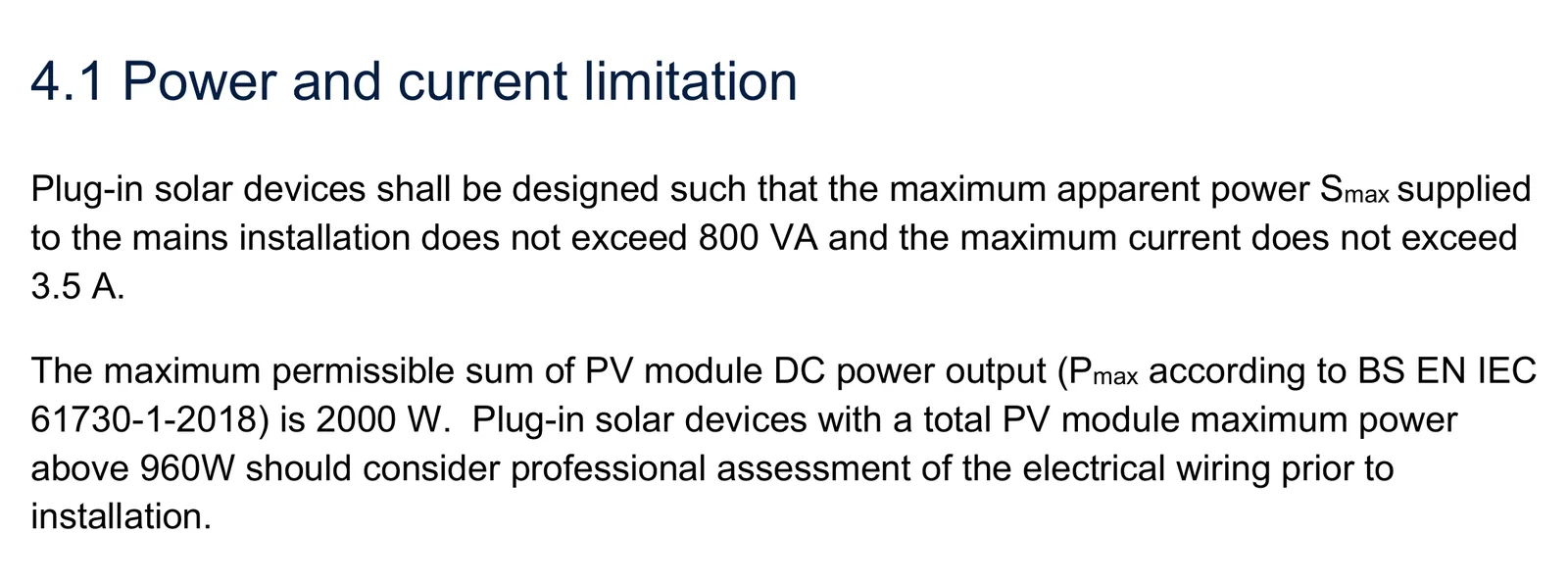
Panel watts and inverter output are different things, which is where most confusion starts. The panels' DC rating can be more than double what the inverter ever pushes into your sockets. Fitting 1,260 W of panels behind an 800W microinverter, as the top Argos kit does, is overpanelling. It is standard practice, and it costs you 1 to 3% a year in clipped peaks while gaining you output every dull morning and winter afternoon. The law caps the AC side at 800 W, which is why a 1,260 W kit is still lawful and still registers at 0.8 kW.
None of this is the same question as how much solar a UK home is allowed in total. If that is what you are after, read the maximum number of solar panels allowed in the UK, which covers roof area, the 3.68kW threshold and what actually caps your system size. For choosing the microinverter and panels themselves, the buying guide has the MPPT voltage limits and part numbers.
The trap if you already have solar: notify-and-go versus ask-first
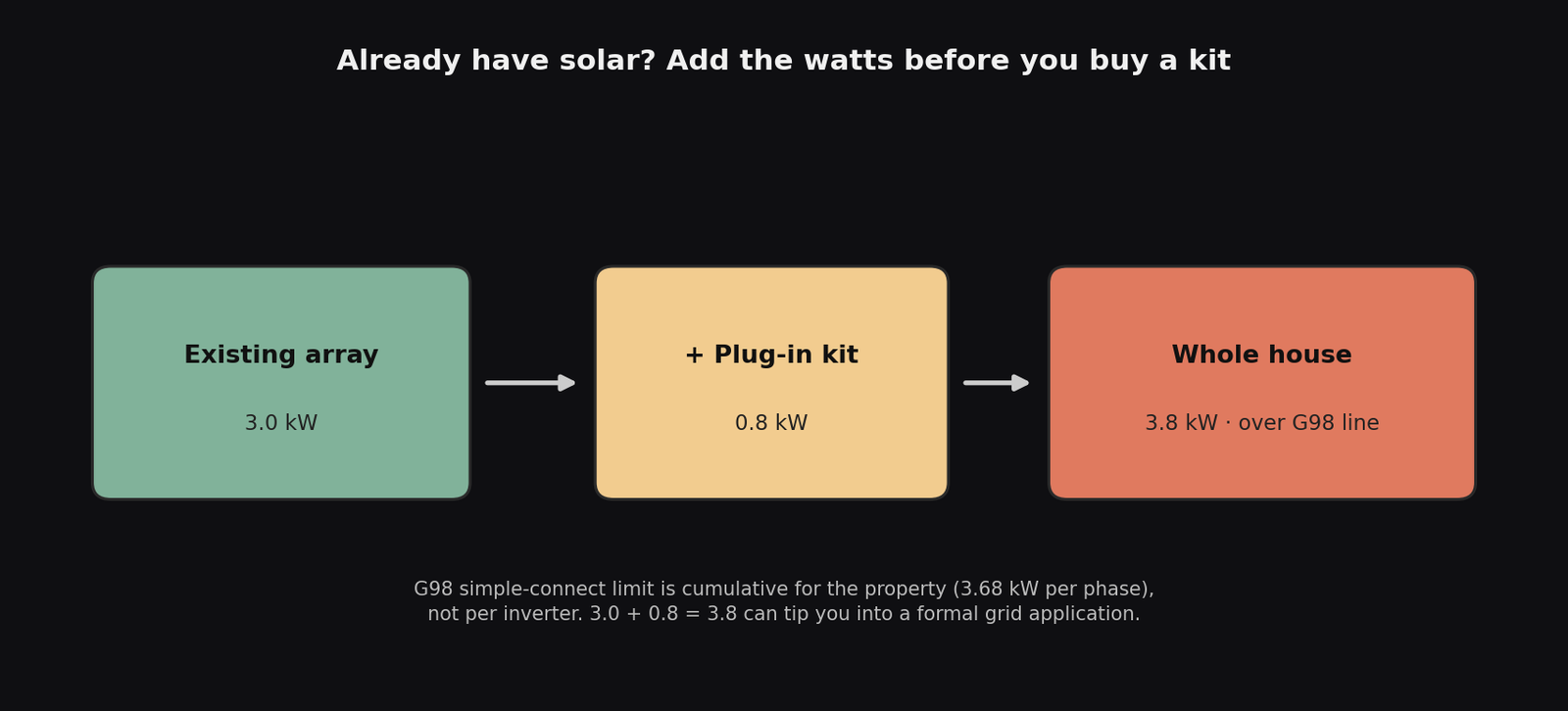
There are two routes for telling your network operator about generation on your property. The fast one is notify-and-connect under G98: you submit a short form online and you are clear to proceed, with the operator having 5 working days to raise a concern. It rarely does for small systems.
That route only covers you up to 3.68 kW of total generation across the whole property, per phase. Not per panel, not per inverter, everything combined. Add an 800 W kit to an existing 3 kW roof array and your total is 3.8 kW, which drops the whole house onto the slow route: a formal G99 application your operator has to approve before you switch anything on. That typically takes weeks.
What counts is the capacity the manufacturer declares, and the test is who can change it. A limit the manufacturer builds in and you cannot reach is part of the rating, which is exactly why a kit with 1,260 W of panels still registers at 0.8 kW. A limit you can dial down yourself in an app is not, so turning your existing system down does not move you back under the threshold. The August 2026 G98 amendment spells it out for plug-in kits: a plug-in device may sit alongside permanently wired generation "provided that the aggregate Registered Capacity of all Micro-generators" stays within 16 A per phase at 230 V. The notification form then asks you to declare it, so you are the one signing that your property total stays under 3.68 kW, or 11 kW on three phases. A plug-in kit is not automatically "just plug it in" for a home that already has solar, and a home with a 4 kW roof array is over the line before it starts.
UK engineer Ben Tasker documented exactly this when he added two 440 W panels to his existing 3.2 kWp array: he hardwired the kit to a fused isolator rather than using a socket, worked within a 3.6 kW export limit, and set the inverter to cap export as a failsafe. His metered build log walks through the numbers. We cover registering a DIY installation with your network operator separately.
You still have to notify even at 1 kWp. A small fence or wall build sits far below any threshold that needs permission, but the notification is the legal minimum, it takes about five minutes online, and it is the first thing a supplier or insurer checks if anything goes wrong.
Are plug-in solar panels safe?
A listed kit on a suitable circuit, yes. The open question has moved from the kit to the house. An 800W microinverter adds less current to a ring main than a toaster draws. The specification requires the inverter to disconnect when it loses the grid or gets unplugged, dropping the plug pins below 34 V within 100 milliseconds so they are not left live. Those requirements bind every listed kit. An unlisted import carries no such guarantee.
What the electrical bodies said on legalisation day is about your consumer unit, not the panels. Electrical Safety First's guide puts it in one table: a Type AC RCD "may fail to provide suitable protection in the event of a fault" with a plug-in kit on the circuit, and is unsuitable. Type A, F and B are suitable. On top of the type, the RCD protecting that socket circuit should be confirmed as bidirectional, and few are labelled in a way a homeowner can read. The IET's survey explains why they are worried: 25% of UK adults know their RCD type, 37% do not know what an RCD is, and 23% would reach for an extension lead if the cable did not reach. The home suitability check takes you through your own board.
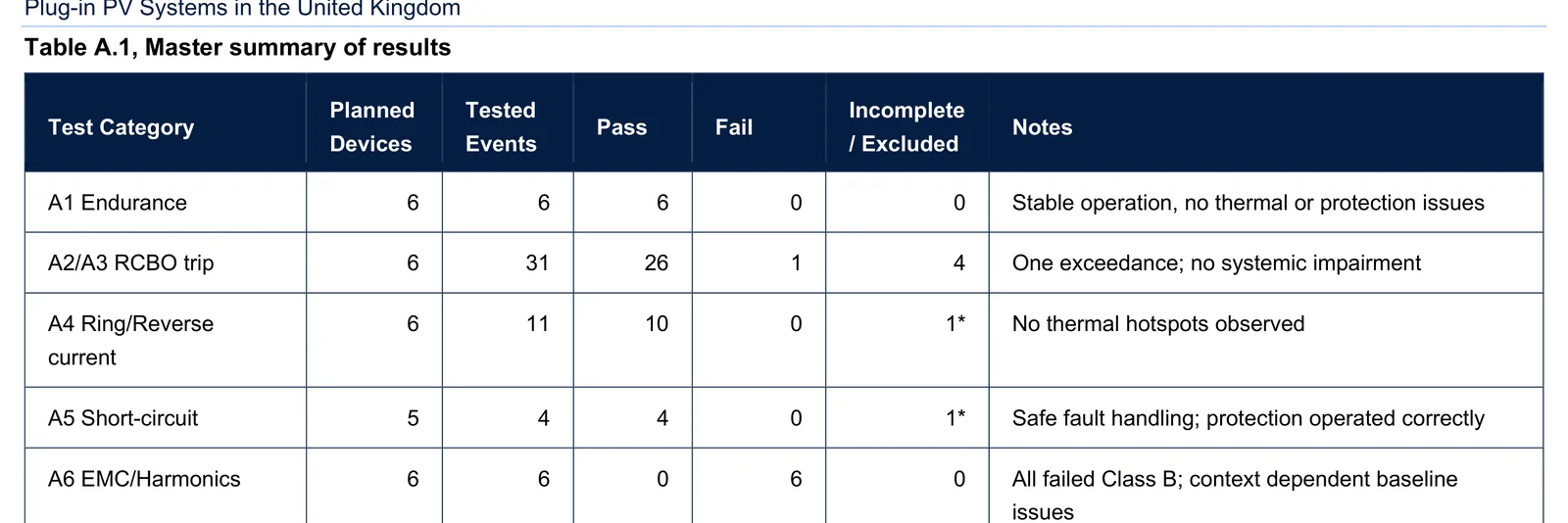
The June 2026 government study is the evidence behind the kit side. Six devices bought on the open market passed on endurance, fault handling, reverse current and anti-islanding, and all six exceeded the Class B conducted-emissions limit at full power. That combination is why the study recommended a controlled deployment framework rather than blocking the technology, and why the register exists. The full test-by-test breakdown is in what the UK electrical safety study found.
Why was plug-in solar illegal in the UK?
Because a breaker cannot see solar current. A plug-in kit injects power downstream of the breaker protecting that circuit, so a cable can carry more than its rating while the breaker sits under its trip point. That hidden overload, not shock risk, is the engineering reason the wiring rules required generators to be wired in rather than plugged in. The full explanation is in why you cannot just plug a generator into a socket.
It is also why the government commissioned a study on real UK ring circuits at 800 VA before writing a specification, and why the 800 W cap exists at all.
Can renters use plug-in solar?
Physically, yes, and that is the point of the product. A plug-in kit needs no drilling, no roof access and no structural change, so it usually falls outside the alteration clauses that cover things like knocking through a wall or fitting a satellite dish. When you move out, the panels come with you, and the rules expect that: the plug-in notification form has a line for the address the kit came from, and a second form tells your old network operator it has gone.
Legally, there is no help. No UK law forces a landlord or freeholder to allow it. Germany changed its civil code in October 2024 to give tenants and flat co-owners an enforceable right, with refusal limited to specific grounds. The UK rules say nothing on the subject. Check your tenancy agreement, get written agreement before you install, and keep the record. Permission is a separate gate from the plug rules, and legalisation did not open it.
One practical surprise for flat dwellers: the first compliant kits are not balcony kits. Argos and UKSOL both state the UKSOL range is "not suitable for balconies", and the ground-mount versions need ballast you buy separately. If your only outdoor space is a railing, the compliant product for you does not exist yet. A garden, a yard or a solid south-facing wall does have one.
Key dates
- 16 March 2026. DESNZ announced the intent to legalise sub-800W plug-in solar. Policy intent, not a law change. GOV.UK announcement.
- 1 April 2026. China removed the 9% VAT export rebate on solar panels. Kits sold in Europe use Chinese panels and microinverters, and the first UK listed kits are priced accordingly.
- 15 April 2026. BS 7671 Amendment 4 took effect. A wiring standards update, not the plug-in enabler. See what the April 2026 rule change actually did.
- 9 June 2026. The IET, ECA, Electrical Safety First, NICEIC and SELECT jointly urged that plug-in solar should not reach the mass market until UK standards and enforcement are in place.
- 16 June 2026. DESNZ published the interim product specification (v1.0), the electrical safety study, and opened a 14-day consultation. 800 VA, 2,000 W of panels, BS 1363 plug with a 5 A fuse.
- 30 June 2026. Consultation closed. 466 responses, over 85% supporting the specification.
- 16 July 2026. Three things landed at once: the government response, version 2 of the specification (45 pages, every numeric limit unchanged from v1.0), and SI 2026/848, the regulations that amend the Plugs and Sockets etc. (Safety) Regulations 1994 and the Electricity Safety, Quality and Continuity Regulations 2002. Laid before Parliament 17 July.
- 20 and 30 July 2026. The ECA warned against putting speed ahead of safety. The IET welcomed the strengthened specification but noted the safety testing covered single units only, not several on one circuit.
- 11 August 2026. Ofgem approved the G98 amendment for plug-in microgeneration, directing that it take effect when the legislation did, so it has applied since 27 August alongside the law. The ENA published it as EREC G98 Amendment 1 (Issue 2). Its scope permits "a single Plug-in Micro-generator" per installation and states that connecting more than one "is not allowed". It lets the customer act as the installer, adds a plug-in notification form (B2) pointing at the ENA Connect Direct site, and a removal form (D2). It exempts plug-in kits from four steps of a normal G98 job: the installer-competency requirement, the photograph of the cut-out, the installation wiring and isolation rules, and the loss-of-mains functional check. It exempts nothing about your own wiring, which still has to meet BS 7671.
- 18 to 19 August 2026. UKSOL's seven kits were listed Compliant on the ENA Type Test Register, the first plug-in solar products to get there.
- 26 August 2026. Ofgem published the October to December price cap: electricity 26.32p/kWh, standing charge 54.83p a day. The same evening DESNZ issued a press release claiming savings of "up to £110 a year", with no basis published.
- 27 August 2026. SI 2026/848 came into force in England, Wales and Scotland. A plug-in microgenerator that complies with the specification, PV-only and capped at 800W AC, may legally connect through a standard socket, one per household. The IET, Electrical Safety First, NICEIC and SELECT all issued statements the same day: not every home is suitable, check your RCD. Perlight, InstaGroup, Thunder Energy and City Plumbing kits joined the register on 27 and 28 August. Argos listed the UKSOL range.
- 1 October 2026. The price cap unit rate moves from 26.11p to 26.32p/kWh.
- 15 October 2026. The Amendment 4 transition period ends. All new electrical work must comply with the updated wiring rules. Nothing to do with plug-in solar.
- Late October to mid November 2026. Octopus Energy's estimated delivery for plug-in kits ordered from 11 September. Orders placed before that date are due between the end of September and mid October. A retailer estimate, and the first real test of whether "on sale" means "in gardens". Argos shows no delivery date.
- 31 March 2027. 0% VAT on battery storage is set to expire. That relief applies to installed supply-and-fit systems, not a kit you order online and fit yourself, so do not expect 20% off a DIY build.
Here is the DESNZ short from March 2026 that started the public conversation, uploaded a week after the formal announcement:
What the April 2026 rule change did and did not do
BS 7671 Amendment 4 took effect on 15 April 2026 and is widely miscredited with legalising plug-in solar. It did not. It is a wiring standards update whose main new content for this topic is a chapter on stationary battery wiring: protection, ventilation, fire safety and installation. It also adds Power over Ethernet rules and revises medical-location wiring, neither of which touches solar.
The rule that actually barred a socket connection sits elsewhere: the wiring regulations say a generating set must not be connected to a final circuit through a plug and socket, and the April update left it alone. Legalisation runs on a separate track outside BS 7671, through the plugs-and-sockets safety regulations and the DESNZ product specification. If you see a page claiming a numbered BS 7671 section legalises plug-in solar, it is wrong, whichever number it cites.
Amendment 4 is still worth knowing about if your kit includes storage, because it is the standard a hardwired battery installation now has to meet.
What is still open
- Whether the network operators have caught up. Partly. The G98 amendment created a plug-in notification form, and the Energy Networks Association now runs a consumer registration site, myplugin.solar, that sends the notification to your network operator for you. Electricity North West links to it from its own plug-in solar page. A check of the other five operators' sites on 22 September found no plug-in page. The notification answer below has the detail.
- Export payments. Octopus says buyers of its own kit who take its electricity and have a smart meter can join one of its export tariffs, but it names no rate and no kit had arrived by 22 September. British Gas still says plug-in systems are not yet eligible. Ofgem's Smart Export Guarantee guidance asks for a certified installer as well as a certified product, which a self-installed kit cannot show, though a supplier may pay without it if it chooses. There is no Ofgem consultation on changing the rule, whatever affiliate pages claim. Outside the Octopus route, assume £0 until a tariff exists.
- Northern Ireland. The connection change does not extend there. No consultation or timetable has been published.
- Whether battery kits ever get a route. The law excludes storage in the definition itself. The G98 wording leaves room for it, nothing else does.
- One per circuit. Closed for now, in the negative. The G98 amendment kept one per household. A change would need another amendment and the multi-unit testing the IET asked for.
- Renter protections. The rules give no right to install. Germany legislated one in 2024; the UK has not.
- The full BSI standard. Not published, not in BSI's standards-development pipeline under any name I could find, and no date. The interim specification is the rulebook, and it is written into the law by version.
- Delivery. Whether Octopus meets its new delivery window, whether Argos publishes a date again, and whether the HDM Solar, APsystems, Skyworth, Impact Crowd, Zendure and EcoFlow listed kits reach a UK shelf.
What people get wrong about plug-in solar
- "Legal means any plug-in kit is fine now." It means a kit listed Compliant on the ENA register is fine. Check the model number, not the brand.
- "The kits on Amazon are the ones that got legalised." Most Amazon results are unlisted microinverter kits and battery kits. Modular Solar is the exception I found, selling its own listed units there. A familiar brand is not enough: EcoFlow and Zendure now have listed kits, but the EcoFlow STREAM microinverter kit sold online is not one of them. The listed kits are at Screwfix, City Plumbing, Argos, and direct from Thunder Energy, UKSOL, PatioSun, Modular Solar and Octopus.
- "It plugs in, so any home can have one." The IET and Electrical Safety First both say not every home is suitable. A Type AC RCD rules yours out until an electrician changes it. See the home check.
- "The government says £110 a year." It says "up to £110", with no basis published. Assume £43 to £84 without a battery and £0 export.
- "German payback posts show 2 years." Many of them value every kWh generated. See our guide to plug-in solar rules across Europe.
- "It will cut my winter bills." December output is close to zero. This is a summer and shoulder season helper. See whether plug-in solar works in winter.
- "Two kits on an extension lead is fine." One device per household, no extension leads or adaptors. The first is in G98, the second in the specification.
- "An outdoor socket makes it legal." It does not, and never did. See whether an outdoor socket makes plug-in solar legal.
- "I already have solar, so 800 W more is free extra." G98 limits are cumulative for the whole property. See the G98 trap.
- "Legalisation means my flat will allow it." There is no UK tenant or leaseholder right, and the first compliant kits are not balcony kits anyway.
- "It is legal across the UK." England, Wales and Scotland. Northern Ireland is not covered.
Frequently asked questions
Are plug-in solar panels legal in the UK?
Yes, in England, Wales and Scotland, since 27 August 2026. SI 2026/848 lets a plug-in microgenerator, PV-only with a maximum AC output of 800 W, connect through a standard socket if it complies with the government's interim product specification. In practice that means a model listed Compliant on the ENA register: 70 kits on 22 September 2026. One device per household. Northern Ireland is not covered.
How do plug-in solar panels work in the UK?
Panels feed DC into a microinverter, the microinverter converts it to 230 V AC, and that AC flows into your home circuit. Whatever is running uses the solar first instead of drawing from the grid, and your meter records less import. When the panels stop, your home switches back automatically. Nothing is stored. For the full walkthrough, read how plug-in solar panels work in UK homes.
How many plug-in solar panels can I have?
One device per household, up to 800 VA of inverter output, and up to 2,000 W of panels. The August 2026 G98 amendment fixed the per-household limit: "Connecting more than one Plug-in Micro-generator is not allowed." If you already have roof solar, add the watts to the whole property total first, because the 3.68 kW notify-and-connect limit counts everything.
Can you buy a solar panel with a plug socket in the UK?
Yes. A solar panel with a plug on the end is exactly what SI 2026/848 legalised, for a listed device: PV-only, 800 VA of AC output, a factory-fitted BS 1363 plug with a 5 A fuse, no extension leads. Screwfix, City Plumbing and Argos all sell listed versions, from £336. The £139.99 microinverter kits with a UK plug on Amazon are not listed and have no socket route, so the plug on the end is not the thing that makes it legal. Fitting an outdoor socket does not change the answer either, as whether an outdoor socket makes plug-in solar legal explains.
Can I buy plug-in solar panels from Lidl or Aldi?
Not in the UK. Neither chain stocks a plug-in kit in Britain as of 22 September 2026. Both have sold balcony kits in Germany for several years at €199 to €399. In Britain Argos moved first, with the UKSOL range from £599, and Screwfix and City Plumbing have since followed.
Is balcony solar the same as plug-in solar?
Yes. Same hardware, same limits, same rules, different mounting habit: balcony solar and plug-in solar are the same thing.
Is plug-in solar legal in Northern Ireland?
Not yet. Regulation 3 of SI 2026/848, the part that makes a socket connection lawful, extends to England, Wales and Scotland only. Northern Ireland has its own Electricity Safety, Quality and Continuity Regulations and its own G98, and neither has been amended. The product rules in regulation 2 do apply UK-wide, so a listed kit can be sold in Northern Ireland; it just cannot lawfully be plugged in there. No consultation or date has been published.
Do I need to tell my network operator about a plug-in kit?
Yes, and you do it yourself, within 28 days of plugging the kit in. I have read the amendment, and this is the part no coverage has picked up, so here it is in plain terms. G98 now says that for a plug-in kit the customer can take the role of installer, and it adds a form of its own: Form B2, the installation document for a plug-in microgenerator. The form itself tells you to notify online once the kit is installed, and to send the form to your network operator only if you would rather not do it online. The online route now has a front door built for householders: myplugin.solar, run by the Energy Networks Association. You verify your email, enter your postcode, pick your device from the compliant list and submit, and the site sends the notification to your network operator. You sign a short declaration: that the details are right, that this is the only plug-in device in the property, and that everything generating on the property adds up to no more than 3.68 kW, or 11 kW on a three-phase supply.
Have four things to hand: the manufacturer and model, the reference the kit carries on the ENA register, your MPAN from an electricity bill, and the date you plugged it in. You do not need the photograph of your cut-out that a normal G98 job asks for, because plug-in kits are exempt from that step. Two more that catch people out: if you move the kit to a new home you give the old address on the form, and when you take a kit out of use for good there is a second form, D2, to tell the operator it has gone. Our guide to registering with your network operator walks through the process.
My take: what I would do now
If you have roof access, this is not your product. A full system generates roughly five times as much for the money. I run 7.15 kWp with a Sunsynk hybrid inverter and 16 kWh of Fogstar storage, and the payback numbers are in a different league. Plug-in solar exists for the households a roof system cannot reach: renters, flats, north-facing roofs, listed buildings.
If that is you, the order of work is: open your consumer unit and read the RCD label before you open a shop page. Type A, F or B and you can carry on; Type AC and the first purchase is an electrician's visit, not a kit. Then add up any generation you already have, get landlord or freeholder consent in writing, and only then pick a model from the register and order it. Use the wait for delivery to sort the ballast, the wall fixing and the outdoor socket.
Then watch two things. The first is the register, which changes weekly and can take a kit off as easily as it puts one on. The second is the first supplier to actually pay for export from a plug-in kit, because that is the change that would double what these kits are worth. I will update this page when either moves.
Read more on plug-in solar
This page covers the law, the dates and the products. These go deeper:
- Is your home suitable for plug-in solar?: how to read your RCD, the bidirectional question, and the one-per-household and 3.68 kW rules in one check.
- How plug-in solar panels work: panels, microinverter and socket, and what happens when you generate more than you use.
- Plug-in solar kits UK: cost and buying checklist: what to check on any kit, with a component kit builder.
- What an 800W plug-in solar kit can actually power: the kWh translated into appliances.
- Does an outdoor socket make plug-in solar legal?: the three rulebooks people blur into one.
- Maximum number of solar panels allowed in the UK: what really caps your system size.
- Plug-in solar rules across Europe: what Germany did first and what the UK copied.
- Octopus Nook: what the plug-in home battery actually is: the storage side, which the plug-in specification excludes.
