
No. Fitting a weatherproof outdoor socket does not make plug-in solar legal, and the socket was never the thing standing in the way. Since 27 August 2026 a PV-only kit listed as Compliant on the ENA register may use a standard household socket, and an outdoor one wired as part of a normal socket circuit counts. What decides it is the kit and the circuit, not the socket’s weather rating.
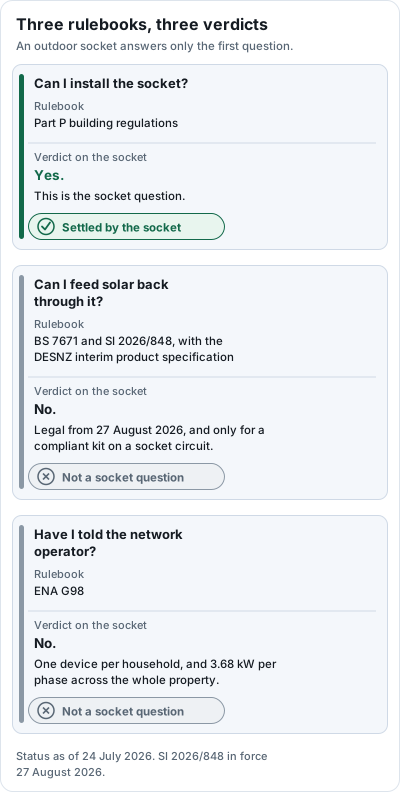
The reason this question keeps coming up is that three different rulebooks are in play and they get blurred into one. One governs whether you may install the socket. One governs whether you may push generation back through a plug. One governs telling your network operator. An outdoor socket only ever touched the first.
Does fitting an outdoor socket make plug-in solar legal?
No. An outdoor socket changes two things: how well the connection survives weather, and where you can reach a plug outside. Neither of those is what the rules turn on.
Since 27 August 2026, when SI 2026/848 came into force, a plug-in microgenerator that meets the government’s product specification may legally use a standard socket. Before that date the wiring standard restricted connecting a generating set, which is what your microinverter is, to a final circuit through a plug and socket, and an IP66 enclosure never lifted that restriction. It only kept the same restricted connection dry.
The new route does not care about the weather rating either. It puts a condition on the circuit behind the socket, and it rules out one of the arrangements people have in mind when they ask this question. An outdoor socket wired as part of a normal socket circuit qualifies. A socket rated IP66 and fed from a lighting circuit does not. For the full legal picture, including what the specification covers and what it leaves out, see the main guide to UK plug-in solar law.
What the new rules say about plugging in outdoors
Two lines in the interim product specification (version 2, published 16 July 2026) decide how this works outdoors. The kit may be connected to socket circuits only, and extension leads and multi-way adaptors are not permitted. Read together, those two lines separate a proper outdoor socket from the arrangement most people actually improvise.
“Socket circuits only” is a condition on the wiring behind the socket, not on where the socket sits. A weatherproof socket fitted as a spur off your ring final circuit, or on its own radial that serves socket-outlets, is a socket circuit. An outdoor point fed from a lighting circuit, or from a sub-circuit serving fixed equipment in a garage, is not. So the useful question about an outdoor socket is not what it is rated to but what it hangs off, and that is something an electrician can tell you in a minute.
The extension-lead ban is the part that bites hardest. The specification requires a factory-fitted, non-rewireable BS 1363 plug with a fuse of 5 A or less, so the cable between the microinverter and the plug is whatever the manufacturer supplied and you cannot lengthen it. No extension lead, no adaptor, no reel. That means the kit has to reach a socket with its own cable, and it rules out the arrangement I see suggested most often: an indoor socket with a lead run out through a window or a door. A fixed outdoor socket within reach of the panels is the version of this that the specification can accommodate. A lead trailed outdoors is the version it cannot.
Where the specification is silent, I am not going to fill the gap. It does not address outdoor installation as a category, does not set an IP rating for the socket, and does not say whether an outdoor socket needs anything an indoor one does not. My reading is that the ordinary outdoor wiring requirements continue to apply on their own account, because nothing in the specification displaces them, but that is a reading and not a ruling. If your install depends on the answer, ask the manufacturer for their written position before you buy.
This is buyable now, and the check has become simple. When I read the Energy Networks Association register on 10 October 2026, its plug-in solar category held 133 entries: 120 listed Compliant and 13 listed Non-compliant. City Plumbing, Argos, Wilko, Homebase and Very all listed kits on 10 October 2026, from £336. So the question to put to a seller is a model number question. Look up the exact model on the register on the day you buy, because brand is not enough and statuses move both ways: InstaGroup and Fusion Renewables each have models listed Compliant and at least one model listed Non-compliant.
The retailers back up the point this article makes. Both Argos and UKSOL tell you to plug the kit into “a suitable outdoor socket”, and both say not through extension leads or cable reels. The fixed outdoor socket is the arrangement the specification can accommodate, and the retailers selling the first compliant kits say so in their own product copy.
What an outdoor socket actually changes
An outdoor socket is a genuinely useful thing to have. It solves two real problems. They are just not the problem people expect it to solve.
The first is weatherproofing. An outdoor socket is housed in an IP66-rated enclosure, so it is dust-tight and stands up to jets of water, and it is protected by a 30 mA RCD that cuts power on an earth fault. If you are running any cable outdoors, for a mower, a hot tub, Christmas lights or a solar kit, that protection is worth having on its own merits.
The second is access. It gives you a fixed point to plug into outside instead of an open window and a lead across the floor. Since 27 August that has stopped being a convenience. It is now the difference between an arrangement the specification allows and one it does not.
Three rulebooks people blur into one
Here is each of the three lanes in the diagram at the top, with what it actually requires. Only the first one is a socket question.
Part P: can I install the socket at all?
This is the building-regulations track and it is about the socket, not about solar. A genuinely new circuit for the socket is notifiable work: a registered electrician carries it out and self-certifies, or you notify building control before you start. Adding a socket to an existing circuit is treated differently by nation. In England, outdoors stopped being a special location in 2013, so a socket added to an existing circuit is usually not notifiable. In Wales, outdoor work remains a special location, so an outdoor addition stays notifiable. Scotland and Northern Ireland run their own building standards rather than Part P.
Either way the work must meet the wiring standard, which outdoors means the IP66 enclosure and 30 mA RCD protection described above. Get this lane wrong and you have breached the Building Regulations. Get it right and you have a compliant socket, which tells you nothing about what you may plug into it.
The wiring standard and product law: can I feed solar back through it?
This is the lane that decides plug-in solar, and it has moved. SI 2026/848 now creates a route for a plug-in microgenerator: 800 VA maximum inverter output, 3.5 A maximum current, up to 2,000 W of panels measured at standard test conditions, anti-islanding, the moulded plug and 5 A fuse, socket circuits only, and no storage. Before 27 August 2026 the wiring standard’s restriction on connecting a generator through a plug and socket applied with no exception for outdoor sockets.
One part of that law stops at the border. Regulation 3, the part that makes the socket connection lawful, extends to England, Wales and Scotland only. Northern Ireland has its own network regulations and its own version of G98, and neither has been amended, so plugging a kit in there is still not lawful. No timetable has been published for changing that.
Every one of those conditions is on the kit or the circuit. Not one of them is on the socket’s weather rating. A socket can be perfectly IP66 and the kit plugged into it still fall outside the rules, which is exactly why the retail framing at the top of this article is misleading.
G98: have I told the network operator?
Small generation is notified to your distribution network operator under G98, and the socket’s rating has nothing to do with it. Two details matter more than most articles admit. The limit is one plug-in device per household, not one per circuit, and that is now settled rather than pending. The July specification permitted one device per household final ring circuit, with a note that G98 restricted it to one per household unless and until G98 was amended. G98 was amended in August 2026, and the amendment went the other way. Its scope now reads: “Connecting more than one Plug-in Micro-generator is not allowed.”
The same amendment sets the aggregate rule in plain terms. A plug-in device may sit alongside permanently wired generation “provided that the aggregate Registered Capacity of all Micro-generators is such that the current, at a nominal voltage of 230 V, does not exceed 16 A per phase”. That is the 3.68 kW figure, and it is cumulative across the property.
You file the notification yourself, and the amendment now says so. G98 lets the customer take the role of installer for a plug-in kit, and adds Form B2 for the purpose, which points you at the connect-and-notify process on the ENA Connect Direct site. You have 28 days from plugging in, and you declare that this is the only plug-in device in the property and that everything generating there stays under 3.68 kW. None of that is affected by where the socket is. See confirming your network operator registration for the process.
The second is cumulative capacity. G98 covers up to 3.68 kW per phase across the whole property, not per inverter. If you already have a 3 kW array, adding an 800 W kit takes the property to 3.8 kW and pushes the whole installation into G99, which means a formal application and your operator’s approval before you connect, typically taking weeks. A plug-in kit is not automatically a plug-in job for a house that already has solar, whatever socket you plug it into.
One note on language, because it gets used loosely. Breaching the wiring standard is not a criminal offence the way people mean when they say “illegal”. It is non-compliant, with real consequences for your insurer, your network operator and any future sale. Failing to notify a notifiable socket under Part P does breach the Building Regulations directly. Those are different kinds of not-allowed, and the outdoor socket sits only in the Part P lane.
Why the shops make it sound solved
Retail listings bundle a weatherproof kit with an outdoor-rated socket and a line about plugging in outside. Read quickly, that reads as “outdoor socket, therefore sorted”. The socket in the box is a legitimate product. The leap is the implication that making the connection point weatherproof also makes the plug-in step allowed.
A related line circulates: that an electrician will fit an outdoor weatherproof socket for the kit to plug into, and that this is what makes it compliant. Be precise about what a compliant install actually needs. It needs a kit listed Compliant on the register, a socket circuit behind the socket, an RCD of a type that suits plug-in solar, no extension lead, one plug-in device in the home, and a G98 notification. The socket happening to be outdoors is none of those things. It is a good idea for other reasons, and it is not the qualification.
It is also worth knowing what is actually on the shelf. The kits with a socket route are PV-only, and on 22 September 2026 they were at Screwfix, City Plumbing and Argos, and direct from brands such as Thunder Energy, PatioSun and UKSOL. Everything with a battery in the box sits outside the route, because SI 2026/848 defines a plug-in microgenerator as a device that is not designed to import electricity to store it. The EcoFlow STREAM Ultra at £898.99 on Amazon is legal to buy, own, and run off-grid or through an electrician-installed connection. It has no socket route, and no timeline has been set for one.
Amazon is where this trips people up. On 23 September 2026 a search there returned an EcoFlow STREAM 800W microinverter with two 500W panels at £549, and several unbranded 960W flexible panel sets with an 800W inverter from £359, some with “G98” in the title. I could not match any of them to a Compliant entry in the plug-in solar category. EcoFlow has since listed two plug-in kits, but the STREAM microinverter kit sold online is not one of them. They look like the Argos kit and they cost less, and a UK plug moulded onto the cable is not what makes a kit lawful.
The underlying reason for all this caution is the same indoors or out, and it has nothing to do with rain. A plug-in kit injects its current downstream of your circuit breaker, so the breaker only sees the current arriving from the grid, never the solar contribution added on top. On a hard-loaded circuit a cable can carry more than its rating while the breaker, seeing only its share, never trips. That hidden overload lives on the wiring, not at the socket face. Weatherproofing does not touch it. If you want the mechanism in full, the explainer on how plug-in solar works covers it.
The way to run solar outdoors today
The hardwired route is still there and still worth knowing about, because it takes any kit and any wattage up to the G98 limit. A registered electrician hardwires the system to its own protected connection and you notify your network operator under G98. That is the route in Northern Ireland, where the socket connection is still not lawful, and the route for any kit that is not on the register.
For the socket route, the sequence runs in this order.
- Have an outdoor socket installed properly, on a socket circuit, by someone who can tell you which circuit it is on.
- Ask that electrician which RCD protects the circuit. Electrical Safety First calls a Type AC RCD unsuitable for plug-in solar. Type A, F and B are suitable, and the device also has to work with power flowing both ways. Our guide to whether your home is suitable for plug-in solar shows you how to read the label.
- Check that your property’s total generation stays under 3.68 kW per phase, counting any existing array.
- Buy a kit whose exact model is listed Compliant on the ENA register on the day you order.
- Notify your network operator under G98, within 28 days, quoting that model number.
The order matters more than it looks. The socket is a fixed installation with a lead time and possibly a building-control notification. The kit is a purchase you can make in an afternoon, and there are twenty listed models to choose from. Doing the slow part first is the only bit of this you can usefully get ahead on.
Common questions about outdoor sockets and plug-in solar
Can I fit an outdoor socket myself and plug a kit in?
Whether you can fit it yourself depends on where you live and what you are wiring. A genuinely new circuit is notifiable work under Part P, while in England a socket added to an existing circuit is usually not notifiable. In Wales it still is, and Scotland and Northern Ireland have their own building standards. It must meet the wiring standard either way. Plugging a kit into it is a separate question with a separate answer: only a kit listed Compliant on the ENA register, on a socket circuit, with no extension lead.
Is an IP66 outdoor socket safer for plug-in solar than an indoor one?
For water ingress and shock, yes. An outdoor-rated socket with a 30 mA RCD is the right choice for anything outdoors, and it is a better answer than a lead through a window on safety grounds as well as compliance ones. But the concern that makes plug-in backfeed cautious is the hidden overload on the circuit downstream of the breaker, and that sits on the wiring, not at the socket. An outdoor socket does not reduce it.
Does a weatherproof socket meet the plug-in solar rules?
Not on its own. The specification’s conditions are on the kit and on the circuit: inverter output, panel rating, the moulded plug and fuse, anti-islanding, socket circuits only, no storage. The socket’s weather rating appears nowhere in that list. A weatherproof socket can be the right place to plug a compliant kit in, and it does nothing at all for a kit that is not compliant.
Do battery or zero-export kits get around the socket rule?
No, and the position on batteries has hardened. SI 2026/848 defines a plug-in microgenerator as a device not designed to import electricity to store it, so the exclusion now sits in the law itself rather than only in the specification. A storage product has no socket route, and no timeline has been set for one. Electrical Safety First goes further and tells people not to install plug-in battery systems at all. A kit that only charges a battery and powers appliances directly, with nothing pushed back onto your house circuit, avoids the backfeed concern by not backfeeding, but that is a different product from one plugged into a socket. Any kit that plugs into a socket and can feed power onto that circuit is caught by the same rule regardless of how it is marketed.
If you are planning outdoor solar, the sensible spend is a properly installed weatherproof socket on a socket circuit, done by a registered electrician who can tell you which RCD protects it. Then buy a listed kit. Treat “outdoor socket, therefore legal plug-in solar” as a shop line rather than a rule. The socket was never the thing the law was waiting on, and now that the law has arrived, it is the kit and the circuit behind the socket that decide.
