
Not every home is suitable for plug-in solar, and the part that decides it is the RCD in your consumer unit. If the RCD protecting your socket circuit is a Type AC, you should not plug a kit in until an electrician has changed it. Type A, F or B is suitable, provided it also works with power flowing both ways. Two more rules sit on top: one plug-in device per household, and less than 3.68 kW of generation across the property.
That is the message the electrical safety bodies put out on 27 August 2026, the day socket connection became legal. The IET said not all homes will be suitable. Electrical Safety First published a consumer guide that names the RCD as the deciding component. NICEIC and SELECT said the same. None of them is saying do not buy. They are saying check the board before the shop page, and this article shows you how.
Why does the RCD decide whether plug-in solar is safe in your home?
Because a microinverter can leak a little DC into your AC wiring, and a Type AC RCD cannot see DC. An RCD protects you from electric shock by comparing the current going out on the live with the current coming back on the neutral. If some of it is leaking away through a fault, or through you, the two no longer match and the RCD trips in a fraction of a second. A Type AC device is built to sense a pure alternating-current imbalance. Put a small DC component on the same wiring and the sensing core can saturate, so the device fails to trip when it should. In Electrical Safety First’s words, a Type AC RCD “may fail to provide suitable protection in the event of a fault” and is “unsuitable for the addition of plug-in solar panels”.
The second point is direction. Everything on a socket circuit until now has drawn power out of it. A plug-in kit pushes power into it, so the RCD protecting that circuit sees current flowing the wrong way through it. Not every RCD or RCBO is designed for that. Electrical Safety First says the device “must be verified as being bidirectionally capable”, and then admits the problem: “few RCD/RCBOs can be easily identified as being bidirectionally capable by the consumer”. Some manufacturers add a suffix such as “BD” or “Bi-dir” to the label. Most do not mark it at all.
So there are two questions about the same device. Is it a Type A, F or B rather than AC? And is it bidirectional? The first you can answer from the label. The second usually needs the manufacturer’s data sheet or an electrician. That is the real reason the IET said the key question “is not something most householders can reasonably be expected to assess themselves”, and its survey shows why: 25% of UK adults know their RCD type, 37% do not know what an RCD is, and only 11% know both the type and how to test it.
How do you find out which RCD type you have?
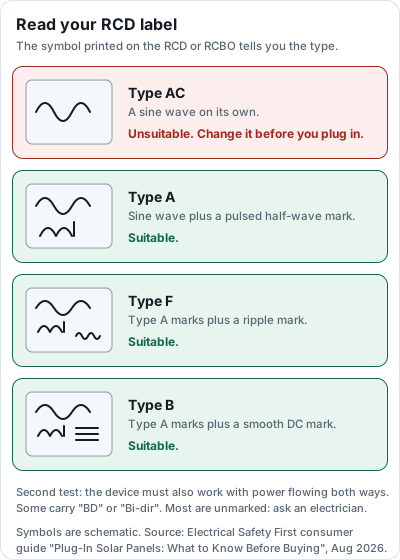
Open the consumer unit door and look at the wider switches with a “T” test button. The type is printed on the front as a symbol. Most homes have one of two layouts. A split-load board has two or three wide RCDs, each protecting a group of the narrower breakers next to it. A newer board has a row of RCBOs, one per circuit, each a combined breaker and RCD. Either way you are looking for the device that protects the socket circuit you plan to use, not the one for the lights or the cooker.
| Marking on the device | Type | Plug-in solar |
|---|---|---|
| A single sine wave | AC | Unsuitable. Have it changed first. |
| A sine wave plus a pulsed half-wave mark | A | Suitable if bidirectional |
| Type A marks plus a ripple mark | F | Suitable if bidirectional |
| Type A marks plus a smooth DC mark | B | Suitable if bidirectional |
Take a photograph of the whole board with the cover open, and a close-up of each wide device. If you cannot find any symbol, look for the type written in words on the side or in the small print, or search the model number printed on the front. Then check the label for “BD” or “Bi-dir”. If there is no such marking, do not assume either way. Send the photographs and the model numbers to an electrician and ask two questions: is this a Type A, F or B, and is it rated for bidirectional current? That is a five-minute job for them and it saves you a wasted purchase.
One more thing to look for while the cover is open: the date on the certificate or label inside the door. A board that has not been inspected in years is worth an inspection before you add generation to it, whatever the RCD type. Electrical Safety First’s advice is to have your electrics checked before you buy, and I would rather spend that money once than find out the hard way.
What if you have an old fuse box with no RCD at all?
Then the plug-in kit will not damage anything, but you have no shock protection on that circuit, and that needs fixing before you add a generator to it. Electrical Safety First is precise here. Rewirable or cartridge fuses “will not be impaired through the addition of plug-in solar panels”. The problem is what the fuse box does not do: it detects overload, not leakage, so a fault that puts the panel frame or the cable live will not trip anything. The guide still advises an inspection first, and in practice the fix is a consumer unit with Type A RCBOs, which is a normal job for a registered electrician.
Do not let a shop page talk you past this. The Argos listing for the first compliant kits says to plug into “a suitable outdoor socket”. Suitable is doing a lot of work in that sentence, and the board behind the socket is what makes it so.
Which socket can you use, and which can you not?
A socket on a normal socket circuit, reached without an extension lead. Nothing else. The product specification only permits connection to socket circuits, and Electrical Safety First lists the arrangements that are out: extension leads, cable reels, multiway adaptors, travel adaptors, RCD adaptors, lighting circuits, and circuits that supply fixed equipment such as an oven or hob. The IET’s survey found 23% of adults would reach for an extension lead if the cable did not reach, which is exactly the case the rule exists for.
An outdoor socket is fine if it was fitted as part of a socket circuit, and it is the sensible place to plug in. The kits come with a 4 m cable, so measure from where the panel will stand to the nearest socket before you order, not after. If the socket does not exist yet, have one fitted on a socket circuit by an electrician and ask which circuit it is on. Our guide on whether an outdoor socket makes plug-in solar legal covers the building-regulations side.
There is one more threshold that trips the two-panel kits. Where the panels total more than 960 W, the manufacturer must advise you to consider a professional assessment of your wiring before installation. That covers most two-panel kits on sale: the UKSOL 1,030 W and 1,260 W bundles, the Perlight 930 W and 1,000 W models, and the Thunder Energy 900 W kit all cross it. A single 460 W or 515 W panel does not. The advice is not a legal bar, but if you are already paying an electrician to confirm your RCD, ask them to look at the socket circuit at the same time.
The two rules that are not about your wiring at all
One plug-in device per household, and less than 3.68 kW of generation across the whole property. Both come from G98, the connection standard your network operator works to, and both were confirmed in the amendment the ENA published in August 2026. Its scope permits “a single Plug-in Micro-generator” per installation and says plainly: “Connecting more than one Plug-in Micro-generator is not allowed.” The hoped-for move to one device per circuit did not happen.
The second rule catches homes that already have solar. The same amendment allows a plug-in kit alongside permanently wired generation only “provided that the aggregate Registered Capacity of all Micro-generators” stays within 16 A per phase at 230 V, which is 3.68 kW. A 3 kW roof array plus an 800 W kit is 3.8 kW, over the line, and the whole property drops from a notification into a formal G99 application that has to be approved before you switch on. A 4 kW array is over before you start. The G98 trap in the main guide has the detail.
Either way, your network operator must be told, and the amendment makes that your job rather than an installer’s. It says the customer can take the role of installer for a plug-in kit, and it adds Form B2, the installation document for a plug-in microgenerator. The form points you at the connect-and-notify process on the ENA Connect Direct site, with the paper form as the fallback. The Energy Networks Association now also runs a householder site, [myplugin.solar](https://myplugin.solar/), where you verify your email, enter your postcode, pick your device from the compliant list, and submit. The site sends the notification to your network operator. You have 28 days from plugging in. You declare that this is the only plug-in device in the property and that all generation on the property adds up to no more than 3.68 kW, or 11 kW on three phases, so the two rules above are the two things you are signing your name to. Our guide to registering with your network operator covers the process.
One requirement in the amendment has no counterpart in the marketing. A plug-in kit has to carry a permanent warning label about the hazards of electrical energy, and where one is installed, a warning label also has to go near the cut-out or the consumer unit, so anyone working on the board can see that the property has a generator plugged in somewhere. Check the box for that label when the kit arrives, and if there is not one, ask the seller for it.
What should an electrician actually check, and what should you ask for?
Ask for the RCD type and bidirectional rating on the socket circuit in writing, and for a general condition check of the board. The standard inspection is an Electrical Installation Condition Report, and any registered electrician can do one. For plug-in solar, add four specific requests so the visit answers the right questions.
- Confirm the type of the RCD or RCBO protecting the socket circuit you will use, and whether it is bidirectionally rated, quoting the manufacturer’s data.
- If it is Type AC, quote for replacing it with a Type A RCBO on that circuit, or a Type A RCD if the board is split-load.
- Check the socket circuit itself: the cable size, the state of the connections, and whether the outdoor socket, if you have one, sits on it.
- Test the RCD with the test button and with an instrument, and record the result, because Electrical Safety First notes that DC leakage from EV chargers, computers and power supplies can desensitise an RCD over time.
SELECT, the Scottish electrical trade body, put the reason plainly on legalisation day: plug-in solar products “interact directly with a property’s fixed wiring and protective devices, which is why the installation should always be assessed by a competent, qualified electrician before any equipment is connected”. I would not go as far as saying every home needs a visit. A recent board with Type A RCBOs whose data sheet confirms bidirectional operation answers the question on its own. But if you are guessing at any part of it, the visit is cheaper than the kit.
Landlord, freeholder and insurer: the three people to tell
Get written consent from anyone who owns or manages the building, and tell your insurer before you plug in. One case is different in the rules themselves: a landlord fitting kits across several flats at once is a multiple-premises project under G98, which needs the network operator’s approval before anything is connected rather than a notification afterwards. If your building is doing this scheme-wide, that is the landlord’s job, not yours. No UK law gives a tenant or leaseholder a right to install plug-in solar, so the landlord or freeholder can say no, and the time to find out is before you have spent £599. The Property Institute warned in August that leaseholder installations can go unnoticed by managing agents, which is the wrong way for them to find out. Zurich UK’s head of large property claims said the same week that plug-in solar “shouldn’t be treated like a plug-and-play gadget”. An insurer that is told, and has the register listing and the notification on file, has nothing to object to.
One practical note for flats. The first compliant kits are ground or solid-wall products. Argos and UKSOL both say their range is “not suitable for balconies”, and the ground mounts need ballast you buy separately. If your only outdoor space is a railing, the check above is still worth doing, but the kit for you does not exist yet.
The whole check on one page
- The RCD or RCBO on the socket circuit is Type A, F or B, not AC.
- The same device is confirmed bidirectional, from its label, its data sheet, or an electrician.
- If the home is on a fuse box with no RCD, an electrician has inspected it and fitted RCD protection on the socket circuit.
- The socket is on a socket circuit, reached with the kit’s own cable, with no extension lead or adaptor.
- For a two-panel kit above 960 W, an electrician has looked at the circuit.
- It will be the only plug-in device in the home.
- Existing generation plus 800 W stays under 3.68 kW per phase.
- The exact model is listed Compliant on the ENA register on the day you order.
- Landlord or freeholder consent is in writing, and the insurer has been told.
- The network operator is notified within 28 days of plugging in, on Form B2 or through the ENA Connect Direct site, with the warning label fitted near your consumer unit.
If every line is true, plug it in. If the first two are not, the right first purchase is an electrician’s visit, not a kit. For what the kit will actually do for you once it is running, read what an 800W plug-in solar kit can power, and for prices and the register list, the buying guide.
Common questions
Do I need a Type A RCD for plug-in solar?
You need a Type A, F or B RCD or RCBO on the socket circuit, and it must be bidirectionally capable. Type AC is listed as unsuitable by Electrical Safety First because it may not trip with DC residual current present. If yours is Type AC, have it replaced before you connect a kit.
Can I plug a solar panel into an extension lead?
No. The product specification permits a factory-fitted plug into a socket on a socket circuit only, and Electrical Safety First rules out extension leads, cable reels and every kind of adaptor. If the 4 m cable does not reach, the answer is a properly fitted socket nearer the panel, not a longer lead.
I have an EV charger. Does that change anything?
Two things. Your charger will have its own protection, usually Type A or B, so its circuit is not the concern; the socket circuit for the kit is. And Electrical Safety First notes that DC leakage from chargers and electronics can gradually desensitise an RCD, so test the RCD with its button regularly and ask your electrician to include it in the check.
Can I check my RCD myself?
You can read the type from the symbol on the front, and you can press the test button, which should trip it instantly. What you cannot do at home is confirm it is bidirectionally rated unless the label says “BD” or “Bi-dir”, or you find the model’s data sheet. That is the question to put to an electrician, with photographs of the board.
Is my home too old for plug-in solar?
Age is not the test; the board is. A rewired home with Type A RCBOs is fine whatever its age. A 1990s split-load board with Type AC RCDs is not, until the RCD on the socket circuit is changed. A fuse box with no RCD at all needs RCD protection added first. In each case the fix is a normal electrical job, and it is worth doing whether or not you then buy a kit.
Read more on plug-in solar
- Is plug-in solar legal in the UK?: the law, the register, what is on sale and the traps, kept current.
- Plug-in solar kits UK: cost and buying checklist: the listed kits, prices and what to check on each.
- How plug-in solar panels work: why a breaker cannot see solar current, and what anti-islanding does.
- Does an outdoor socket make plug-in solar legal?: the three rulebooks people blur into one.
- Registering a DIY solar installation with your network operator: the G98 notification, step by step.
