
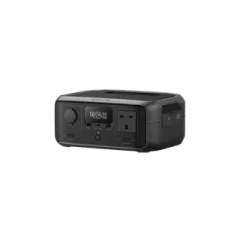
No UK rule forces your home battery to be remotely controllable, and none lets an energy supplier control it without your agreement. Where a supplier does control a battery today, it is because the owner signed up to a scheme that asks for it, and every such scheme is contractual. The draft “smart appliance” rules proposed for 2027 set standards for new products; they do not hand your battery to anyone.
The fear is understandable, because the language around “consumer-led flexibility” is genuinely confusing and some coverage has overstated it. I have been through the government’s Smart Secure Electricity Systems response, the draft regulations and the supplier terms; here is where control actually sits, checked on 22 July 2026.
What does the law require today?
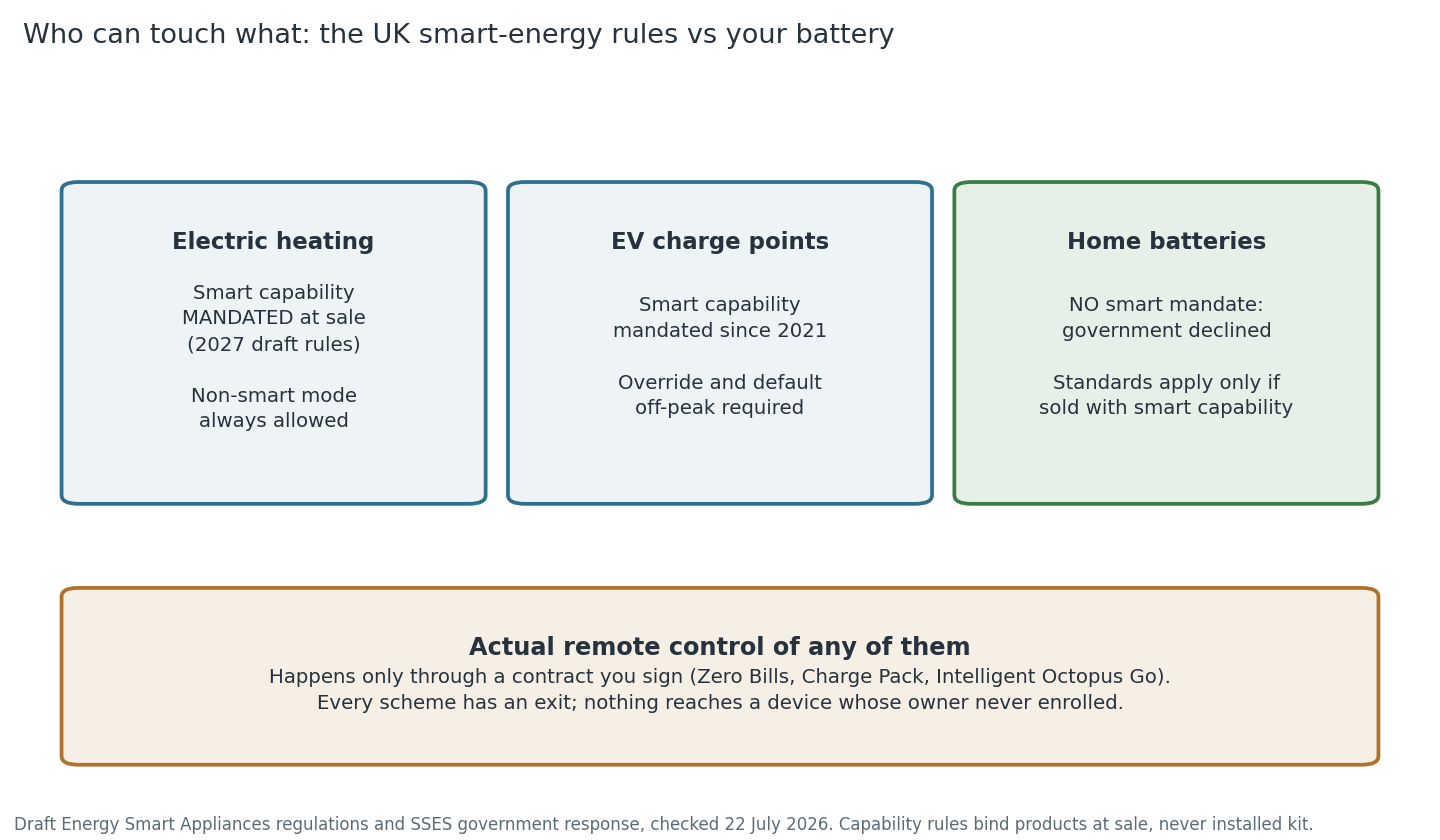
For home batteries: nothing. There is no requirement for a battery to have remote or smart functionality, no licence regime for controlling one, and nothing in the smart-energy proposals reviewed here creates a forced-intervention power over an installed battery. The one smart mandate already in force covers EV charge points, which since the 2021 regulations must be sold with smart-charging capability, default off-peak hours and a consumer override. Capability is not control: nobody operates your charger without a contract either.
What changes with the new smart energy rules?
The Energy Smart Appliances regulations, still in draft with core device rules proposed to commence on 31 December 2027, are narrower than the headlines. The actual smart mandate covers electric heating appliances: heat pumps, storage heaters, heat batteries and hot-water appliances must be sold with smart capability. Even there, the government’s own wording is that consumers “will always retain the option to use their devices in non-smart mode.”
Home batteries are explicitly not mandated. The government considered it and declined, keeping only a reserve power to legislate later if the market stalls. The draft rules apply to a battery only if it is already sold with smart capability, and what they impose on it are standards: the ETSI consumer-cybersecurity baseline, a randomised delay of up to 10 minutes so millions of devices cannot lurch at once, and an override that must work both permanently and momentarily.
Nothing applies retroactively. The obligations sit on manufacturers and importers at the point of sale, an already-installed battery is untouched, and replacement batteries and heating appliances are exempt until the end of 2029.
Who will be allowed to control home devices?
The second half of the regime licenses the organisations, and it is also not law yet: Ofgem’s implementing consultation ran from December 2025. Under the proposals, any company controlling domestic devices at scale needs a load-control licence carrying fair-treatment duties, complaints and redress routes, protection against being unfairly locked into contracts, and cybersecurity obligations. The draft is explicit that a provider “must at all times” give the consumer the option to override load control, planned or in effect.
Read as a whole, the regime is consent-shaped: capability standards on new products, licences and override rights around the companies. What it conspicuously does not contain is a power to volunteer your battery for you.
When do suppliers really control batteries?
When you sign up. Three Octopus examples show the range of what “control” means in practice:
- Zero Bills. The deepest control: the battery is “intelligently controlled by Octopus Energy” as a condition of the £0-bill guarantee. Customers adjust comfort settings but are told to leave the advanced system settings alone, and there is no way to opt out of control while keeping the guarantee.
- Charge Pack. Octopus schedules your battery and runs roughly two grid sessions a week for a guaranteed minimum of £12 a month. There is no per-session opt-out; the exit is leaving the scheme. Our Charge Pack review works through whether that trade is worth it.
- Intelligent Octopus Go. Control of the EV charger only, not a home battery: Octopus schedules the charging, and a bump-charge button plus an app stop keep the override in your hands.
The common thread: every one of these is opt-in by contract, every one can be left, and none reaches a battery whose owner never enrolled. That is the current UK reality of supplier battery control.
Can you opt out, and what does it cost you?
You can always leave, but leaving has a price tag set by the scheme, not by law. Per the published scheme material: quit Zero Bills control and you lose the £0 guarantee; leave Charge Pack and you lose the £12 monthly floor; stop letting Intelligent Octopus Go schedule the car and you lose the cheap smart-charging rate. Notice periods, fees and post-exit detail live in each contract, so read yours before relying on a clean exit. The draft regulations proposed for 2027 would harden your override rights; they do not make the paid schemes control-free.
The practical checklist before joining any battery-control scheme: what exactly is controlled, what you are paid, how you exit, what the exit costs, and, for a battery, whether the extra cycling is addressed in writing. If a scheme’s terms cannot answer those five, that is your answer.
Which decision is actually yours to make?
If you are weighing a control-for-money scheme now, start with our Charge Pack analysis and the Zero Bills vs DIY solar comparison: they are the two live schemes where the question is real. If you simply want your battery to stay yours, nothing in the current draft changes that; buy on your own terms and keep the schedule in your own app.
