
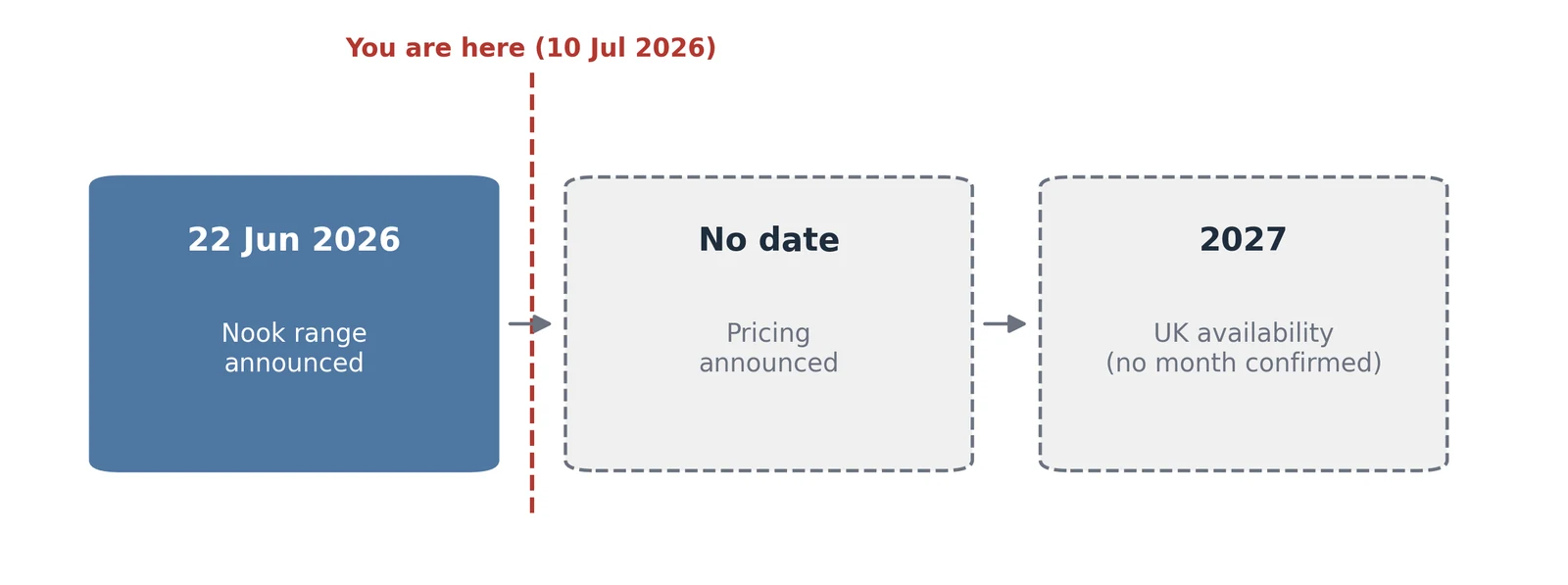
The Octopus Nook is a plug-in home battery range announced on 22 June 2026: a 2 kWh Cube that plugs into a normal wall socket with no installer, and a larger wall-mounted Colossus that stacks to 30 kWh. Pricing has not been announced. UK availability is 2027. On stage, Octopus claimed a Nook can pay for itself in two or three years even without solar; I run a 16 kWh battery on the same tariff arbitrage, and that claim only works at a price no finished battery currently sells for.
The official product page is Octopus’s Nook batteries page. For how Octopus describes related charging and storage products in help content, see their Charge Pack help article. Everything else you have read about the Nook usually traces back to the launch keynote and those Octopus pages.
What did Octopus actually announce?
Two products on one platform. The Nook Cube is a 2 kWh battery you plug into a normal wall socket, stackable to 10.5 kWh, with no professional installation. The Nook Colossus is a wall-mounted, professionally installed battery in 5 kWh and 10 kWh sizes, stacking to 30 kWh. Both carry a 12-year warranty and arrive in the UK in 2027.
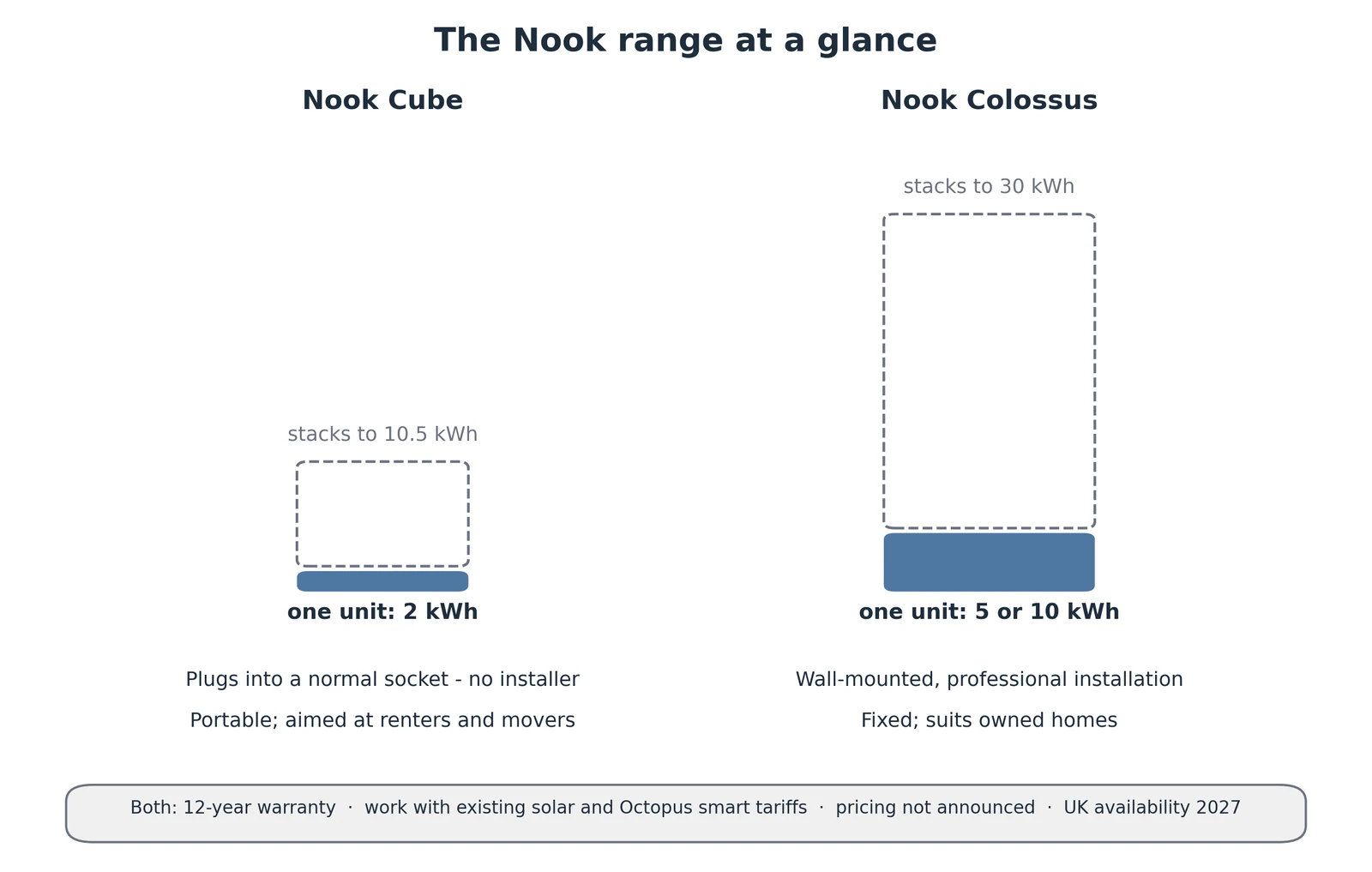
That is close to the full list of confirmed facts. The sources are the launch keynote at the Energy Tech Summit on 22 June 2026 and the Nook page on the Octopus website. Octopus has not disclosed who manufactures the Nook hardware.
Both products run what Octopus calls Octopus Intelligence: they charge themselves when grid electricity is cheapest on the smart tariffs, and you can override the behaviour in the app. Jackson gave the example of choosing whether your solar goes into the house or into the battery; the promise is that the defaults save money immediately and everything stays configurable.
The Cube is aimed at people who cannot have a normal home battery: renters, flats, anyone who cannot drill into a wall or pay for an installer. You plug it in, it charges when electricity is cheap, and because nothing is installed, nothing stops you taking it with you when you move. The Colossus is a conventional installed battery that will compete with the established brands.
| Nook Cube | Nook Colossus | |
|---|---|---|
| Capacity | 2 kWh per unit, stacks to 10.5 kWh | 5 or 10 kWh per unit, stacks to 30 kWh |
| Installation | Plugs into a wall socket, no installer | Wall-mounted, professional installation |
| Aimed at | Renters and flats | Owned homes |
| Warranty | 12 years | 12 years |
| Price | Not announced | Not announced |
| UK availability | 2027 | 2027 |
Two more things were said on stage that you should treat as launch claims rather than facts, because no pricing exists to check them against. Jackson said the Colossus will be “about a third cheaper than the best-known battery brands”, and that even without solar a Nook pays for itself “in two or three years”. The middle of this article tests the second claim.
How does the Nook compare with hardwired, DIY rack and Powerwall batteries?
Think of four different products, not four versions of the same one. Capacity, install friction, control and backup behaviour are the useful axes. Prices for Nook are unknown, so the table stays qualitative where money would be guesswork.
| Nook Cube (plug-in) | Nook Colossus / typical hardwired home battery | Typical DIY 48V rack | Tesla Powerwall 3 | |
|---|---|---|---|---|
| Capacity | 2 kWh per unit (stack to 10.5 kWh) | 5 to 10+ kWh modules, Colossus up to 30 kWh stack | Often 10 to 16+ kWh per rack | 13.5 kWh listed |
| Install | Plug into a wall socket; no installer announced | Professional wall mount and fixed wiring | Owner sources modules; fixed wiring and certification still need a qualified installer | Tesla Certified Installer only |
| Control | Octopus Intelligence app defaults and overrides | Installer app and tariff automations | Owner control via inverter software (for example Solar Assistant) | Tesla app, installer ecosystem |
| Backup during a power cut | Not confirmed by Octopus for the Cube | Possible on many hardwired hybrids when designed for it | Possible when the inverter and wiring are set up for islanding | Designed for whole-home or backed-up circuits when Gateway and install scope include it |
| Who it suits | Renters, flats, “no drill” homes | Owned homes wanting a supplier-led package | Owners who want capacity and control, and will do the admin | Owners wanting a premium integrated package |
| Price status (July 2026) | Not announced | Colossus not announced; other hardwired packs are quote-led | Measurable: my 16 kWh system was about £3,300 all-in | Quote-led; hardware-only figures are not installed prices |
If you want the long-form routes rather than this product page, use the home battery overview and the battery without solar guide.
Is the Nook the same as plug-in solar?
No, and the difference is the direction of power. A Nook draws electricity out of the socket to charge, exactly like any appliance, and charging that way is legal today. Plug-in solar pushes generated electricity into the socket, and that is now legal in Great Britain for a PV-only kit listed Compliant on the ENA register. A battery is a different case: SI 2026/848 defines a plug-in microgenerator as a device not designed to import electricity to store it, so a plug-in battery is excluded by the law itself, and Electrical Safety First advises against installing plug-in battery systems. Charging a battery from a socket needs no rule change. What Octopus has not yet said is how the Cube gets the stored power back out to your appliances, so the charging half is settled and the discharging half is not.
The government has started work on the second half. In September 2026 the Department for Energy Security and Net Zero put out a tender for a plug-in battery safety study. It covers batteries with up to 800 W of AC output, used on their own or paired with a plug-in solar kit. The study runs from November 2026 to March 2028. A study is not a rule change, and it sets no date. My reading is that a battery which pushes power back through a wall socket will not get a legal route before that study reports.
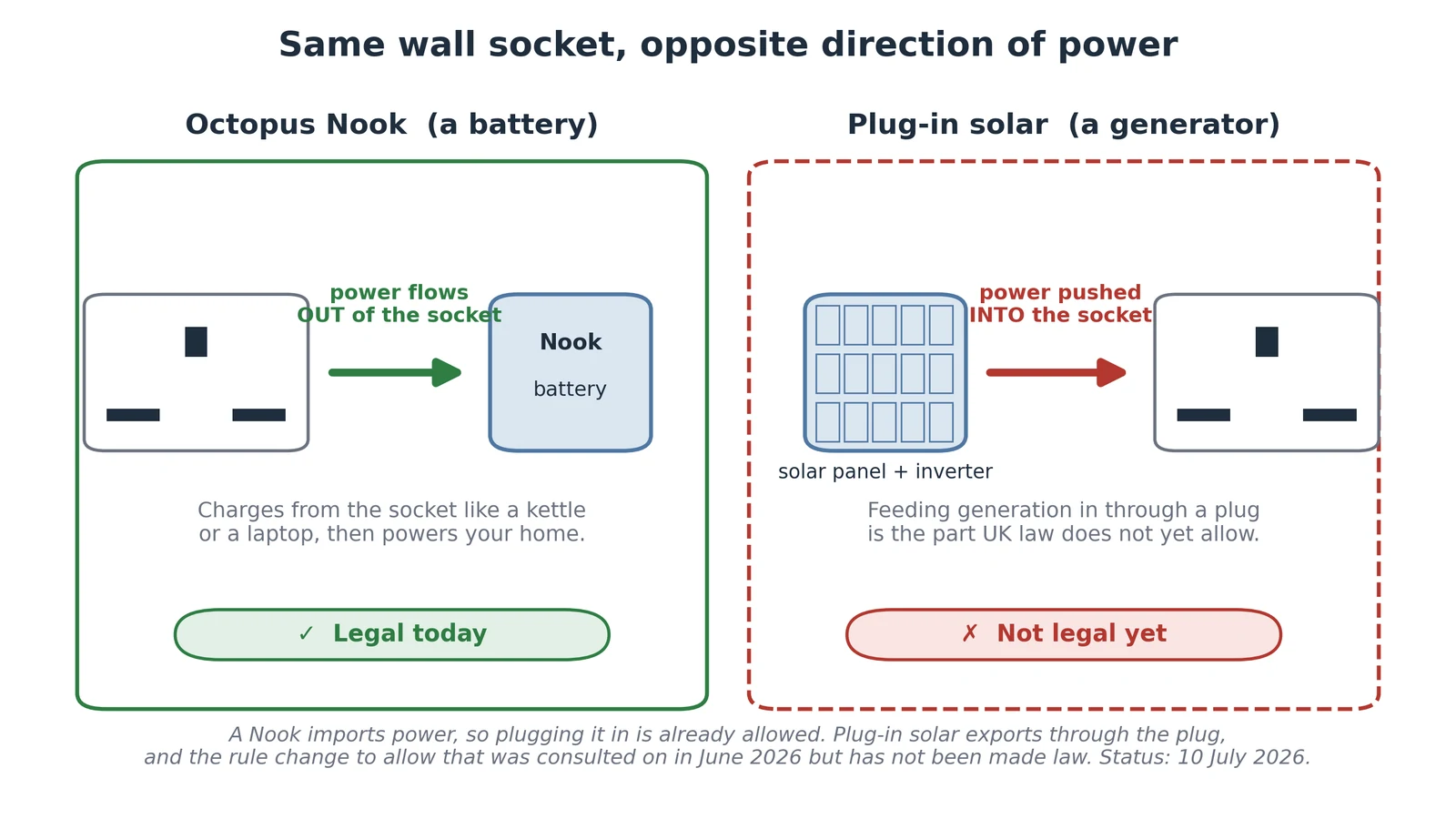
The confusion is understandable, because Jackson introduced the Nook minutes after talking about the government’s plan to make plug-in “balcony” solar easy. But they are separate tracks. The government made the plug-in solar rule change on 16 July 2026 and it came into force on 27 August 2026, for kits listed against a product rulebook, which covers solar generators, not batteries. Octopus now sells a plug-in solar bundle of its own, and its M1-800-E microinverter is listed Compliant on the register. Octopus sold out its first plug-in solar kits and started delivering them in early October. Orders placed after 28 September are due by the end of November. That bundle is a separate product from the Nook, and each needs its own model check. I keep the full state of the saga current in the plug-in solar rules guide.
One honest caveat, which connects to the unknowns list further down: Octopus has not disclosed how the Cube feeds stored power back to your appliances. If devices plug into the unit itself, no rule is involved. If it pushes power back through the wall socket, that is a compliance question Octopus has to answer before sale, not something you need to solve. Either way, the 2027 date rests on Octopus’s own production and pricing decisions rather than on the plug-in solar rule change.
Does the “two or three years” payback claim add up?
Only at a price no finished plug-and-play battery currently sells for. A fully cycled 2 kWh Cube saves £100 to £120 a year depending on which Octopus tariff you can get, so a two-to-three-year payback implies a launch price somewhere between £200 and £360. That is possible, but it would undercut every finished battery product on the market and land at or below the price of bare DIY cells.
Here is the mechanism. A battery without solar makes money one way: it charges when electricity is cheap and replaces grid electricity when it is expensive. How much money depends entirely on which cheap-rate tariff you can get, and that is where the Nook Cube runs into a problem with its own target audience.
The cheapest overnight rate Octopus sells is Intelligent Octopus Go: 8p/kWh for six hours between 23:30 and 05:30. That night rate is fixed nationally, so it is 8p in London and 8p in Manchester, and only the day rate and standing charge move with your region. But Intelligent Octopus Go is built around an electric car. Eligibility runs through a compatible EV or home charger, and although there is reportedly a route through the signup flow without one, it is not an open tariff you can simply choose. Octopus aims the Cube at renters and people in flats, which is close to the opposite of the group that has a driveway and a home charger. A large share of the people this product is designed for cannot assume they will be on 8p.
The open fallback is standard Octopus Go at 9.5p/kWh, also fixed nationally, over a shorter window of 00:30 to 05:30. Anyone can take it. Those are the two numbers that matter, both read off Octopus’s own tariff pages on 24 July 2026, and it is worth knowing they are different products rather than two versions of one, because that confusion is why you will see “Octopus Go” quoted at anything from 7p to 10p elsewhere. If a figure you read somewhere does not name the product and the window, it is not worth much.
Set against the July to September 2026 price cap unit rate of 26.11p/kWh, that gives two spreads: 18.11p if you can get Intelligent Go, and 16.61p if you cannot. The October to December cap of 26.32p widens each spread by 0.21p. That adds less than £2 a year to one Cube, so the rounded figures below do not change. So I have run the payback both ways. I walk through the full arithmetic, with my own measured system, in the battery storage without solar guide.
| Tariff | Night rate and window | Spread vs the 26.11p cap | One 2 kWh Cube saves | Price the two-to-three-year claim implies | Implied cost per kWh |
|---|---|---|---|---|---|
| Intelligent Octopus Go (needs an EV or charger) | 8p, 23:30 to 05:30 | 18.11p | £110 to £120 a year | £220 to £360 | £110 to £180 |
| Octopus Go (open to anyone) | 9.5p, 00:30 to 05:30 | 16.61p | £100 to £110 a year | £200 to £330 | £100 to £165 |
The arithmetic behind those rows is simple. A 2 kWh Cube cycled in full every day shifts about 730 kWh a year, which is £132 gross at the 18.11p spread and £121 at 16.61p. Batteries lose 10 to 15% of the energy in the round trip, and no battery cycles perfectly every day, so call it £110 to £120 and £100 to £110 respectively. Both are estimates that assume disciplined daily cycling, which is exactly what Octopus Intelligence is built to automate.
Now run the claim backwards, taking each end of the saving range against each end of the payback claim. On Intelligent Go, £120 a year over three years prices the Cube at about £360; £110 a year over two years puts it at £220. That is £110 to £180 per kWh of storage for a sealed, app-controlled consumer product. On standard Go the same claim needs a lower price still: £200 to £330, or £100 to £165 per kWh. The cheapest route I know today is DIY rack batteries at £109 to £121 per kWh, which is what Fogstar Energy listed when I checked on 24 July 2026, and those are bare cells that still need an inverter and an electrician.
Read that second row again, because it is the sharper version of the point. On the tariff a renter can actually sign up for, a two-year payback would need a finished, cased, app-controlled Cube to cost less per kWh than bare cells do. My own 16 kWh system cost about £3,300 all in and pays back in a measured 3.2 to 3.4 years. If Octopus prices the Cube where the claim needs it to be, it genuinely is the “careful choice” Jackson called it. Until a price exists, the payback claim is marketing arithmetic that cannot be checked, and checking it against the tariff most Cube buyers will actually be on makes it harder to believe rather than easier.
Put those numbers side by side and the size of the gap is the whole argument.
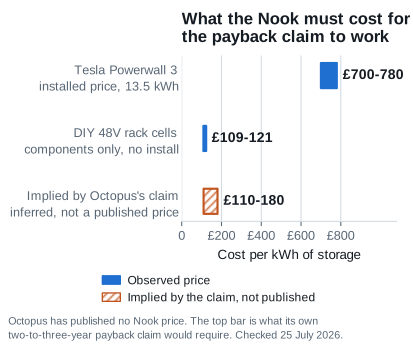
The same test applies to the Colossus. Ten kWh at full cycling saves roughly £560 to £600 a year on Intelligent Go, or £510 to £550 on standard Go, so a three-year payback implies somewhere between £1,550 and £1,800 for a professionally installed 10 kWh battery. Notice that the two launch claims sit uneasily together. The best-known brand of all, the Tesla Powerwall 3, is an installer-quoted job at roughly £700 to £780 per kWh installed, the figure I use in my battery overview, which puts 13.5 kWh at about £9,450 to £10,530. Tesla publishes no UK price, so that is a range installers quote rather than a figure anyone has listed. A third cheaper than that reads two ways, and neither gets near two or three years. Per kWh it is £467 to £520, so a 10 kWh Colossus lands at £4,670 to £5,200 and pays back in roughly eight to ten years at £510 to £600 a year. Per system, a third off a £9,450 to £10,530 Powerwall is £6,300 to £7,020 for a smaller 10 kWh battery, which is eleven to fourteen years. The per-kWh reading is the fairer one, because it compares like capacity with like, and it is still three to five times the claim. Both claims can hold only if the batteries earn well beyond the simple overnight spread, for example by chasing Agile’s volatile days or being paid for grid-balancing events. Which tariffs the Nook will support, and how well, is covered in my Octopus export tariffs guide if you want the current tariff landscape.
What does 2 kWh actually cover?
Two kWh is small. In the battery guide I use 1 to 1.5 kW as a typical evening baseload for a UK home, and one Cube covers that for about an hour and a quarter to two hours, a little less once round-trip losses take their share. It will not cook dinner: an oven pulls 2 to 3 kW and would flatten a single Cube in well under an hour, assuming the Cube can even deliver that much power at once, which Octopus has not specified.
What one Cube plausibly does is shave the most expensive evening hours off your background usage. The stack-to-10.5-kWh option matters because one unit does not carry a whole evening. Renters should read the £100 to £120 a year above as a per-Cube ceiling, not a floor: the saving scales with how much of your usage the battery can actually cover.
What is still unknown
Months, and possibly more than a year, before availability, the unknowns outnumber the facts. Here is the honest list:
- Price. The entire economic case rests on it, and Octopus has not announced one for either product.
- The full specification. Chemistry, weight, maximum charge and discharge power, and exactly how the Cube delivers stored power back to your appliances. That last detail decides how much of your evening usage one unit can offset.
- The manufacturer. Octopus has not disclosed who manufactures the Nook hardware.
- The date. On 1 October 2026 Octopus said “Q1 next year” for the Cube, with no month and no price.
- Tariff dependence. Whether the batteries work, or work well, if you are not an Octopus customer on an Octopus smart tariff.
None of this is a criticism. This is a normal unknowns list for a product a year from launch. It is only a problem if you read the launch coverage as a spec sheet. I will update this page when pricing or a full specification lands.
What would I do before 2027?
If you rent or live in a flat, the Nook Cube is the first product I have seen from a major UK supplier aimed squarely at you, and waiting for the price is the right move. There is nothing to buy or pre-order yet, and no waiting list to join. Watch the official Nook page for product updates rather than third-party recaps.
If you own your home and want battery economics now, you do not need to wait: the arbitrage the Nook will automate already works today with an installed or self-built battery, at a measured 3.2 to 3.4 year payback in my case. The battery without solar guide covers the hardware, the tariffs, and the maths.
And if you came here because you thought the Nook meant plug-in solar had arrived: it has, but only the panel half. Socket connection became legal in Great Britain on 27 August 2026, and on 2 September the register listed 20 compliant PV-only kits. A plug-in battery still has no socket route. The plug-in solar rules guide tracks exactly where it stands.
Octopus Nook FAQ
When is the Octopus Nook available in the UK?
Octopus now says the first quarter of 2027 for the Cube. Its 1 October 2026 press release says the “Nook Cube” battery is “due to launch in Q1 next year”. The range was announced on 22 June 2026 at the Energy Tech Summit. The release gives no month and no price, and it does not say how the Cube returns power to your appliances. Treat any more specific date you read elsewhere as a guess.
Is the Octopus Nook legal in the UK?
Yes, in the sense people mean when they ask: charging a battery from a wall socket is as legal as plugging in any other appliance, and the plug-in solar rule change that took effect on 27 August 2026 covers PV-only kits and does not apply to a battery drawing power out of a socket or feeding power back into one. How the Cube returns stored power to your appliances is not yet disclosed; that compliance detail is Octopus’s to settle before the product goes on sale.
Do you need solar panels for the Octopus Nook?
No. The Nook charges from the grid when electricity is cheap on a smart tariff and covers your usage when it is expensive. Octopus claims it pays for itself in two or three years without solar, which cannot be verified until pricing exists. With solar panels it also stores your surplus generation instead of exporting it.
