
An 800W plug-in solar kit exists to cover your home’s background draw: the fridge, router, TV and lighting that tick along while you are not looking. When its output reaches that 200-400W band, it offsets the lot; the rest of the time the grid tops up the difference.
Two headline facts before the detail. Socket connection is legal in Great Britain, and has been since 27 August 2026, as long as the exact model is listed as Compliant on the ENA plug-in solar register. A hundred and twenty kits were listed on 10 October 2026, and the rule is one device per household. Realistic value without a battery is about £40-85 a year.
First, what “800W” means. It is the maximum AC output of the kit’s inverter, not the panel rating: a typical kit pairs two panels with a microinverter capped at 800W. And a grid-tied kit does not pick appliances to run; it feeds whatever it is generating into your home, your appliances draw what they draw, and the grid makes up any shortfall. Everything below follows from those two facts.
Can an 800W kit cover your base load?
Base load is the electricity your home draws around the clock from always-on devices: fridges, chargers, TVs, laptops, routers. A typical UK home’s always-on draw sits in the 200-400W band; a late-evening glance at your smart meter’s live display, big appliances off, shows your own figure. When the kit’s output reaches that level, it covers the base load entirely. In weak light (early morning, heavy cloud, midwinter) it covers part, and the grid quietly supplies the rest.
There is no storage involved. The kit’s electricity is consumed by whatever is running at that moment and your meter slows down. Anything you cannot use flows out to the grid.
Which appliances can 800W cover completely?
| Appliance | Typical wattage | Can 800W cover it completely? |
|---|---|---|
| Fridge-freezer | 100-150W (when compressor runs) | Yes, easily |
| Wi-Fi router | 10-15W | Yes |
| TV (55") | 80-120W | Yes |
| Laptop charging | 45-65W | Yes |
| Washing machine | 400-500W (heating cycle: 2,000W) | Only during a cold wash |
| Electric kettle | 2,000-3,000W | No |
| Oven | 2,000-2,500W | No |
| Electric shower | 7,000W and up | No |
| Home EV charging | well above 800W | No |
“No” in that table does not mean the solar switches off. Boil a 2,000W kettle while the kit is producing 600W and the solar contributes its 600W; the grid supplies the other 1,400W. The kit keeps paying for its share of everything. What it cannot do is make a high-power appliance cheap to run, because its share of a 2,000W load is small and brief.
The washing machine row shows the same logic within one appliance. The motor and drum draw 400-500W, which solar can cover when its output and your other loads allow. When the machine heats water, a 2,000W element switches on and most of that comes from the grid. On a flat tariff, a cold wash in the middle of a sunny day is about the cheapest you can run one.
How much does an 800W kit generate?
The 800W on the box is a ceiling, not a promise. Output only approaches the cap around clear middays; overcast days run at a small fraction of it, and winter daylight lower still (our plug-in solar explainer walks through a generation day in detail). Over a year, a UK kit realistically delivers 650-800 kWh, against roughly 2,700 kWh a typical home uses.
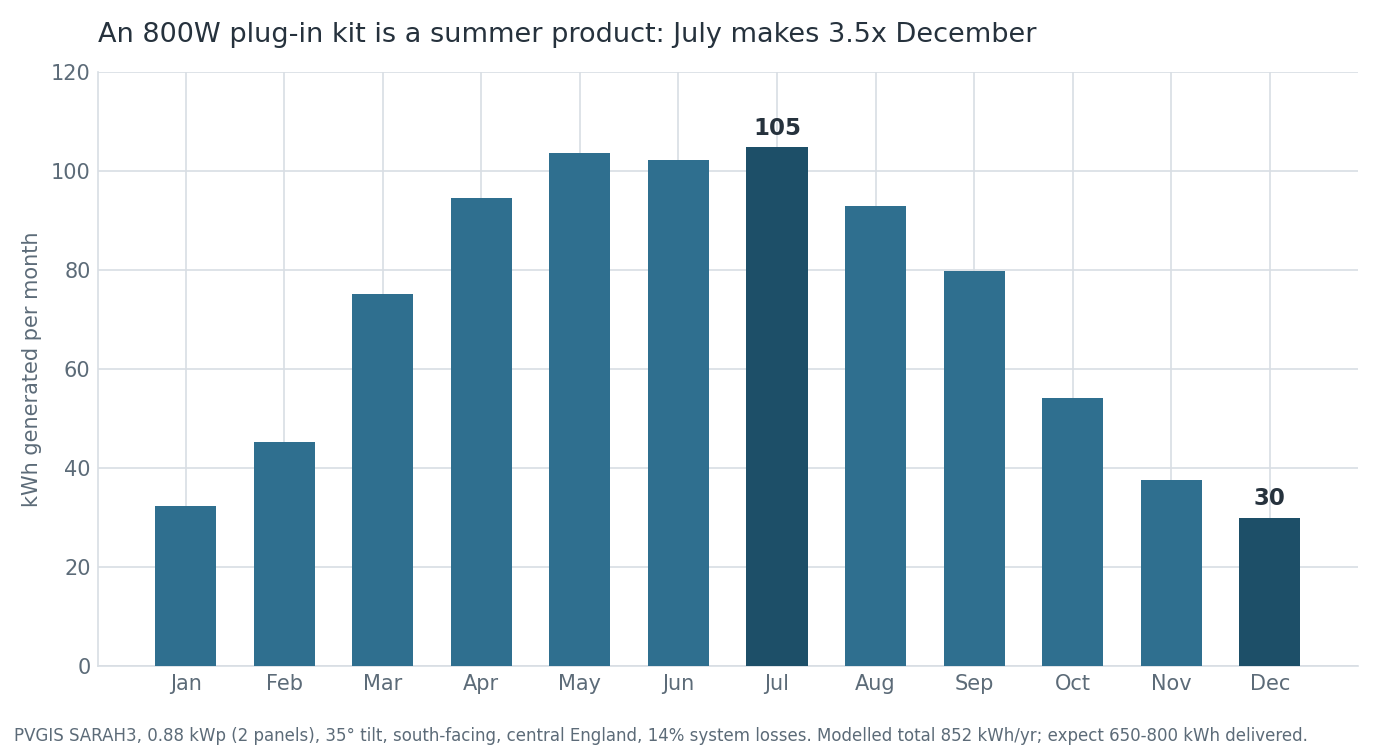
The chart shows the seasonal shape of the modelled array yield, before the inverter’s 800W cap trims the peaks: about 105 kWh in July, about 30 kWh in December, for a south-facing kit at a good tilt in central England. The model totals 852 kWh a year for that near-ideal setup; realistic delivered totals run 650-800 kWh once orientation, shading and the inverter’s 800W clipping bite. Your own roofline moves these numbers, so treat the chart as the seasonal shape, not your quote.
One nuance the marketing skips: the 800W cap is on AC output, but the product rules allow up to 2,000W of panels behind it. Extra panel capacity does nothing on a perfect midday, when the inverter clips at 800W, but it lifts generation in the mornings, evenings, winter and cloud. Kits above 960W of panels carry a disclosure advising a professional check, so read the listing carefully.
How much money does it save?
Two numbers decide your saving: how much the kit generates, and how much of that you use rather than give away. Without a battery, a household that is out during the day self-consumes 25-40% of generation. Assume no export income: Smart Export Guarantee tariffs generally require an MCS-certified installation, which a self-installed plug-in kit will not have, so exported electricity is an unpaid gift to the grid. Octopus is the one exception so far. On 10 October 2026 its plug-in page offered Prime Outgoing Octopus to buyers of its own kit who also take its electricity and have a smart meter. That pays 9p/kWh outside 4pm to 7pm, so almost all of a plug-in kit’s export earns 9p. British Gas still says plug-in systems are not yet eligible for its export tariff. For any other kit, assume export is worth nothing.
At the price cap unit rate of 26.32p per kWh, which runs from 1 October to 31 December 2026, 650-800 kWh of generation at 25-40% self-consumption saves roughly £40-85 a year. Matched to what a listed kit actually costs, the payback picture looks like this:
| Scenario | Kit cost | Annual saving | Payback |
|---|---|---|---|
| Cheapest Argos kit, someone home in daylight | £599 (UKSOL Pro Compact 515W) | ~£84 | ~7 years |
| Same kit, house empty from 9 to 5 | £599 | ~£43 | ~14 years |
| Dearest Argos kit, house empty from 9 to 5 | £999 (UKSOL Pro Duo 890W) | ~£43 | ~23 years |
You improve the numbers by pointing flexible loads at the middle of the day: the cold wash, the laptop charging, the dishwasher run. You cannot improve them much by spending more on the kit, because the saving is capped by your own daytime consumption.
One number in circulation is higher than any of these. The government press release of 26 August 2026 says households “could save up to £110 a year” and that a kit provides “up to 20% of average home electricity use”. It publishes no basis for either figure: no self-consumption rate, no unit rate, no generation figure and no orientation. Both are “up to” numbers, so read them as a ceiling for a household that is home all day with a south-facing kit, not as a forecast for yours.
What can an 800W kit not do?
- Power anything in a power cut. The microinverter shuts down within a fraction of a second of losing the grid. That is anti-islanding, a required safety feature that protects engineers working on the lines, not a fault.
- Make high-power appliances cheap. Kettle, oven, hob, electric shower, immersion heater, tumble dryer heat cycle and EV charging all draw far more than the kit produces.
- Store anything. A kit using the socket route cannot include battery storage. The law’s own definition excludes any device designed to import electricity in order to store it.
- Run the whole house. Its job is reducing background grid import while solar output is available, nothing more.
Can you legally plug one in?
Yes, in Great Britain, since 27 August 2026. That is the day SI 2026/848 came into force. It allows a socket connection for a device that generates from sunlight, produces no more than 800W of AC, comes with a factory-fitted plug, and is not designed to import electricity in order to store it. No extension leads, no adaptors.
The exact model has to appear as Compliant on the Energy Networks Association plug-in solar register. On 10 October 2026 that category held 133 entries: 120 listed Compliant, from 26 makers, and 13 listed Non-compliant. Search the model number, not the brand. InstaGroup and Fusion Renewables each have models on both sides of the line, and statuses move in both directions, so check on the day you buy.
One kit per home, and that is now written into the network rules. G98 Amendment 1, published in August 2026, says it plainly:
This EREC G98 permits the connection and operation of a single Plug-in Micro-generator, including plug-in Solar PV and plug-in Electricity Storage, in a Customer’s Installation where the Plug-in Micro-generator has a Registered Capacity of 800 W or less. Connecting more than one Plug-in Micro-generator is not allowed.
ENA, EREC G98 Amendment 1, Issue 2, clause 2.2, August 2026
Northern Ireland is not covered. The part of SI 2026/848 that makes the socket connection lawful extends to England, Wales and Scotland only, and Northern Ireland’s own network regulations have not changed. No timetable has been published.
Legal does not mean suitable for every home. On 27 August the IET and Electrical Safety First both said so, and they named the deciding part: the RCD in your consumer unit. A Type AC RCD is unsuitable for plug-in solar. Type A, F and B are suitable, and the device also has to work with current flowing in both directions. A board running on rewireable or cartridge fuses has no RCD at all and needs an inspection first. Our guide to whether your home is suitable for plug-in solar walks through the check.
Two things stay outside the socket route. The cheap look-alike kits on Amazon do not appear as Compliant in that register category, whatever the listing claims. And kits with a battery built in are excluded by the definition in the law itself, so no listing can bring them in. Electrical Safety First tells people not to install plug-in battery systems at all. The full rules, dates and traps live in our plug-in solar UK guide.
One trap if you already have rooftop solar: G98’s 3.68kW limit is cumulative per phase across the property. A 3kW system plus an 800W kit on the same phase reaches 3.8kW and can require G99 approval before connection. Check your existing system’s size before assuming a plug-in kit is plug-and-go.
What should you check before buying?
Check your consumer unit first, because that decides whether your home is suitable at all. Look for the RCD or RCBO protecting your socket circuits and read the type off the label. Type AC means stop and talk to an electrician before you spend anything. Type A, F or B is what you want, and it should also be capable of working with current flowing both ways. Our home suitability check shows you what the markings look like.
Check the register second. Type the exact model number into the ENA plug-in solar list and look for Compliant. A brand name on its own tells you nothing, and the entry can change either way.
Measure your own base load third: read your smart meter’s live display late in the evening with the big appliances off. If it shows a few hundred watts, an 800W kit maps well onto your home. Then read how plug-in solar works for the mechanism, and the plug-in solar buying guide for kit prices, mounting and renter considerations.
