
Plug-in solar became legal in Great Britain on 27 August 2026, and you can buy a compliant kit today. When I read the ENA plug-in solar register on 10 October 2026 it listed 120 kits as Compliant, from 26 manufacturers, up from 70 on 22 September. City Plumbing, Argos, Wilko, Homebase and Very all range listed kits now. Prices start at £336 for one panel and £444 for two.
The conditions attached to that are the reason this guide exists. Which kits are actually listed, why the cheaper look-alikes on Amazon are not, what a compliant kit has to meet, what one costs, what it saves, and the one part of your own house that decides whether any of it applies to you.
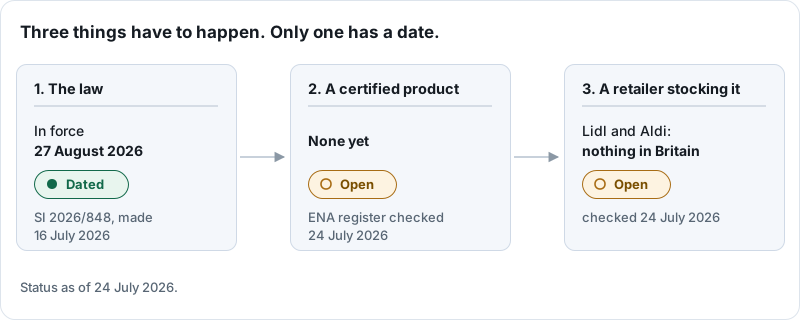
Where buying stands on 10 October 2026
- Law: SI 2026/848 came into force on 27 August 2026. A listed kit may connect to an ordinary socket in England, Wales and Scotland. Northern Ireland is not covered.
- Listed products: 120 kits show Compliant on the ENA plug-in solar register, from 26 manufacturers. Worldwide Solar has 31, Perlight Solar 18, City Plumbing 13, UKSOL 7, and PatioSun, Thunder Energy and Zendure 6 each. Nineteen other manufacturers hold the rest, among them Octopus Energy, Modular Solar Technologies and The Solar Centre. Seven of the 26 manufacturers are new since 22 September, Worldwide Solar among them. Anker and Fox ESS are still absent.
- Retail: City Plumbing, Argos, Wilko, Homebase and Very all range listed kits, and several brands sell direct. Prices run from £336 to about £1,000. Currys lists two INSTAGEN ONE kits, but both were out of stock and neither page gives a model number to check. Octopus has sold out for now. It says its first deliveries arrived in the week of 1 October. Lidl, Aldi and IKEA still sell nothing.
- What still stops people: one plug-in device per household, an RCD of the wrong type, and a property total above 3.68 kW per phase.
I re-check this box against the primary sources rather than the news cycle. If the date above is more than a few weeks old, treat the register and retail lines as the ones most likely to have moved.
If you have searched “balcony solar kit UK”, you are looking at the same hardware covered here. Balcony solar is the European name for plug-in solar: one or two panels, a microinverter, and a plug. A balcony rail is one mounting option; in the UK most people use a garden wall, shed, garage, or flat roof instead.
Can You Buy a Legal Plug-in Solar Kit in the UK Today?
Yes, with conditions. Since 27 August 2026 a kit listed as Compliant on the ENA plug-in solar register may go into an ordinary wall socket without an electrician. On 10 October 2026 there were 120 such kits, from 26 manufacturers. Worldwide Solar, Perlight Solar and City Plumbing list the most models.
Buying one is a different question from finding one, and that gap has closed fast. City Plumbing has the cheapest listed kits I have found, and its prices had not moved on 10 October: a one-panel DMEGC 465W kit at £336 and a two-panel DMEGC 930W kit at £444. On the same day Wilko and Homebase each listed six UKSOL kits from £599 to £999, Very listed five, and Argos listed five, with two ground-mount kits at 10% off. On 22 September Screwfix listed a PowerXpress 800W kit at £669, PatioSun started at £449, and Thunder Energy started at £549.99, up from £499.99. When I checked on 12 September, UKSOL’s own store started at £599 collected. On 23 September Modular Solar still started at £465, and Plug In Solar still sold the Perlight PowerPlug MAX range from £588. Octopus Energy prices a one-panel bundle (a 460W JA Solar panel, a Fox ESS microinverter, a 5 m cable with a three-pin plug, and a mount) at £450 and a two-panel bundle at £650, but its page said sold out on 10 October. Octopus says its first kits reached customers in the week of 1 October.
Four conditions decide whether the socket route is open to you, and all four have to hold at once:
- The exact model is listed Compliant on the register on the day you order. Brand is not enough. InstaGroup has two models listed Compliant and a third listed Non-compliant.
- It will be the only plug-in device in the home. G98 Amendment 1, published in August 2026, now says so in terms.
- The RCD protecting that socket circuit is Type A, Type F or Type B, and works with power flowing both ways. A Type AC RCD is unsuitable, and a fuse board means an inspection first.
- You live in England, Wales or Scotland. The part of SI 2026/848 that makes the connection lawful does not extend to Northern Ireland, and no timetable has been published for it.
The third one is where most people stop, because it is about your consumer unit rather than the kit. I walk through reading your own board in a separate guide: is your home suitable for plug-in solar? For the law itself, and how it got here, see the plug-in solar UK guide.
You still have two routes, and the second one has not gone away. Buy a listed kit and plug it in yourself. Or go hardwired: have a registered electrician fit panels and a microinverter to their own breaker and notify your DNO under G98, exactly like a small roof array. The hardwired route waits on no delivery date and no register entry, and it is priced further down this page.
What Is on Sale, and Which of It Actually Qualifies
Twenty-six manufacturers held the 120 Compliant listings on 10 October 2026. Here they are, matched to where you can actually buy them. On 10 October I rechecked the cheapest City Plumbing kits, the UKSOL prices at the big retailers, and the Octopus prices. The other prices are from 22 and 23 September. I have not yet checked where the seven newest makers sell.
| Brand | Listed Compliant | Where to buy | Price seen 22 Sep 2026 unless marked |
|---|---|---|---|
| Worldwide Solar | 31 kits on Hoymiles HMS-800-2WB or VaySunic VM800WE-P2 microinverters (new since 22 Sep) | Not checked | Not seen |
| Perlight Solar | PowerPlug MAX and PowerPlug FLEX+ at 465, 500, 930 and 1000 W, plus single-panel variants and five PowerPlug+ models added on 3 Oct (18 kits). The PowerPlug+ MAX 465 moved from Non-compliant to Compliant | pluginsolar.co.uk | £588 to £810 |
| City Plumbing | One- and two-panel CPS sets: DMEGC and Jinko panels with Hoymiles HF-800-WB or HMS-800-2WB microinverters (13 kits) | cityplumbing.co.uk | £336 to £468 |
| UKSOL | Pro Compact 460W and 515W, Pro Duo 890W, Pro Advanced 920W, Pro Plus 1030W, Pro Max 1260W (7 kits, ground and hybrid mounts) | Wilko and Homebase (six kits each), Argos and Very (five each), uksol.uk, City Plumbing | £599 to £999 at Wilko, Homebase and Very, and £539.10 to £899 at Argos (10 Oct); £670.80 and £951.60 at City Plumbing |
| PatioSun | Lite, Lite+, Duo, Duo+, Max, Max+ (6 kits) | patiosun.myshopify.com | £449 to £779 |
| Zendure | SolarFlow 800 with two panels, no battery (6 kits, listed 21 Sep) | Not on zendure.co.uk | Not seen |
| InstaGroup | INS-PPG-800 and INS-PPG-435 (the INS-PPG2-800 is listed Non-compliant) | Page still says coming soon | Not seen |
| Modular Solar Technologies | 340W and 475W Solar Units, each also listed with a 400W inverter (4 kits) | modular.solar, and its own Amazon seller account | £465 and £650 |
| TSUNESS | TSOL-ESK800-U, TSOL-ESK800, TSOL-ESK800-Air(V) | Not checked | Not seen |
| EcoFlow | STREAM plug-in solar kit UK, EF-PS-800 with SPDG505 panels (2 entries) | Not found; EcoFlow’s own STREAM microinverter kit page still says not to buy it for UK plug-in solar | Not seen |
| The Solar Centre | One-panel and two-panel kits | Not checked | Not seen |
| Thunder Energy | Thunder Bolt 460W and 920W, plus four entries added on 5 Oct: flat-roof versions of both and the Bolt Max 530W (6 kits). The Storm kits sold alongside them are not listed | thunderenergy.co.uk | £549.99 and £749.99 |
| HDM Solar | PSK1000, PSK2000 | No retail listing found | Not seen |
| APsystems | Premium Set Single-510W, Premium Set Dual-1020W, both full black | No retail listing found | Not seen |
| Skyworth | SVBS-T900-800, SWBS-T900-800 | No retail listing found | Not seen |
| PowerXpress | Plug-in Solar 920W two-panel kit with mounting | Screwfix | £669 |
| Octopus Energy | M1-800-E microinverter | octopus.energy | £450 one panel, £650 two, sold out (10 Oct) |
| The Impact Crowd | Impact Plug-in Solar V1 | No retail listing found | Not seen |
| Segen | PIS-FE-SO-66H-470, and PIS-FE-SO-66H-940 added on 2 Oct | Trade supplier | Not seen |
| VALE | 900Wp kit on the EcoFlow EF-PS-800 | Not checked | Not seen |
| Solarfy | Solo 455 (2 entries, new since 22 Sep) | Not checked | Not seen |
| Voltacon | HF-800-WB (new since 22 Sep) | Not checked | Not seen |
| Jiangsu VDS | One kit (new since 22 Sep) | Not checked | Not seen |
| Fusion Renewables | One kit (new since 22 Sep; two more are listed Non-compliant) | Not checked | Not seen |
| Clean My Carbon | Clean 800w (new since 22 Sep) | Not checked | Not seen |
| Smith Bros | SolarGo-One 435 (new since 22 Sep) | Not checked | Not seen |
Thirteen entries carry a Non-compliant status on 10 October, down from fifteen on 22 September. Three are Sigenergy Plug-in PV models. Worldwide Solar had six Non-compliant entries on 22 September, and now it has none and 31 Compliant. InstaGroup and Fusion Renewables each have some models listed Compliant and some listed Non-compliant. Non-compliant is a register status, not a safety verdict. It means the submission was not accepted as demonstrating compliance with the specification. Either way, those models have no socket route today.
Statuses move in both directions, and entries disappear and come back. EcoFlow, TSUNESS and Segen left the plug-in category in early September and returned with Compliant entries between 9 and 22 September. Octopus Energy and Modular Solar Technologies did the same a week earlier. Anker and Fox ESS are still absent. Absence from the register is not compliance, and a status you read last month may not be the status today. Check the exact model number on the day you order, and take a screenshot.
Now the trap. When I searched Amazon UK for an 800W plug-in kit on 23 September, I got an EcoFlow STREAM 800W microinverter with two 500W panels at £549, and several unbranded 960W flexible panel sets with an 800W inverter from £359. Some of those listings say “G98” in the title. I could not match any of them to a Compliant plug-in solar listing, and G98 in a title is not a register entry. A familiar brand is not enough: EcoFlow now has two listed kits, but the STREAM microinverter kit sold online is not one of them, and on 22 September EcoFlow’s own UK page still said not to buy it for plug-in solar. Modular Solar is the exception I found, selling its own listed units on Amazon. The rest look like the Argos kit, several cost less, and none has a legal route into a socket. Electrical Safety First makes a point worth repeating here: online marketplaces are not legally responsible for the safety of goods sold through them.
Battery kits are a separate exclusion, and it now sits in the law rather than the specification. SI 2026/848 defines a plug-in microgenerator as a device that is not designed to import electricity to store it. The EcoFlow STREAM Ultra, £898.99 on Amazon with 1.92 kWh of storage, is legal to buy and legal to own. It has no socket route, and it never will under this definition. The same goes for a listed kit once you add a battery. Zendure’s SolarFlow 800 can take one elsewhere in Europe, but the six UK kits on the register have none, and adding one takes the kit outside the legal definition. Electrical Safety First goes further and says plainly: do not install plug-in battery systems in your home.
If you want the storage anyway, and plenty of people reasonably do, buy it for what it is: an off-grid or hardwired system, priced accordingly, with an electrician involved if it is going to feed the house. One wrinkle to know about is that the new G98 wording does mention plug-in Electricity Storage. That is the network standard leaving room for a future case. The law has not followed it.
What If You Already Have Solar Panels?
G98 notification covers up to 3.68kW per phase, and that limit is cumulative across your whole property, not per inverter. If you already have a 3kW roof array and add an 800W plug-in kit, your property moves to 3.8kW and drops out of G98 into G99: a formal DNO application you need approval for before connecting, typically weeks rather than days.
DNOs assess your maximum physical capacity, not a software export limit you could dial down later. On a three-phase supply the 3.68kW allowance applies per phase, so which phase you connect to can matter. G98 Amendment 1 spells this out for plug-in kits: one may sit alongside permanently wired generation only if the aggregate registered capacity stays inside 16 A per phase at 230 V. A plug-in kit is not automatically “just plug in” for a home that already has solar, and a 4 kW roof array is over the line before you start.
What Does a Compliant Kit Need?
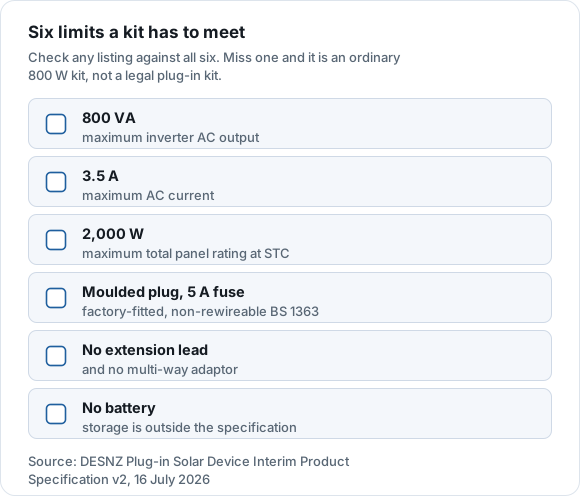
Two things, and the first one takes a minute. The exact model has to be listed as Compliant on the ENA plug-in solar register. Then the hardware has to meet the limits below, all of which come from version 2 of the interim specification, published 16 July 2026 and named in the law itself. Some listings you will see are genuinely compliant and some are German-market hardware relabelled for a UK audience, and the difference is not visible in the product photo.
| Requirement | Why it is there |
|---|---|
| Listed as Compliant on the ENA plug-in solar register | The public record that a manufacturer has demonstrated compliance for that model. It is the one line you can check yourself in a minute. |
| 800 VA maximum inverter output | Caps how much power one kit can push into your wiring, so a fault stays small. |
| 3.5 A maximum AC current | Keeps the current within what a standard socket and its fuse can carry safely. |
| 2,000 W maximum total PV module rating, measured at STC | Limits how many panels you can hang off one kit, even once the inverter clips the output. |
| Mandatory manufacturer advice above 960 W of panels | Above that point the manufacturer has to tell you to consider a professional assessment of your circuit. Version 2 made that disclosure compulsory for them; acting on it stays your call. |
| Factory-fitted, non-rewireable BS 1363 moulded plug | Stops anyone fitting the wrong plug, or wiring one incorrectly, at home. |
| Fuse rated at 5 A or less | A correctly rated fuse is what actually protects the cable if something goes wrong. |
| No extension leads or multi-way adaptors | Both can carry less current than they look like they can, and both mask a fault from the socket circuit’s breaker. |
| Anti-islanding and accessible-pin protection | Forces the inverter to stop generating within a fraction of a second of being unplugged, so the pins stay safe to touch. |
| Socket circuits only | The permission covers ordinary socket circuits, not lighting circuits or a spur you improvise. |
| Independent conducted-emissions evidence at maximum rated output | Proves the inverter will not interfere with other electronics on your circuit. The 2026 government safety study found all six devices it tested exceeded the limit at full power, so this is not a formality. |
| Manufacturer-supplied mounting with structural, weather, ventilation and fire evidence | Stops a lightweight bracket being sold for a job it was never tested for. |
| DNO instructions and a consumer-unit label | Tells your network operator, and anyone who later opens your consumer unit, that a generator is connected. |
| Battery systems excluded | SI 2026/848 defines a plug-in microgenerator as a device not designed to import electricity to store it. A product with storage in it falls outside the law, not just the specification. |
Two numbers do most of the work, and they are really one number. 800 VA is the ceiling on inverter output, which is why every kit on sale anywhere in Europe tops out there. UK mains runs at roughly 230V, and 800 divided by 230 is about 3.5, so the current cap falls straight out of the power cap rather than adding a second restriction.
Read the register line carefully, because it is easy to over-read. A Compliant status means the manufacturer’s submission was accepted as demonstrating compliance with the specification. It is not a safety verdict on your house, and Non-compliant is not an accusation that a product is dangerous. Statuses have already moved both ways since 18 August, and whole entries have left the category. So check your exact model number on the day you buy, not the brand, and not what a review said last month.
One rule sits outside the product spec and catches people out. You get one plug-in device per household, and that is now settled rather than pending. Version 2 of the specification is written for one device per final ring circuit, with a note saying the grid connection rules restrict it to one per household unless they are amended. They were amended in August 2026, and the amendment went the other way. The scope clause of EREC G98 Amendment 1 permits a single plug-in microgenerator of 800 W or less, and then says it in one line: “Connecting more than one Plug-in Micro-generator is not allowed.” One home, one device.
How Much Does an 800W Kit Cost?
£336 to £999 for a listed kit, panels included. That is the real spread across the compliant kits I could buy when I checked on 10 October 2026. The cheapest is City Plumbing’s one-panel DMEGC 465W kit at £336, and the cheapest two-panel kit is its DMEGC 930W at £444. PatioSun Lite was £449 on 22 September. The Octopus one-panel bundle is £450, but it was sold out on 10 October. At Wilko and Homebase the UKSOL range runs from the Pro Compact 515W at £599 to the ground-mounted Pro Duo 890W at £999. Argos had the same ground kit at £764.10, 10% off its £849 list price. Every one includes panels, microinverter, frame and cable. At the start of September the floor was £549.99, so the price of a two-panel kit has fallen about a fifth as more sellers arrived.
There is no compliant kit with a battery in it, at any price. Storage is excluded by the law’s own definition, so a kit-plus-battery price range no longer exists for the socket route. If you see one quoted, it is either an off-grid product or a page written before 27 August.
| Route | Hardware cost | Realistic annual saving | Payback on hardware |
|---|---|---|---|
| Listed plug-in kit, you plug it in yourself | £336-999 | £43-84 | 5-10 years on a £444 two-panel kit, 7-14 on a £599 one, longer above that |
| Self-sourced hardwired parts, electrician’s fee on top | £310-450 | £39-73 | 4-8 years before the fee |
The hardwired row looks better on paper and it is, on hardware alone. Add £80 to £150 for the electrician who ties it into its own breaker and the two routes converge. What you are really choosing between is a fitted price with a delivery date and a cheaper price with a trade booking. Both are legal. Only one needs a register listing.
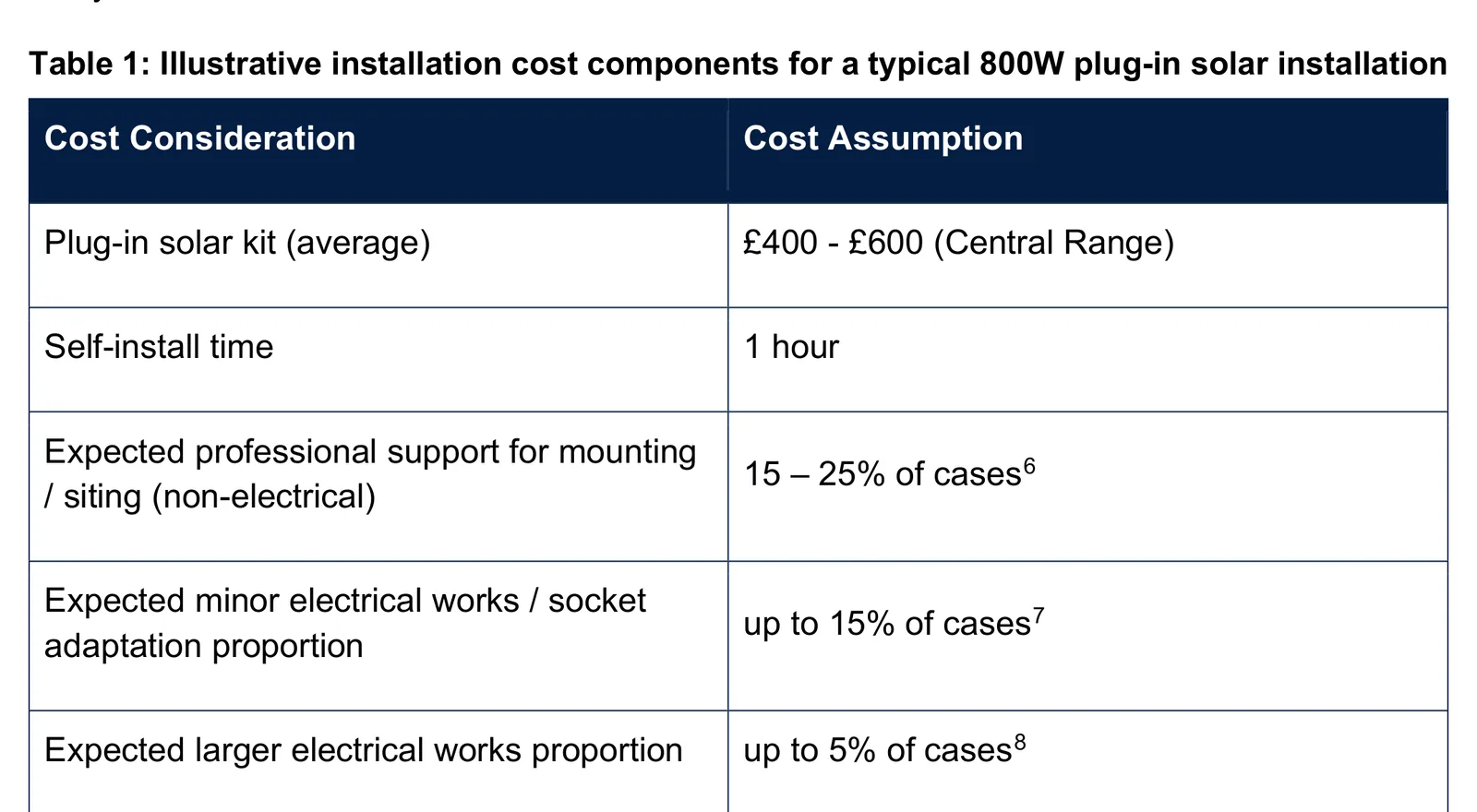
Note what the government’s own table quietly admits: up to a quarter of households are expected to want practical help with mounting, and up to one in five some electrical work. The hardware price is the kit. The install around it is not always free. It is also worth seeing that the June assumption of £400 to £600 for a branded packaged kit sat below where the first real UK kits landed.
One cost you should not budget a saving against is VAT. The 0% rate applies to installed, supply-and-fit systems, not to a kit you order online and put up yourself. Nobody is knocking 20% off a self-bought plug-in kit, so ignore any listing that implies otherwise.
How Much Could Plug-in Solar Save?
Our default, conservative estimate: £43 to £84 a year. An 800W kit makes roughly 650 to 800 kWh a year in the UK. Without storage you only benefit from generation while something in the home is using electricity, so realistic self-consumption for a household that is out during the day is 25 to 40%. At 26.32p/kWh, the Ofgem price cap unit rate from 1 October to 31 December 2026, that is £43 to £84.
Worked through: 650 kWh x 25% x 26.32p is about £43. 800 kWh x 40% x 26.32p is about £84. That is the whole calculation. There is no hidden multiplier and no export value in it.
The rate has a shelf life. The 26.32p cap runs only to 31 December 2026. Cornwall Insight forecasts about 30p for January 2027. Ofgem confirms the real figure by 25 November 2026, so I have kept 26.32p until then.
A battery does not change this number, because no compliant kit has one. If you buy storage anyway, you are buying an off-grid or hardwired product and the socket rules stop applying to it. Price it on its own terms.
Payback: 5 to 14 years, depending on what you paid. Divide £444 by a £43 saving and you get 10 years; divide it by £84 and you get 5. Do the same on a £599 Argos kit and the answer is 7 to 14 years. On the £999 kits it is longer again, and not proportionally better, because the second panel adds daytime output that a household out all day cannot use. The £336 kit has one 465W panel, so it makes a little over half as much energy and saves less. You use a bigger share of a smaller output, so I would not quote it a shorter payback until I have measured one. All of that is longer than most people expect, and much longer than the two to four years you will see quoted on kit listings and on some sellers’ own pages.
The government’s number, and why I do not use it. The gov.uk press release of 26 August 2026 says households “could save up to £110 a year” and that a kit provides “up to 20% of average home electricity use”. It publishes no basis for either figure: no self-consumption rate, no unit rate, no generation figure, no orientation. Both are “up to” numbers. Treat £110 as the ceiling for someone at home all day with a south-facing kit, not as a forecast. The earlier DESNZ analytical annex, below, is the only published working I have seen that lands near it.
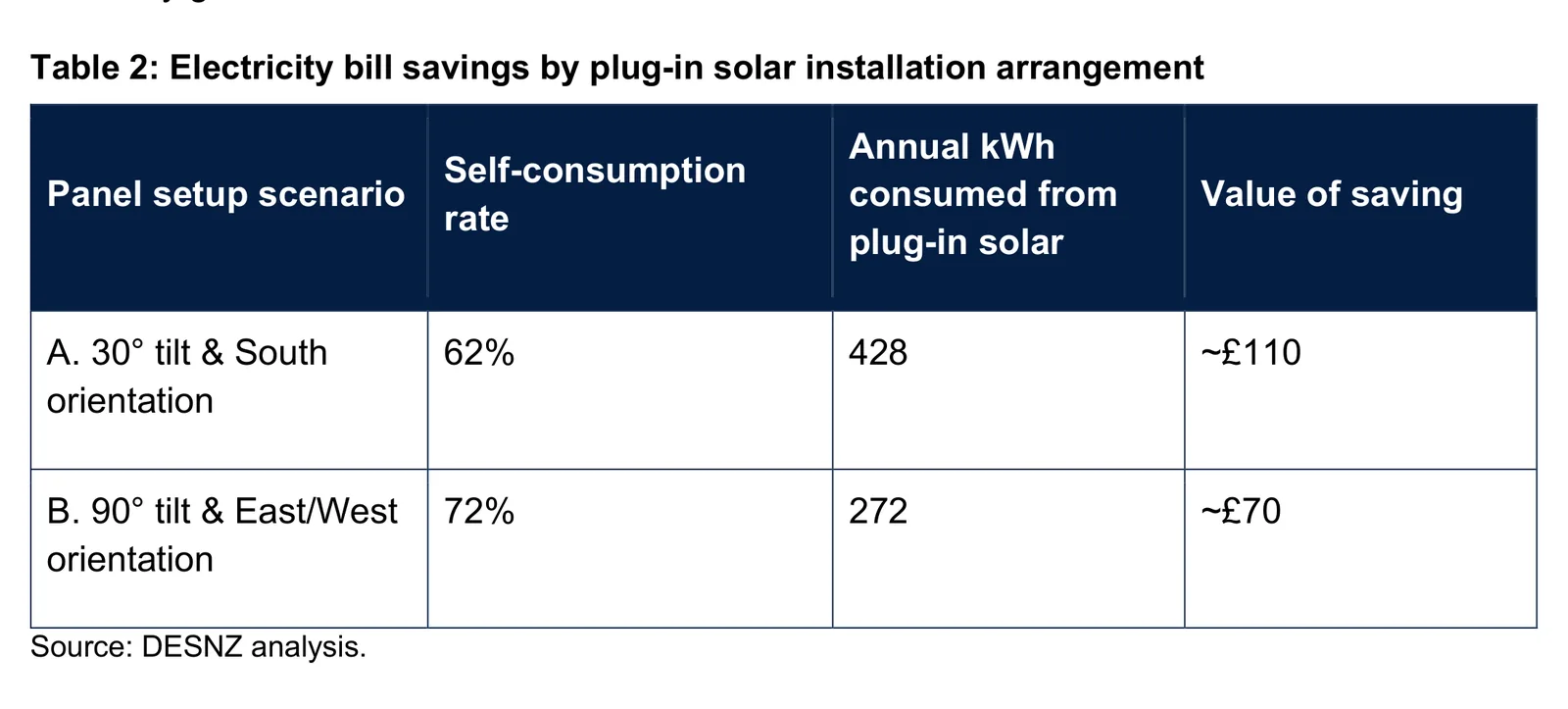
The two scenarios are honest about their own trade-off. The vertical east-west kit makes less electricity overall but you use more of it, because generation spreads across morning and evening when someone is actually home. Orientation changes when you generate, and for a kit without a battery, when you generate is worth more than how much.
Export income: assume zero. Getting paid for exported electricity through the Smart Export Guarantee generally needs an MCS-certified installation, and a kit you buy and fit yourself cannot be one. Every number above is about electricity you no longer have to buy, nothing more.
That has changed, but only for one supplier. On 10 October Octopus’s plug-in page said buyers of its own kit who also take Octopus supply get Prime Outgoing Octopus. That tariff pays 16p/kWh from 4pm to 7pm and 9p/kWh at other times, fixed for 12 months. It needs a smart meter that sends half-hourly export data. Export starts only after you register the kit on the ENA site and your network operator approves it. Kits bought anywhere else cannot join an Octopus export tariff. British Gas ran a prize draw for 30 kits that closed on 16 September, but on 22 September its own explainer still said plug-in systems were not yet eligible for its export tariff. Outside the Octopus route, export is worth £0 today.
Octopus’s £150 a year, checked. Octopus’s press release of 1 October 2026 says plug-in customers pocket “roughly £150 a year” on its Outgoing export tariff. Its footnote calls this an estimated annual saving for a household with a two-panel kit, and it publishes no basis. So I ran the numbers myself. A two-panel kit makes 650 to 800 kWh a year. Export alone cannot reach £150: at 9p you would need to export about 1,670 kWh, and even at 15p you would need 1,000 kWh. Both figures are more than the kit makes in a year. As a bill saving with no export, £150 needs 71 to 88% of the output used at home at 26.32p/kWh. That compares with the 25 to 40% I assume for a household that is out during the day.
My own estimate for the Octopus route keeps that 25 to 40% self-use at 26.32p and exports the rest at 9p. I use 9p because a plug-in kit generates mostly outside the 4pm to 7pm window that pays 16p. On those assumptions, a 650 kWh kit is worth about £87 to £104 a year, and an 800 kWh kit about £107 to £127. On the £650 two-panel Octopus kit, that is a payback of roughly 5 to 8 years on hardware. The result beats my £43 to £84 default, but it stays below £150. It also applies only to the Octopus kit with Octopus supply.
Where Can You Buy a Compliant Kit? City Plumbing, Argos and Wilko Yes, Lidl and Aldi No
City Plumbing, Argos, Wilko, Homebase and Very, plus Screwfix and a growing list of direct sellers. I checked the big retailers on 10 October 2026. City Plumbing’s Plug-In Solar PV category still starts at £336 for a one-panel DMEGC 465W or 475W kit with a Hoymiles microinverter, and its cheapest two-panel kit is still the DMEGC 930W at £444. Wilko and Homebase each list the same six UKSOL kits at the same prices, with free home delivery and no click and collect. Five showed “In stock for delivery”, and the Pro Max 1260W was out of stock. Very lists five UKSOL kits from £599 to £999, without the Pro Max, and one of its product pages estimated delivery in mid November. I found five UKSOL kits at Argos by searching for “uksol”, with free standard delivery. On 22 September Screwfix listed the PowerXpress 800W bifacial kit at £669, fulfilled by an approved supplier.
| UKSOL kit | Panels | Mount | Wilko and Homebase, 10 Oct 2026 | Argos, 10 Oct 2026 |
|---|---|---|---|---|
| Pro Compact 515W | 1 x 515W | Hybrid | £599 | £599 |
| Pro Compact 460W | 1 x 460W | Ground | £679 | £539.10 (10% off) |
| Pro Duo 890W | 2 x 445W | Hybrid | £849 | £849 |
| Pro Plus 1030W | 2 x 515W | Hybrid | £899 | £899 |
| Pro Max 1260W | 2 x 630W | Hybrid | £989, out of stock | Not listed |
| Pro Duo 890W | 2 x 445W | Ground | £999 | £764.10 (10% off) |
Every one of those clips to 800W AC whatever the panel wattage says, which is why a 1,260W kit still registers at 0.8 kW. Two lines in the small print matter more than the price: the ground-mount kits need ballast that is not included, and both Argos and UKSOL state the range is not suitable for balconies. Wind loading on a rail is the reason, and it is a fair one.
Currys is the newest high-street name, and it needs one extra check. On 10 October it listed an “INSTAGEN ONE Plug In Solar Kit” at £499 for one panel and £599 for two, each with a 435W bifacial panel and an 800 VA microinverter. Both were out of stock. Neither page gives a model number that I could match on the register. Ask Currys for the exact model number, and find it listed Compliant before you order.
Beyond the big retailers, several brands sell direct. I last checked their prices on 22 and 23 September. Thunder Energy sells the listed Thunder Bolt 460W at £549.99, up from £499.99, and the Bolt 920W at £749.99. It also sells Storm flexible kits from £499.99, which are not the listed Bolt models, so check the name before you pay. On 23 September it also offered a paid installation and network-notification service at £399.99 in Greater London. It now also sells Bolt Plus kits, the listed Bolt solar kit with a 1.92 kWh battery, from £1,549.99. The law gives a kit with storage no socket route, so treat Bolt Plus as a job for an electrician. PatioSun sells six kits from £449 to £779, though its shop still sits on a myshopify.com address. On 23 September Modular Solar sold a 340W unit at £465 and a 475W unit at £650, delivery and cables included, and claimed a four-and-a-half-year payback that is well short of what my own numbers support. It now also sells its units on Amazon through its own seller account. Plug In Solar carried the Perlight PowerPlug MAX range from £588 on the same date. UKSOL’s own store cut its prices in early September and starts at £599 collected. On 22 September it took advance orders only for its four hybrid-mount kits, marked available from 1 November, so ask about delivery before you order a hybrid kit anywhere. Octopus Energy says its first 500 kits sold in two weeks, and its JA Solar bundle showed as sold out on 10 October. Octopus says the first deliveries reached doorsteps in the week of 1 October. Its page gives three delivery windows: the end of September to mid October for orders placed before 11 September, the end of October to mid November for orders from 11 September, and by the end of November for orders after 28 September. On 22 September its product page carried no compliance statement, though its microinverter is listed Compliant. InstaGroup is on the register but its page still says coming soon.
Lidl and Aldi still sell nothing in Britain as of 10 October 2026, more than six months after the government named supermarket partners preparing UK launches. IKEA listed no plug-in kit either. On 12 September Wickes and Toolstation showed no complete plug-in kit, and on 10 October B&Q listed only a mounting kit. Amazon has plenty of kits, and apart from Modular Solar’s own units none of the ones I found are listed Compliant, which is the subject of the next few lines.
Amazon UK lists plenty of 800W kits, much of it built to Germany’s plug-in rules rather than the UK specification. Germany also caps the inverter at 800 VA and requires anti-islanding, so the engineering is close. The paperwork is not. Version 2 of the UK specification says that where it and the German standard differ, the UK document wins, and a German-market unit does not arrive with a UK conformity assessment or a register entry.
A UK plug fitted to the box is not evidence of anything either. The £139.99 Solarsys microinverter kit on Amazon ships with a UK 13 A plug and has no compliant listing. The plug is the easy part to change. The conformity assessment behind it is not.
So the signal to watch is not a supermarket press release. It is the register. When a brand you want appears there as Compliant against the model number printed on the box, that brand has a socket route. Until then it does not, whatever the listing says.
What Should You Check on the Panels and Microinverter?
Which check applies depends on which route you are on, and the two use different parts of the same register. For socket use, search the ENA register under the Plug-in Solar device type and find your exact model listed Compliant. For the hardwired route, you want an inverter with a confirmed G98 type-test entry instead, which is what your electrician and your DNO care about. A G98 entry does not give a product a socket route, and a plug-in listing is not a substitute for the G98 check on a hardwired build.
Next, check panel Voc against the inverter’s maximum input voltage. If you wire panels in series, their Voc values add together, and exceeding the inverter’s maximum can damage it. A 450W panel at roughly 41V Voc fits comfortably under the Hoymiles HMS-800W-2T’s 65V-per-channel limit; two in series would not.
Two 430-450W panels feeding one 800W inverter is normal, not a mistake. That is overpanelling: the inverter clips output above 800W regardless of how much DC the panels could theoretically produce, so pairing roughly 860-900Wp of panels against an 800W inverter is the standard configuration. The specification allows up to 2,000W of panels at STC against that same 800 VA inverter, so a kit that looks over-panelled to you is probably just built to the rules.
What Else Should Be in the Box?
DC cable length between panels and inverter is usually 1-2 metres. If your panels sit further from the inverter than that, budget for an extension. Confirm the AC plug fitted is UK BS 1363, not a German Schuko plug needing an adaptor; an adaptor on a generator connection is not something to improvise.
Most microinverters include Wi-Fi monitoring through a manufacturer app. Confirm it works from a UK account and does not need a separate hub sold as an extra. None of this affects safety, but it affects whether the kit you unbox matches what you expected to install.
What Should You Check on the Plug, Socket and Consumer Unit?
The specification requires a manufacturer-supplied, non-rewireable BS 1363 plug with a BS 1362 fuse rated at 5A or less already fitted. Do not swap the fuse for a higher rating, and do not fit your own plug if one arrives loose. Both undo the protection the spec is built around.
No extension leads and no multi-way adaptors, ever. Electrical Safety First puts cable reels, travel adaptors and RCD adaptors in the same list, and rules out lighting circuits and circuits feeding fixed equipment such as an oven or a hob. Argos repeats the extension lead and cable reel point on every UKSOL listing. All of them can carry less current than the socket circuit is rated for, and all of them sit between the kit and the breaker that is meant to protect it.
Check the socket itself: a dedicated, unshared socket on a circuit in good condition, not the same double socket as a kettle and a heater. A consumer-unit label is part of the specification too, so the next electrician who opens your consumer unit knows a generator is connected downstream. For why the socket route is risky in the first place, including how a plug-in kit can hide an overload from the circuit’s breaker, see how plug-in solar actually works.
Then the part that decides whether you can buy at all: the RCD protecting that socket circuit. This is the check the safety bodies put front and centre when the law changed on 27 August 2026, and it is about your house rather than the kit.
- Type AC is unsuitable. Electrical Safety First says a Type AC RCD may fail to give suitable protection in a fault, because a microinverter can put a small DC residual current onto the AC side that this type cannot see.
- Type A, Type F and Type B are suitable. Type A tolerates DC residual above 6 mA, Type F above 10 mA.
- The type is not the whole test. The device also has to be capable of working with power flowing both ways, and Electrical Safety First is blunt that few RCDs or RCBOs can be easily identified as bidirectional by a consumer. Some carry a BD or Bi-dir suffix. It is not consistent.
- A fuse board is a stop sign. Homes still on rewirable or cartridge fuses have no RCD protection at all and need an inspection before anything is plugged in.
The IET’s own survey explains why the bodies pushed this so hard: 25% of UK adults know their RCD type, 37% do not know what an RCD is, and 23% said they would reach for an extension lead if the cable did not reach. If you are not sure which camp you are in, work through the home suitability check before you order anything. It starts with the label on your consumer unit, and it is cheaper than a return.
One habit worth keeping afterwards. Leakage from EV chargers and ordinary electronics adds up and can desensitise an RCD over time, so press the test button on the board every few months.
What Should You Check on the Mounting System?
The specification requires manufacturer-supplied mounting backed by structural, weather, ventilation and fire evidence, not a generic bracket bought separately. That evidence is what stops a mount being sold for wind loads or a surface it was never tested against.
Wind restraint matters whatever the specification says. A 500W+ panel presents roughly 2 square metres to a crosswind. Fence and wall mounts need two anchor points, top and bottom, and a mechanical stop if the panel can tilt. A panel that lifts in a gust and slams back breaks the glass and fractures the wiring harness, and standard home insurance will not cover it.
South, east, or west-facing surfaces all work: a garden wall, a shed or garage roof, or a ground frame. South gets you the most generation; east-west spreads it across the day, which suits a household without a battery slightly better because more of it lands during waking hours. A balcony rail needs one extra check: the UKSOL kits are stated as not suitable for balconies, so make sure the exact kit you buy lists balcony mounting. In England, the planning rules for plug-in solar give no automatic planning permission for a kit on a wooden wall, fence, gate or balcony, or on a listed building. They also limit a kit to 0.2 m out where the wall or balcony runs alongside a road or pavement. If your home is listed, or the kit falls outside those limits, ask your council first.
For practical fixing advice by wall and roof type, see our mounting guide.
Should You Buy a Listed Kit or Hardwire?
The question is no longer whether to wait. It is which of the two legal routes fits you, and the honest split is about timing and about where the panels are going to sit.
Buy a listed kit if you want the simplest path. City Plumbing, Wilko, Homebase and several brands selling direct will ship one now, from £336 for one panel or £444 for two. Argos and Very list UKSOL kits too, and one Very page estimated delivery in mid November. Octopus has sold out for now, and on 22 September UKSOL’s own store marked its hybrid-mount kits available from 1 November. You plug it in yourself, you notify the DNO, and no electrician is involved unless your consumer unit or socket fails the checks above.
Go hardwired if you want to choose the panels and inverter yourself, or if you already have roof solar and sit close to the G98 ceiling anyway. An electrician fits the kit to its own breaker and handles the notification as part of the job. The parts cost less than a packaged kit, but at £444 for a listed two-panel bundle that gap has narrowed, and the fee closes the rest of it.
Two lines in the compliant kits’ small print change the answer for some people. The UKSOL range, which is every kit Argos sells, is stated by both Argos and UKSOL as not suitable for balconies. The ground-mount versions need ballast that is not in the box, so budget for slabs or a weighted frame. If your only outdoor space is a railing, the compliant product for you does not exist yet, and a hardwired build with a properly engineered rail mount is the route that does.
Do not buy either way if any of these apply: your consumer unit has a Type AC RCD or a fuse board and has not been inspected, you already have roof solar and have not checked the whole-property G98 limit, you rent or are leasehold without written permission, your plan involves two kits or an extension lead, or the listing is an import sold as if the UK rules already match. That last one is the most common failure. An unlisted unit may never get a UK conformity assessment retrofitted, so you can end up owning hardware that works perfectly and still cannot legally go in a socket.
If you already have solar and are close to the 3.68kW G98 threshold, read the note on existing panels above before buying anything. An 800W addition can tip your whole property into a G99 application regardless of what the plug-in rules say.
If you rent, plug-in solar suits you because it needs no drilling or structural change, not because you have any statutory right to demand it. No UK law forces a landlord or freeholder to allow it, and legalisation did not change that. Ask first, get the agreement in writing, and check the balcony point above before you picture the panels on a railing.
Build a Hardwired Small-Solar System Now
What a hardwired 800W-class build costs today. Two 500W+ panels, one 800W microinverter, brackets and cabling, fitted to its own breaker by an electrician:
| Component | Typical price (April 2026) | Notes |
|---|---|---|
| 800W microinverter | £133-150 | The two units with confirmed ENA Type Test Register references in the kit builder below: the Hoymiles HMS-800-2T at about £133 and the EcoFlow STREAM 800 at about £150. Cheaper units are listed elsewhere, but I could not source a UK price for Deye or the other brands often named alongside these two, so they are not in this band. Integrated RCD and a G98/G99 approval are the must-haves. |
| 2 × 500W+ panels | £220-260 | DMEGC 515W, JA Solar 500W, Aiko 490W are the usual suspects. Price sensitive to the April 2026 China VAT rebate phase-out. |
| Brackets / rail | £25-40 | Aluminium L-brackets or short rail off Amazon. Flexible for fence, wall or shed end. |
| DC / AC cabling + connectors | £20-30 | If not bundled with the microinverter. |
| AC tie-in (electrician, Part P) | £80-150 | Required: this build is hardwired, not socket-plugged. |
| Total hardware (electrician fee on top) | £360-450 | Excludes the electrician; under £400 is achievable on hardware alone. |
Two things carry over from the checklist above, wherever you source parts. Wind restraint is not optional (see the mounting section above for anchor points and mechanical stops), and this build is hardwired to its own breaker, never plugged into a socket. Legalisation did not change that: the socket permission applies to a listed product, and a set of parts you assembled yourself cannot be one.
You do not need a packaged kit. The same components are available individually from UK solar suppliers, often cheaper than a branded bundle. Here are two realistic builds using products from our panel directory, priced for the hardwired route above, not for a socket.
Budget Build: Single Panel (~£191)
| Component | Example | Price (ex VAT) |
|---|---|---|
| Panel | DMEGC 450W All Black | ~£61 |
| Microinverter | Beny 800W (G98 status: claimed, not yet confirmed on ENA register) | ~£90 |
| MC4 cables + AC cable | MC4 extension cables plus AC cable to the consumer unit for the electrician’s tie-in | ~£15 |
| Mounting | Ground/wall brackets or balcony rail clamps | ~£25 |
| Total | ~£191 |
Expected output: 350-450 kWh a year, south-facing at roughly 30 degrees. Assume 25-40% self-consumption without a battery and the 26.32p/kWh cap that runs to 31 December 2026: that offsets roughly £23-47 a year. Against the £191 hardware cost, payback runs roughly 4 to 8 years, before any electrician fee.
Standard Build: Two Panels (~£310-316)
| Component | Example | Price (ex VAT) |
|---|---|---|
| Panels (x2) | JA Solar 445W or DMEGC 450W | ~£122-128 |
| Microinverter | Hoymiles HMS-800-2T (G98 confirmed, ENA ref HOYMZ/03493) | ~£133 |
| MC4 cables + AC cable | MC4 extension cables plus AC cable to the consumer unit for the electrician’s tie-in | ~£20 |
| Mounting | Ground frame or wall brackets for 2 panels | ~£35 |
| Total | ~£310-316 |
Expected output: 600-700 kWh a year. At the same 25-40% self-consumption and 26.32p/kWh, annual savings run roughly £39-74. Against the £310-316 hardware cost, payback is roughly 4 to 8 years, before any electrician fee. This is still the sweet spot for most people, comfortably under the government’s £400-600 assumption for a branded 800W kit.
Component prices are from UK solar retailers as of July 2026 and exclude VAT. The 0% VAT rate applies to installed (supply-and-fit) systems only, so a self-sourced DIY kit does not get it and you should not budget for a 20% discount. Check our solar panel prices tracker for the latest, as China’s export rebate removal continues to push prices.
Hardwired Small-Solar Kit Builder (G98-listed inverters)
Every inverter below is confirmed on the ENA Type Test Register for G98. All are 800W AC output or under. This builder is for the hardwired route only: an electrician fits the kit to its own breaker and notifies your DNO under G98. Nothing it produces may be plugged into a wall socket. The battery option below is for the hardwired route too: adding storage takes a product outside the legal definition of a plug-in microgenerator entirely.
Inverters confirmed on the ENA Type Test Register for G98. Always verify your exact model variant before purchase. ENA reference codes shown in brackets.
Non-negotiable before you buy for socket use
- Factory moulded BS 1363 plug (not a DIY rewired plug)
- Fuse no higher than 5 A
- No extension leads, multi-ways, or travel adaptors
- One device per household. G98 Amendment 1 says connecting more than one is not allowed
- Inverter AC output no more than 800 VA and 3.5 A; panels no more than 2,000 W at STC
- If panels exceed 960 W, the manufacturer must tell you to consider a professional assessment; take the advice
- Already have solar? Add the watts; G98 is cumulative for the property
- Inverter warranty years vs your payback years
- No battery in the product, because storage falls outside the legal definition
- This exact model number listed Compliant on the ENA plug-in solar register, checked on the day you order
- Written landlord or freeholder permission if you do not fully control the building
- A Type A, F or B RCD on that socket circuit, confirmed to work with power flowing both ways
- An address in England, Wales or Scotland. Northern Ireland is not covered
If any line fails, do not buy it for socket use. On 10 October 2026 the 120 kits listed as Compliant cleared every product line. The last three checks are yours to make, not the manufacturer’s.
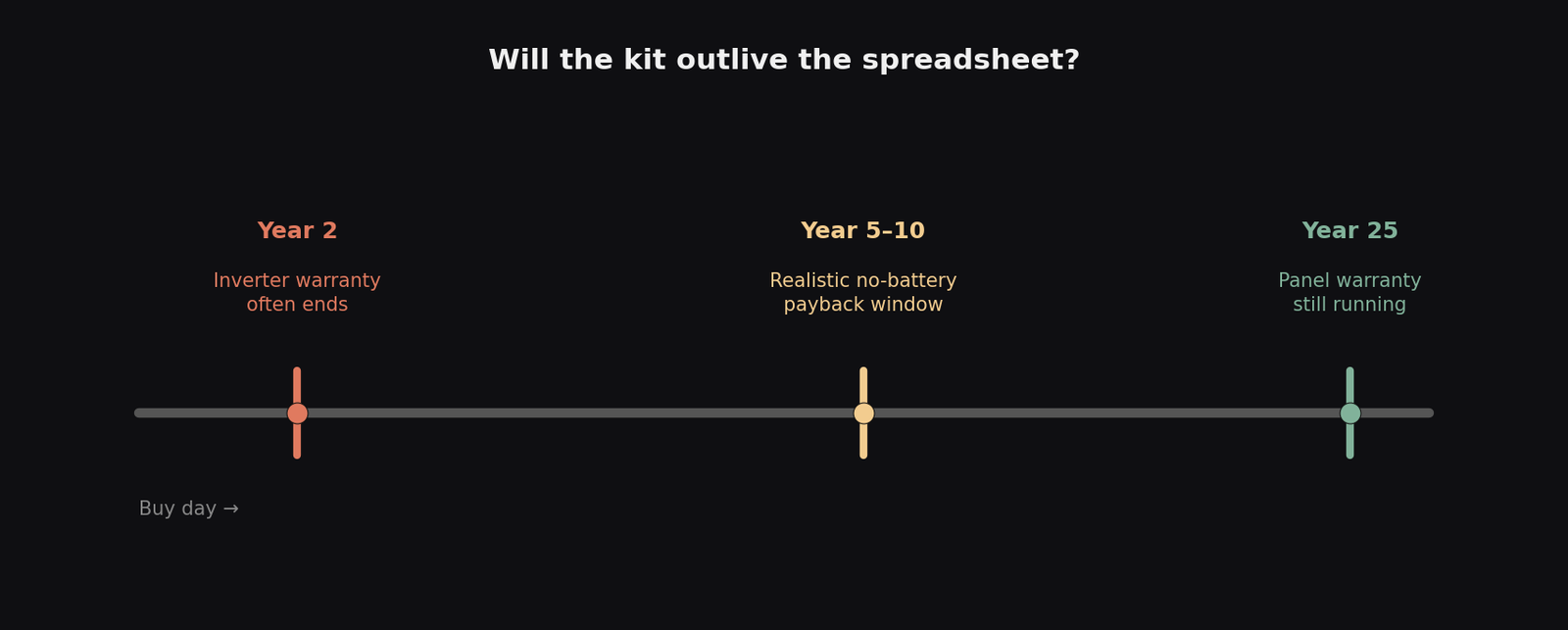
Price the failure risk too. Panel warranties run 25 years, and the UKSOL kits at Argos carry a 10-year warranty, but microinverter cover is often shorter than a realistic 7 to 14 year payback. That means the part most likely to fail is the part least likely to still be covered. German “pays back in two years” posts usually include free export on old reverse-running meters, which does not transfer to UK smart meters or to a kit you fitted yourself. Assume £0 export income and check the inverter warranty against the payback year before you buy.
The short version, on 10 October 2026: you can buy a compliant kit from £336, City Plumbing, Wilko and Homebase will ship one now, the register decides which models qualify, and your RCD decides whether your house does. The hardwired route is still there if you would rather choose the parts yourself. For the law itself see the plug-in solar UK guide, and for why a socket connection needed a new rule at all, see how plug-in solar works.
