
UK solar panel prices at SolarSell on 13 July put current mainstream N-Type panels at roughly £62-79 ex VAT, or 12.9-15.8p per watt. Across the same six mainstream models observed at each monthly checkpoint, the median fell from 14.88p/W in April to 14.35p/W in July, down 3.6%. A 4kW installed system remains around £6,000-8,000.
The monthly series follows exact products rather than whichever panels happened to be in stock on each date. May and June held at 14.64p/W before the July checkpoint moved lower. Five of the six models are JA Solar and one is Aiko, so this is a direction-of-travel signal from one supplier rather than a UK market average.
For full specifications, market history and datasheet downloads, see our UK solar panel directory with 81 panels from 12 data sources. It keeps products that were sold in the UK even when no current price is available, and marks specifications unavailable where a datasheet has not been verified.
This guide covers what a single panel costs, what a full system costs installed or DIY, where to buy, and what to watch through the rest of 2026.
| Monthly checkpoint | Median ex-VAT price | Change from April |
|---|---|---|
| 15 April | 14.88p/W | Baseline |
| 15 May | 14.64p/W | -1.6% |
| 15 June | 14.64p/W | -1.6% |
| 13 July (month-to-date) | 14.35p/W | -3.6% |
What Do Solar Panels Cost in the UK Right Now?
Current mainstream N-Type listings at SolarSell ran from about £62 to £79 ex VAT on 13 July 2026. The core 455-490W products were £62-74, while the 535-610W panels were £72-79. That is roughly 12.9p to 15.8p per watt before VAT. A retail buyer would budget about £74-95 including VAT, before delivery.
The metric that matters is price per watt (£/W). It lets you compare panels of different sizes on a level playing field. The 455W JA Solar low-carbon panel at £61.93 works out to £0.136/W. The 610W JA Solar panel at £78.55 is £0.129/W, so its higher unit price still buys more generating capacity for each pound.
| Panel | Power | Price ex VAT | £/W | Cell Type |
|---|---|---|---|---|
| JA Solar low-carbon bifacial | 455W | £61.93 | £0.136 | N-Type TOPCon |
| JA Solar traceable bifacial | 460W | £63.51 | £0.138 | N-Type TOPCon |
| JA Solar all-black bifacial | 455W | £65.34 | £0.144 | N-Type |
| LONGi Hi-MO X10 | 490W | £67.69 | £0.138 | HPBC |
| JA Solar low-carbon bifacial | 535W | £72.19 | £0.135 | N-Type TOPCon |
| JA Solar bifacial | 540W | £73.89 | £0.137 | N-Type TOPCon |
| Jinko Tiger Neo 3.0 | 470W | £74.31 | £0.158 | N-Type TOPCon |
| JA Solar bifacial | 610W | £78.55 | £0.129 | N-Type TOPCon |
| Viridian Clearline | 445W | £196.06 | £0.441 | N-Type |
The current mainstream range is roughly £0.13-0.16/W ex VAT, with the 610W bifacial at the lower end. Panels are now a relatively small part of a complete system cost. Labour and business costs dominate an installed quote, while the inverter can cost roughly as much as the panels.
The outlier in the table is Viridian at £0.44/W ex VAT. Viridian panels are manufactured in the UK and positioned as a premium product. They can suit buyers who want UK manufacturing or a specific integrated-roof appearance, but this listing is roughly three times the price per watt of the mainstream imported panels above.
How Much Does a Full Solar System Cost?
A 4kW solar system costs £6,000-8,000 fully installed in 2026, or about £1,500-1,800 in DIY hardware including VAT. The official median across a record 265,682 MCS installations in 2025/26 was £1,780 per kW: £7,100 for a 4kW system, and the lowest real-terms level DESNZ has recorded.
| System | Panels | DIY hardware (inc VAT) | Installed | Payback (installed) |
|---|---|---|---|---|
| 3kW | 7× 450W | £1,200-1,500 | £4,500-6,000 | ~13.2 years |
| 4kW | 9× 450W | £1,500-1,800 | £6,000-8,000 | ~12.7 years |
| 5kW | 11× 450W | £1,800-2,100 | £7,000-9,000 | ~13 years |
| 6kW | 13× 450W | £2,100-2,500 | £8,500-10,500 | ~13.6 years |
Panels are only part of the cost. Here is where the money actually goes on a typical 4kW system:
| Component | DIY Cost | Installed Cost |
|---|---|---|
| Panels (9× 450W) | £670-710 | £560-590 |
| Hybrid inverter | £500–800 | £500–800 |
| Roof mounting | £200 | £200 |
| Cable, connectors, isolators | £100 | £100 |
| Installation labour | n/a | £1,500–2,500 |
| MCS certification + DNO | n/a | £500–800 |
| Total | £1,470-1,810 | £3,360-4,990 |
Notice the component sum stops at £3,360-4,990 while real quotes mostly land at £6,000-8,000, with the DESNZ 2025/26 median at £7,100 for 4kW. The gap is business overhead, scaffolding, and margin. Knowing it exists is negotiating power: a quote near £5,000 is genuinely sharp, and £8,000-plus deserves a second opinion.
UK Solar Installation Costs: 2013/14–2025/26
Annual median installed cost per kW for 0–4 kW residential systems
Source: DESNZ Solar PV Cost Data (MCS-certified installations). Includes panels, inverter, mounting, labour, and certification. Costs are nominal (not inflation-adjusted). The 2022–2024 spike reflects the energy crisis driving record demand; underlying panel costs were falling throughout. Costs then fell for two consecutive years; the 2025/26 figure covers a record 265,682 MCS installations and is the lowest on record once adjusted for inflation (release of 28 May 2026).
The VAT catch: 0% installed, 20% DIY
An MCS installer’s quote is zero-rated: the whole supply-and-install package carries 0% VAT until 31 March 2027, then reverts to 5%. Buy the same panels yourself and you pay 20% at the checkout, because the relief only applies when one company supplies and fits.
The DIY route still wins on total cost by miles. Just remember that trade listings, including the ex VAT prices in this article’s tables, need a fifth added when you budget as a retail buyer.
Adding battery storage (e.g. 10–16 kWh) adds £2,000–4,000 to either route. A full solar-plus-battery system installed by an MCS company typically costs £7,000–10,000. DIY with battery: £3,500–5,500.
How Long Until a Solar System Pays For Itself?
About 12.7 years for a typical 4kW system at £7,000: roughly £465 a year in avoided grid electricity plus £86 in export income at a conservative 5p SEG rate. Smaller and larger systems land in the same 12-14 year window, because cost and generation scale together.
Self-consumption decides your result. Use half your solar electricity at home and those numbers hold; an empty house from 9 to 5 pushes payback out by years. One DIY caveat: you need MCS (or equivalent) certification to claim SEG export payments, which is a big part of what the installed premium buys. The full working, battery cases included, is in whether solar panels are worth it in 2026.
Where to Buy Solar Panels in the UK
There are two routes: trade/wholesale suppliers (cheaper per panel, often minimum orders of 3–5) and retail (single panels, slightly higher price). Here are the main options:
| Supplier | Type | Min Order | Notes |
|---|---|---|---|
| City Plumbing | Trade counter | 1 panel | Collection may be available from local branches. |
| ITS Technologies | Online | 3-5 panels | Stocks several mainstream panel brands. |
| Midsummer Wholesale | Trade only | Varies | Account access may be required. |
| Bimble Solar | Online retail | 1 panel | Often useful for small, used or clearance orders. |
| Solar Trade Sales | Trade | Varies | Check live stock and volume terms. |
| Alternergy | Online retail | 1 panel | Also lists mounting and cable. |
If you are buying for a DIY install, start with suppliers that allow single-panel orders or collection. For a larger system, compare the delivered total rather than the panel price alone because minimum orders and freight can erase a small unit-price saving.
Why Have Prices Dropped So Much?
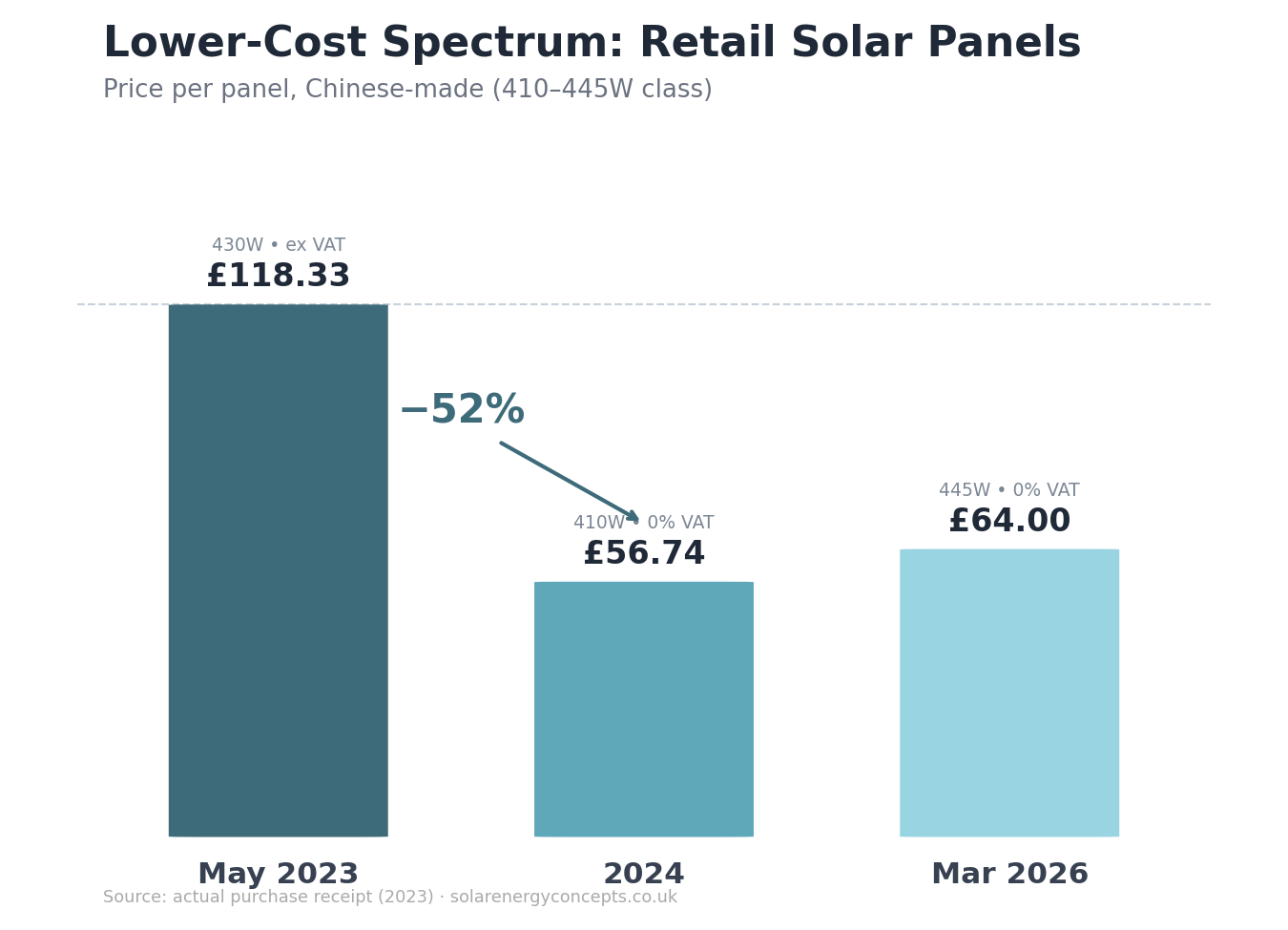
Two supply-side factors drove much of the panel-price drop between 2024 and early 2026:
- Chinese manufacturing overcapacity. China produces roughly 80% of the world’s solar panels. A massive buildout of factory capacity in 2023–2024 created a supply glut. Manufacturers cut prices to maintain market share, and the savings filtered through to UK retail.
- N-Type technology matured. The industry shifted from older PERC cells to N-Type TOPCon, which is now mass-produced at scale. Higher efficiency at lower manufacturing cost per watt.
Are UK Solar Panel Prices Rising in 2026?
The monthly matched-panel series shows a modest decline across mainstream listings, not a broad post-rebate rise.
China’s export rebate removal took effect on 1 April 2026. The fixed mainstream basket was 14.88p/W on 15 April, 14.64p/W in May and June, and 14.35p/W on 13 July. That leaves the monthly median 3.6% below April. Prices did not move uniformly: in the shorter 1-to-13 July comparison, 12 of 13 repeat listings were unchanged while one premium REC panel rose 13.1%.
The fixed monthly basket excludes panels that entered or left the supplier’s listings, so availability changes cannot create a false price movement. It is still a narrow sample: five models are JA Solar, one is Aiko and all come from SolarSell. My March forecast of an 8-15% retail rise by late 2026 is not supported by this tracked mainstream series so far.
Battery prices need separate evidence. A panel crawl cannot establish a battery-price lag, and no battery observation was promoted from the 13 July crawl without an exact canonical SKU or retailer URL match. Battery history and package pricing therefore remain separate from the panel movement measured here.
The 0% VAT on installed solar is scheduled until 31 March 2027, then reverts to 5%. That tax change can affect an installed quote after the deadline, but it is separate from the wholesale panel-price movement measured here.
When Should You Buy?
If you are planning a solar system for 2026, mainstream panel listings remain inexpensive and the official installed median fell 9% in real terms last year. The fixed monthly panel basket is 3.6% below April, so there is still no evidence here of a broad post-rebate rise. Individual products can move differently, which is another reason not to rush a purchase.
That said, do not rush into a purchase just because prices might rise 10%. The difference on a 4kW system is roughly £60–80 on panels. It matters, but it is not worth making a bad decision over. Get the right panels for your roof, the right inverter for your usage, and buy when you are ready.
If you are waiting for plug-in solar kits, they became legal to run from a UK socket on 27 August 2026 under SI 2026/848. A listed kit is capped at 800 VA of output and 2,000 W of panels, and you can run one per household. Argos was first to shelves at £599 for an 800 W kit, and by 22 September City Plumbing had pulled the entry price down to £444 for a two-panel kit and £336 for a one-panel kit. Even that works out far above the per-watt prices above, so do not budget a plug-in kit from today’s euro prices on German websites.
What to Look for When Buying
At today’s prices, the differences between mainstream panels are small. Here is what actually matters:
- Compare the cell technology and the price. N-Type TOPCon is now the mainstream choice, but an older PERC panel can still be useful when the specification, warranty and lower price suit the job. Compare the exact product rather than applying a hard price ceiling by cell type.
- Physical size matters. Two 445W panels from different brands can have different physical dimensions. Check that the panels fit your available roof space. Our panel directory lists dimensions where they have been verified.
- Voc for string sizing. If you are connecting panels in series to a string inverter, the open circuit voltage (Voc) of each panel determines how many you can chain together. Higher Voc = fewer panels per string. This matters for overpanelling and inverter compatibility.
- Warranty length. A 25-year product warranty and a 30-year linear power guarantee are common on current mainstream panels, but coverage differs by model. Check the exact manufacturer datasheet and warranty terms before buying.
- Export eligibility. If you want to claim the Smart Export Guarantee (SEG), check the chosen supplier’s evidence requirements before you buy. Many accept MCS certification, while some accept an equivalent route. Confirm that your installer, panels and inverter meet that tariff’s terms.
For a comparison of panels observed on the UK market, including specifications, price history and datasheets where available, see the Solar Panel Directory.
Solar Panel Price FAQs
How much does one solar panel cost in the UK?
Roughly £62-79 ex VAT for the mainstream 455-610W N-Type listings observed at SolarSell on 13 July 2026, or about £74-95 including VAT before delivery. That is approximately 12.9-15.8p per watt. Premium products can cost more: the Viridian 445W listing was £196.06 ex VAT.
How much does a 4kW solar system cost in 2026?
£6,000-8,000 installed by an MCS company; £7,000 is typical and sits close to the DESNZ 2025/26 median of £1,780 per kW. The same system in DIY parts costs about £1,500-1,800 including VAT, before any electrician or scaffolding fees.
Is VAT still 0% on solar panels?
Only when one company supplies and installs the system. Residential installations are zero-rated until 31 March 2027, then the rate reverts to 5%. Hardware bought on its own carries the standard 20% VAT, which is why trade listings show ex VAT prices.
Will solar panel prices go up in 2026?
The tracked mainstream basket has moved down, not up. Its median ex-VAT price fell from 14.88p/W in April to 14.35p/W in July, a 3.6% decline. That does not mean every panel became cheaper: one premium REC listing rose 13.1% between the two July crawls.
How many solar panels do I need for a 4kW system?
Nine 450W panels give you 4.05kW, or seven of the 600W-class bifacials. Physical size differs more between brands than wattage suggests, so check dimensions against your roof before ordering. Our panel directory lists dimensions where they have been verified.
This article is updated as prices change. Last updated: 14 July 2026, with monthly matched-panel tracking from April to July and DESNZ’s May 2026 installation cost release.
