
Two people I know got solar installed in 2026. Both went back to their installers within weeks asking for more battery capacity. Both had to push. Neither had been told why the quote was sized the way it was.
This is not installers are bad. This is the numbers you need to ask about before you sign.
How do installers size batteries?
The standard method takes your annual electricity usage in kWh, divides it by 365, and specs the battery to cover that daily average. For a typical UK household at 7.4 kWh per day (DESNZ 2024 data), that points to an 8 to 10 kWh battery. Sunsave, one of the larger UK installers, publishes exactly this guidance: “9 to 10 kWh is ideal for the average home.”
It is also worth knowing what 9 to 10 kWh actually means in practice. The nameplate kWh is not what cycles each day. Most BMS reserves 10 to 20% to keep cells off zero and protect cycle life, so a 10 kWh battery is closer to 8 kWh of working capacity. The installer’s quote is already shaving the working envelope before winter even starts.
It is a reasonable heuristic. It optimises for self-consumption of summer solar surplus, which is where the payback model works neatly. Quote looks clean. System works as promised in spring and summer. Reviews are positive.
The problem is winter.
Why average daily usage is the wrong number for winter
London PVGIS data (south-facing, 35 degree pitch, 4 kW array) shows December yielding about 150 kWh for the month, roughly 4.8 kWh per day. July yields about 506 kWh, or 16.3 kWh per day. December is 29.6% of July.
At the same time, DESNZ household consumption figures put winter electricity usage roughly 27% higher than summer: 9.4 kWh per day against 7.4. Add a heat pump and you are looking at 15 to 20 kWh per day in cold weather.
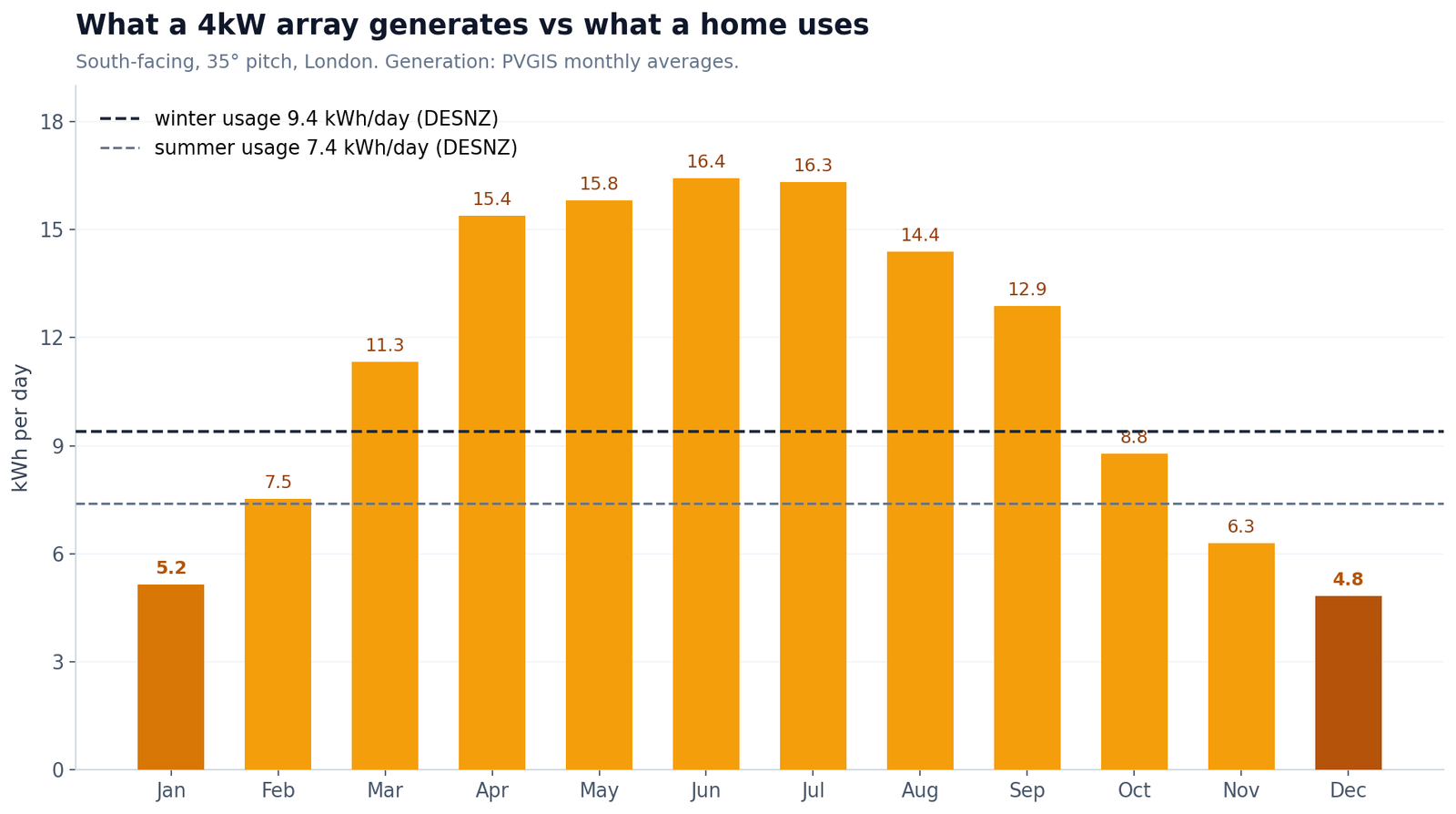
So in December, a 4 kW south-facing array will rarely fill a 10 kWh battery from solar alone. The battery’s job changes completely. It stops being a solar store and becomes a grid-arbitrage device. You charge it overnight on a cheap tariff (standard Octopus Go, 9.5p/kWh between 00:30 and 05:30) and discharge it into peak-rate consumption (Ofgem cap for 1 July to 30 September 2026, 26.11p/kWh). The sizing logic that made sense in August becomes actively wrong.
The installer who sized for average daily usage is not incompetent. They are using a method that has no seasonal correction built into it.
The other piece installers do not always factor in: winter is where the double-dip pattern earns the most. On standard Octopus Go I charge the battery to 100% overnight in the 00:30 to 05:30 window at 9.5p, run the house off it through the day, and export the solar generation to Octopus Outgoing at 12p flat. In December that earns more per kWh than the summer self-consumption case, because the import-export spread is wider than the SEG rate alone. A bigger battery means more of the day runs on 9.5p import cost instead of 26.11p, and more of the panels’ generation leaves on the export meter.
What does an extra kWh of battery actually earn?
With standard Octopus Go at 9.5p charging and the Ofgem cap for 1 July to 30 September 2026 at 26.11p per kWh displaced (both rates checked 24 July 2026):
- Net saving per cycle: 26.11p minus 9.5p = 16.61p, multiplied by 95% round-trip efficiency = 15.8p
- Annual at one cycle per day: about £58 per usable kWh
- On Intelligent Octopus Go at 8p the spread is 18.11p and the annual figure is about £63 per usable kWh, but eligibility is gated on having a compatible EV or home charger, so it is not open to every household
That is the gross economics per extra kWh cycled daily. Real-world is slightly lower because you will not arbitrage every single day. Worth being straight about the direction of travel: at the January to March 2026 cap of 27.69p the same sum came out at about £70 per usable kWh. The cap has fallen and the Go night rate has risen, so the arbitrage case is weaker than it was six months ago. It still works, but by a narrower margin, and the October to December cap is not published yet, so re-run this with your own two rates before you commit.
My own upgrade landed exactly here. I went from a 10 kWh pack to 15 kWh. The extra 5 kWh on the nameplate is closer to 4 kWh after the BMS reserve. On an average December day it covers another four hours of household demand that would otherwise come from the grid at peak. Annual saving on that extra capacity ran at about £290 across 2026, measured on my own meter at the import and export rates I was on through that year rather than at today’s spread. Against an upgrade cost of £1,400 that is just under five years to break even on the marginal capacity alone, and the larger pack also cycles shallower, so the warranty maths got better at the same time.
The marginal cost of adding capacity at install time is roughly £225 to 350 per kWh (add-on battery module, shared installation labour). Retrofit later and the same capacity costs 30 to 50% more: a separate site visit, possible inverter swap, potential cabling work. MCS-registered firms quoting for a 5 kWh standalone retrofit in 2026 are coming in at £4,500 to 6,500. VAT is 0% now and rises to 5% from March 2027.
Marginal payback on extra capacity bought at install time: roughly 5 to 7.5 years if you are on a time-of-use tariff and cycle it daily. That is the £225 to 350 per rated kWh below, against about £46 a year per rated kWh once you take the 20% BMS reserve off. It still sits inside the battery’s warranty period and inside the 13 to 14 year payback of the system as a whole, but at the top of that cost range it is no longer the easy call it was at the January cap rate.
One more number worth knowing. Lithium batteries sized larger than your daily need cycle at lower depth of discharge. NREL research shows that cycling at 70% depth of discharge instead of full cycles extends cycle life by roughly 150%. LiFePO4 cells are already rated 4,000 to 6,000 cycles. A slightly oversized battery, cycled shallowly, outlasts a tightly sized one by years.
Battery Sizing Reality Check
Plug in your numbers. The maths follows the article. Outputs update live.
Maths: arbitrage saving = (peak minus cheap) x 95% round-trip x 365, applied to usable kWh (rated minus 20% BMS reserve). Retrofit premium taken as 35% (midpoint of 30 to 50%). Winter solar yield assumed 1.2 kWh/day per kWp installed (PVGIS London, south-facing 35 degree). Default winter daily usage of 9.4 kWh comes from DESNZ household consumption data; heat pump checkbox bumps to 18 kWh. Rate defaults are standard Octopus Go at 9.5p (00:30 to 05:30, open to anyone) and the Ofgem cap of 26.11p for 1 July to 30 September 2026, both checked 24 July 2026. Replace them with your own two rates.
When the installer is right
This is not a one-size argument. The bigger-battery case only holds if you have a time-of-use tariff or plan to get one. Without grid charging, the Which? position applies directly: there is no point buying a battery bigger than your solar array can fill in a typical day. Capacity that rarely cycles is dead capital.
The same logic means: if you are on a flat-rate tariff and your main goal is daytime self-consumption, the average daily usage formula is fit for purpose. The installer is not steering you wrong. They are optimising for the correct thing given your setup.
Other cases where the conservative quote is reasonable:
- Budget constraints. The marginal payback of 5 to 7.5 years is real, but so is the upfront cost. An installer who wins the job at a lower price is serving a real customer need.
- Low usage or predictable patterns. Work-from-home households with constant daytime loads get much more from solar self-consumption and less from overnight arbitrage.
- G99 avoidance. Adding battery capacity does not by itself trigger G99 (that threshold is about export, not storage). But installers sometimes conflate the two and treat any system expansion as G99 territory.
Why do installers cap arrays at 4 kWp?
Export-connected inverters below 3.68 kW per phase fall under G98, which means a notification to your DNO with no approval wait. Above that threshold, you are in G99 territory: pre-approval, which can take 2 to 8 weeks, sometimes longer. EvoEnergy, a national installer, publishes a policy recommending a maximum 4 kWp array “for most homes” and cites G99 hassle as a primary reason.
That is a rational commercial decision for an installer. It is not the same as the technically correct answer for your house.
Here is what the numbers say about going bigger. Increasing from 5.88 kW to 7.56 kW on the same 5 kW inverter (a panel-to-inverter ratio of 1.3, within the commonly recommended 1.1 to 1.3 range) produces an estimated extra 2,500 kWh per year for roughly £1,500 in additional panel cost. What that is worth depends on where the extra kWh go: about £300 a year if all of it exports at Octopus Outgoing’s 12p flat rate, about £650 if all of it displaces grid import at the 26.11p cap rate. Payback lands somewhere between 2.5 and 5 years on that basis. The inverter clips very rarely in winter because irradiance is low. Winter is where over-panelling earns its keep.
You can add panels beyond the inverter’s rated output without crossing the G98 export threshold, because the excess generation routes to DC-coupled battery charging rather than grid export. The export cap is set by the inverter, not the panels. That is what keeps over-panelling G98-compliant. My own system runs nearly 7 kWp of panels on a 3.6 kW inverter. The DC battery absorbs what the inverter cannot export.
The cold-weather note: lithium batteries cannot charge below 0 degrees C. An outdoor battery in a UK January loses usable capacity in a sub-zero spell as the BMS restricts charging to protect the cells (manufacturer derating curves put the hit at roughly a quarter of capacity). If outdoor siting is unavoidable, add headroom, or site the battery in a shed or garage to keep it above the BMS cut-off.
Ask for a 5 kW inverter now, even if you only need 3.68 kW today
The inverter is cheap to get right now and expensive to fix later. Ask for a 5 kW hybrid inverter, not the 3.68 kW unit most installers default to. The upgrade is usually a few hundred pounds, and it is the headroom that lets your battery run a heat pump and the oven at the same time in a few years.
The reason installers default small is paperwork, not your interest. A 3.68 kW inverter stays under the G98 limit, so they just notify the DNO. Go bigger and you are into G99: a pre-approval application that can take 2 to 8 weeks. That is more work for them, so the quote keeps you small. But here is the thing. The hardware gets cheaper every year. The G99 process does not. It is a fixed, one-time job, and your installer already knows how to put the documents together. Clear it once, now, while they are on site.
Think about where your house is heading. Put in a heat pump and your winter evening load is no longer a kettle and the telly. It is heating plus cooking plus everything else, often well over 3 kW at the same time. A 3.68 kW inverter cannot push that much out of the battery, so you end up buying from the grid at peak rates with a full battery sitting there. A 5 kW inverter covers it.
I learned this the slow way. I started on G98, then had to go through the G98 to G99 upgrade when I expanded the system. It works, but it is a second round of forms and waiting I could have skipped. If I specified the system again, I would ask for the bigger inverter and the G99 application from day one. A few hundred pounds and one form, sorted before the scaffolding comes down.
What to say to your installer
You do not need to argue. You need to ask specific questions that change the shape of the conversation.
Before the quote is finalised:
“What daily usage figure did you use to size the battery, and is that the summer or winter figure?” If the answer is “average annual,” ask what the household’s December and January daily consumption looks like. For a heat pump home, that number is likely 15+ kWh/day, not 7.4.
“What is the marginal cost to add another 5 kWh of battery capacity now versus in two years?” The answer should come back as a number. If the installer cannot give you a figure, that is itself useful information.
“Are we in G98 or G99 territory, and what changes that?” A good installer will know the 3.68 kW export threshold and tell you exactly where your system sits. If the answer is “we always stay under 4 kWp to keep things simple,” follow up with: “What does G99 add to the cost and timeline for this job?”
“If I go on Octopus Go or Intelligent Octopus Go, does the battery sizing change?” Standard Go is open to anyone; Intelligent Octopus Go is cheaper but needs a compatible EV or home charger. Most installers have seen this question before. The ones who sized assuming grid charging will say yes. The ones who did not account for it will have to rethink.
“What is the minimum array size you would recommend for this to be worth the G99 application?” This reframes the G99 threshold from a barrier to a calculable cost.
You are not trying to trip anyone up. You are trying to make sure the system you buy in June 2026 still earns its keep in December 2028.
The numbers summary
| Parameter | Value | Source |
|---|---|---|
| December vs July yield (4 kW south 35 degree, London) | 29.6% | PVGIS/JRC |
| Winter usage uplift over summer | +27% | DESNZ household consumption data |
| Arbitrage saving per usable kWh/day cycled | £58/year standard Go, £63/year Intelligent Go | Ofgem cap 26.11p (1 Jul to 30 Sep 2026), Go 9.5p, Intelligent Go 8p (EV-gated), 95% efficiency |
| Marginal battery cost at install | £225 to 350/kWh | MCS installer market data |
| Retrofit premium | +30 to 50% | Separate visit, potential inverter swap |
| Marginal payback at install | 5 to 7.5 years | Based on above |
| G98 export threshold (single phase) | 3.68 kW | G98 connection standard |
| G99 pre-approval time | 2 to 8+ weeks | DNO practice |
FAQ
Does a bigger battery always pay back faster?
No. The payback depends entirely on whether you are on a time-of-use tariff that lets you charge cheaply overnight. Without grid charging, battery size is constrained by what your solar array generates in a day. A larger battery that only cycles on solar will cycle less often and take longer to pay back, or never will. The economics shift completely once you add a cheap overnight rate.
What happens if I add panels and go over 3.68 kW output?
Crossing the 3.68 kW export threshold per phase moves you from G98 (notification only) to G99 (pre-approval required). G99 requires submitting system designs to your DNO and waiting for approval, typically 2 to 8 weeks, sometimes longer. The application itself is not expensive, but the delay and paperwork are real. Some DNOs are faster than others. You can legally run a larger panel array on a G98-connected inverter provided the export does not exceed the threshold, which DC-coupled battery charging helps manage.
Should I upgrade the battery before or after the panels?
The two decisions interact. More panels in winter mean more DC charging headroom for a larger battery. More battery means you can absorb a larger panel array without wasting generation. If forced to choose, battery storage on a time-of-use tariff tends to pay back faster year-round than panels alone (the arbitrage maths above works in December as well as June), but every system is different. Model your December generation first, and have a look at winter battery automation patterns to see what the capacity is actually doing on a cold-month tariff.
What is the cold-weather problem with batteries?
Lithium batteries cannot charge below 0 degrees C. In practice, outdoor installations in the UK lose around a fifth to a quarter of usable capacity during a sub-zero cold snap as the battery management system restricts charging to protect the cells. This is a reason to site batteries indoors where possible, and a reason to add capacity headroom if outdoor siting is unavoidable. The discharge side is mostly unaffected down to around -10 degrees C for LiFePO4.
How do I find out my winter daily usage before buying?
Log into your smart meter account or your energy supplier’s app and pull monthly consumption data for the last two winters. Divide the monthly total by days in the month. That is your actual winter baseline, not a national average. If you are planning a heat pump, contact the heat pump installer for an estimated annual consumption figure, then apply a seasonal split: roughly 40% of heat pump usage falls in the three coldest months. Background on the interaction between heat pumps and solar in UK winters is worth reading before you finalise battery capacity.
