
Octopus Go vs Intelligent Octopus Go is mainly a choice between control and automation. I would choose Octopus Go if I wanted a fixed cheap overnight window and complete control of my EV and home battery. I would choose Intelligent Octopus Go if my car or charger was compatible and I wanted Octopus to schedule the EV charging for me.
This is an import tariff comparison: it is about the electricity you buy for an EV and home battery. If you are comparing payments for electricity sent back to the grid, use my separate Octopus export tariff comparison.
What is the practical difference between Octopus Go and Intelligent Octopus Go?
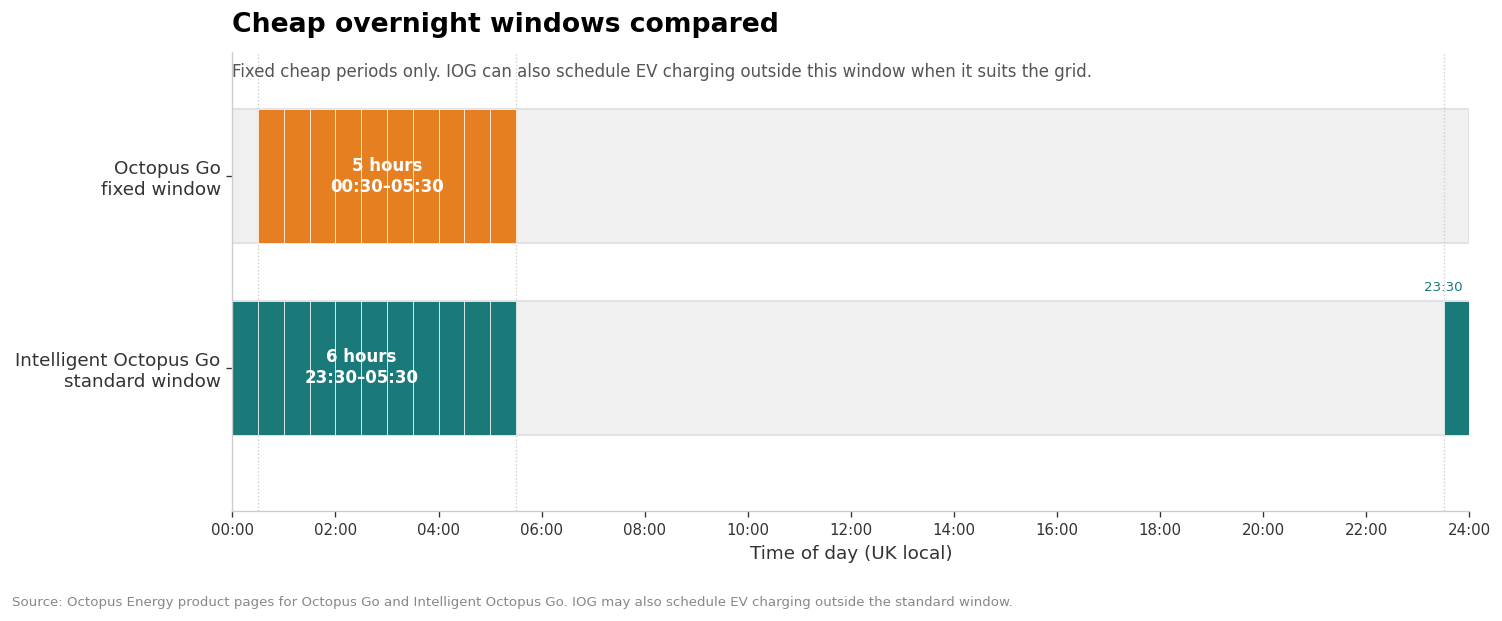
Octopus Go gives you one fixed overnight cheap period, from 00:30 to 05:30, and you decide what charges in it (see the Octopus Go product page). Intelligent Octopus Go has a standard 23:30 to 05:30 window, then schedules a compatible EV or charger around the grid (see the Intelligent Octopus Go product page). Both need an EV and a smart meter, but Intelligent Go adds compatibility and app requirements.
| Question | Octopus Go | Intelligent Octopus Go |
|---|---|---|
| What kind of tariff is it? | Time-of-use EV import tariff | Smart EV import tariff |
| Fixed cheap window | 00:30-05:30 | 23:30-05:30 |
| Off-peak rate | Postcode quote required | About 8p/kWh in the standard window |
| Charging control | You set the charging schedule | Octopus schedules a compatible car or charger |
| Extra cheap periods | No scheduled extra slots | Scheduled EV charging can be about 7p/kWh |
| Equipment route | No compatible home charger is currently required, but Go eligibility still applies | Needs a compatible car or charger, smartphone and half-hourly smart meter |
| Best fit | Control, simplicity and broad charger choice | Compatible equipment and hands-off EV charging |
Every rate below moves with your postcode, tariff version and the date, so treat the pence figures as a guide, not a quote. Octopus Go does not publish one UK-wide rate, so check its cheap and daytime prices against your postcode quote. Intelligent Go’s standard-window rate is about 8p/kWh. Octopus publishes current eligibility and rates on the Octopus Go product page and the Intelligent Octopus Go product page.
Why would I choose ordinary Octopus Go?
Octopus Go is the simpler choice when I want to decide exactly when each device charges. Its fixed 00:30-05:30 period is short but predictable. I can set my EV charger, battery inverter or other equipment to use that period without handing charging decisions to Octopus or checking whether my car or charger is on a compatibility list.
That does not mean it is a tariff for people who want to stay up and manage cables. A fixed timer in an EV charger or battery inverter can do the work. The point is that the schedule is mine. I can choose how much battery capacity to fill, whether the car takes priority, and whether to leave room for solar generation the next day.
Go still has eligibility conditions. You need to be an Octopus customer, have a compatible smart meter, and charge an EV at home. A home charger is not currently required. The exact import rate is postcode-quoted, so I would not make a battery calculation from somebody else’s screenshot or an old tariff article.
Why would I choose Intelligent Octopus Go?
Intelligent Octopus Go suits me when my main aim is low-effort EV charging and my car or charger is compatible. Octopus controls the charging schedule and can place it outside the standard 23:30-05:30 period. That can give the EV more charging opportunity without me trying to predict the best overnight slots myself.
The standard off-peak window runs for six hours, from 23:30 to 05:30, at about 8p/kWh. When Octopus schedules the EV outside that window, the scheduled charging rate can be about 7p/kWh.
The trade-off is that this only works if the right equipment is compatible. You need an eligible EV or plug-in hybrid charged primarily at home, and Octopus must be able to control either that vehicle or a compatible charger. You also need an Octopus account, a smartphone and a half-hourly smart meter. I would check the exact car or charger before choosing the tariff, not after changing it.
How can each tariff charge a home battery off-peak?
Both tariffs can help a home battery charge from cheap imported electricity overnight. The reliable planning window is the published fixed off-peak period: 00:30-05:30 on Go, or 23:30-05:30 on Intelligent Go. Set the battery inverter to charge within that period, then let the battery cover some later household demand.
If you want Octopus to manage the house battery separately from the EV, their Charge Pack add-on is aimed at that job. On their support channels they describe Intelligent Octopus Go staying in control of a compatible car, while Charge Pack manages battery charge and discharge on grid needs and wholesale rates. Treat that as product behaviour to confirm on your account, not as a fixed rate card.
With Go, this is straightforward. I would set a battery charge window inside 00:30-05:30 and decide its target state of charge around my EV requirement. If the EV and battery share a limited supply, I would also check that the charger, inverter and household demand do not try to pull more power than the installation can provide.
With Intelligent Go, I would still treat the published 23:30-05:30 period as the home-battery window. This is similar to the basic tariff-arbitrage approach I describe in my guide to a battery without solar: cheap import is stored for later use. The tariff does not remove the need to configure the battery sensibly around the car.
Do extra Intelligent Go slots make the whole house cheap?
No. This is the detail I would be most careful not to misunderstand. An extra Intelligent Octopus Go slot is scheduled EV charging, not a promise that all electricity used by the home receives the same price outside the normal 23:30-05:30 off-peak window. Plan household and battery charging around the fixed window unless Octopus’s current terms say otherwise.
That distinction matters most for a battery household. It is tempting to see an extra scheduled car slot and assume the battery, dishwasher and the rest of the house can also run cheaply. Do not build that assumption into the numbers. The relevant terms distinguish the scheduled EV charge from the standard six-hour home window.
I would therefore keep the two jobs separate. Let Intelligent Go optimise the compatible EV if that suits the setup. Let the home battery follow its own schedule inside the normal off-peak period. It is less dramatic, but it avoids planning a system around electricity pricing that may not apply to the rest of the house.
Which tariff suits your EV and home battery setup?
My honest verdict is simple. Octopus Go suits a household that wants control, does not need Octopus-compatible charging equipment, or wants its battery and car schedules to remain entirely self-managed. Intelligent Octopus Go suits a household with a compatible car or charger that values hands-off EV charging and is happy for Octopus to set the car’s charging slots.
- Choose Octopus Go if you want a fixed 00:30-05:30 cheap period, broad charging-equipment choice and direct control of both the EV and battery schedule.
- Choose Intelligent Octopus Go if your car or charger is compatible, you charge the EV primarily at home and you want Octopus to schedule that EV charging. Use the standard 23:30-05:30 window for the home battery.
- Pause before choosing either if your EV charging pattern is uncertain. Check the current postcode quote, smart-meter status, vehicle or charger compatibility and the latest Octopus terms first.
A tariff is only one part of the decision. If you are weighing a fully managed solar, battery and heat-pump package against building your own system, see my comparison of Octopus Zero Bills and DIY solar. For this narrower import-tariff choice, I would not chase Intelligent Go simply because it sounds smarter. Choose the one whose charging rules match the equipment and level of control you actually want.
