
Octopus will pay you a guaranteed minimum of £12 for every month your home battery is enrolled in Charge Pack, its new battery add-on. In exchange, Octopus schedules your battery day-to-day and calls on it to support the grid around twice a week. I have not signed a battery up to it; I have been through the product page, the FAQ and the sign-up conditions instead.
The provisional verdict: you are a candidate if you are already on a supported import tariff, already export on Outgoing Octopus, and were never going to manage the schedule yourself. Even then, the £12 is the only known gross credit; the net result depends on the export switch, on how well Octopus’s scheduler actually drives your battery, and on the wear question nobody has answered. Wait if you run your own charging strategy, if your export tariff pays better, or until Octopus answers that wear question in writing.
What is Charge Pack?
Charge Pack is an add-on, not a tariff: you keep your existing import tariff and Octopus layers its scheduling on top. Day-to-day, it charges your battery when your energy is cheapest, on your overnight rate or your spare solar, and runs the house from the battery when the day rate kicks in.
The second layer is grid-support sessions. Octopus monitors local market forecasts, and when the grid needs help it instructs your battery to charge or discharge. Sessions run around twice a week, with up to 24 hours’ notice. You also get live device data inside the Octopus app.
If you already run your own charge schedule, read that again. Joining means Octopus’s scheduler replaces yours. That is the whole trade: money for control.
How much does Charge Pack pay?
| Term | What Octopus states |
|---|---|
| Guaranteed minimum | £12 per enrolled month, topped up at the end of each month |
| Grid-support sessions | Around 2 per week |
| Session notice | Up to 24 hours ahead |
| Session credits | Paid into your Octopus account a few days after each session |
| Your bills | Continue separately as normal |
| Charging in a session | Compensated so it effectively costs your off-peak rate |
| Discharging in a session | Compensated at the difference between your day import rate and your export rate |
The £12 is a floor, not a payment rate. Session rewards vary and Octopus publishes no per-session or per-kWh figure; at the end of the month it tops you up to £12 if the sessions earned less. Over 12 months that floor is equivalent to £144, if you stay enrolled and eligible and the terms do not change. Octopus publishes no contract length or notice period, so treat anything beyond the current month as Octopus’s intention rather than a guarantee.
The compensation rules matter more than they look. If a session drains charge you would have used yourself, you would otherwise buy that electricity back at your day rate. Octopus credits the difference between your day rate and your export rate so you are not out of pocket. As an illustration only: with a 26p day rate and a 12p export rate, that credit is about 14p for each discharged kWh, on top of the export payment itself.
Octopus’s claim that sessions “will never cost you anything” is about your bill. It says nothing about your battery, which I come back to below.
What control do you hand over?
Three things, and none of them is negotiable at sign-up.
- The schedule. Octopus decides when your battery charges and discharges, every day, not just during sessions.
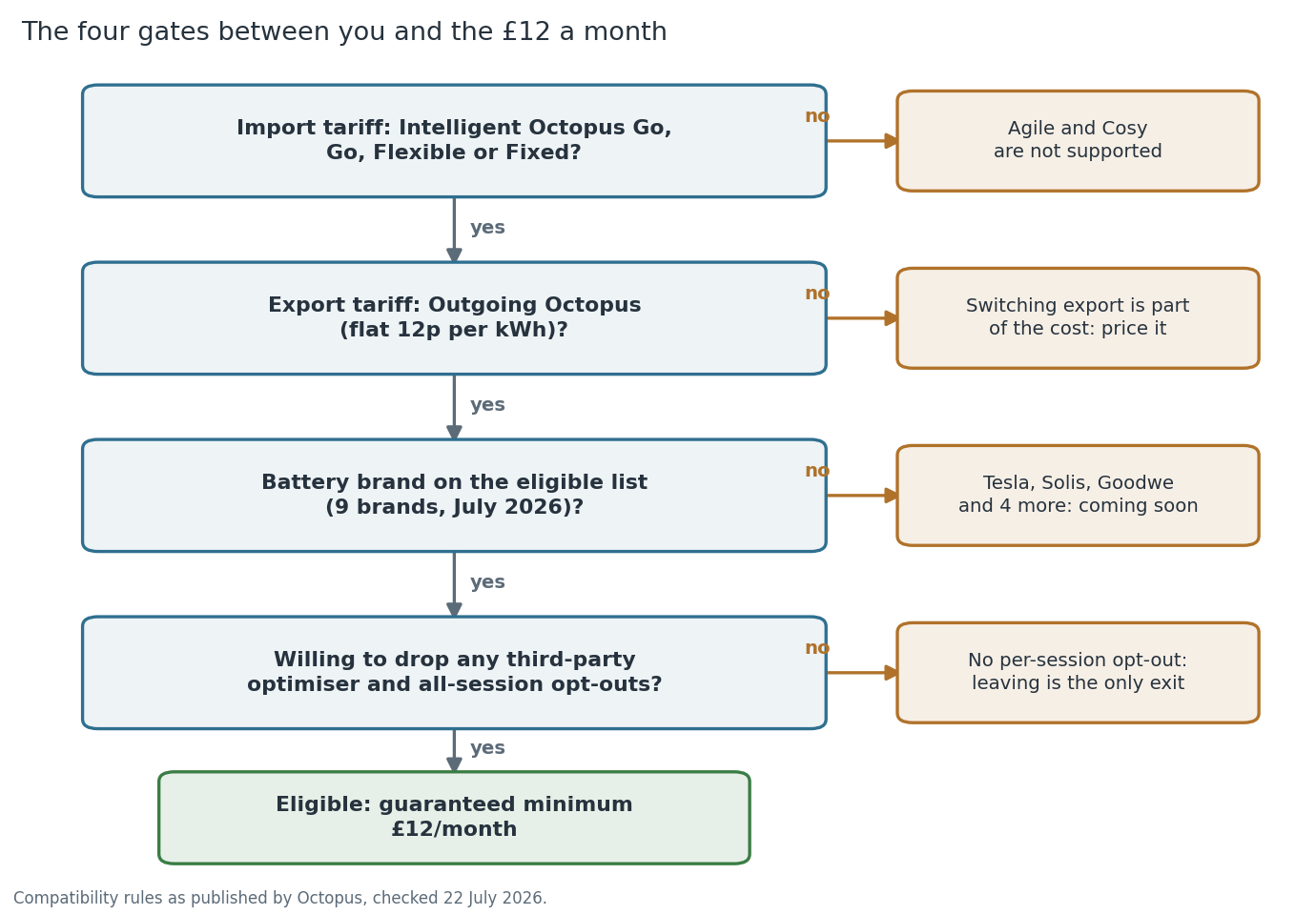
- Session participation. There is no per-session opt-out. The FAQ is explicit: “you are automatically opted into all sessions when you sign up”. If a session lands at an awkward time, you cannot skip it. Leaving the scheme entirely, via a form or an email to Octopus, is the only exit.
- Third-party optimisers. Charge Pack is not stackable with services like Axle Energy. Octopus’s stated reason is that two providers fighting over one battery “creates a problem”. On Intelligent Octopus Go you cannot use a third-party battery service at all; Charge Pack is Octopus’s sanctioned alternative.
Which tariffs does Charge Pack work with?
Your import tariff must be Intelligent Octopus Go, Octopus Go, Flexible or Fixed. Your export tariff must be Outgoing Octopus, which Octopus’s tariff page advertised at a flat 12p per kWh when checked on 20 July 2026 (rates change and vary by region; check the current figure before you sign). Agile is not on Octopus’s published compatible-import list, so do not assume you can keep it. Cosy is not listed as supported either; Octopus invites Cosy customers to register for updates. Octopus Flux and Intelligent Octopus Flux are separate standalone battery tariffs, not hosts for this add-on.
The export requirement is the one to price up. If your current export tariff pays better than Outgoing Octopus for your usage pattern, switching is part of Charge Pack’s cost. Run your own numbers with our Outgoing Octopus export tariff guide before signing anything.
Which batteries are compatible?
Nine brands are eligible as of 22 July 2026: AlphaESS, EcoFlow, Enphase, FoxESS, GivEnergy, HanchuESS, Huawei, Sigenergy and SolarEdge. Seven more are listed as coming soon: Tesla, Solax, LuxPower, Solis, Goodwe, Duracell and Hinen. You also need a working smart meter. Octopus does not state a minimum battery size, and it publishes no geographic or meter-type restrictions beyond that.
One name on that list needs a footnote. GivEnergy Ltd entered administration in April 2026, ceased trading, and its administrator has stated that no further hardware warranties or app support will be honoured. Eligibility is a listing for people who already own the hardware, not a reason to go and buy some. If you have a GivEnergy battery already, Charge Pack is a genuine bonus on top of a unit you have paid for. If you are shopping for a battery in order to qualify, choose a manufacturer that is still trading. Worth asking Octopus directly as well: Charge Pack schedules your battery through the manufacturer’s cloud connection, so it is fair to ask what happens to the GivEnergy integration if that service stops. The guide to avoiding an orphaned system covers what an owner can still do.
Sunsynk and Deye do not appear on either published list as of the same date. If that is you, nothing changes for now: keep running your own schedule and check Octopus’s current compatibility list before applying.
Is £12 a month actually good money?
The £12 monthly floor is payment for scheduling control and grid participation, not free money. Whether it is good payment depends on what your battery earns today.
If your battery sits on the installer’s default schedule, Charge Pack adds tariff-aware charging plus a gross credit you were not earning. Whether that becomes a net gain depends on two checks: whether switching export to Outgoing Octopus loses you money, and the unanswered wear question below.
If you already run a tight schedule yourself, the only known credit is £12 a month gross. Anything above it is unpublished, and whether Octopus’s scheduler matches a good manual setup is unpublished too; there is no performance data to compare.
What you can price is the restriction list: Agile is not on the published compatible list, so assume your Agile strategy does not carry over, and your export tariff is fixed by the scheme.
Our Agile battery strategy guide and cheap-rate charging calculator show what a self-managed setup earns, which is the number to weigh the floor against.
The genuine unknown is battery wear. Grid sessions can change or add to your battery’s throughput, and nothing Octopus publishes for Charge Pack addresses cycle counts, throughput, state-of-charge floors, or what happens if scheme cycling collides with your manufacturer warranty. Check whether your warranty caps total energy throughput or cycles rather than just years; the answer decides how much scheme cycling matters to you.
Before joining: read your warranty document for a throughput or cycle cap, and ask Octopus in writing whether Charge Pack cycling is covered. I could not find that answer anywhere official, and for a scheme built on moving energy through your battery, that is a gap you should not fill with optimism.
Should you join, or wait?
Join if all of these are true:
- You are on, or happy to move to, Intelligent Octopus Go, Go, Flexible or Fixed for import.
- You are on, or lose nothing by moving to, Outgoing Octopus for export.
- Your battery brand is on the eligible list.
- You were never going to micro-manage the schedule yourself.
Wait if any of these is true:
- You are on Flux or Intelligent Octopus Flux, purpose-built battery tariffs you would have to leave.
- You run an Agile import strategy.
- Your current export tariff beats Outgoing Octopus for your pattern.
- Your warranty has a throughput cap and Octopus has not answered the wear question in writing.
- You use a third-party optimiser you would have to drop.
What should you ask before you sign?
Can you skip individual grid sessions?
No. Octopus states you are automatically opted into all sessions when you sign up. The only way out of a session is out of the scheme: you leave Charge Pack entirely using its opt-out form or by emailing Octopus.
Does Charge Pack work with Agile Octopus?
Agile is not on the published list of compatible import tariffs, which names only Intelligent Octopus Go, Octopus Go, Flexible and Fixed. Octopus has not published an explicit ban, but as of July 2026 you cannot treat Agile as supported.
Does Charge Pack cover battery wear or warranty risk?
Octopus does not address this anywhere in the Charge Pack material: no cycle figures, no throughput estimate, no warranty indemnity. The “never lose out” promise covers tariff costs, not battery degradation. Check your own warranty for throughput limits and get Octopus’s answer in writing before joining.
Is Charge Pack the same as Octopus Power Pack?
No. Power Pack is Octopus’s vehicle-to-grid product for EVs, currently limited to a V2G-enabled BYD Dolphin with a Zaptec Pro charger. Charge Pack is for stationary home batteries. The names are close; the products are not.
What should you do next?
Price the whole package, not the headline:
- Compare your current export rate against Outgoing Octopus’s current rate.
- Compare what your current battery schedule earns against handing it over, using the calculator linked above.
- Put the £12 monthly floor on the other side of the scales, with above-floor session pay treated as unknown.
For the reference points, start with Go vs Intelligent Octopus Go and Flux vs Agile for a home battery, then quantify what your current setup earns. Charge Pack’s side of that comparison stays unknown until you have observed it for a few months, including whether your solar self-consumption is protected during sessions, which Octopus does not publish either.
