
Plug-in solar panels make DC electricity from sunlight, a microinverter converts it to 230V AC, and that AC feeds into your house wiring through an ordinary socket. Whatever your appliances are drawing at that moment uses the solar power first, so your meter records less import. Two panels and a microinverter produce up to 800W. Plugging one into a UK socket has been legal in Great Britain since 27 August 2026, as long as the exact model is listed as Compliant on the ENA plug-in solar register: see our full status guide for the register, the prices and the traps.
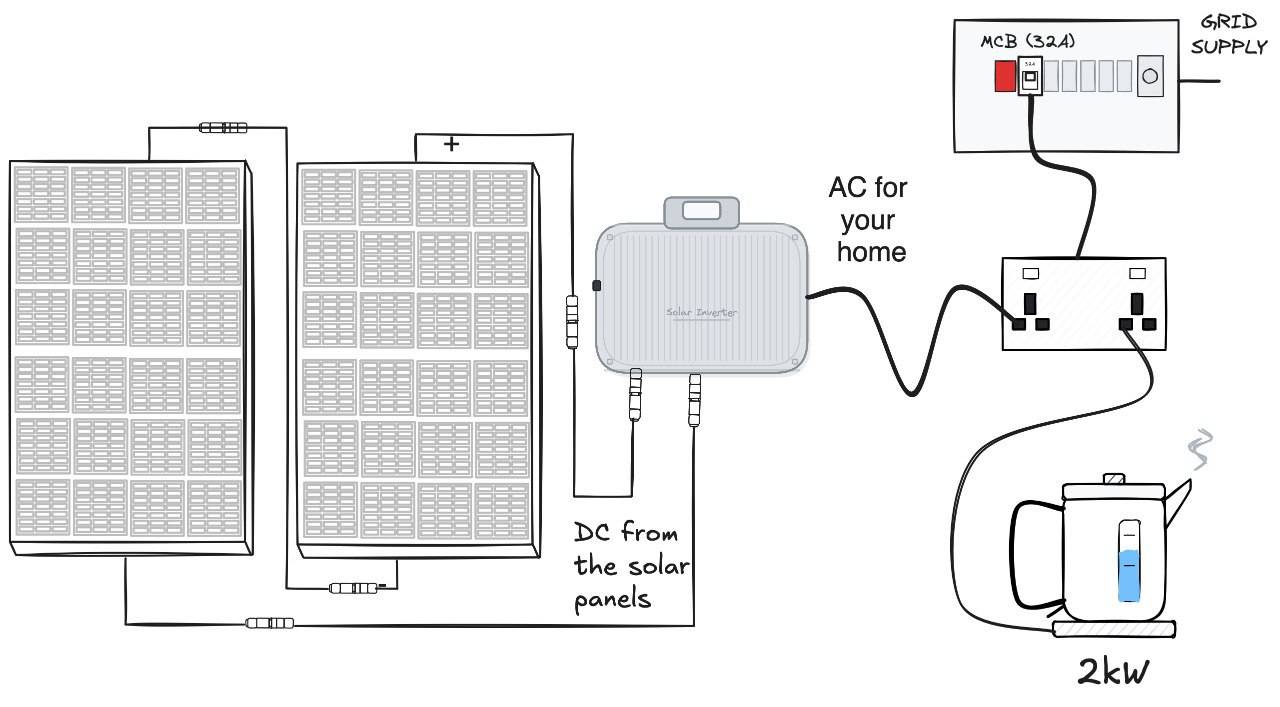
That is the whole mechanism in one picture. The rest of this guide covers what each part does, where the power goes moment to moment, the electrical reason Britain would not let you plug one in, and where the rules stand today.
What Are Plug-in Solar Panels?
A plug-in solar system is built from two active parts: one or two solar panels that generate DC electricity, and a microinverter that converts it to 230V AC and is designed to feed it into a home circuit through a standard socket. The panels are the same rooftop-grade monocrystalline panels used on a full roof array, just fewer of them, mounted somewhere accessible: a balcony rail, a fence, a garden frame.
Because there’s no roof work and no scaffolding, most people can have the panels in place within an afternoon. What takes longer is the checking that comes first: whether the exact model is on the register, and whether your own circuit is suitable. Both are covered further down this guide.
Is Balcony Solar the Same as Plug-in Solar?
Yes. Balcony solar, plug-in solar, and Balkonkraftwerk describe the same technology: a small solar system, typically one or two panels plus a microinverter, designed to connect through a standard socket. “Balcony solar” is the German and central European term, where millions of these systems are mounted on apartment balcony rails. In the UK the common term is “plug-in solar” because people mount them in gardens, on walls, sheds, and garage roofs, not just balconies. The hardware and the underlying regulatory questions are the same whichever name you use.
The Three Components You Need
A plug-in solar system has three parts. Nothing else.
- Solar panels: one or two standard monocrystalline panels, typically 400–450W each. These are the same panels used on rooftops, just fewer of them. They convert sunlight into DC (direct current) electricity, which nothing in your house can use directly.
- Microinverter: a small sealed box built into the cable or mounted behind the panels, and the only clever component in the system. It converts panel DC into 230V AC, matches the voltage and 50Hz frequency your wiring is already running at so the two can share the same copper, and holds its output fractionally above the grid’s so current flows into your house rather than the other way. It also carries the safety behaviour: it stops generating within a fraction of a second of losing the grid, and it clips its own output at 800 VA no matter how much the panels offer it.
- A plug: connects the microinverter output to a socket on your ring main. In Germany, this is a Schuko plug. The UK interim specification requires a factory-fitted BS 1363 plug with a 5A fuse and partly insulated pins, and bans extension leads and adaptors.
For a deeper look at how microinverters compare to string inverters and when each makes sense, see our guide to adding panels with microinverters.
How Does Electricity Move From the Panels Into Your Home?
Here is the sequence from photon to lower electricity bill:
- Sunlight hits the solar cells. Each panel contains 108–144 silicon cells arranged in a grid. Photons from sunlight knock electrons loose in the silicon, creating a flow of DC electricity. A 445W panel produces roughly 10–11 amps at 40–45 volts in direct sun.
- The microinverter converts DC to AC. Your home runs on 230V AC at 50Hz. The microinverter takes the low-voltage DC from the panels and converts it to AC that matches the grid’s voltage and frequency closely enough to sit on the same wires without fighting it. Modern microinverters like the Hoymiles HMS-800W-2T do this at 96.7% efficiency, so very little energy is lost in the conversion.
- AC feeds into your home circuit. The plug connects to a socket on your ring main, and the current flows into the circuit and is used by whatever is drawing power at that moment. Your wiring does not distinguish between electricity from the grid and electricity from your panels, because there is nothing to distinguish. It is all 230V AC on the same copper.
- Your meter measures the difference. The meter sits between your house and the grid and counts only what crosses it. If you are using 500W while the panels are producing 400W, the meter sees 100W of import, and 100W is what you are billed for. The other 400W never crossed the meter, so as far as your supplier is concerned it never existed.
- When the sun goes down, the inverter stops. No sun means no DC input, so the microinverter produces nothing and your home draws entirely from the grid again. There is no switch to flip and nothing to remember. The handover happens continuously, second by second, all day.
Where Does the Power Actually Go?
Nowhere clever, and that is the part most product pages skip. The kit’s current joins the same wires everything else in the house is connected to, and electricity goes to the nearest thing asking for it. Your fridge, your router, your standby loads and your lights take it before the grid gets a look in, not because anything decides that, but because they are closer.
So one number decides whether a plug-in kit is worth owning: self-consumption, the share of what you generate that your own house uses at the moment it is generated. A unit you use yourself is a unit you did not buy at roughly 26p. A unit you don’t use leaves the property, and on a self-installed kit you are paid nothing for it. Generation is not the number that matters. Self-consumption is.
Put figures on it. A kit that makes 700 kWh a year at 30% self-consumption, which is normal for a house that is empty on weekdays, saves you about £55. The same kit at 70%, which needs either someone home in the day or a battery, saves about £128. Identical hardware, identical sunshine, more than double the money. That is why the useful questions to ask before buying are about your daily routine, not about the panels.
What Happens to the Surplus You Don’t Use?
When your panels generate more than your home is drawing at that moment, the surplus flows out through your meter and onto the grid automatically. There’s no local storage without a battery, so that extra power leaves the house rather than sitting around waiting for you to need it.
Assume you get nothing for it. Smart Export Guarantee payments require an MCS-certified installation, and a self-installed plug-in kit cannot get MCS certification. Every exported unit is given away, not sold, until you have a certified installation that qualifies for an export tariff. The one exception so far is Octopus. On 10 October 2026 it offered Prime Outgoing Octopus to buyers of its own kit who also take its electricity and have a smart meter. That tariff pays 9p/kWh outside 4pm to 7pm, which covers almost every hour a plug-in kit generates. Its first kits arrived in early October.
That’s different from wasting the electricity. The unit still gets used, just not by you: your surplus reduces demand somewhere else on the local network. From a straightforward money perspective that distinction doesn’t help your bill. What you don’t consume yourself, you don’t save on.
What Can 800W of Plug-in Solar Power?
Real UK yield from a two-panel 800W kit. Roughly 5-6 kWh on a clear April day, 7-8 kWh on a clear June day, and near zero on an overcast December afternoon. Across a full year, a good site at 28° tilt facing south in central England returns 750-900 kWh per kWp, per PVGIS SARAH3, so a kit clipped at 800 W lands around 650-800 kWh.
Fit more panel than the inverter can pass, 1-1.1 kWp behind the same 800 W microinverter, and 800-1,000 kWh a year becomes realistic. That sounds like cheating and isn’t. The extra panel area does nothing at midday in June, when the inverter is clipping anyway, but it lifts output through every dull morning and grey afternoon when the inverter was never the limit. Overpanelling buys you the bad hours, not the good ones.
For context, the average UK home uses around 2,700 kWh of electricity a year (Ofgem’s typical domestic consumption figure). A kit generating 650-800 kWh could in theory offset a quarter to a little under a third of that, or nearer 37% if you overpanel as described above, and only if every unit were used on site. In practice only part of it is, for the self-consumption reason above.
800W is the maximum AC output from a standard plug-in solar kit. In practice, output varies with weather, angle, and time of day. On a clear summer day in the south of England, expect 600–800W around midday. On an overcast day, 100–300W. In winter, 50–200W during the short daylight hours.
To put that in context, here is what 800W can run simultaneously:
| Appliance | Typical Wattage | Running on 800W? |
|---|---|---|
| Fridge-freezer | 100–150W (when compressor runs) | ✅ Easily |
| Wi-Fi router | 10–15W | ✅ |
| TV (55″) | 80–120W | ✅ |
| Laptop charging | 45–65W | ✅ |
| Washing machine | 400–500W (heating cycle: 2,000W) | ⚠️ Only during cold wash |
| Electric kettle | 2,000–3,000W | ❌ Far exceeds 800W |
| Oven | 2,000–2,500W | ❌ |
The sweet spot for plug-in solar is base load, the electricity your home draws 24/7 from always-on devices. A typical UK home’s base load is 200–400W. An 800W system covers this completely during daylight hours and often has surplus to spare. For a deeper look at base load and how solar offsets it, see our guide on solar energy and your home’s base load.
Without a battery, a kit like this only offsets electricity you use while the sun’s out. Realistic self-consumption for a home that’s empty during the day is roughly 25-40%, worth roughly £40-85 a year at the price cap unit rate of 26.32p/kWh, which runs from 1 October to 31 December 2026. Our buying guide covers the full cost and savings maths.
Why Can’t You Just Plug a Generator Into a Socket?
The wiring rules still ban connecting a generator to a household circuit through an ordinary plug and socket, and the reason is not the one most people assume. It isn’t live pins, which modern microinverters solved years ago. It is a measuring problem, and it has a name: breaker masking. This is the part of the story almost nobody explains, so it is worth doing properly.
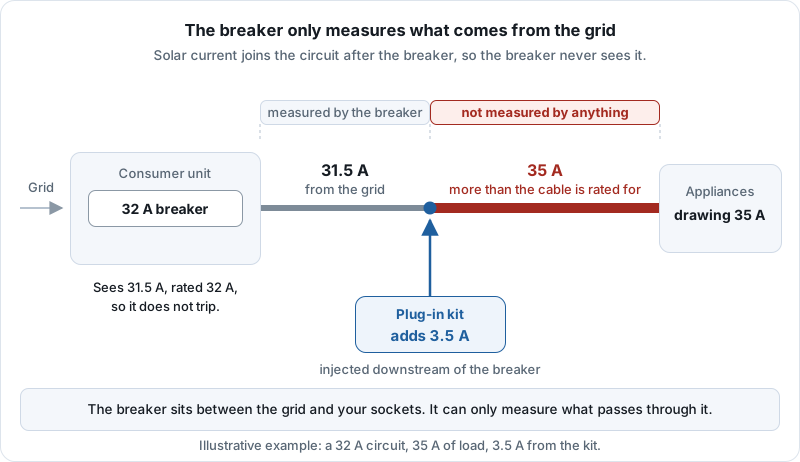
Start with what a breaker actually does, because it is less than most people think. A breaker is not a guardian watching over a whole circuit. It is a gate at one specific point, the point where that circuit leaves your consumer unit, and it trips on the current passing through the gate. Everything it knows about your wiring, it learns from that one measurement.
That works perfectly as long as the grid is the only thing supplying the circuit, because then every amp reaching every appliance has to pass through the breaker first. The cable is rated for the breaker, the breaker measures the lot, and the arrangement is sound. A plug-in kit breaks the assumption it rests on. The kit injects its current at a socket, downstream of the gate, in the stretch of circuit the breaker has no visibility of at all.
Now load the circuit up. Say the appliances on it are drawing 35 A between them while your kit is supplying 3.5 A of that. The grid only has to make up the difference, so 31.5 A passes through the breaker. It reads that as comfortably inside its 32 A rating and does nothing, because from where it sits nothing is wrong. The cable between the kit and those appliances is carrying the full 35 A, more than it is rated for, and no device in the house is watching that stretch of copper.
Nothing dramatic follows from that in most houses. Cables do not fail at 110% of rating, they get warm, and a few amps of hidden overload for an hour on a summer afternoon is not a fire. The problem is that it is invisible, so it does not self-correct: the normal feedback, a breaker tripping and you working out why, has been removed. Overload on a healthy circuit is a nuisance you find out about. Masked overload is one you don’t.
This is also what the 800 W and 3.5 A caps are for, and seeing that makes the numbers stop looking arbitrary. You cannot remove the blind spot without rewiring the house, so the specification bounds it instead. Cap the kit at 3.5 A and the worst overload it can ever hide is 3.5 A, whatever else is happening on the circuit. The limit is not a judgement about how much solar a home needs. It is the size of error the designers were willing to leave undetected.
Why a UK Ring Circuit Makes This Worse
Britain wires sockets differently from most of Europe, and the difference matters here. A UK ring final circuit leaves the consumer unit, runs past a string of sockets, and comes back to the same breaker, so the circuit is a loop with both ends on one 32 A device. Current reaching any socket can arrive along either leg, and how it divides between them depends on where that socket sits in the loop and what else is drawing power at the time.
That is a sound design for its original purpose. It lets a 32 A circuit run on lighter cable than a single 32 A run would need, because the load shares across two paths. It also means no one can say with confidence how many amps any particular length of that cable is carrying at any moment, and the ring was only ever designed on the assumption that all of it comes from the breaker.
Most of continental Europe wires sockets as radials instead: one cable, one direction, a smaller breaker, fewer sockets on it. Inject current partway along a radial and the picture is still simple, because there is only one path and one place the extra current can go. Germany’s balcony solar sits on circuits that are far easier to reason about than ours, which is part of why a country can adopt the same 800 W product and face a smaller version of the same question.
What This Means If Your Wiring Is Older or Marginal
A listed 800 W kit on sound wiring with normal loads is not the thing to worry about. Masking bites where the circuit had no margin to give away in the first place, and that is worth being honest about rather than reassuring about.
Since legalisation the electrical bodies have pointed at one component in particular, and it is not the panels. It is the RCD in your consumer unit. Electrical Safety First says a Type AC RCD is unsuitable for the addition of plug-in solar, because a small DC residual current can stop it protecting you. Type A, Type F and Type B are the suitable ones, and the section on the socket and the circuit below has the rest of the detail. Our guide to whether your home is suitable for plug-in solar walks through the labels on your own board.
The IET published a survey on the day the law changed, and it explains why the bodies are worried. A quarter of UK adults know which type of RCD they have. Thirty-seven per cent do not know what an RCD is. Eleven per cent know the type and how to test it. And 23% said they would reach for an extension lead or a multiway adaptor if the cable did not reach.
The situations that deserve a second look before you connect anything:
- A circuit that already trips. If the ring occasionally cuts out when the tumble dryer and the kettle coincide, it is already running at its limit, and you are proposing to add a few amps it cannot see.
- A socket that runs warm, or shows browning around the pins. That is a bad connection making heat, and a bad connection gets worse with more current through it, not better. Fix it first, whatever else you do.
- A spur, or a socket you are not sure is on the ring. A spur is a branch off the ring on lighter cable with its own limits, and it is exactly the kind of segment where a small hidden addition matters most. If you cannot say which sockets are ring and which are spur, that is the question to answer.
- An old installation with rewireable or cartridge fuses. A fuse board gives you no RCD protection at all. Electrical Safety First says a home like that needs an inspection before a kit goes anywhere near a socket.
- Extension leads, adaptors, and the wrong circuit. The specification bans running a kit through an extension lead or a multi-way adaptor, and this is why: a lead rated for a kettle was never designed to carry a second current source on top of whatever else is plugged into it. Electrical Safety First adds cable reels, travel adaptors and RCD adaptors to that list. It also says never to use a lighting circuit, or a circuit feeding fixed equipment such as an oven or a hob.
Notice what the hardwired route does about all of this. A system wired to its own dedicated breaker at the consumer unit is not downstream of anything. Its current passes through a protective device sized for it, on a cable serving nothing else, so the blind spot never opens. That is the real difference between the two ways of connecting solar, and it explains why the hardwired option has been legal all along while the socket needed a new specification, a safety study and a change in the law to allow.
Does Plug-in Solar Work During a Power Cut?
No. When the grid goes down, your panels stop feeding power into your home within a fraction of a second, so you get no backup power during a cut. That’s not a limitation, it’s the safety design working as intended.
The cutoff is called anti-islanding, and a grid-tie microinverter detects the loss using the very thing it was synchronising to. Once the grid’s voltage and frequency are no longer there to follow, it has nothing to lock onto, so it shuts down rather than energising a dead network by itself. That stops it back-feeding lines an engineer may be working on, and it is also what makes the plug safe to handle.
The UK interim specification puts a number on it: a compliant product’s plug pins must fall below 34 volts within 100 milliseconds. That is now a binding requirement for every kit listed on the register, not a promise about future hardware. An unlisted kit carries no such guarantee. Germany’s product standard, which the UK specification is modelled on, requires the same behaviour.
The same protection covers you pulling the plug rather than the grid failing, because from the inverter’s side the two look identical. Unplug the kit mid-generation and the pins are dead before your hand can reach them, so moving the panels or coiling the cable away is not live working.
What Does the Specification Require From the Socket and Circuit?
The interim specification caps a plug-in kit’s AC output at 800 VA and its current at 3.5 A, whatever the panels can produce on the DC side upstream. It also bans running one through an extension lead or a multi-way adaptor. Given how breaker masking works, that follows: a lead or adaptor rated for a kettle was never designed to carry a second, hidden current source on top of whatever else is plugged into it. The kit belongs on a socket circuit, which rules out lighting circuits and circuits feeding fixed equipment such as an oven or a hob.
It settles the plug question too. A compliant kit must come with a manufacturer-fitted, non-rewireable BS 1363 three-pin plug, fused at no more than 5 A, with partly insulated pins so the exposed metal is never live. Panels are capped at 2,000 W on the DC side, and above 960 W of panels the manufacturer must tell you to consider a professional assessment, which is advice to you rather than a requirement on you.
Your side of the deal is a normal, healthy UK socket on a circuit you know the state of. If the socket or the wiring behind it is tired, fix that first.
There is now a named test for that circuit, and it is the one the safety bodies led with on legalisation day. A microinverter can put a small DC component onto the AC side. A Type AC RCD can fail to see it, which is why Electrical Safety First calls Type AC unsuitable for the addition of plug-in solar panels. Type A tolerates a DC residual above 6 mA, Type F above 10 mA, and Type B handles more again, so all three are suitable.
Type alone is not the whole check. The RCD or RCBO protecting that circuit also has to work with current flowing in both directions, and almost none of them say so on the front. Some carry a “BD” or “Bi-dir” suffix in the part number, but the marking is not consistent between makers. If your board still runs on rewireable or cartridge fuses, there is no RCD at all, and an inspection comes before a purchase. Our guide to whether your home is suitable for plug-in solar takes you through reading your own board.
Does plug-in solar need a dedicated circuit or a fused spur?
No to both. A compliant kit plugs into an ordinary socket on a socket circuit, as long as the socket is in good condition and the circuit passes the RCD checks above, so you do not need a new circuit for it. Follow the kit’s own instructions too. A fused spur is the wrong fitting altogether. It is a permanent wired connection, and the plug-in route covers only a kit that connects through its own factory-fitted plug.
The specification makes the plug the only way in. The kit must come with a manufacturer-fitted plug that you cannot rewire, and you connect it only through that plug. If you cut the plug off and wire the microinverter into a fused connection unit, the kit is no longer a plug-in kit. It becomes a hardwired installation, and that is a different route with different rules. A competent electrician has to confirm that the microinverter is approved for a permanent connection, do the work to the wiring regulations, and check whether G98 or G99 applies to your home. The installer then notifies your network operator, instead of you doing it through the plug-in route.
A new circuit is worth paying for in one case: when the only socket in reach is on a spur, or on wiring you are unsure of. A spur is a single branch off the ring, so its cable has one path back to the consumer unit instead of two. That is where a hidden extra current matters most, as the section on older wiring explains. An electrician can fit a weatherproof socket on its own circuit, and the kit then plugs into that socket as normal.
What If Your Home Already Has Solar?
Then a plug-in kit may not be a plug-in job for you, legal or not. This is the detail almost every write-up of legalisation missed.
Small generation connects to the grid under G98, the notify-and-connect route your installer used if you already have panels. G98 has a ceiling of 3.68 kW per phase, and that ceiling is cumulative across the whole property. It is not an allowance each new device gets to spend afresh. The August 2026 amendment to G98 says the same thing for plug-in kits: one may sit alongside permanently wired generation only while the aggregate registered capacity of the lot stays inside 16 A per phase.
So a house with a 3 kW array has 680 W of headroom, not 3.68 kW. Add an 800 W kit and the property totals 3.8 kW, which is over the line, and the entire installation drops out of G98 into G99. G99 is a different animal: a formal application to your network operator that has to be assessed and approved before anything is connected, and that typically runs to weeks rather than days.
Two things make this bite harder than it first sounds. Network operators go by the capacity the manufacturer declares for the equipment, and the dividing line is who can change it. A restriction the manufacturer locks in counts, which is how a kit with more panel wattage than that still registers at 0.8 kW. A limit you can reach and change yourself does not count, so dialling your export limit down in an app does not put you back under the threshold. And on a three-phase supply the 3.68 kW applies per phase, so which phase the new kit lands on can change the answer entirely.
The practical move is to add up what you already have before you buy anything. If your existing inverter is 3 kW or above, assume you are in G99 territory and start the conversation with your network operator first. Our guide to registering a DIY solar installation with your DNO walks through what that application involves.
What Rules Apply in the UK Right Now?
You can run a plug-in kit from a socket, and you have been able to since 27 August 2026. That is the day SI 2026/848 came into force, exactly as it was made. The law writes a “plug-in microgenerator” into the rulebook: a device that generates from sunlight, produces no more than 800 W of AC, is meant for a standard plug and socket, and is not designed to import electricity in order to store it.
The law does not describe the product itself. It names the DESNZ interim product specification by name and version instead, so version 2 of 16 July 2026 is the legal test. Its limits are the ones set out above: 800 VA and 3.5 A on the AC side, up to 2,000 W of panels, and a factory-fitted BS 1363 plug fused at 5 A or less.
Compliance is public, and that is the part to use. The Energy Networks Association runs a plug-in solar category on its type test register. When I read it on 10 October 2026 it held 133 entries: 120 listed Compliant, from 26 makers, and 13 listed Non-compliant. Worldwide Solar, Perlight Solar and City Plumbing hold the most models. Search the exact model number rather than the brand. InstaGroup and Fusion Renewables each have models on both sides of that line, and statuses move in both directions: Perlight moved a model from Non-compliant to Compliant in early October.
One device per household is now settled rather than pending. The Energy Networks Association published G98 Amendment 1 in August 2026, and its scope says so in as many words:
This EREC G98 permits the connection and operation of a single Plug-in Micro-generator, including plug-in Solar PV and plug-in Electricity Storage, in a Customer’s Installation where the Plug-in Micro-generator has a Registered Capacity of 800 W or less. Connecting more than one Plug-in Micro-generator is not allowed.
ENA, EREC G98 Amendment 1, Issue 2, clause 2.2, August 2026
The relaxation to one device per circuit, which the July specification had left open, did not happen. One home, one kit.
There is a limit almost nobody has printed. Regulation 3, the part of SI 2026/848 that makes the socket connection lawful, extends to England, Wales and Scotland only. Northern Ireland has its own network regulations and its own version of G98, and neither has changed. If you live in Northern Ireland, plugging a kit in is not yet lawful, and no timetable has been published.
Two kinds of product sit outside all of this. The kits that fill an Amazon search for “plug in solar” do not appear as Compliant in that register category, however the listing is worded, so they have no socket route. And a kit with a battery built into it is excluded by the legal definition itself, because the law covers a device that is not designed to import electricity to store it.
For anything the register does not cover, the hardwired route is still there and always was. A registered electrician wires the system to its own breaker at the consumer unit and notifies your network operator under G98, the same route used for a small roof array.
That is the short version. For the full legal picture, the timeline, and what is confirmed against what is merely being claimed, see our main plug-in solar guide.
What Did the UK Electrical Safety Study Find?
Alongside the June 2026 consultation, the government published an independent electrical safety study (RAF013/2526, commissioned from Arceio Ltd and Eurofins). The study tested six representative plug-in solar products on UK-style domestic circuits. Within the conditions it tested, all six demonstrated the core characteristics of safe operation: thermal behaviour, anti-islanding, and fault handling all held up. But every kit also exceeded a radio-interference limit, and the reason is worth understanding before you read too much into “tested safe.”
Every one of the six kits exceeded the Class B quasi-peak limit for conducted electrical emissions when running at its maximum rated output, and five of the six also exceeded the Class B average limit. For context, ordinary background loads in the test home, appliances with nothing to do with solar, also exceeded Class B on their own. That doesn’t excuse the panels’ results, but it shows the limit is a demanding one that plenty of everyday electronics can trip too.
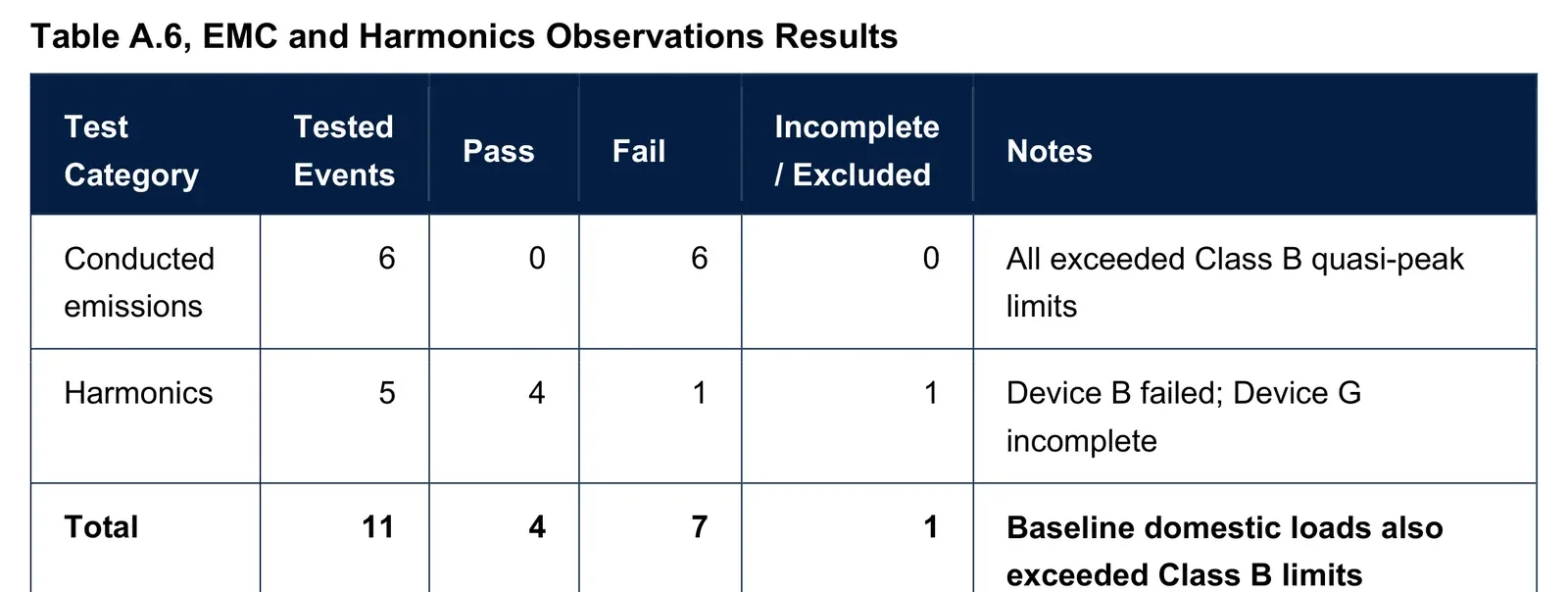
Read this as evidence about test boundaries and product-quality variance, not a verdict that plug-in solar is unsafe. Nothing about the emissions was linked to a safety incident in testing, and it isn’t proof that every kit currently on sale would fail the same test: it’s a six-product sample, not a market survey. The study’s own conclusion was that plug-in PV can operate safely within a no-modification boundary, and it recommended enabling a controlled deployment framework rather than blocking the technology. What it does confirm is why a conformity step was needed at all: the six kits tested had an emissions gap to close, and nothing in the study told a buyer which products had closed it.
The register is what closed that gap. A hundred and twenty kits were listed Compliant on 10 October 2026, which means each submission has been accepted as demonstrating compliance with the specification. A kit that is not listed has not answered the same question, whatever “UK ready” claim sits on the box. The study itself was a safety investigation and not a certification scheme, so it never certified anything, and a “Non-compliant” line on the register is a status for a submission rather than a verdict on a product’s safety.
Where Should You Put Plug-in Solar Panels?
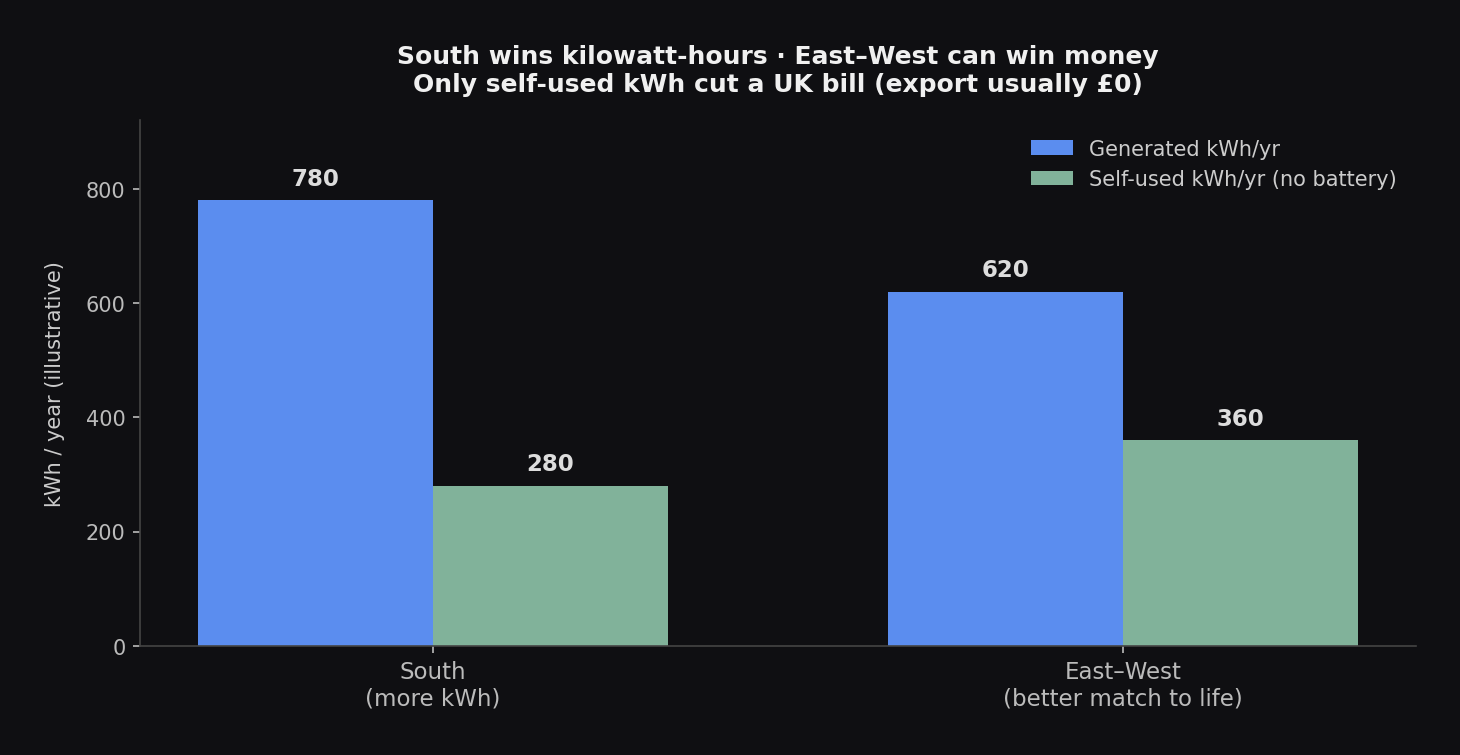
The best position is wherever gets the most direct sunlight for the longest part of the day. In the UK, that means:
- South-facing balcony or wall: ideal. A 30–35° tilt gives the best annual output. Vertical mounting (on a balcony rail) produces about 70% of the optimal, but is the easiest to install.
- Garden or patio: prop panels against a south-facing wall or use a ground mount frame. Easy access, easy to adjust angle seasonally.
- Flat roof: use tilt frames to angle the panels. Without tilt, flat panels produce about 87% of optimal output in the UK.
- East or west facing: usually less total kWh than south, but often more money if generation matches morning and late-afternoon loads. UK kits are paid by the electricity you do not buy, not by export. South wins kilowatt-hours; east-west can win self-use.
- North facing: not viable. Output is too low to justify the cost.
Avoid shading from trees, neighbouring buildings, or overhangs. Even partial shading on one panel reduces the output of the entire system. For more on how panel angle affects output, see our guide on solar panel tilt and orientation.
Does Plug-in Solar Work in Winter?
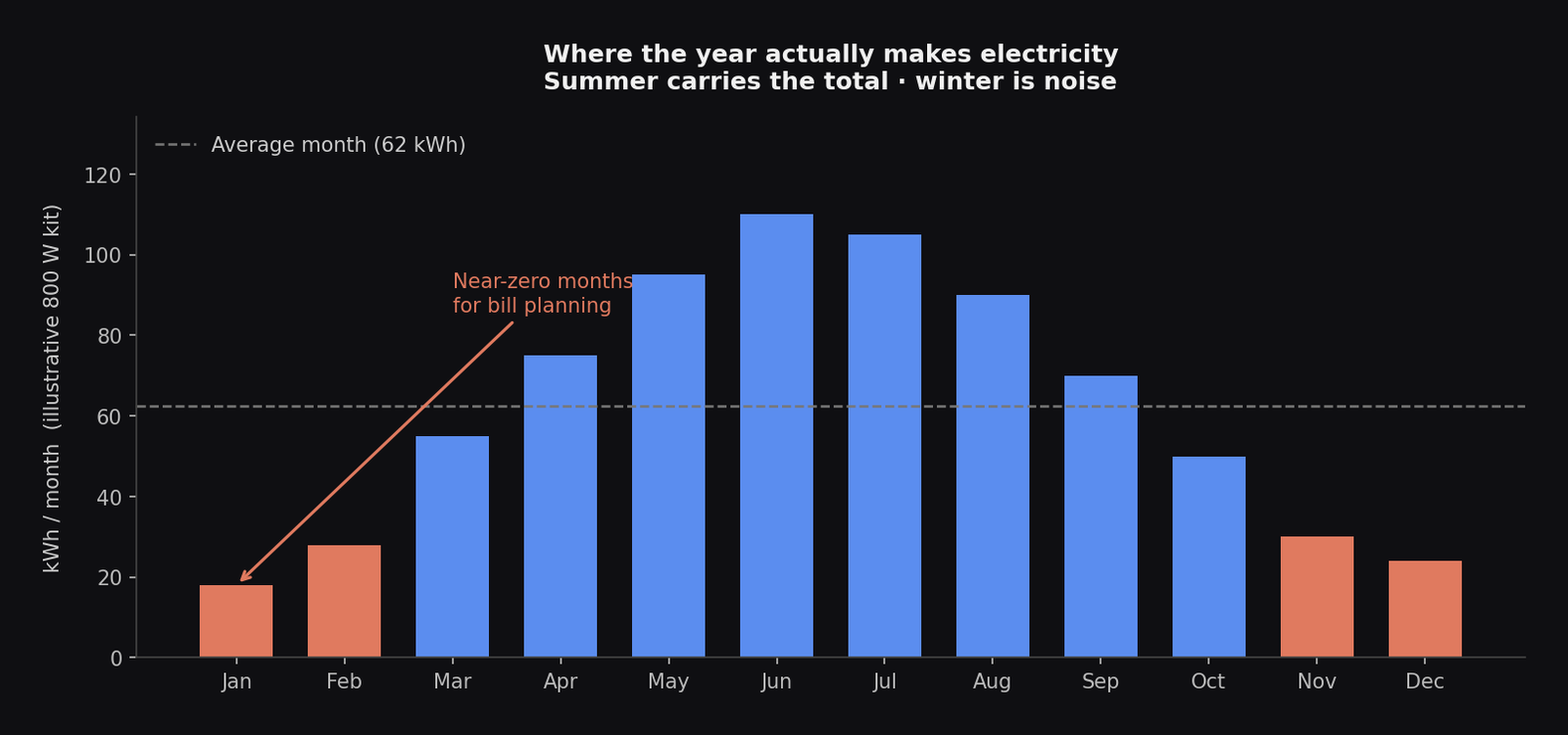
Yes, but not in the way product photos imply. On a dull December afternoon, output can fall to near nothing. Summer and the shoulder months carry the annual total. Do not buy an 800 W kit to cut winter heating bills. Buy it for spring-to-autumn daylight, daytime habits, or a battery if evenings still need that power.
Annual figures like 650-800 kWh a year are real for a good site. They are not spread evenly across twelve months.
Do Plug-in Solar Panels Need a Battery?
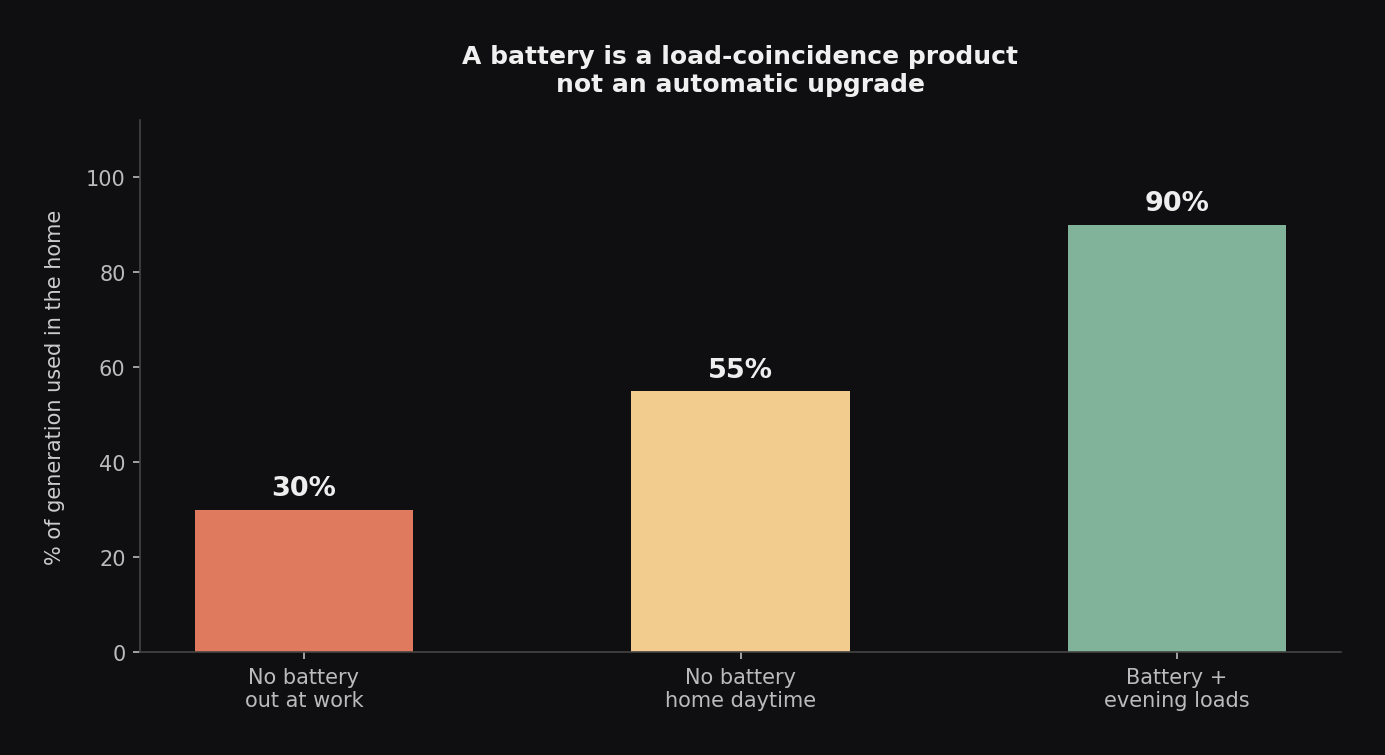
Not to make them work. A plug-in kit generates and feeds power into your home with or without a battery attached. What a battery changes is the self-consumption number, and since that is the number that decides the value, it changes the economics rather than the mechanism.
Without one, you only benefit while the sun is out and something is drawing power at the same time, so a household that is out all day typically self-consumes 25-40%. A few kWh of storage holds the midday surplus until the evening, and self-use can climb to 70-90% depending on how much you actually use after dark. A battery is a load-coincidence product, not an automatic upgrade: if your evenings are quiet, it buys you less than the brochure suggests.
One thing to be careful about: a kit with a battery built into it has no socket route at all. The exclusion sits in the law now, not only in the specification. SI 2026/848 defines a plug-in microgenerator as a device that is not designed to import electricity in order to store it, so a kit with storage inside it falls outside the definition. Electrical Safety First goes further and tells people not to install plug-in battery systems in the home. A battery bought separately and wired in by an electrician is a different question. Our battery storage guide covers sizing and real numbers.
What About a Plug-in Battery on Its Own?
That is a different product with a different legal position, and it is worth separating clearly. A battery plugged into a socket only draws power out of the wall like a kettle or a washing machine, so nothing about it needs the socket rules to change. It is legal today. What it saves you comes from charging on a cheap overnight tariff and discharging in the evening, not from solar at all.
The one people are asking about is the Octopus plug-in home battery, the Nook: a 2 kWh Cube that needs no installer and stacks to 10.5 kWh, alongside a larger wall-mounted Colossus, announced for the UK in 2027 with no price yet. That page covers what Octopus has actually confirmed and why the launch payback claim does not survive contact with the numbers.
Plug-in Solar vs a Full Roof System
Plug-in solar is not a replacement for a roof-mounted system. It is a first step for people who cannot access their roof: renters, flat owners, or anyone who wants to start small.
| Plug-in (800W) | Roof system (4kW) | |
|---|---|---|
| Cost | £550–1,200 for a listed kit | £4,000–6,000 installed |
| Annual generation | ~650-800 kWh, or up to ~1,000 kWh overpanelled | ~3,500 kWh |
| Electrician needed | No | Yes |
| Renters can use | Yes | Usually no |
| Export income | No (self-installed, non-MCS) | Yes (SEG eligible) |
| Portable | Yes, take it when you move | No, stays with the house |
If you have roof access and own your home, a full solar system with a hybrid inverter and battery storage delivers far higher returns. But if you are renting, in a flat, or just want to test the water before committing, plug-in solar is the way to start. See our full ROI analysis for how roof systems compare financially.
Three questions decide the outcome, and all three are free to answer. Start with the RCD in your consumer unit, because a Type AC device means you stop and talk to an electrician before you spend anything. Then work out how much of a normal weekday you are at home, because that sets your self-consumption and therefore your saving. Then add up any generation you already have, because that decides whether connecting is a notification or a formal application. Our home suitability check covers the first one properly.
