
Most solar panels on a house in England need no planning permission. They count as permitted development if they stay inside the size and siting limits, and those limits loosened on 27 August 2026. A house wall can now take panels that stick out 0.4 m, and a garden array can sit near the boundary if it stays low.
The change came from a planning order, SI 2026/896. It changed the rules for every kind of home solar, not only the new plug-in kits, and almost all of the new freedom went to houses. Flats kept the old limits. The government skipped a formal consultation to bring the order in quickly, and its explanatory memorandum says it has no plans to issue new guidance. So older advice will linger. Our own wall-mounting guide quoted the old 200 mm rule until this week.
I read the old rules, the new rules and the memorandum side by side. This page sets out what changed, what did not, and how to check your own plan before you buy anything. It covers England only.
What changed on 27 August 2026?
Four things changed for houses. Walls and balconies got more depth, garden arrays can now go near the boundary, the old one-array and 3 m size limits went, and plug-in kits on wood lost their automatic permission. Roofs did not change at all.
| Where | Before 27 August 2026 | From 27 August 2026 |
|---|---|---|
| House wall | 0.2 m out from the wall | 0.4 m, or 0.2 m if the wall runs alongside a road |
| House balcony or roof railing | No rule of its own | 0.4 m, or 0.2 m if it runs alongside a road |
| Pitched roof | 0.2 m off the slope, nothing above the ridge | Unchanged |
| Flat roof | 0.6 m above the highest point | Unchanged |
| Garden array within 5 m of the boundary | Not allowed | Allowed: 1 m high in front of the house, 2 m elsewhere |
| Garden array further in | Up to 4 m high | Up to 4 m high |
| Number of garden arrays | One | No limit |
| Size of a garden array | 9 m² of panels, no side over 3 m | 9 m² of panels |
| Plug-in kit on wood | No rule of its own | No permitted development |
Do you need planning permission for solar panels on your roof?
No, for a normal house roof, and nothing changed here. On a pitched roof, the panels can stand no more than 0.2 m off the roof slope, and no part can rise above the highest point of the roof, not counting the chimney. On a flat roof, no part can rise more than 0.6 m above the highest point of the roof.
Two conditions apply to every system on a building. As far as practicable, you site the panels so that they change the look of the building and of the area as little as possible. And you take them down as soon as reasonably practicable once you no longer need them.
A flat roof in a protected area needs one extra step. That covers conservation areas, National Parks, National Landscapes, the Broads and World Heritage Sites. Before you start, you must apply to the council to ask whether it wants to approve how the panels look. You can begin only once the council says in writing that it does not need to approve them, or approves them, or 56 days pass without a decision.
How far can solar panels stick out from a house wall?
0.4 m, unless the wall runs right alongside a road or pavement. There the limit stays at 0.2 m. You measure straight out from the wall surface. The same limits apply to the enclosure around a balcony, and to a railing, balustrade or parapet on a roof. The order calls the road-side case a wall that “abuts on a highway”.
The government gave a reason for each number. The memorandum says the 0.4 m limit “will allow panels to be installed at the optimum angle for energy generation”. It kept 0.2 m next to a highway “to minimise the risk of panels being blown off in high winds onto a highway”.
The extra depth is worth having. A panel flat against a wall faces the low winter sun well but wastes the high summer sun. Tilting the bottom edge out turns it towards the summer sky. I ran a south-facing wall in Birmingham through PVGIS, the European Commission’s solar model, to see what each limit allows.
| Wall panel set-up | Panel angle | Yield per kWp a year | Versus flat on the wall |
|---|---|---|---|
| Flat against the wall | 90° | 710 kWh | Baseline |
| Landscape panel tilted to the old 0.2 m limit | About 82° | 787 kWh | +11% |
| Landscape panel tilted to the new 0.4 m limit | About 72° | 863 kWh | +22% |
| For comparison: a roof at 35° | 35° | 968 kWh | +36% |
So on a south-facing house wall, the new limit adds roughly a tenth to what the old one allowed. A portrait panel is taller, so it reaches only about 78° inside 0.4 m and gains less. Check your bracket’s depth at the bottom edge, not at the fixing, because the bottom edge is the part that sticks out furthest.
Part 14 does not define “abuts”. My reading is that a wall standing on the edge of a road, pavement or public footpath abuts the highway, and a wall set back behind a front garden or a drive does not. If your wall sits somewhere in between, use 0.2 m or ask the council.
A second test applies in conservation areas and World Heritage Sites. There, you cannot fit panels at all on a wall, balcony or roof railing that “fronts” a highway. A wall can front a road from across a front garden without abutting it, so this test catches more walls than the 0.2 m one does.
For brackets, fixings and wiring, see our guide to wall-mounted solar panels.
What are the rules for solar panels in the garden?
A garden array can now sit within 5 m of the boundary, as long as it stays low. The limit is 1 m high in front of the house and 2 m elsewhere near the boundary. Further in, it is 4 m. Before 27 August, nothing stand-alone could go within 5 m of any boundary, which ruled out most small gardens. The memorandum says the change means “those with smaller outdoor spaces will be able to benefit”.
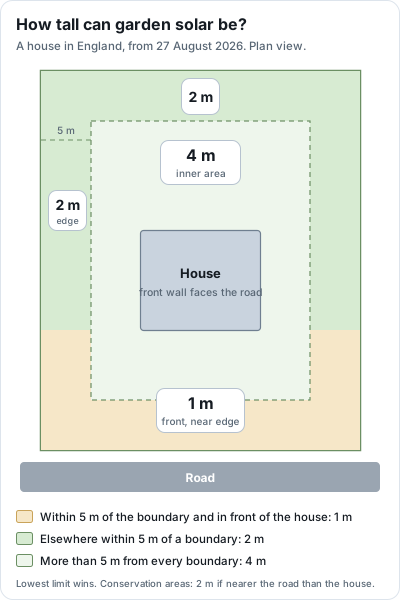
These are the limits for a house garden:
- Height. The lowest limit that applies wins. It is 1 m within 5 m of the boundary and forward of the front wall of the house. It is 2 m elsewhere within 5 m of the boundary, and 2 m in a conservation area if the array sits nearer a bordering road than the house does. Anywhere else, it is 4 m.
- Size. The panels can cover up to 9 m². A standard 1,722 mm by 1,134 mm panel covers about 1.95 m², so four panels fit (7.8 m²) and five do not (9.8 m²). The old rule that no side of the array could exceed 3 m has gone for houses.
- Number. The old limit of one array per garden has gone for houses. The order does not say plainly whether the 9 m² cap now applies to each array or to all of them together, so treat a second array as a question for the council.
- Protected land. In a conservation area, a National Park, a National Landscape, the Broads or a World Heritage Site, an array within 5 m of the boundary needs an application to the council before you start. So does an array in a conservation area that sits nearer a bordering road than the house.
- World Heritage Sites. Nothing within 5 m of the boundary, and nothing nearer a bordering road than the house.
- Listed houses and scheduled monuments. Nothing anywhere in the grounds without planning permission.
- Two standing conditions. As far as practicable, site the array to affect the look of the area as little as possible. Take it down as soon as reasonably practicable once you no longer need it.
The 1 m limit is easier to meet than it sounds. A landscape panel tilted to 35° stands about 0.65 m tall, and a portrait panel at 30° about 0.86 m, before the frame adds any clearance. So a low frame in a front garden can stay inside 1 m. Measure from the ground to the highest point of the panel and frame together.
Can you put solar panels on a fence or garden wall?
Yes, for a house, and that is new. In these rules a fence, a gate or a garden wall does not count as a building. So panels fixed to one count as stand-alone solar and follow the garden rules above, not the house-wall rules. Under the old rules, nothing stand-alone could go within 5 m of the boundary, so panels on a boundary fence needed planning permission. Now they do not, as long as they stay inside the limits.
On a boundary fence, the 2 m limit applies, or 1 m in front of the house. So a panel on a 1.8 m fence meets the height limit if its top edge stays at or below 2 m, outside the 1 m zone in front of the house. The area limit and every other condition above still apply. Two cautions apply. A plug-in kit on a wooden fence, gate or wall gets no permitted development, so it would need planning permission. And if your neighbour owns the fence, you need their agreement before you fix anything to it, whatever the planning rules say.
Can you put solar panels on a shed, garage or gazebo?
Yes. A shed, a garage, a summer house or a gazebo counts as a building, so the roof and wall rules apply to it. That means 0.2 m off a pitched roof, 0.6 m above a flat roof, and 0.4 m out from a wall unless the wall runs alongside a road. The shed or gazebo itself has its own outbuilding rules, and this order did not change them.
Do plug-in solar kits need planning permission?
They follow the same rules as any other solar panel, because the order now writes plug-in solar into the definition of solar PV. One extra limit applies to plug-in kits only. A plug-in kit on a wooden wall, balcony, fence or gate, or on any timber-clad part of a building, gets no permitted development. The memorandum says that rule is there “to mitigate the risk of fire spread”, and it applies to houses and to flats.
Planning is a separate gate from the socket rules. A kit can be listed Compliant and still need planning permission where you want to fix it. Our plug-in solar guide covers the socket rules, the register and the RCD check.
What if your home is listed or in a protected area?
- Listed buildings. A listed house gets no permitted development for solar, on the house, on any building in its grounds, or anywhere in the garden. The memorandum calls this a clarification of the old wording. You need planning permission. Work that alters the listed building itself, such as fixings into its walls or roof, also needs listed building consent, which is a separate application. Ask the council first.
- Conservation areas. No panels on a wall, balcony or roof railing that fronts a road. A garden array nearer a bordering road than the house can be only 2 m high, and you must apply to the council before you start. A flat roof also needs that application. In each case, wait for the council’s written answer or for 56 days to pass.
- National Parks, National Landscapes and the Broads. A flat roof, or a garden array within 5 m of the boundary, needs an application to the council before you start.
- World Heritage Sites. No panels on a wall, balcony or roof railing that fronts a road. A garden array cannot go within 5 m of the boundary, or nearer a bordering road than the house.
- Article 4 directions. A council can remove permitted development rights in a street or an area. Check your council’s website or planning map before you rely on any limit on this page.
Do the new rules apply to flats?
Mostly not. The memorandum says the rules for blocks of flats remain “largely unchanged”. A block of flats still has 0.2 m on every wall, one garden array only, nothing within 5 m of the boundary, and 9 m² of panels with no side over 3 m. The height limit is 4 m, or 2 m in a conservation area if the array sits nearer a bordering road than the building.
Two new limits do reach flats. Nothing can go on a listed block of flats or on any building in its grounds. And a plug-in kit cannot go on a wooden wall, balcony, fence or gate, or on timber cladding. A house converted wholly into flats counts as a block of flats. A flat above a shop falls under neither class, so ask the council. If you are a leaseholder, you also need the freeholder’s consent, which is a separate question from planning.
What about Wales, Scotland and Northern Ireland?
This order changes the rules in England only. The memorandum says its “territorial application” is England. Wales, Scotland and Northern Ireland each set their own permitted development rules for solar, and I have not checked them for this page. Ask your council before you rely on any English limit there.
How do you check your plan before you buy?
- Confirm the basics. Check that you are in England, and whether your home is a house or a flat.
- Check the designations. Look up whether your home is listed, and whether it sits in a conservation area, a National Park, a National Landscape, the Broads or a World Heritage Site. Check for an Article 4 direction too. Your council’s website or planning map shows all of these.
- Measure. For a wall, decide whether it runs alongside a road, then measure how far the bottom edge of the panel will sit from the wall. For the garden, measure the distance to the nearest boundary, note whether the spot is in front of the house, and work out the height of the panel and frame together.
- Apply first where the rules say so. In the protected positions above, send the council an application before you start, to ask whether it wants to approve how the panels look. Wait for its written answer, or for 56 days to pass without one.
- Get it in writing if you are unsure. You can apply to the council for a Lawful Development Certificate for proposed development. It confirms in writing that your plan is permitted development, which also helps when you sell the house.
One transitional rule helps if you planned something under the old rules. Work that was permitted development before 27 August 2026 but is not permitted now can still go ahead until the end of 26 August 2027. That is article 6 of the order.
Planning is one gate of several. A roof needs to carry the weight, the electrics need to meet the wiring regulations, and your network operator needs a notification under G98 or an application under G99. Export payments usually need an MCS-certified installation. A landlord or freeholder may need to agree. None of these depends on planning, and planning permission does not settle any of them.
Frequently asked questions
How close to my boundary can I put solar panels?
For a house in England, right up to it, since 27 August 2026, as long as the array stays low. Within 5 m of the boundary the limit is 2 m high, or 1 m in front of the house. In a World Heritage Site, nothing can go within 5 m of the boundary. A block of flats still cannot have an array within 5 m of the boundary.
Do I need planning permission for solar panels on a fence?
Not for a house in England, if the panels stay within 2 m of the ground, or 1 m in front of the house, and the garden array totals no more than 9 m² of panels. Before 27 August 2026, panels on a boundary fence did need permission. A plug-in kit cannot go on a wooden fence, and a fence your neighbour owns needs their agreement.
Do I need planning permission for solar panels on a listed building?
Yes. A listed house gets no permitted development for solar on the house, on its outbuildings or in its garden. You need planning permission. Panels fixed to the listed building itself also need listed building consent, which is a separate application. Ask the council before you buy anything.
Does the 0.4 m wall rule apply to my flat?
No. The 0.4 m limit applies to houses only. A block of flats keeps the 0.2 m limit on every wall, whether or not the wall runs alongside a road.
Do my neighbours have to agree?
Not for permitted development. Planning permission is a matter between you and the council. But you cannot fix panels to a fence or wall that your neighbour owns without their agreement, and the rules ask you to site panels so that they affect the look of the area as little as practicable.
