
Storm damage to roof-mounted solar panels goes through your buildings insurance, and the claim is won or lost on three things: whether your insurer knew you had panels, whether the weather met the insurance definition of a storm, and whether you can show the damage was the storm’s fault rather than wear and tear. I have never put a storm claim through myself, so what follows is the paper trail talked through: what the ABI tells you to do, how the Financial Ombudsman decides disputes, and where insurers push back.
One safety rule before anything else: stay off the roof. A damaged panel can remain live and keep generating in daylight; it cannot be switched off at the module, and storm-damaged wiring may be exposed. Every check below works from the ground.
Does home insurance cover storm-damaged solar panels?
Roof-mounted panels count as part of the building, so they sit under buildings insurance, not contents. Standard UK buildings policies that cover storm damage generally extend that cover to the panels; Aviva’s policy wording, for example, reportedly folds fixed clean energy installations into its buildings definition, and Admiral also reportedly includes fixed solar panels within buildings cover. Check your own policy booklet for the exact wording, because definitions differ.
The point most owners miss comes before any storm: installing solar is a material change to your insurance risk, and you are expected to tell your insurer. If you never did, a claim can be refused or reduced, and not just for the panels: related roof and electrical damage can be caught too. If your insurer does not know about your array and no storm has hit yet, fixing that today is worth more than everything else in this article. If the storm has already happened, declare the panels when you claim anyway: late disclosure may affect the outcome, but concealment reliably makes it worse.
Also standard: damage caused by faulty materials, faulty design or poor workmanship is typically excluded. A badly fitted array that lifts in wind lands in the gap between your insurer and your installer, which is why the who-to-call map below matters.
What counts as a storm to your insurer?
The widely used industry and ombudsman working definition sets numeric thresholds, any one of which can qualify: wind gusts of at least 48 knots (55mph), torrential rain of at least 25mm per hour, or snow at least a foot deep within 24 hours. Insurers routinely pull local weather-station data and reject claims where recorded gusts fell short. Two counters exist: the Beaufort scale notes slight structural damage from around 47mph, and the ombudsman has said it will not always be fair to reject solely because gusts fell just under 55mph. A rejection on wind data alone is challengeable.
A named storm (the Met Office names one when amber or red impacts are expected) is useful evidence because it dates the event and corroborates the conditions. It is not a coverage trigger: a named storm does not guarantee a payout, and an unnamed gale can still meet the working definition. Policy wording and causation remain separate tests.
The post-storm inspection checklist, from the ground
- Scan the array from the ground or an upstairs window. Use your phone camera’s zoom. You are looking for cracked or shattered glass, a panel that has shifted, lifted or hangs, missing panels, and debris (tiles, branches) resting on the array.
- Open your monitoring app and screenshot the generation graph. A sudden output drop, or one string or optimiser reading zero after the storm, is dated documentary evidence. Panel-level systems can identify the exact failing panel from the app.
- Photograph the inverter display. Fault codes and error lights are part of the evidence file.
- Note, but do not touch, the isolator and consumer unit. If a breaker has visibly tripped, record it. Do not start switching things or investigating wiring: storm water and electrical kit together are a shock and fire risk.
- Photograph everything before any tidy-up. The insurer wants the scene as the storm left it.
If there is arcing, smoke, a burning smell, or a panel about to fall, keep people clear and call 999. For exposed wiring or suspected electrical damage without immediate danger, get a qualified solar or electrical professional out. Nothing on a storm-damaged roof is a DIY job, including inspection.
How to make the claim
The ABI’s storm guidance reduces to a clear order of operations.
- Document first: photos and video from the ground, plus your monitoring screenshots.
- Contact your buildings insurer as soon as reasonably possible, policy number to hand. Many insurers take the notification online.
- Check whether you have home emergency cover; it can pay for immediate temporary repairs.
- Only carry out emergency or temporary repairs to prevent further damage if it is safe and you have spoken to the insurer first. Keep photos and an itemised invoice for anything done.
- Do not authorise permanent repairs before the insurer agrees. The insurer may arrange an assessment or ask you for repair estimates from local firms; getting estimates early rarely hurts.
Why storm claims get refused, and what beats a refusal
When a dispute reaches the Financial Ombudsman, it asks three questions: was there a storm on the date the damage happened, is the damage consistent with storm damage, and were storm conditions the main cause, or would the damage have happened anyway? Refusals map onto all three: sub-threshold wind fails question one, damage that storms do not plausibly cause fails question two, and “wear and tear” is fought at question three, where the insurer argues the roof, fixings or array were already degraded and the storm merely finished the job.
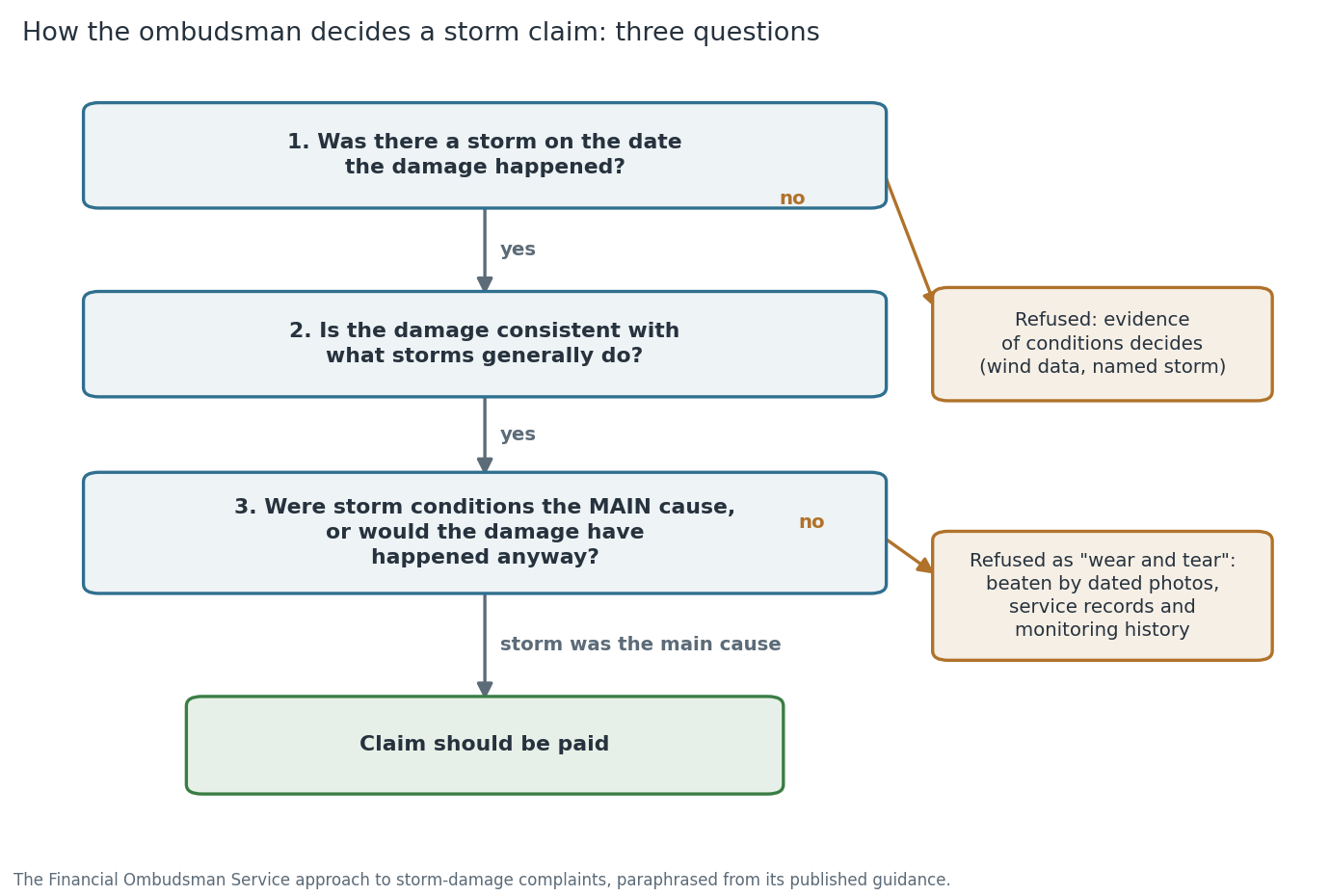
What beats a wear-and-tear refusal is independent evidence of good pre-storm condition. In one ombudsman roof case, the insurer called the damage gradual wear and tear; a surveyor and a roofer showed the roof had been in fair condition before an exceptional wind ripped it off, and the ombudsman ordered the claim paid with interest plus compensation. That case is not a solar precedent, but it shows what a challenge rests on, independent evidence of pre-storm condition: installation paperwork, service records and dated photos of your array in good condition are claim insurance you can collect now, before any storm. Monitoring history supports the file by dating the output change; it does not prove your fixings were sound, which is what the paperwork and photos are for.
Storm, bad fitting or a dud panel? Who to call
| What happened | First call | Why |
|---|---|---|
| Storm broke glass, lifted or removed panels, damaged roof and array | Buildings insurer | Panels are part of the building; sudden storm damage is an insured peril |
| Mounts pulled out or clamps failed without extreme wind | Installer | Fitting faults are excluded from storm cover; MCS installers must give a minimum 2-year workmanship warranty |
| Workmanship fault but the installer has gone bust | Insurance-backed guarantee provider | The IBG in your RECC/HIES paperwork keeps the workmanship warranty alive |
| Panel failed internally, no impact damage | Panel manufacturer | Product warranties cover the module itself, commonly 10-25 years |
| Insurer refuses the claim and you disagree | Financial Ombudsman Service | Free and independent, after the insurer’s final response or 8 weeks |
Your next move
Before storm season: confirm your insurer knows about the panels, file your installation paperwork where you can find it, and screenshot a healthy month of generation as a baseline. If the damage is repairable rather than an insurance event, our solar panel repairs guide covers the fix routes, and solar panel warranty cover explains what the manufacturer owes you. If you are fitting panels and want them to survive the next named storm, start with structural calculations for solar panels.
