
Solar panel kits for sheds work well for lights, charging and occasional small appliances. Start with what you use each day, then size the panel for the season when you need it. A kit that feels generous in June can leave you short in December. If you need reliable heat or daily power tools, a cable from the house usually makes more sense.
This guide is for an isolated, off-grid shed. Its panel charges a battery and powers equipment in the shed. It does not feed the house. My own DIY array and batteries serve my house, so the shed figures below are a planning example, not a measured result from a shed kit.
Which way of powering a shed fits your job?
| What you need | Likely starting point | Why |
|---|---|---|
| LED lights, phone charging and a radio | Small off-grid kit | A low daily energy load can fit a modest panel and battery. |
| Laptop and occasional small tools | Larger off-grid kit or portable station | Check battery energy and the tool’s starting power before buying. |
| Daily heating, a regular fridge or dependable office power | House supply designed by an electrician | A cable can supply power after several dark days. |
| Solar panels on the shed roof to cut house bills | Grid-connected roof array | The roof generates for the house, which is a different electrical design. |
For a shed roof that feeds the house, use my shed and garage solar guide. If the roof is flat, first check its structure and waterproofing in the flat garage roof guide.
What can a shed solar kit actually run?
A panel rating tells you its output under test conditions. It does not tell you how long a lamp will run tonight. For that, add the energy each device uses in watt-hours (Wh). Multiply its power in watts (W) by the hours you use it. Check the rating label or measure the device with a plug-in meter.
| Load for one day | Example calculation | Energy |
|---|---|---|
| Two LED lights | 2 × 8 W × 4 hours | 64 Wh |
| Radio | 10 W × 3 hours | 30 Wh |
| Laptop charger | 60 W × 2 hours | 120 Wh |
| Phone charging | 10 W × 2 hours | 20 Wh |
| Total in this example | Add the four rows | 234 Wh per day |
Your next line is the load you cannot switch off. A fridge or a security camera runs across the night. An occasional drill can wait for a sunny day. Write both on your worksheet, because an average daily total hides that difference. If you use mains sockets, add the inverter’s own standby draw from its manual or measure it.
A power tool has a second number: starting power. A motor can demand more power at start than during steady work. Choose the inverter using the tool’s rated input and its start demand, not just the day’s Wh total. Check the inverter’s continuous and surge ratings, then confirm that the battery can deliver that current.
How do you size the panel and battery for a UK shed?
For the 234 Wh worksheet, begin with a battery that can cover at least one full day without solar. If you plan to use only 80% of its nameplate energy, divide 234 by 0.8. That gives about 293 Wh of nominal capacity before inverter losses and any reserve for another dull day. The 80% figure is a planning choice, not a promise for every battery.
A 12.8 V, 100 Ah battery holds 1,280 Wh on its label, because volts multiplied by amp-hours gives watt-hours. Its usable energy depends on the battery limits, temperature and conversion losses. The European Commission PVGIS off-grid guide uses panel Wp, nominal battery Wh, daily consumption and a discharge cut-off. It then reports days when the battery runs empty. That is a better test than dividing an annual solar estimate by 365.
What changes between summer and winter?
My monthly UK solar output table uses a central England PVGIS example: south-facing panels at 35 degrees, with 14% grid-system loss. It gives 121.6 kWh per kWp in June and 36.5 kWh per kWp in December. Scale that to one 100 W panel and divide by days in the month: about 405 Wh per June day and 118 Wh per December day. Those are monthly averages, not daily guarantees.
This quick scale is a roof-energy reference, not energy available at an off-grid socket. Charging, the battery, inverter standby, shade and a full battery can reduce useful energy. PVGIS uses a different loss model for its off-grid tool. For a winter-use shed, enter your postcode, panel angle, panel Wp, battery Wh and load into PVGIS off-grid. Check its monthly empty-battery days. Increase panel or storage until that result fits how often you can tolerate a power cut.
For example, the 234 Wh worksheet already exceeds the 100 W panel’s average December roof output. A 200 W panel doubles the reference to about 236 Wh per December day, still before off-grid losses. I would test a larger panel and battery in PVGIS, then check shade in the actual garden. No finite small kit makes every dark winter day sunny.
How much battery reserve is enough?
Decide how many days you want without useful sun. Multiply daily Wh by that number, then divide by the usable fraction of your chosen battery. Add conversion loss if loads use the inverter. For two 234 Wh days at an assumed 80% usable fraction, the starting point is 585 Wh nominal before inverter loss. A fridge or daily office use deserves a larger reserve and a check against the manufacturer’s discharge limits.
What must a complete shed kit include?
The usual path is panel, charge controller, battery, then either 12 V or 24 V loads or an inverter for 230 V appliances. A listing called a “solar kit” can stop after the controller. Check its contents line by line before you compare prices.
- Panel and mounting: Confirm its Wp, size, weather rating, roof fixings and wind exposure. Look for tree shade in winter. A small roof still needs sound fixings and a weather-tight cable entry.
- Charge controller: It manages battery charging. PWM is simple and cheaper. MPPT tracks the panel’s best operating point and can recover more energy when panel voltage sits well above battery voltage. Victron explains the difference. Match its input voltage, current and battery profile to the actual parts.
- Battery: Compare nominal Wh, usable limits, discharge current, temperature range and warranty. LiFePO4 is often attractive for repeat cycling. Lead-acid can cost less at purchase but needs a different charging profile and a conservative discharge limit. Check the exact manual.
- Inverter: You need one only for 230 V loads. Choose pure sine output for a laptop charger, fridge motor or other sensitive equipment. Check continuous watts, starting surge, idle consumption and whether the battery can supply it.
- Protection and cables: Confirm suitable DC fuses, disconnects, cable sizes, connectors and enclosure. The battery can deliver a very high fault current. The Victron DC wiring guide explains why cable and fuse ratings must agree.
A 12 V design is simple for small loads. At the same power, a 24 V battery path carries half the current, so cables can be easier to design for a larger inverter. Do not mix 12 V appliances with 24 V without a suitable converter. Let the load and cable run decide the voltage.
What do shed solar kit tiers cost?
These are examples from manufacturer pages I checked in September 2026, not a market average. Promotions, variants and stock change. The cheapest listing below does not include a battery. Check the exact basket and delivery cost before treating any two “kits” as comparable.
| Tier and likely use | What the listing includes | Indicative UK price |
|---|---|---|
| 100-200 W panel and controller, for light charging | An ECO-WORTHY panel kit lists panel, PWM controller and mountings. No battery or inverter. Listed sold out. | About £130 for the shown variant, checked September 2026. |
| 400 W lithium kit, for regular small loads | A Renogy kit lists panels, battery, controller and pure sine inverter. Battery and inverter variants differ. One selected variant was backordered. | About £960-£1,180 across listed variants, checked September 2026. |
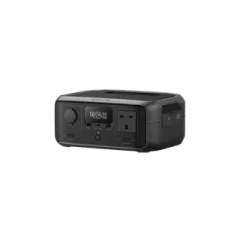
| Portable station plus panel, for no fixed shed wiring | BLUETTI AC70 bundles list a 768 Wh station with either a 100 W or 200 W panel. | About £650-£850 across the two bundles, checked September 2026. |
The first tier is useful only when you already have a suitable battery, or you plan to buy one separately. The second tier buys more energy storage and an inverter, but the panel still has to refill it in winter. A portable station puts battery, controller and sockets in one box. You can carry it indoors, but check its solar input limits and whether the panel can stay outdoors while the station remains dry.
Will a kit run tools, a fridge or a heater?
Occasional cordless tool charging is much easier than running a high-power mains saw. Check the charger input in watts and add its daily Wh to the worksheet. A corded tool also needs enough inverter surge power. If work must continue on a wet winter day, a house supply is the safer design choice.
A fridge is possible, but its daily energy use depends on the model, set temperature and shed temperature. Measure it over several days, including a warm period. Give it enough battery reserve for nights and poor weather. A small battery that empties overnight can spoil food even if the panel performs well at noon.
Space heating is the wrong job for a small shed kit. As an example, a 2,000 W heater used for two hours consumes 4,000 Wh. That is four times a 1 kWh battery’s nominal energy, before losses. A 400 W panel cannot supply 2,000 W while it runs. Improve insulation first. For a regularly heated garden office, plan a properly designed house supply.
How do you make an off-grid shed safe?
Keep the off-grid circuit physically separate from any house supply. Never connect an ordinary off-grid inverter to a shed socket that also connects to the house. A system that never connects to the distribution network does not need a G98 connection notification. The ENA connection guide distinguishes systems that never connect to the network from grid-connected generators. A grid-tied array or socket-connected plug-in product follows different rules.
In England, Approved Document P covers electrical installations in a dwelling and connected outbuildings supplied from it. It does not automatically make every isolated solar shed a Part P job. Rules differ across UK nations. If you want fixed 230 V sockets or lights, ask a competent electrician to design and test that wiring. Ask the local building control body where notification is unclear. My DIY solar legality guide covers the wider boundary.
Put a battery and controller where water cannot reach them and where you can inspect them. Follow the maker’s clearance and temperature limits. Do not mount a controller on bare combustible timber if its manual requires a non-flammable base. Fit a suitable fuse close to the battery and protect cables from tools, rodents and sharp metal. Secure the panel against wind and protect the equipment against theft.
Cold matters in an unheated shed. Many lithium batteries restrict charging near freezing, so check the exact battery and controller manuals. A lead-acid battery needs the ventilation specified for its design. The HSE warns that vented lead-acid batteries release hydrogen during charging. Do not apply a whole-house battery location rule to every portable station. Follow the product manual and the design for this shed.
When is a house cable or grid-connected roof better?
Choose an off-grid kit when the shed is remote, the loads are small, and an occasional empty battery is acceptable. Choose a professionally designed house cable when you need dependable sockets, refrigeration or heat. Compare the whole installed cable quote with the cost of a kit, replacement batteries and your time. The cheaper panel bundle can become the dearer way to get reliable power.
If your real aim is lower house bills, the roof may be useful even when the shed does not need power. A grid-tied shed array sends generation to the house through a designed connection. A plug-in solar kit is another separate route for household demand where the exact product and circuit qualify. Neither is the same as an isolated shed battery kit.
I would finish the worksheet before ordering anything. Record each device’s watts, hours and start demand. Then check your winter shade, model the panel and battery in PVGIS off-grid, and list every part missing from the basket. If the result depends on perfect December sunshine, change the design or run a cable.
Sources and calculation notes
- European Commission Joint Research Centre, PVGIS 5 user manual: off-grid inputs, hourly battery model, and empty-battery results. The June and December figures are scaled from this site’s PVGIS monthly table.
- Victron Energy, PWM or MPPT technical note and DC wiring guide: controller choice, current, cabling and fusing.
- GOV.UK, Approved Document P; Energy Networks Association, G98/G99 connection guide; HSE, Using electric storage batteries safely.
- Manufacturer price examples, checked September 2026: ECO-WORTHY panel kit, Renogy complete kit, and BLUETTI bundles.
