
There is no legal maximum number of solar panels allowed in the UK for a conventional system on a standard home. For planning, the Planning Portal solar panels guide explains when roof-mounted panels may not need a planning application if permitted-development criteria are met. The number is normally decided by your usable roof area, the inverter’s AC rating, your DNO connection under G98 or G99, and whether the extra panels make financial sense.
This distinction matters because panel capacity and inverter capacity are not the same thing. You can have 4kWp or more of panels connected to a 3.68kW inverter. The panels are rated on the DC side, while the G98 threshold applies to the generating capacity connected to the AC grid.
This guide covers conventional roof-mounted solar. Plug-in and balcony solar follows a separate set of product and connection rules, so I would treat that as a different project.
Is there a legal maximum number of solar panels allowed in the UK?
No national rule gives an ordinary house a maximum panel count. Roof-mounted solar is usually permitted development when it meets the relevant conditions. Planning rules control matters such as position and visual impact, while electricity network rules control inverter capacity. Neither normally says that you may have only 10, 12 or 16 panels.
The government’s permitted development guidance places domestic solar within the microgeneration rules rather than setting a panel-count allowance. The exact planning regime differs across England, Scotland, Wales and Northern Ireland, so check the rules where you live.
Listed buildings, conservation areas, flats, leasehold homes and properties with removed permitted development rights need extra care. The government’s renewable energy planning guidance explains the main exceptions. I am not covering those cases here because the answer depends on the building and its location.
What actually limits your panel count?
Four constraints decide how many panels you can sensibly install: usable roof area, the inverter’s supported DC input and AC output, the connection capacity accepted by your DNO, and your budget. The lowest of those limits usually determines the finished array, although panel orientation and household consumption affect whether filling every space is worthwhile.
| What actually limits your panel count | What to check | Practical consequence |
|---|---|---|
| Roof area | Clear dimensions, orientation, shading, ridges, valleys, chimneys and required fitting clearances | Determines how many full panels physically fit |
| Inverter AC rating | Continuous AC output, supported DC input, MPPT voltage and current limits | Determines maximum grid-connected output and whether the proposed strings are compatible |
| DNO and G98/G99 | Aggregate generating capacity per phase and local network capacity | Determines whether you can connect first and notify, or need approval before connection |
| Budget | Installed cost, expected self-consumption, export rate and future electricity demand | Determines whether the final few panels repay their cost |
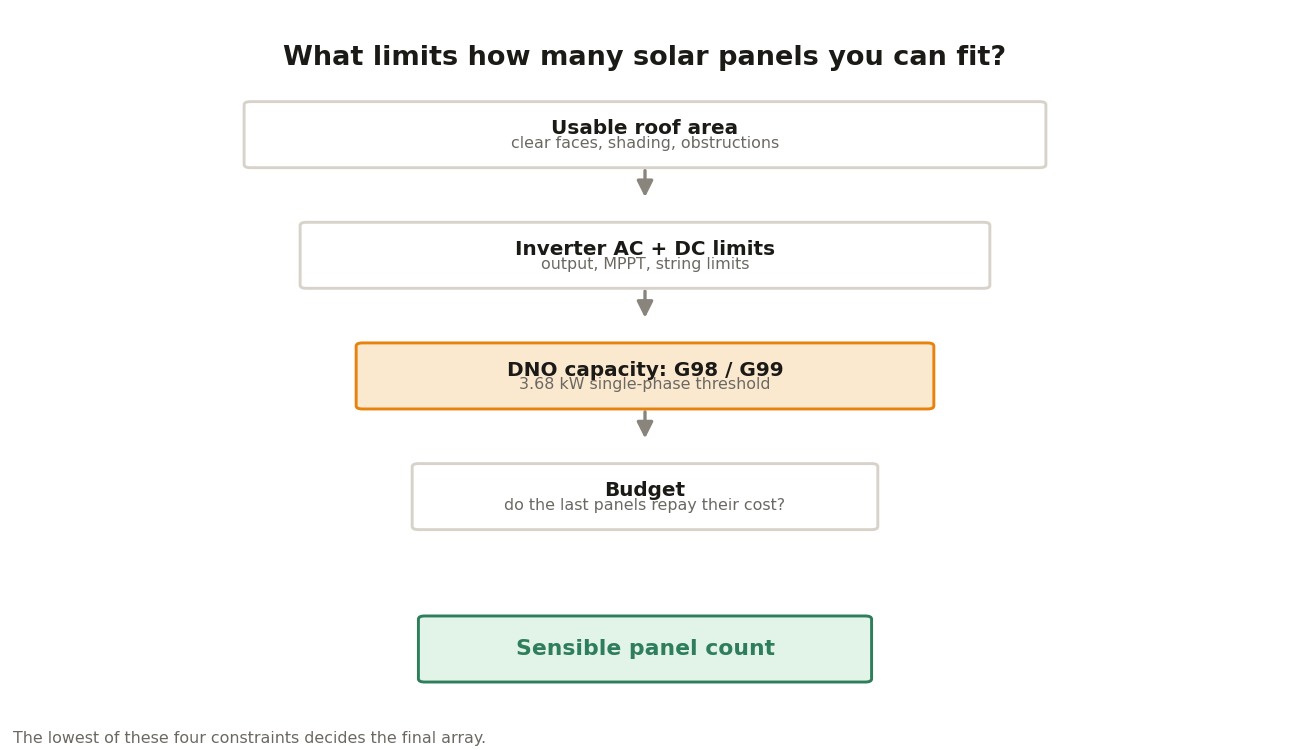
I would check these in that order. Measure the roof first, choose a workable panel layout, then select an inverter and connection route around that design. Starting with an arbitrary panel number can leave you with an awkward roof layout or an inverter that does not match the array.
How does roof area translate into a panel count?
A modern domestic panel occupies roughly 1.9m² before fitting clearances. For example, a 400W LONGi module measures 1,722 by 1,134mm, or 1.95m². Ten panels therefore cover about 19.5m² of panel surface, but the usable roof area must be larger because panels cannot normally fill every centimetre.
The dimensions come from the manufacturer’s 400W module datasheet. Current panels vary, so use the exact dimensions of the model in your quotation rather than assuming every panel is identical.
A quick area division only gives a first estimate. A 30m² roof does not automatically take 15 panels. The installer still has to produce a dimensioned layout around:
- ridges, verges, eaves and adjoining roof faces;
- chimneys, roof windows, vents and aerials;
- shaded areas and safe access for installation;
- portrait or landscape mounting and the rail arrangement.
House size is useful only as a starting point. A compact two-bedroom house with a clear south roof may have a better layout than a larger house broken up by dormers. My 2-bed south-facing, 3-bed east-west and 4-bed south-facing guides show how roof shape, direction and household demand change the design.
How many 400W panels fit under the 3.68kW G98 threshold?
Nine 400W panels provide 3.6kWp of DC capacity, while ten provide 4kWp. Both can be paired with a 3.68kW AC inverter under G98 if the inverter and string design support them. The tenth panel does not automatically trigger G99 because G98 limits AC generating capacity, not the panels’ combined nameplate rating.
| Panel layout | Panel capacity | Example inverter AC rating | Connection route |
|---|---|---|---|
| 9 × 400W | 3.6kWp DC | 3.68kW | G98, subject to full compliance |
| 10 × 400W | 4.0kWp DC | 3.68kW | Can remain G98 because AC capacity is unchanged |
| 12 × 400W | 4.8kWp DC | 3.68kW | Potentially G98, but inverter DC, MPPT and string limits must be checked |
| 10 × 400W | 4.0kWp DC | 4.0kW | G99 approval before connection on single phase |
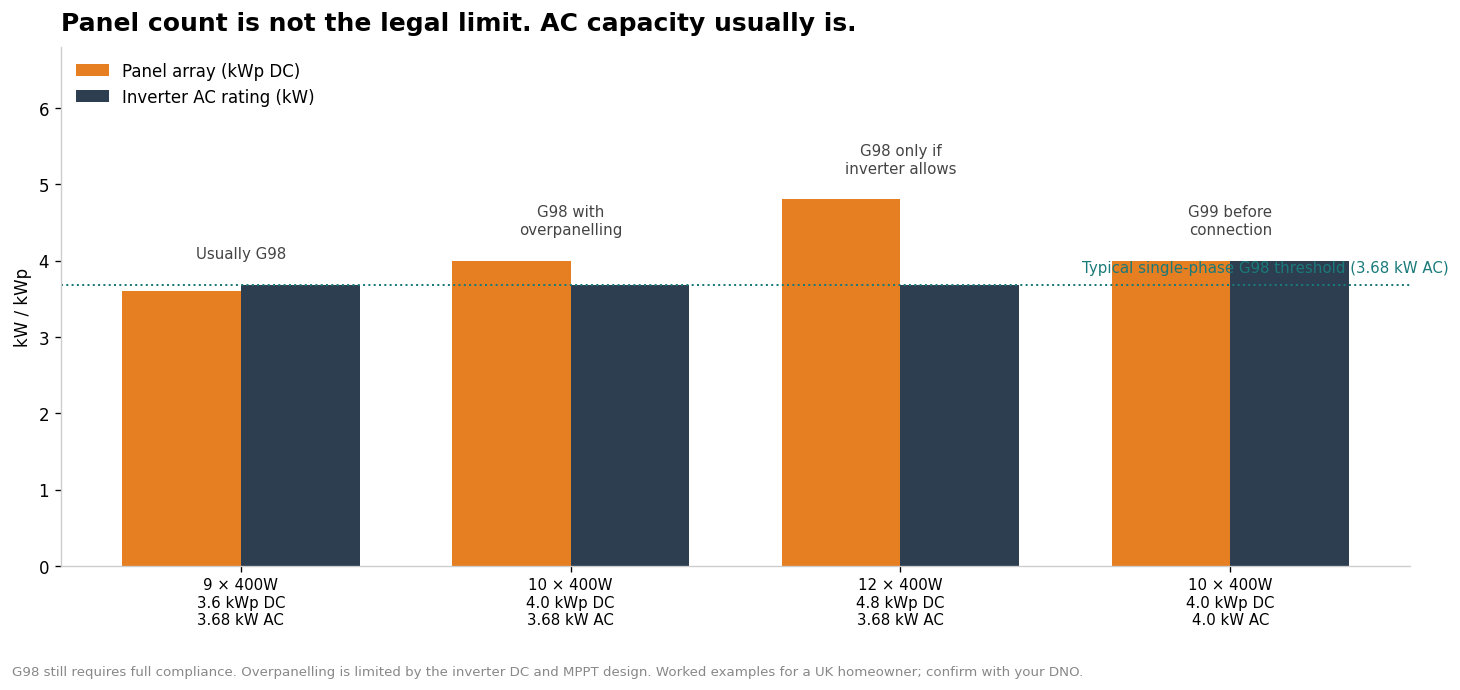
Using more panel capacity than inverter AC capacity is called overpaneling. It helps the inverter reach useful output earlier in the morning, later in the afternoon and during dull weather. On a bright day the inverter may clip the top of the production curve, but that does not mean the rest of the extra generation is wasted.
The sensible ratio depends on orientation, shading and the inverter datasheet. A south-facing array reaches a stronger midday peak than an east-west array, so it will usually clip sooner at the same DC-to-AC ratio. My inverter selection guide explains the checks, while How a Solar Inverter Works covers the DC and AC sides in plain English.
When do G98 and G99 change the answer?
G98 covers fully type-tested generation up to 16A per phase. That corresponds to 3.68kW on single phase or 11.04kW across three phases. Above that aggregate capacity, G99 applies and you need your DNO’s approval before connecting. Approval can depend on the available capacity of the local electricity network.
The Energy Networks Association distributed generation guide confirms that the 16A threshold applies per phase and to the aggregate generating capacity at one premises. Existing solar, batteries capable of exporting and additional inverters can therefore count together.
G98 is commonly described as connect and notify. A compliant small system can be commissioned and then notified to the DNO through the prescribed process. G99 is apply first and connect only after permission. It is not a ban on larger domestic systems.
I went through this when I expanded my own system from a 3.6kW inverter arrangement to one capable of 5.6kW. The extra panels were not the deciding issue. The combined AC capability was. I have set out that process in my G98 to G99 upgrade account.
Is fitting the maximum possible number of panels worthwhile?
Not always. Extra panels are most valuable when you can use their electricity, store it in a correctly sized battery, or receive a worthwhile export rate. At the time of writing, the Ofgem electricity price-cap average is 26.11p/kWh, while SEG export rates vary by supplier and can be much lower than imported electricity.
Ofgem reviews the cap every three months, and the 1 July to 30 September 2026 average electricity rate is 26.11p/kWh for Direct Debit. Your regional rate and tariff may differ. SEG rates are set by individual suppliers, with offers often around 5p to 15p/kWh, so check the live terms rather than building a 25-year calculation around one rate.
A south-facing system in southern or central Britain can produce roughly 950 to 1,000kWh per installed kWp each year at a sensible roof angle. The worked location in my 2-bed guide produces 978kWh/kWp at 28 degrees using the European Commission’s PVGIS calculator. Your postcode, roof angle, orientation and shading will move that figure.
If you export a large share at 5p while buying it back later at 26.11p, self-consumption becomes the stronger part of the calculation. A battery can shift surplus into the evening, but it adds cost and should be sized from real consumption rather than used to justify an oversized array.
For a broader cost and payback check, use Are Solar Panels Worth It in 2026?. It keeps the panel decision connected to the household bill rather than treating roof coverage as the goal.
What should you do before asking for quotations?
Measure the clear roof faces, estimate how many exact panel dimensions fit, and decide whether you want to remain at 3.68kW AC or apply under G99. Then compare quotations using the same panel layout, inverter rating, annual PVGIS estimate and assumed export rate. Then two quotes that look identical on price stop being identical, because you can see which one gets more panels through the same connection.
- Sketch each usable roof face and mark chimneys, windows, valleys and shaded areas.
- Ask for a dimensioned panel layout, not just a promised panel count.
- Check the inverter’s AC rating, maximum DC input, MPPT voltage range and current limits.
- Confirm whether the quotation assumes G98 notification or G99 approval.
- Run the proposed array through PVGIS using your postcode, roof angle and orientation.
- Compare the result with your annual use and daytime consumption before adding a battery.
If you are still deciding what a complete system needs, start with the Solar Energy Concepts start-here guide, then use the house-size System Guides to compare your roof with a worked example.
