
If you’re thinking of putting solar on a 2-bed with a south-facing roof, here’s what you can expect. South-facing is the best-case scenario in the UK: 978 kWh per kWp per year at 28° tilt, per PVGIS. The catch is that a 2-bed household uses around 2,100 kWh a year (Ofgem TDCV), so a generous south-facing array will generate more than you can consume. If you’re new to all of this, start here first.
I’ve got solar at home across three orientations and I’ve measured the output for three years. The thing that changed how I think about right-sizing was this: without a battery you’re exporting at 5-12p what you’ll buy back at 26.11p (the Ofgem cap for 1 July to 30 September 2026). On a south roof with a small household, that gap is at its widest in June and July when you’re producing 25+ kWh a day and using 6. The fix is a battery, or a smaller array, or both. For how tilt affects real output, see the panels-tilt guide with three years of metered data.
On a south-facing roof, single-MPPT is fine. You’re not splitting strings across different orientations, so there’s no voltage conflict to manage. That simplifies the inverter choice and keeps cost down.
What a 2-Bed South-Facing Roof Must Optimise For
- Self-consumption over generation. Every kWh used directly saves 26.11p at the Ofgem cap running from 1 July to 30 September 2026. Every kWh exported earns 5p on statutory SEG or 12p on Octopus Outgoing Fixed. Import displacement is 2-6x more valuable than export. Don’t size the array to maximise generation. Size it to match your actual daytime load.
- Moderate overpanelling, not aggressive. Target 125-135% of inverter AC rating. South-facing panels will clip on peak summer days, so returns on aggressive overpanelling diminish above 140%. Enough extra DC to boost spring and autumn output, not so much that you waste summer generation.
- Battery from day one. A hybrid inverter costs only £200-300 more than a string inverter. Fit the battery at the same time if you can. At 2,100 kWh annual consumption, a 5kWh battery shifts enough summer surplus to make the economics work. Without it, self-consumption stays at 20-30% of generation and you’re building for export returns, not grid displacement.
- Single MPPT is fine here. Clean south-facing roofs don’t need dual MPPT. One string, one peak, one voltage curve. Keep it simple.
South-Facing: The Classic Midday Peak
South-facing panels produce their maximum output between 11am and 2pm. That’s the geometry. The issue is that for most 2-bed households, those are the quietest hours of the day electrically. The house is often empty, fridge-freezer and standby loads tick along at 200-300W, and everything else waits until people get home at 5pm.
Without a battery, 40-55% of summer output exports to the grid at 5-12p. With a 5kWh battery, that surplus charges during the midday peak and covers the evening. On a low-mid 2-bed the ceiling is your own demand rather than your roof: solar plus battery can cover roughly three quarters of a 2,100 kWh household’s yearly electricity, and that is only about 37% of what a 4.45kWp south array generates. At high consumption the same kit uses a far larger share of its own output. The battery is where the ROI lives on this roof. A battery overview covers sizing and chemistry in detail. See also the battery storage directory for current pricing.
What a 2-Bed Actually Uses
Low to Mid: ~2,100 kWh/year
Gas central heating, standard appliances, no EV. The Ofgem Typical Domestic Consumption Value for a 2-bed is 2,100 kWh/year. That’s roughly £548/year at the 26.11p/kWh price cap in force from 1 July to 30 September 2026. Demand concentrates 7-9am and 5-9pm, with a dip during the day unless someone works from home.
At this consumption level, a well-sized budget system generates about twice your annual usage. That sounds good, but it means export waste is real unless you have storage. A modest 5.12kWh battery captures most of the evening demand dip and lifts the share of generation you use yourself from around 20% to around 37%. Turned the other way round, solar and battery together cover about three quarters of everything the house consumes in a year. What is left is winter, when the roof cannot keep up whatever you fit.
High: 5,000+ kWh/year
Heat pump, EV, or both. A heat pump adds 2,500-4,000 kWh/year depending on your home’s insulation. An EV adds 2,000-3,500 kWh depending on mileage. Annual bills can hit £1,385+.
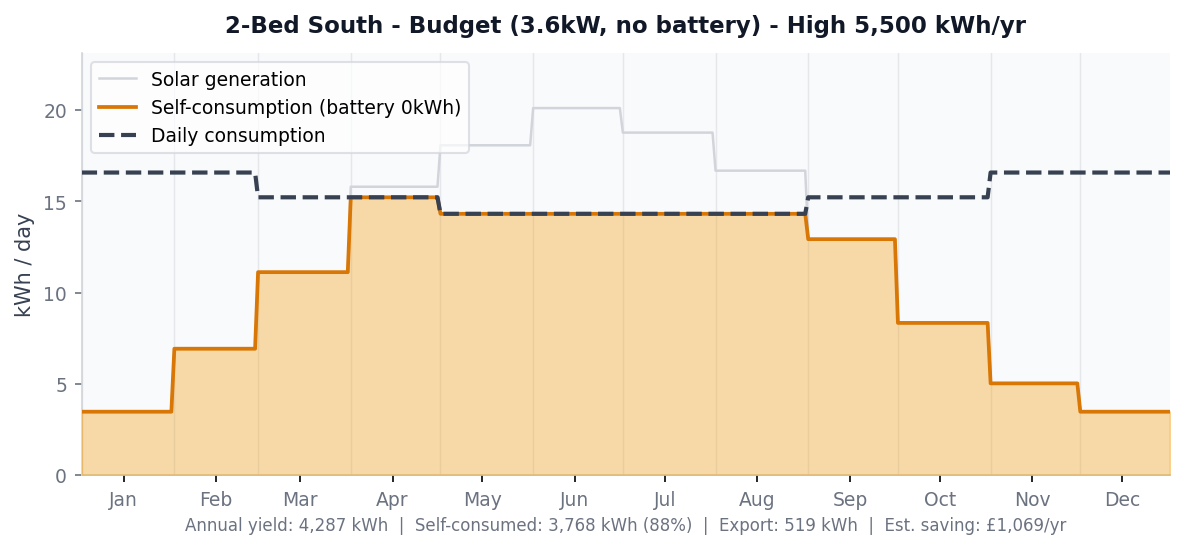
At this consumption level the south-facing midday peak actually matches up with the heat pump cycling through the day. Self-consumption rates of 55-70% are achievable even without a battery. With one, expect 66-78% of output, depending on how hard you have overpanelled. This is where the premium system earns its cost back fastest.
Budget Option: 3.6kW Hybrid, 10 Panels, 5.12kWh Battery
Solar Energy Concepts System Rating
System Specification
Inverter: Solis 3.6kW 5G Hybrid EH1
- AC output: 3.6kW (G98 compliant, notification only)
- 2 independent MPPTs, single string on south-facing is all you need
- Max DC input: 600V / 15A per MPPT / 5.7kW total
- MPPT range: 90-520V
- Hybrid design allows battery addition later without replacing the inverter
Budget £575-653 for a 3.6kW hybrid inverter. Treat that as an allowance rather than a price. Solis publishes no UK list price, and when I went looking on 24 July 2026 every figure in circulation traced back to a reseller listing rather than the manufacturer. Get your own quote before you rely on the totals below.
Overpanelling target: 124% of the 3.6kW AC rating = 4,450W DC. On a south-facing roof, moderate overpanelling is correct. You’ll clip slightly in peak summer, but the extra panels lift spring and autumn output where self-consumption is highest and waste is lowest.
Panel Options
| Strategy | Panels | Total DC | Overpanel % | String Check |
|---|---|---|---|---|
| Best value | JA Solar JAM54D40 445W × 10 | 4,450W | 124% | 10 × 39.1V = 391V < 600V. Isc 14.43A < 15A. Vmp 326.5V in 90-520V. OK. |
| Smallest footprint | LONGi Hi-MO X6 455W × 10 | 4,550W | 126% | 10 × 39.15V = 391.5V < 600V. Isc 14.79A < 15A. Vmp 329.8V in 90-520V. OK. |
| High efficiency | Aiko Neostar 490W × 9 | 4,410W | 122% | 9 × 40.98V = 368.8V < 600V. Isc 14.93A < 15A. Vmp 309.6V in 90-520V. OK. |
Battery
Fogstar 5.12kWh Server Rack (£730-900, checked 24 July 2026)
This is not optional. At 2,100 kWh annual consumption, the midday south-facing surplus has nowhere to go without storage. The 5.12kWh Fogstar captures most of the evening demand dip and lifts the share of generation you use yourself from around 20% to around 37% at low-mid usage. The hybrid inverter makes adding it straightforward. See the battery overview for sizing logic and chemistry options.
Total System Cost
- DIY hardware: £2,445-3,283 (panels £640-730 + inverter allowance £575-653 + battery £730-900 + mounting and cables £500-1,000). These are retail prices and they include VAT at the normal rate. Components you buy yourself are not zero-rated, whatever a forum post tells you.
- Electrician for the final AC connection under Part P: £150-300.
- DIY total: £2,595-3,583, midpoint £3,089. Every ROI figure below uses that midpoint.
- Installed by an MCS company: £3,742-4,931. That is an installer-quoted range for the finished job, not the component list with labour bolted on. A qualifying supply-and-fit installation is zero-rated for VAT, so the installer buys the same hardware roughly a fifth cheaper than you can.
DIY Feasibility
This is one of the most DIY-friendly builds available. One string of 9-10 panels into a hybrid inverter, plus a single battery module. At 3.6kW AC you notify the DNO under G98, not apply. A 5-minute online form. The Solis 3.6kW EH1 is well-documented in the UK DIY solar community. You can mount the panels and run the DC side yourself. A qualified electrician makes the final AC connection to your consumer unit under Part P (£150-300). No MCS is needed, though without it you won’t be eligible for SEG export payments. On a self-consumption-first 2-bed, the foregone export income is the price of DIY: about £136 a year at low-mid consumption on the 5p statutory rate, which is the difference between a 5.7-year and a 7.5-year payback on the midpoint build.
Expected Performance
| Metric | Low-Mid (2,100 kWh) | High (5,000 kWh) |
|---|---|---|
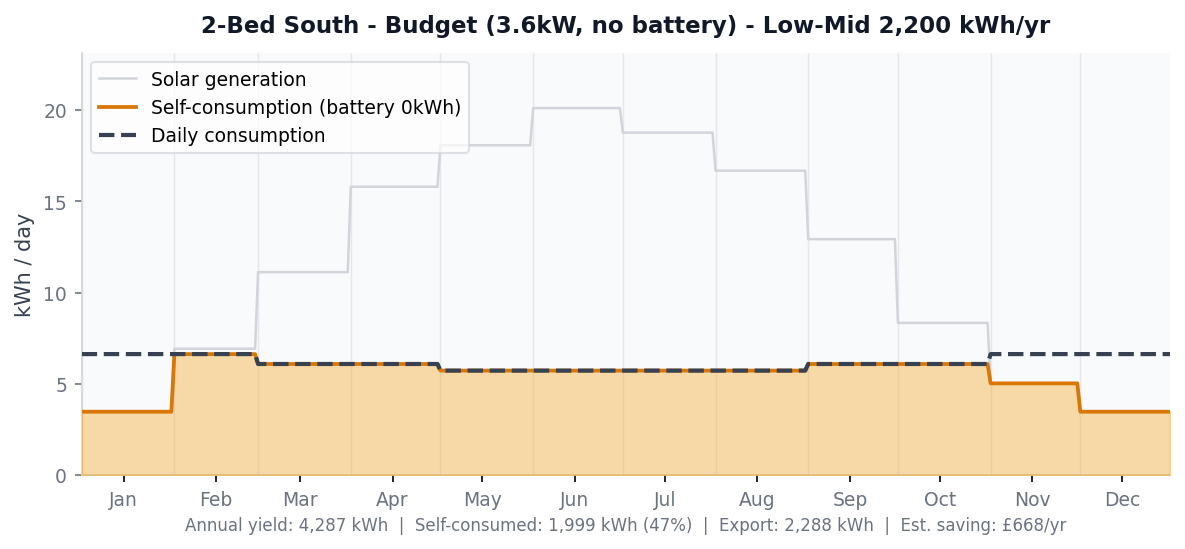
| Annual yield | 4,287 kWh | |
| Self-consumption (with 5.12kWh battery) | 37% (1,570 kWh) | 78% (3,344 kWh) |
| Export | 63% (2,717 kWh) | 22% (943 kWh) |
| Grid savings (at 26.11p) | £410/year | £873/year |
| Export income (SEG 5p) | £136/year | £47/year |
| Total annual saving | £546/year | £920/year |
The low-mid column is capped by the house, not the roof. Self-consumption cannot exceed what you actually use, and 1,570 kWh is already about three quarters of a 2,100 kWh household’s total demand. Grid savings are that figure at 26.11p/kWh, the Ofgem cap for 1 July to 30 September 2026. Moving from statutory 5p SEG to Octopus Outgoing Fixed 12p adds roughly £190/year at low-mid consumption and £66/year at high, which on this roof matters more than it should.
Premium Option: 5kW Hybrid, 14-16 Panels, 10kWh Battery
Solar Energy Concepts System Rating
System Specification
Inverter: Solis 5.0kW S5 Smart Hybrid
- AC output: 5.0kW (requires G99 application, see below)
- 2 independent MPPTs, 1 string each
- Max DC input: 600V / 15A per MPPT / 8.0kW total
- MPPT range: 90-520V
- Hybrid design with native battery support
Allow £707-770 for a 5kW hybrid inverter, on the same footing as the budget build: an allowance, not a sourced price, because Solis publishes no UK list price and everything I could find on 24 July 2026 was a reseller listing.
Overpanelling target: 142% of the 5.0kW AC rating = 7,120W DC. The higher DC capacity recovers more from shorter winter days. On a south-facing roof in summer you’ll clip some, but the winter and shoulder-season uplift is worth it for high-consumption households.
Panel Options
| Strategy | Panels | Total DC | Overpanel % | String Check |
|---|---|---|---|---|
| Best value | JA Solar JAM54D40 445W × 16 (8 + 8) | 7,120W | 142% | 8 × 39.1V = 312.8V < 600V. Isc 14.43A < 15A. Vmp 261.2V in 90-520V. OK. |
| Smallest footprint | Aiko Neostar 490W × 14 (7 + 7) | 6,860W | 137% | 7 × 40.98V = 286.9V < 600V. Isc 14.93A < 15A. Vmp 240.8V in 90-520V. OK. |
Battery
Fogstar Energy 10kWh Outdoor (10kWh, £1,499)
The target for a 2-bed premium system is at least 150% of daily low-mid consumption (5.75 kWh/day x 1.5 = 8.6 kWh). The 10kWh Fogstar clears that threshold. It captures summer midday surplus for evening use and enables winter tariff arbitrage on standard Octopus Go: fill the battery from the grid in the 00:30 to 05:30 window at 9.5p/kWh, then cover the expensive morning and evening peaks from storage instead of importing at 26.11p. That is a spread of 16.6p/kWh, worth about £1.66 a night on a full 10kWh cycle through the darkest months. Both rates were checked on 24 July 2026, and the 26.11p cap runs only to 30 September 2026.
This slot used to say GivEnergy 9.5kWh Gen 3, and it cannot any more. GivEnergy Ltd entered administration in April 2026, ceased trading, and its administrator has stated that no further hardware warranties or app support will be honoured. Stock still appears at the old £2,580-3,104 pricing, so the unit remains buyable. What you cannot buy is anyone standing behind it. Read how to avoid an orphaned system before you take a discounted one.
The replacement is not like for like, and it is worth knowing which way. The GivEnergy was an all-in-one with its own inverter inside. The Fogstar is a battery only, so it relies on the Solis hybrid above to do the converting, which this build already has. If you would rather have an installed all-in-one, I cannot give you a price I can source first-hand today. Fogstar is the one brand whose UK prices I can confirm directly, at £109 to £121 per usable kWh on the larger racks when I checked on 24 July 2026; every other brand I tried came back as a reseller estimate, an installed-system quote or nothing at all. So get an all-in-one quote in writing and check three things before you sign it: who honours the warranty if the manufacturer stops trading, how many years it actually runs, and whether a single failed module can be replaced on its own.
Total System Cost
- DIY hardware: £3,930-4,837 (16 panels £1,024-1,168 at the same per-panel price as the budget build + inverter allowance £707-770 + Fogstar 10kWh £1,499 + mounting and cables £700-1,400). Retail prices, VAT included.
- Electrician for the final AC connection: £150-300.
- DIY total: £4,080-5,137, midpoint £4,609.
- MCS installed: £10,305-11,733. An installer-quoted range for the whole job including the G99 application and certification, not a component total.
G99 and MCS
At 5.0kW AC output this system exceeds the G98 threshold of 3.68kW. You must apply for G99 permission from your DNO before connecting. This is a formal application, not a notification. Most DNOs approve residential G99 within 45 days. SSEN (Scotland, parts of South England) can take 60+ days in constrained areas. Submit before the panels arrive if you’re in an SSEN area.
MCS is worth the cost on the premium build: you qualify for SEG, you access time-of-use tariffs that some suppliers restrict to MCS installs, and it protects home insurance and resale value.
When It’s Worth It vs Overkill
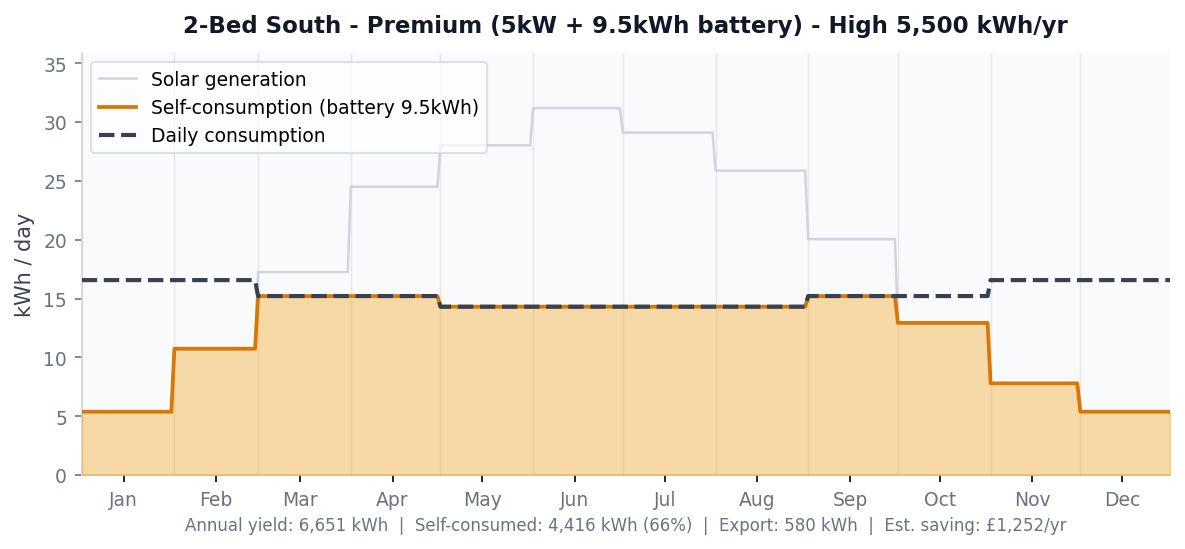
Worth it if you have a heat pump or EV at home, or plan to add one within 2-3 years. At 5,000 kWh/year the premium system self-consumes 66% of its output and the battery earns its keep through avoided grid imports. The 10kWh battery also enables standard Octopus Go arbitrage in winter, when south-facing solar output drops to 2-4 kWh per day.
Overkill if you’re a low-consumption 2-bed household with no plans to electrify heating or transport. The budget system with a 5.12kWh battery already delivers the better return. The extra £1,520 for the premium setup adds £154/year at low-mid consumption. That is a 10-year payback on the incremental spend, and the extra capacity only starts working for you once consumption grows. Go budget, revisit if it does.
Expected Performance
| Metric | Low-Mid (2,100 kWh) | High (5,000 kWh) |
|---|---|---|
| Annual yield | 6,651 kWh | |
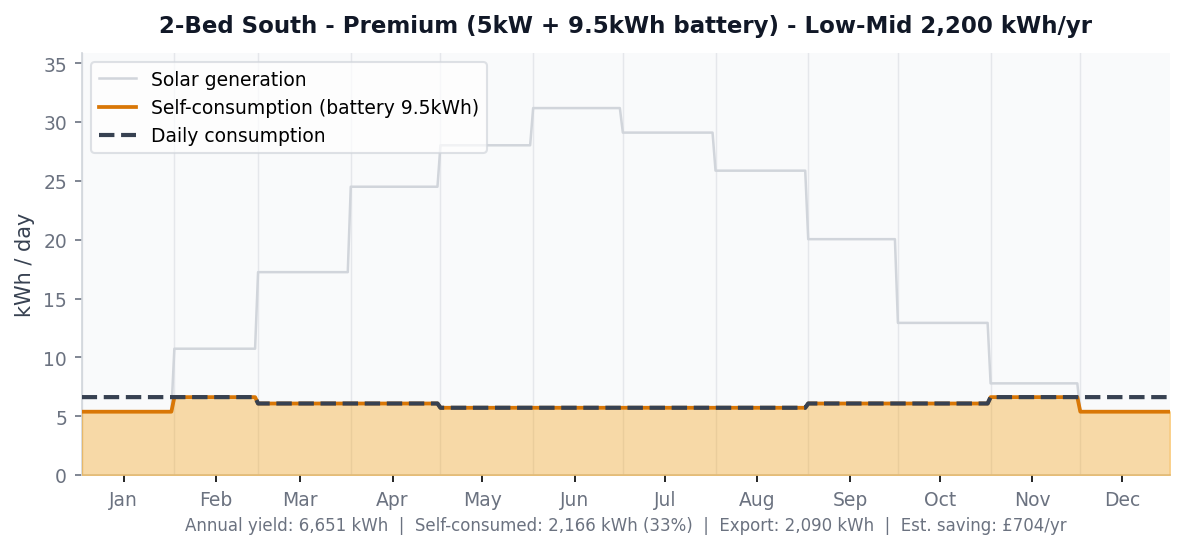
| Self-consumption (with 10kWh battery) | 26% (1,740 kWh) | 66% (4,390 kWh) |
| Export | 74% (4,911 kWh) | 34% (2,261 kWh) |
| Grid savings (at 26.11p) | £454/year | £1,146/year |
| Export income (SEG 5p) | £246/year | £113/year |
| Total annual saving | £700/year | £1,259/year |
The low-mid column is the clearest argument against this system on a small house. 1,740 kWh is roughly 83% of everything a 2,100 kWh household uses in a year, and no bigger array can get past that ceiling. Three quarters of the generation leaves the property at 5p, and the extra £1,520 over the budget build buys £154 a year.
The Battery Is the Real ROI Lever
Without a battery, a south-facing 2-bed system is essentially an export machine for 4-5 months of the year. The midday peak is real, it’s large, and it has nowhere to go in a house that uses 5-6 kWh a day total.
A battery does two jobs here. In summer, it captures the midday peak and shifts it to the evening. In winter, when south-facing generation drops to 2-4 kWh per day, it enables overnight arbitrage on standard Octopus Go: charge between 00:30 and 05:30 at 9.5p, then run the 7-9am and 5-9pm peaks off the battery instead of importing at 26.11p. The UK saw 400% energy price hikes in 2022. A home battery is a hedge against that happening again, separate from whatever your roof generates.
Tariff Strategy
Budget option: A flat-rate tariff works if self-consumption is your goal. The savings come from avoided grid imports at 26.11p, not clever tariff moves. If you’re exporting consistently (visible on your inverter app), move to Octopus Outgoing Fixed at 12p. That roughly doubles export value over statutory SEG at 5p, for no additional complexity.
Premium option: standard Octopus Go is the natural fit. It runs 00:30 to 05:30 at 9.5p/kWh, the same rate nationally, and anyone can sign up for it. Charge the 10kWh battery in that window and cover the evening peak from storage rather than importing at 26.11p. In summer solar does the charging; in winter cheap off-peak grid power fills the battery instead. The 16.6p/kWh spread on a full 10kWh cycle is about £1.66 a night across the darkest three months. Intelligent Octopus Go is cheaper at 8p and starts earlier at 23:30, but eligibility is tied to an electric vehicle or a compatible charger, so it is only worth chasing if you have one. Rates checked 24 July 2026.
DNO Region Notes
South-facing systems export more aggressively than any other orientation in summer. At the budget 3.6kW level this is well within grid tolerances everywhere.
- G98 (budget, 3.6kW): notification only. All DNOs process within days.
- G99 (premium, 5kW): application. UKPN/NPG 20-30 days; WPD/ENW 30-45; SSEN 45-60+.
Timeframes per ENA Engineering Recommendation G99 (statutory 45 working-day limit) and each DNO’s published connections SLA. Actual turnaround varies by local grid capacity.
ROI Comparison
| Budget DIY | Budget Installed | Premium DIY | Premium MCS | |
|---|---|---|---|---|
| Low-Mid Consumption (2,100 kWh/year) | ||||
| Upfront cost | £3,089 | £4,337 | £4,609 | £11,019 |
| Annual saving | £546 | £546 | £700 | £700 |
| Payback | 5.7 years | 7.9 years | 6.6 years | 15.7 years |
| 25-year return | £13,650 | £13,650 | £17,500 | £17,500 |
| High Consumption (5,000 kWh/year) | ||||
| Upfront cost | £3,089 | £4,337 | £4,609 | £11,019 |
| Annual saving | £920 | £920 | £1,259 | £1,259 |
| Payback | 3.4 years | 4.7 years | 3.7 years | 8.8 years |
| 25-year return | £23,000 | £23,000 | £31,475 | £31,475 |
Every figure here comes from one model, rebuilt on 25 July 2026. DIY upfront costs are the midpoints of the £2,595-3,583 (budget) and £4,080-5,137 (premium) totals above, hardware plus the electrician, VAT included. The installed columns are installer-quoted ranges. Import is 26.11p/kWh, the Ofgem cap for 1 July to 30 September 2026; export is the 5p statutory SEG rate; no energy inflation and no degradation are assumed either way. The fast end of any range assumes you buy at the bottom of the cost range, so plan around the midpoints printed above rather than the best case. The DIY columns include export income, which a system without MCS certification will not receive: strip it out and budget DIY payback at low-mid consumption moves from 5.7 to 7.5 years. The premium MCS column assumes an installer will fit the same 10kWh battery; if yours insists on an all-in-one from a brand they support, expect that line to be higher, and ask who honours its warranty. Ofgem publishes the October to December cap by 26 August 2026, at which point every import figure on this page needs rechecking.
Generation Yield Source
All yield estimates are derived from PVGIS, the European Commission’s free solar radiation database (satellite-measured irradiance, PVGIS-SARAH3 model).
| Parameter | Value |
|---|---|
| Location | 52.308°N, -0.717°W (Central England reference) |
| Roof slope | 28° |
| System loss | 14% |
| Database | PVGIS-SARAH3 |
| South aspect | 0° (aspect=0) → 978.0 kWh/kWp/yr |
| Clipping factor | 0.99 (budget, 124% overpanel); 0.96 (premium, 142% overpanel) |
Verify for your postcode using the PVGIS interactive tool (south aspect 0°). Enter your own coordinates to get location-specific figures.
Key Takeaways
- South-facing 2-bed is the easiest solar scenario in the UK. 978 kWh/kWp/year (PVGIS). But easy to over-build: a 2-bed uses 2,100 kWh/year (Ofgem TDCV), so a large array exports most of its output.
- Battery is non-negotiable. Without it, midday surplus exports at 5-12p and you buy it back at 26.11p, the Ofgem cap for 1 July to 30 September 2026. That gap is where the ROI lives.
- Budget 3.6kW + 10 panels + 5.12kWh battery (£3,089 DIY midpoint, hardware plus electrician) pays back in 5.7 years at typical 2-bed consumption, or 3.4 years if you run a heat pump or an EV.
- Premium 5kW + 14-16 panels + 10kWh battery only makes sense if you have a heat pump, EV, or plan to add one. At low-mid consumption the extra £1,520 takes about 10 years to pay back on its own.
- Single-MPPT inverter is fine on a clean south-facing roof. No split strings, no voltage conflict. Keep the system simple.
Related Guides
- How roof tilt actually affects 10-year ROI. Three years of metered data on SE, NW, flat, and wall mounts.
- Start here: your guide to home solar. Read this first if you’re still deciding whether solar is for you.
- Battery overview. Sizing, chemistry, and why storage is the ROI lever on most UK roofs.
- Seven solar myths. Includes the “south-facing is always best” myth and what export economics actually look like.
- Are solar panels worth it in 2026?. Full ROI breakdown with current tariff assumptions.
- 3-bed east/west roof. If your 2-bed has an east/west split, this is the guide to read instead.
- 4-bed south-facing roof. Same orientation, larger house, different sizing logic.
