Overpaneling (also known as DC oversizing) is one of the most effective strategies for getting more from your home solar investment. In the UK’s variable climate, standard solar setups can underperform during winter and on overcast days. By installing more panel capacity than your inverter’s rated AC output, you gain meaningful advantages:
- Significantly increase winter generation when energy demand is highest.
- Charge home batteries more consistently on cloudy or low-light days.
- Improve your Return on Investment (ROI) by making fuller use of your existing inverter.
It might sound counterintuitive or perhaps even risky to connect more panels than your inverter is rated for. However, when designed within manufacturer limits, overpaneling is a well-established, industry-standard practice endorsed by bodies such as the International Electrotechnical Commission (IEC). Done properly, it transforms a standard solar system into one that performs reliably across all seasons.
By understanding the DC/AC ratio, which is the core metric behind overpaneling, you can design a solar energy system that delivers better performance year-round. Here’s how to make it work safely and effectively.
What is Overpaneling?
Overpaneling simply means your solar array’s peak DC power rating is higher than your inverter’s rated AC output. For example, pairing a 10kWp (kilowatts peak) solar panel array with an 8kW AC inverter gives a DC/AC ratio of 1.25. In the solar industry, this ratio is known as the Inverter Loading Ratio (ILR). It is a standard design parameter referenced in IEC 62548-1:2023, the international standard for PV array design.
What are the Benefits of Overpaneling?
Overpaneling delivers the greatest advantage on sub-optimal days. In the UK climate, those days are a regular occurrence. Solar panels rarely produce their laboratory-rated peak power in real-world conditions. Output is influenced by panel temperature, sun angle, partial shading, and time of day. On a typical residential roof, a 10kW array might frequently deliver closer to 7kW or 8kW of actual DC power.
Data from the National Renewable Energy Laboratory’s 2024 Annual Technology Baseline (ATB) models residential PV systems at an ILR of 1.21. This confirms that moderate oversizing is now a standard design assumption, not an edge case. Research consistently shows that an ILR between 1.1 and 1.3 represents the practical sweet spot for residential installations: high enough to ensure the inverter operates efficiently from early morning through late afternoon, yet low enough to keep clipping losses modest.
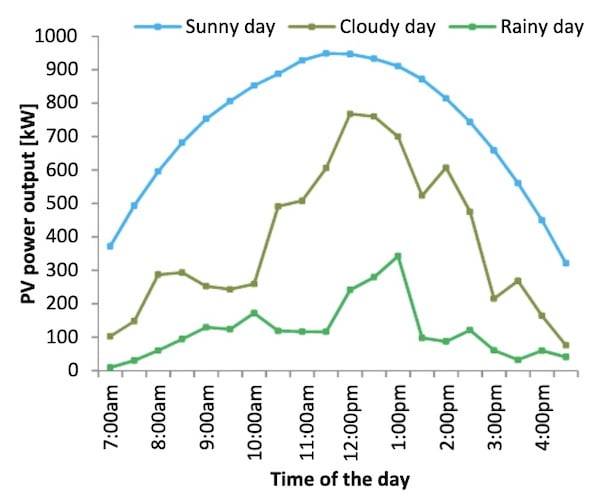
Essentially, adding more panels compensates for real-world inefficiencies, giving your system the boost it needs to deliver consistent energy.
Improved Solar Power Harvest On Cloudy Days
Solar energy production naturally drops during cloudy or overcast weather. Without a generously sized array, these dips often mean drawing more electricity from the grid. Overpaneling provides a practical buffer against this shortfall.
With a larger array, even a cloudy day yields noticeably higher total output compared to a system sized 1:1 with the inverter. While there may be some uncaptured potential (known as inverter clipping) on the brightest days, the additional energy harvested across the darker months comfortably outweighs this loss. An EPRI white paper on DC:AC ratios confirms that the marginal gains from oversizing consistently exceed the marginal clipping losses at ratios up to around 1.3.
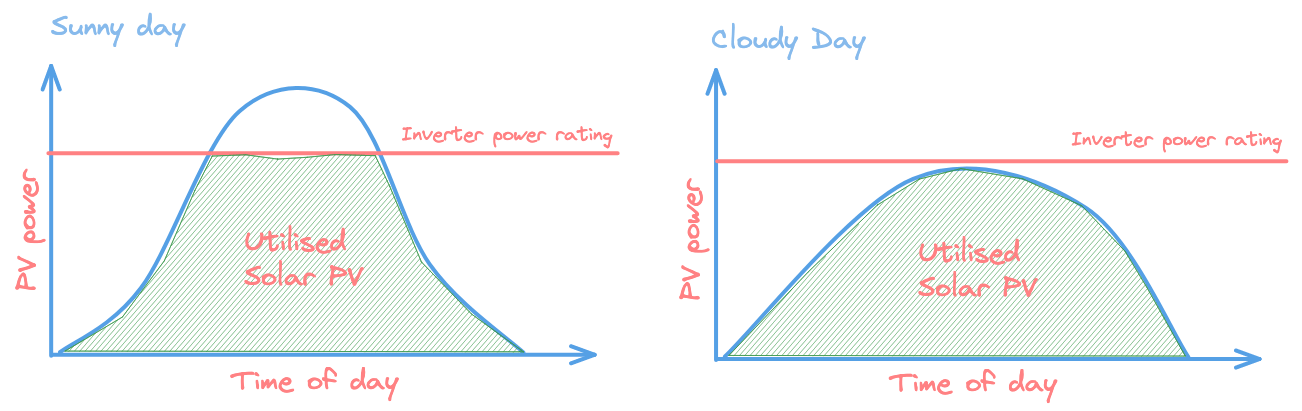
Utilisation of Excess Energy
What happens when conditions are ideal and your extra panels produce more DC energy than the inverter can convert to AC? Modern hybrid inverters handle this gracefully. While the inverter outputs its maximum rated AC electricity to your home (or the grid), many systems can simultaneously route the surplus DC power directly into battery storage. This effectively allows the system to put more of that DC energy to work than a simple AC rating would suggest.
Improved inverter efficiency
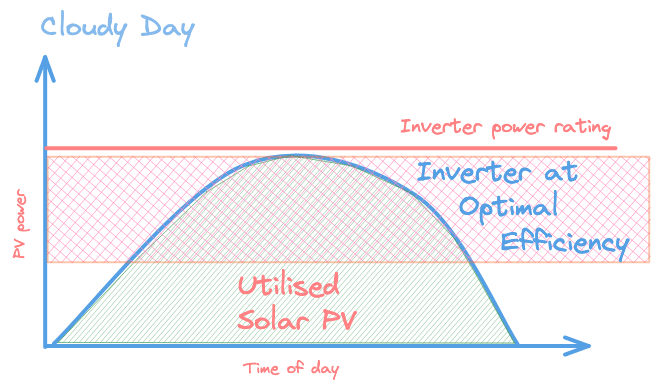
Inverters don’t operate at peak efficiency across their entire power range. They are typically designed to reach maximum efficiency when handling loads between 50% and 80% of rated capacity. If your panels frequently produce less than this threshold, your inverter is operating below its optimal efficiency curve.
Research compiled by Sandia National Laboratories documents this behaviour in detail through PV performance modelling. Fraunhofer ISE, Europe’s largest solar energy research institute, has similarly demonstrated that keeping inverters within their most efficient operating window meaningfully improves annual energy conversion. This can be achieved through moderate DC oversizing, and it is especially noticeable on overcast days.
Overpaneling Delivers a Better Return On Investment
Consider the numbers. A standard system without overpaneling using a 5.88 kW array paired with a 5 kW inverter might generate around 8,000 kWh annually, saving roughly £1,200 per year.
Now apply overpaneling by upgrading to a 7.56 kW array with the same 5 kW inverter. This oversized system could produce approximately 10,500 kWh annually, increasing savings to around £1,575 per year. Since additional panels are relatively inexpensive compared to upgrading the inverter, the economics tend to favour adding capacity. This improves overall ROI while keeping the payback period competitive.
| Aspect | Standard System | With Overpaneling |
|---|---|---|
| Number of Panels | 14 x 420Wp | 18 x 420Wp |
| System Size (kW) | 5.88 | 7.56 |
| Energy Production (kWh/year) | 8,000 | 10,500 |
| Initial Cost (£) | 5,000 | 6,500 |
| Annual Savings (£) | £1,200 | £1,575 |
| ROI (%) | 24 | 24.2 |
| Payback Period (Years) | 4.17 | 4.13 |
| Total Cost (£) | 5,000 | 6,500 |
Important Technical Considerations
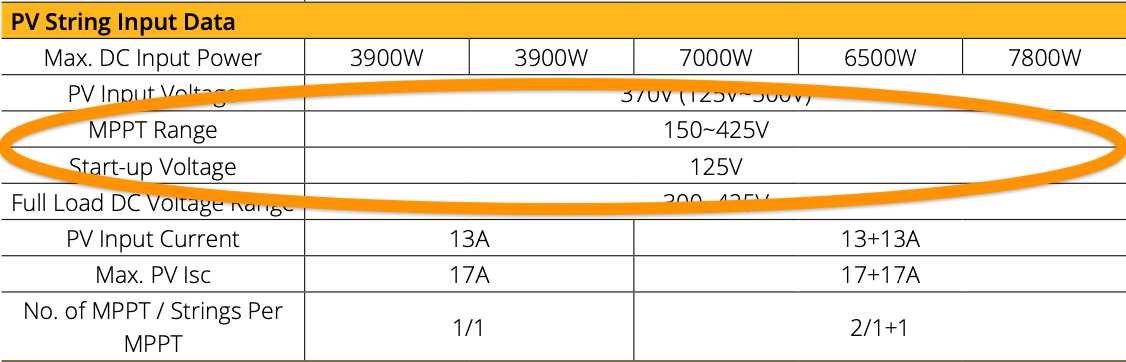
While adding panels is appealing, there are firm electrical limits that must be respected. The primary constraint is the DC voltage limit of your inverter, clearly stated on the manufacturer’s specification sheet.
This can be managed through thoughtful design. For instance, wiring solar panel strings in parallel allows you to increase total capacity (current) while keeping voltage within safe limits. The IEC 62548-1:2023 standard provides detailed guidance on maximum voltage calculation, including adjustments for low-temperature conditions that raise open-circuit voltage.
Beyond safety, there is a point of diminishing returns. Extreme DC/AC ratios (above roughly 1.5 for residential systems) tend to result in excessive clipping losses, making the additional panels difficult to justify economically.
Can The Inverter Handle The Extra Power?
Yes, provided you stay within the manufacturer’s specified limits. The inverter’s Maximum Power Point Tracking (MPPT) circuitry manages the incoming energy intelligently. In simple terms, the inverter only draws the current it needs. This works much like any other electrical device connected to a supply.
Here is an example MPPT specification from a popular Sunsynk hybrid inverter.
Is Solar Overpaneling Safe?
Yes, solar overpaneling is entirely safe when designed correctly. A common misconception is that “extra panels” force too much power into the inverter, leading to overheating or fire risk. In reality, the inverter’s Maximum Power Point Tracking (MPPT) system acts as a gatekeeper. It only draws the exact amount of current it is rated to handle. As long as your array string design strictly prevents the open-circuit voltage (Voc) from ever exceeding the inverter’s maximum input capacity (accounting for cold weather spikes), the system is completely safe and meets IEC 62548 standards.
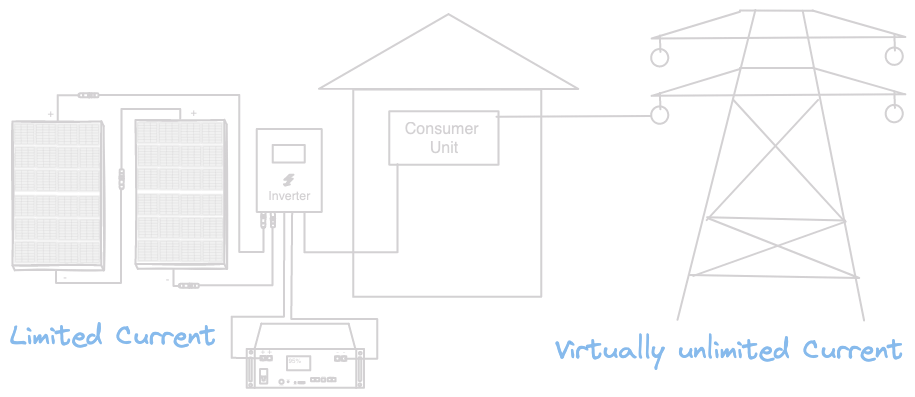
Solar Panels as a Source of Current
The MPPT dynamically adjusts the consumed DC voltage and current to safely optimize the production of AC power. As long as the open-circuit voltage from your solar strings never exceeds the inverter’s maximum input voltage, the inverter will safely limit (clip) the current it draws to protect its internal circuitry.
What Exactly Happens If I Oversize Too Much?
If you connect too many panels in series, you risk exceeding the inverter’s maximum input voltage. This is a serious safety risk. Exceeding the voltage limit can permanently damage the inverter and create a fire hazard. Always design your string lengths to remain well below the maximum voltage rating, with a margin for cold weather, which temporarily raises panel open-circuit voltage.
If you add capacity via current instead (connecting strings in parallel), the consequence is far more benign: inverter clipping. The inverter simply limits the excess power, capping the output graph with a flat line. You forfeit some potential energy, but your equipment remains safe. This is provided the total short-circuit current stays within the manufacturer’s specified input current limit.
Does Overpaneling Void My Inverter Warranty?
No, it generally does not, provided you follow the manufacturer’s oversizing limits. Major manufacturers actively design and warrant their inverters for significant DC/AC ratios. For example, Fronius Symo units typically allow at least 150% oversizing, SolarEdge allows up to 155%, and SMA’s Sunny Boy Smart Energy series permits up to 200%. Your warranty remains fully intact as long as you respect the absolute maximum voltage and short-circuit current (Isc) limits stated on the datasheet.
Understanding the Drawbacks of Overpaneling
It’s important to approach overpaneling with a balanced view. There are two primary considerations to have in mind before designing your array:
- Inverter Clipping (Unrealized Potential): Wasted energy during peak production windows.
- Fault Currents: Higher potential currents affecting system protection coordination.
The Reality of Inverter Clipping
On clear, cool days, your oversized array will generate more DC power than the inverter can convert to AC. Any output above the inverter’s AC ceiling is simply not captured. This is known as “inverter clipping”.
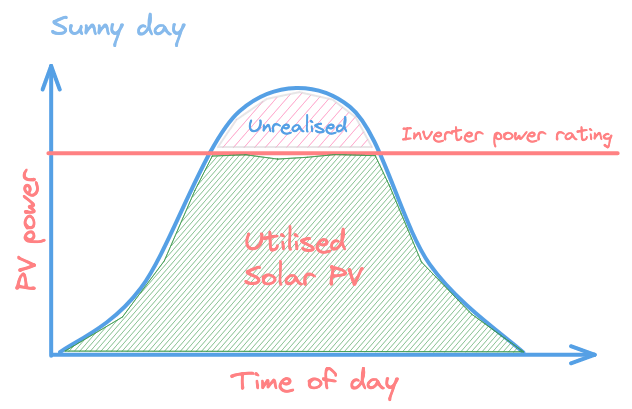
However, analyses from both NREL and EPRI consistently conclude that a moderate amount of clipping is an acceptable and expected trade-off. The small percentage of energy lost during peak midday hours is reliably offset by the substantial gains achieved during mornings, late afternoons, and the numerous overcast days typical of the UK climate.
There is also a major exception to clipping losses if you have a hybrid setup. Because clipping only applies to the AC output limit, many modern hybrid inverters can simultaneously route surplus DC power directly into a battery. For example, this detailed case study demonstrates how a 3.6kW inverter can process nearly double its rated power by dynamically using the “clipped” DC energy to charge a home battery. It’s important to note that not all inverters support this dual-routing capability natively, so always verify your specific model’s DC-coupled charging behaviour.
Managing Higher Short-Circuit Currents
To safely overpanel while respecting voltage limits, designers often employ parallel stringing. This increases the total available DC current in the system. While normal operation is safe, in the rare event of a short circuit, more current will flow towards the fault. It is essential to ensure that your DC isolators, circuit breakers, and the inverter itself are rated to handle these higher potential fault currents. This is a requirement clearly set out in IEC 62548 and reinforced by the UK’s MCS installation standards (MIS 3002).
The UK G98 Overpaneling Advantage
For UK homeowners, overpaneling offers a powerful regulatory advantage regarding the Energy Networks Association (ENA) grid connection rules.
The standard G98 DNO (Distribution Network Operator) application allows for a simple “fit and inform” installation process, bypassing weeks of wait times and potential grid upgrade costs. However, G98 strictly caps your grid export capacity to 16 Amps per phase, which equals roughly 3.68kW of AC power.
By using a 3.6kW hybrid inverter, you automatically comply with the fast-track G98 limit. But by overpaneling that inverter with 5kW or 6kW of solar panels, you generate massive amounts of energy. The 3.6kW of AC goes to your home loads and the grid, while the “excess” DC power bypasses the AC limit entirely and charges your home battery directly. It is the ultimate legal loophole for maximizing a home solar-plus-storage setup without triggering complex G99 grid gridlock.
Looking Forward: Smarter System Design
DC oversizing is a well-proven strategy for managing the realities of weather variability and getting more from your solar investment. By accepting minor losses at peak times (clipping) in exchange for meaningful gains during mornings, evenings, and overcast days, homeowners can build productive systems that deliver consistent energy throughout the year.
If you have the roof space and an understanding of the technical limits, overpaneling is a practical and rewarding step toward greater energy independence. We’d love to hear about your system design, your experiences with oversizing, and any questions you might have. Share them with us here at Solar Energy Concepts.