
If you are choosing between these two batteries today, I would buy the Fogstar route. The blunt reason: GivEnergy Ltd is in administration, and its administrator has said it will not honour further hardware warranties or support. That makes a new All in One purchase unusually high risk, whatever the original spec sheet says.
I have already written up my lived experience with the rack in my Fogstar battery rack owner’s review, so I will not repeat it here. This page is about what a buyer can safely choose now, and about the difference between buying modular battery modules and buying an integrated AC-coupled unit.
What are you actually comparing?
The Fogstar bundle is three 5.12kWh, 51.2V LiFePO4 rack modules, giving 15.36kWh nominal capacity, plus your chosen compatible inverter. The GivEnergy All in One Gen 1 is a 13.5kWh LiFePO4 AC-coupled all-in-one unit. They are not like-for-like boxes, so start with the installation route you want.
Fogstar’s approach is deliberately modular. You buy the battery rack, check that the exact inverter supports it, and have the system fitted by a competent installer. That gives a DIY-minded homeowner more freedom over the inverter and how the system grows, but it also means the battery price is not the price of a working system.
The All in One puts the battery and AC-coupled equipment into one product supplied through installers. That is attractive if you want one integrated unit rather than selecting separate components. It does not remove the need to understand who is responsible for the installation, ongoing support and any remedy if something fails.
How do capacity, power and hardware cost compare?
Fogstar has 15.36kWh nominal capacity across three modules, while the GivEnergy All in One is 13.5kWh. GivEnergy quotes 6.0kW continuous power for its unit. Fogstar states a 100A maximum discharge per module, but you must confirm the inverter and complete system limits rather than assuming a headline power figure.
| Question | Fogstar Energy 15kWh Rack Battery Bundle | GivEnergy All in One Gen 1 6.0 |
|---|---|---|
| Battery type | Three modular 51.2V rack batteries | Integrated AC-coupled all-in-one unit |
| Chemistry | LiFePO4 | LiFePO4 |
| Capacity | 15.36kWh nominal | 13.5kWh |
| Power stated in the source | 100A maximum discharge per module | 6.0kW continuous power |
| Installation route | Retail supply, compatible inverter and competent installer | Installer-only |
| Price position | £2,499.99 ex VAT, hardware-only, at the time of writing | Do not treat it as a normal new retail purchase |
| Warranty position for a new buyer | 10-year manufacturer warranty | Previously advertised as 12 years; the administrator says GivEnergy Ltd will not honour further hardware warranties |
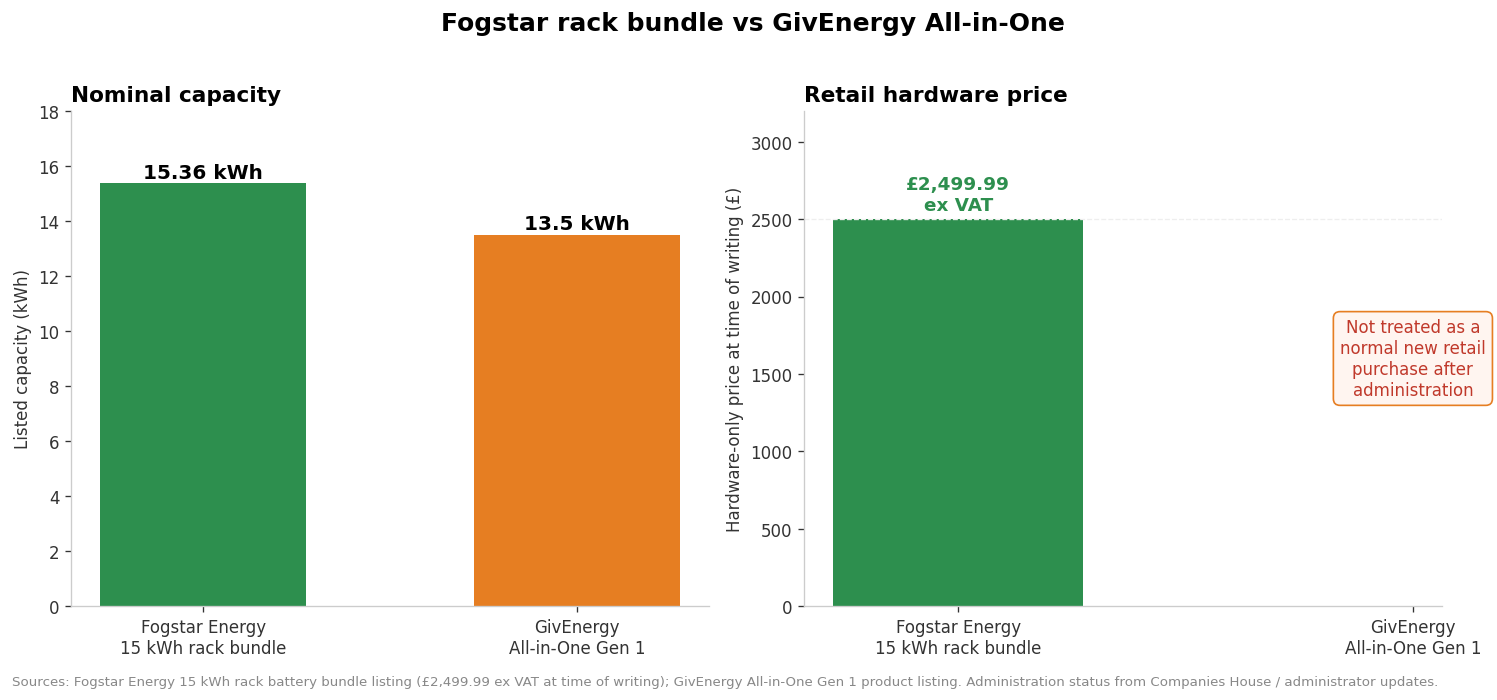
The Fogstar figure comes from the manufacturer’s current bundle listing. It is hardware-only and ex VAT, so do not turn it into an installed price. You still need to price the inverter, VAT treatment, delivery, installation, any backup equipment, DNO work and whether your installer will fit customer-supplied hardware.
I would not use the extra nominal capacity alone to decide this. A battery only performs as a system. The inverter controls charge and discharge, sets the practical power limit and determines whether the battery is compatible in the first place. If you are still working out what capacity fits your household, see my home battery overview and the battery storage directory.
What does GivEnergy Ltd’s administration mean for a new buyer?
It changes the decision materially. As at 13 July 2026, Companies House lists GivEnergy Ltd, company 11571089, as In Administration. The administration began on 9 April 2026 and Christopher Brooksbank is the appointed practitioner.
The administrator’s published GivEnergy update says GivEnergy Ltd has ceased to trade and all employees were made redundant. It also explicitly says GivEnergy Ltd will not honour further hardware warranties, user support or software support. Existing owners are directed first to their installer, with consumer enquiries going to the administrator.
GivEnergy Software Ltd is a separate group company and is not itself in this administration, so nothing here is an allegation about it. The point is narrower and commercial: on the published administration facts, a new All in One no longer comes with the manufacturer warranty and support a buyer would normally expect.
The original All in One product page advertised a 12-year warranty. Do not repeat that as though it were an enforceable manufacturer-backed warranty for a new purchase now. If an installer or retailer offers residual stock, get a written contract naming who provides the warranty, repairs, firmware or cloud support, and spare parts.
Who does each option genuinely suit?
Fogstar suits the homeowner who wants a modular DIY-style battery system and is prepared to choose a compatible inverter with an installer. The GivEnergy All in One only suits someone offered a specific, written third-party remedy that makes the support and warranty position clear. Without that, I would not put new money into it.
- Choose Fogstar if you want separate battery modules, are comfortable doing the compatibility homework and want an active retail supply route with a 10-year manufacturer warranty.
- Choose neither yet if you want a completely hands-off installed package. Get comparable installer quotes and make the contractual support route part of the comparison, not an afterthought.
- Consider a GivEnergy All in One only with safeguards if the seller’s written remedy identifies a financially credible party responsible for every part of the support chain.
An AC-coupled unit can be a sensible shape of system. My objection is not to the design. It is to treating a product made by a company in administration as an ordinary new purchase. For another integrated comparison, see Tesla Powerwall versus GivEnergy All in One.
Which should you buy today?
Buy the Fogstar route if you are choosing between these two today and you genuinely want a DIY-focused system. It is the safer choice because it remains available through its manufacturer with a stated 10-year warranty, while the GivEnergy Ltd administration removes the normal manufacturer warranty and support safety net from a new All in One purchase.
I would choose Fogstar with a compatible inverter, then spend the time getting the installation and controls right. That is more component selection up front, but it is a risk I can inspect and manage. A GivEnergy All in One is only worth reconsidering if the retailer or installer gives you a clear written remedy from a named third party. If they cannot do that, walk away.
If your real question is whether a battery makes sense before you add solar, read can you use a battery without solar panels?. For broader buying options, see the best home batteries in the UK.
