
Tesla Powerwall vs GivEnergy All-in-One is no longer a close new-buying decision. Both are premium 13.5 kWh home batteries, but GivEnergy Ltd is in administration and its administrator says further hardware warranties, user support and software support will not be honoured. For a supported new installation, I would choose Powerwall 3 and get a complete installer quote.
If you want to compare several routes rather than only these two, use my home battery guide, the best home battery comparison and the battery storage directory. Here, the question is whether either of these integrated systems is a sensible purchase now.
What is the practical difference between Powerwall 3 and the GivEnergy All-in-One?
Capacity does not separate these two batteries. Each is listed at 13.5 kWh, but Powerwall 3 combines battery storage with a solar inverter and has configurable output up to 11.04 kW AC. The GivEnergy All in One Gen 1 is a 6 kW, AC-coupled battery, so it adds storage alongside an existing solar inverter.
| Feature | Tesla Powerwall 3 | GivEnergy All in One Gen 1 6.0 |
|---|---|---|
| Listed capacity | 13.5 kWh | 13.5 kWh |
| Battery chemistry | Not stated in Tesla’s UK datasheet | LiFePO4 |
| Continuous AC output | Up to 11.04 kW, configurable | 6 kW |
| Solar arrangement | Integrated solar inverter | AC-coupled |
| Installation route | Tesla Certified Installer | Installer-only |
| Warranty position for a new buyer | 10 years, subject to Tesla’s terms and reliable internet connection | Previously advertised as 12 years; the administrator says GivEnergy Ltd will not honour further hardware warranties |
| Price position | Quote required for the installed system | Do not treat as a normal manufacturer-backed new purchase |
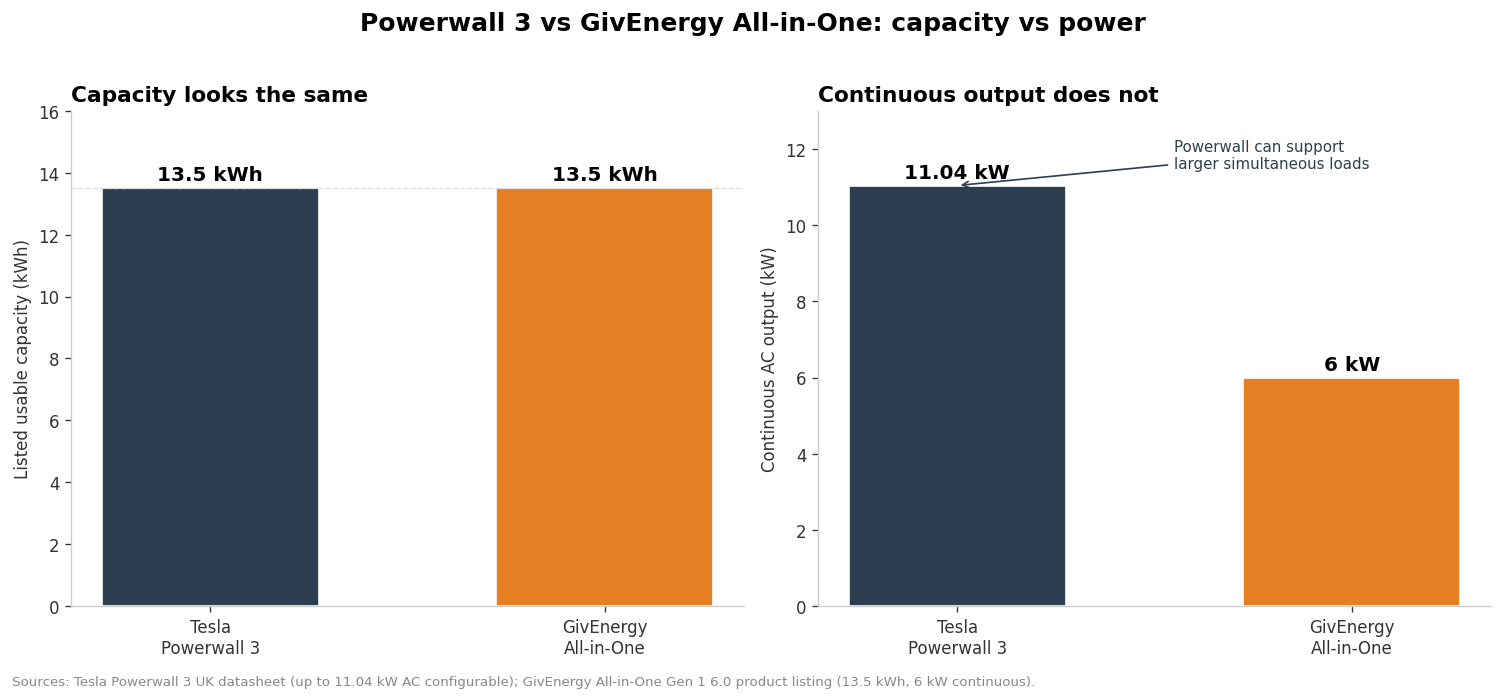
The Powerwall’s higher configurable output only matters if your house has overlapping loads that can use it. It does not make 13.5 kWh into more stored energy. The useful distinction is simpler: Powerwall 3 is designed as one installed solar and battery package, while the GivEnergy unit is an AC-coupled addition to a system that already has an inverter.
What does the price comparison really tell you?
At the time of writing, Tesla listed Powerwall 3 at £5,000 hardware-only, before Gateway, VAT, delivery and installation. That is a useful reference point, not a system price, and neither product has a meaningful one-number installed price. GivEnergy residual stock is not a like-for-like alternative unless its support arrangement is written into the sale contract.
I would ask a Tesla Certified Installer for a quote that names the battery, Gateway, backup scope, solar design, labour and DNO work. Ask whether VAT, delivery and any consumer-unit work are included. Do not compare a retailer hardware figure with a fitted quote, and do not assume an installer will fit customer-supplied equipment.
GivEnergy’s former advertised warranty length should not be used to make its price look better. A warranty is only useful when the party responsible for it is clearly identified and able to provide the remedy. The lower headline price of old stock can therefore hide the largest cost in this comparison: responsibility if something goes wrong.
Which system fits a new solar installation or an existing array?
Powerwall 3 is the clearer fit for a new premium solar installation because its solar inverter is integrated. That gives one installer-led route for the battery and solar conversion equipment. It is still installer-only, and the exact UK output configuration and complete installed cost must be confirmed in the quotation.
The GivEnergy All in One’s AC-coupled design would ordinarily be relevant to a home with working solar already in place. AC coupling can avoid replacing that inverter. However, a technically suitable arrangement is not enough for a new purchase when the original manufacturer company is no longer providing the warranty and support position a buyer would normally expect.
If you are comparing GivEnergy against a more open battery route rather than Powerwall, my Fogstar versus GivEnergy comparison explains the different responsibilities. That is a separate decision from this one. This article stays focused on two integrated 13.5 kWh products.
Why does GivEnergy Ltd’s administration change the recommendation?
It removes the normal manufacturer backing behind a new GivEnergy All in One purchase. Companies House shows GivEnergy Ltd as in administration from 9 April 2026. The appointed administrator’s published statement says the company ceased trading, its employees were made redundant, and it will not honour further hardware warranties, user support or software support.
GivEnergy Software Ltd and other group entities are separate from GivEnergy Ltd and are not in this administration, but that does not put a hardware warranty or support obligation back on a new All in One. This is a commercial-risk warning drawn from the published facts, not an allegation about any other company.
What must a GivEnergy stock quote include before you consider it?
A residual-stock deal needs a written third-party remedy, not reassurance on a sales call. The contract should identify who will honour the warranty, carry out repairs, supply spare parts, provide user support and take responsibility for firmware or cloud support. If those obligations are vague, the lower purchase price is not enough compensation for the risk.
- Warranty provider: name the legal entity, term, exclusions and remedy process.
- Repair route: state who supplies parts and who pays for diagnosis, labour and replacement.
- Support route: state who handles user support, installer escalation and software issues.
- System scope: list the battery, inverter arrangement, backup equipment, DNO work, VAT, delivery and installation.
For an existing owner, the administrator says to contact the installer first, with consumer enquiries also directed to the administrator. That is sensible ownership guidance. It is not the same thing as a manufacturer-backed warranty for someone choosing between two new systems.
Which battery would I choose for a new purchase?
I would choose Tesla Powerwall 3 for a new premium integrated battery purchase. It has the same listed 13.5 kWh capacity, an integrated solar inverter, configurable output up to 11.04 kW AC and a current 10-year warranty subject to Tesla’s terms. Most importantly, it remains available through Tesla Certified Installers with a normal supported-installation route.
One thing should not sway the choice yet: a Tesla electricity tariff. Tesla Energy Ventures holds a UK domestic electricity supply licence, and it appears on Ofgem’s list of electricity licensees. On 10 October 2026 I could find no Tesla tariff that a UK household can join. Choose the battery on its own merits, and treat a Tesla tariff as a bonus if one arrives.
That is not a claim that Powerwall 3 is right for every home or that it will be the cheapest fitted system. It is installer-only and needs a quote. But GivEnergy Ltd’s administration means the All in One is no longer a normal new-product comparison. Unless an independent written contract provides a credible warranty, repair, support, software and spare-parts remedy, I would not buy it new.
Get the Powerwall quote with the exact backup scope and all installation costs shown. If a GivEnergy offer is still tempting, put its written third-party remedy beside that quote and decide whether the saving genuinely pays for the extra risk. For most new buyers, it will not.
Sources: Tesla Powerwall 3 UK datasheet, Tesla UK Powerwall pricing page, GivEnergy All in One product page, Companies House record for GivEnergy Ltd, Companies House insolvency record and administrator update.
