
For a new installation, I would choose the Fox H1-5.0-E-G2 when the installer is supplying a documented Fox high-voltage battery package and will own the commissioning and support. I would choose the Sunsynk SYNK-5K-SG04LP1 when I specifically want a 48V battery system and its established low-voltage platform. High voltage is neither automatically safer, better nor more efficient. The battery architecture, the quotation and the installer’s design decide the useful difference.
This is a deliberately narrow Fox ESS vs Sunsynk inverter comparison. It covers the original non-WL Fox H1-5.0-E-G2 and the non-SM2 Sunsynk SYNK-5K-SG04LP1 5kW ECCO, both single-phase hybrid inverters. I own and use a smaller Sunsynk 3.6kW ECCO, so I can describe why I value its low-voltage platform and local control. I have not owned a Fox, so Fox claims here come from its current documents, not from invented experience.
Which battery architecture should you choose?
Choose the Fox route if you want the installer to deliver one specified high-voltage Fox system. Choose the Sunsynk route if you deliberately want a 48V system and understand that battery compatibility must be confirmed, not assumed. Both inverters are 5kW single-phase hybrids with two MPPTs. That is where the simple comparison ends.
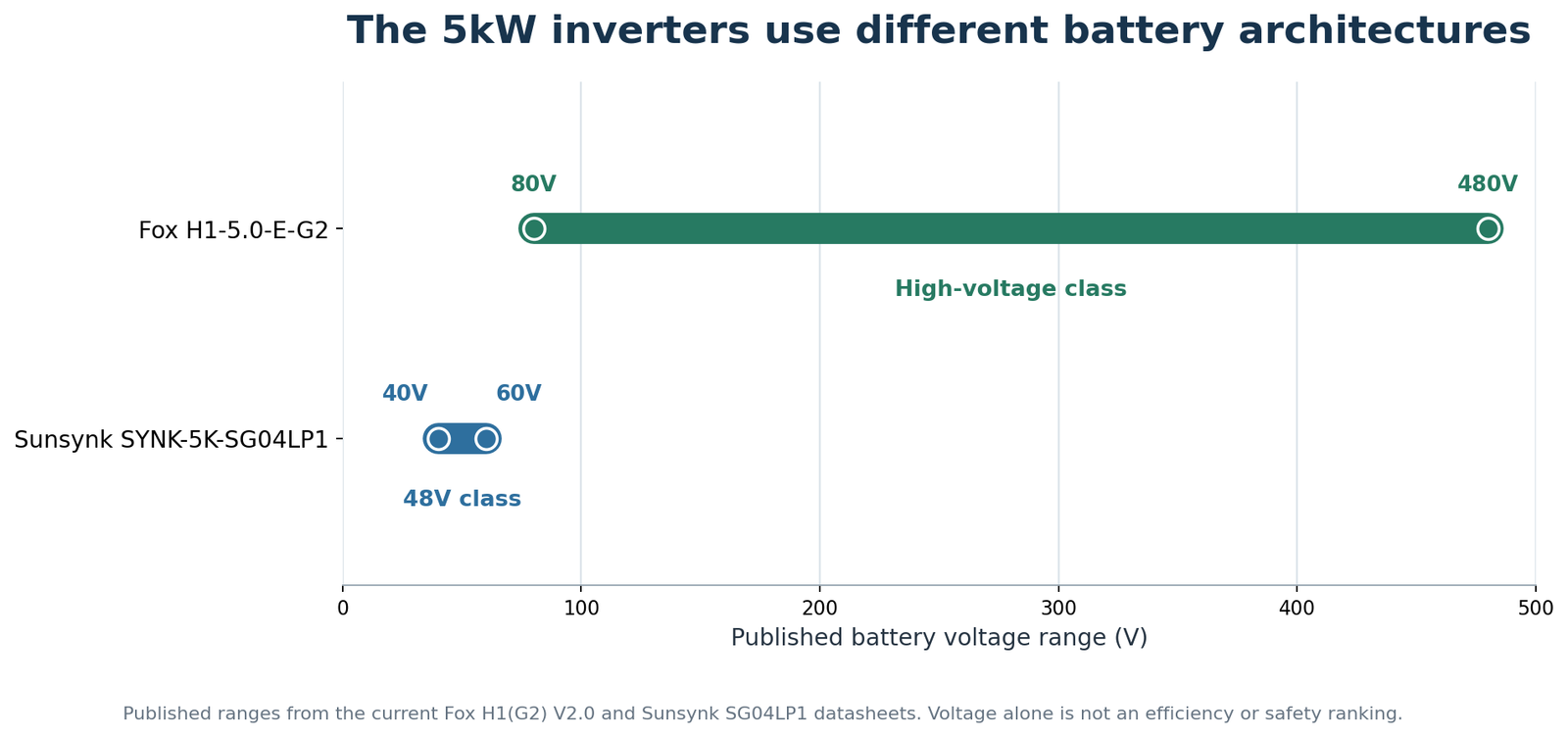
The Fox datasheet specifies an LFP battery connection from 80V to 480V and 40A maximum charge or discharge current. The Sunsynk datasheet specifies a 40V to 60V battery connection and 120A maximum charge and discharge current. Those current numbers are not a power league table: current multiplied by voltage is what matters, and the two manufacturers state the figures for different battery architectures.
High-voltage batteries can reduce current for a given power, which changes the cable and battery-system design. It does not remove electrical risk. A 48V system is not automatically safer, simpler or more efficient either: lower voltage means higher current for the same power, so cable design, protection and workmanship still matter. Neither voltage class proves that one system will save more electricity. The inverter, battery, temperature, state of charge, array, tariff schedule and control settings all affect real losses.
What exact models are being compared?
Model suffixes matter here. This page does not cover the Fox H1-5.0-E-G2-WL, the H1-5.0-E1-G2, Fox KH or H3 models, or Sunsynk’s newer SM2 Compact. Ask for a photograph of the inverter label and make sure it matches the quotation, battery documents and grid-connection evidence. If those model strings do not match character for character, stop and ask the installer to resolve the discrepancy. “Same family” is not enough for compatibility or grid paperwork.
| Exact, commensurable point | Fox H1-5.0-E-G2 | Sunsynk SYNK-5K-SG04LP1 |
|---|---|---|
| Inverter type | Single-phase hybrid | Single-phase hybrid |
| Nominal AC output | 5,000W | 5,000W / 5,000VA |
| PV trackers / strings | 2 MPPTs, one string per tracker | 2 MPPTs, one string per tracker |
| Battery connection | LFP, 80-480V, CAN | 40-60V, lead-acid or lithium-ion, CAN/RS485 BMS |
| Maximum battery current | 40A charge/discharge | 120A charge/discharge |
| Published PV limit | 10,000W maximum DC input; 16A + 16A input current | 6,500W maximum DC input; 18A + 18A input current |
| Warranty wording to resolve | Five years standard; Fox’s UK policy adds five years if registration and FoxCloud conditions are met | Five years, or 10 years with a Sunsynk battery, in the exact-model datasheet |
Fox publishes a 10,000W maximum DC input for the H1-5.0-E-G2, against Sunsynk’s 6,500W figure for the exact 5kW ECCO. That makes string design worth discussing early, especially if you expect to add panels. It is not permission to put any arbitrary array on either inverter. The installer must calculate cold open-circuit voltage, operating voltage, current and MPPT split using the panel datasheet and the actual roof layout.
I would not rank the two on app reviews. Fox documents FoxCloud V2 and Sunsynk documents SolarmanV5 monitoring and remote installer access, but a product page cannot tell you whether an app will suit your household. I run local monitoring and automation with my Sunsynk because I prefer to retain control of the useful data and rules. That is a preference and a setup choice, not proof that Fox owners cannot do the same.
Can either inverter back up the whole house?
Not from the inverter specification alone. Fox specifies EPS output with a battery and a switch-time row in its H1 G2 datasheet. Sunsynk specifies 5,500W rated stand-alone output and 10,000W for 10 seconds, plus 35A maximum continuous grid-to-load pass-through. Neither statement tells you which circuits will work during a cut.
For either quote, the installer must state the backed-up circuits, the changeover or gateway arrangement, neutral and earthing design, maximum off-grid load, battery reserve and how high starting currents will be handled. A kettle, shower, heat pump, induction hob and EV charger can easily exceed what a 5kW off-grid output can supply at once. A 10-second peak rating is not a 10kW continuous supply rating.
Ask for a backed-up-circuits drawing, not a verbal promise
- Which consumer-unit circuits remain live during an outage?
- What is the maximum continuous and short-duration off-grid load for the installed battery?
- What happens if the battery is empty, or an appliance starts while the house is islanded?
- Which changeover, protection and earthing equipment is included in the quoted price?
What do the battery systems mean for expansion and replacement?
The Fox H1 is designed around a high-voltage LFP battery system. That can be a tidy proposition when the installer supplies the compatible Fox battery and owns the design. Before paying, ask which exact battery family, master or control module, cable set and expansion limits the quote includes. A future add-on battery must be compatible with the installed battery generation and its BMS arrangement.
The Sunsynk is a 48V inverter, but that does not mean it works with every 48V battery. The datasheet calls for CAN or RS485 BMS communication for lithium batteries. The compatible battery list, firmware, cable, BMS protocol and warranty responsibility are part of the system. I would want these written down before choosing a non-Sunsynk battery, rather than relying on a retailer listing or a forum setting.
A larger battery does not automatically make a 5kW inverter charge or discharge faster. The battery’s permitted power, the BMS, the inverter limit and the site wiring can all constrain it. Put the battery capacity, usable capacity, maximum continuous charge and discharge power, and any low-temperature restrictions into both quotes. That turns a badge comparison into a system comparison.
Do you need G99 approval or export limiting for a 5kW inverter?
Check the exact model suffix and the proposed connection with the DNO. Do not infer approval from the brand or a family datasheet. Fox’s published G99 report covers H1-4.6-E-G2, H1-5.0-E-G2 and H1-6.0-E-G2. Sunsynk’s published G100 declaration includes the SYNK-5K-SG04LP1 family. Those documents are useful evidence, but the live ENA register directs current users to Connect Direct, and the connection process depends on the actual capacity and export arrangement.
On a typical single-phase UK supply, a 5kW inverter is above the 3.68kW G98 threshold, so the installer should make the relevant G99 application. A DNO may also require or agree a G100 export-limited design, but export limiting does not turn a 5kW unit into a G98 installation or remove the paperwork. Ask the installer to provide the Connect Direct result, the exact model label, the agreed export limit and the submitted or accepted DNO record for your address.
What should you ask both installers before paying?
Send the same questions to both installers. It makes omissions visible and gives you a record to rely on later.
- Please confirm the full inverter and battery model numbers, including every suffix, and attach the current datasheets.
- What are the battery’s nominal and usable capacities, continuous power limit and low-temperature restrictions?
- Which battery is approved with this inverter and BMS firmware, and who supports a battery communication fault?
- Which circuits are backed up, what is the continuous off-grid limit, is changeover automatic or manual, and what equipment creates it?
- What PV string design, maximum cold voltage and MPPT allocation are you quoting?
- Will you provide the exact current Connect Direct evidence and handle the applicable G99/DNO process?
- What warranty applies to the inverter, battery, labour, gateway and monitoring hardware, and who processes each claim?
- Will the monitoring account be registered to my email, and will I receive the final settings and as-built single-line diagram?
- What is included in the installed price: VAT, scaffolding, consumer-unit work, export limiting, monitoring, battery cables and commissioning?
So, Fox ESS or Sunsynk?
For a homeowner who wants a single, installer-delivered high-voltage package, the Fox H1-5.0-E-G2 is the cleaner route if the battery, support and backup design are all documented. For someone who consciously wants a 48V battery architecture, the exact 5kW Sunsynk ECCO is the more relevant platform. Neither choice is justified by saying that high voltage is automatically safer, more efficient or better.
If both installers are competent, I would compare the complete quotations in this order: the battery family and usable capacity, the backed-up circuits and continuous off-grid limit, the controls I will actually use, the warranty and fault route, then the installed price for equivalent storage and electrical work. My own smaller Sunsynk makes me comfortable with the practical appeal of its low-voltage ecosystem, but I have not owned or commissioned the Fox H1-5.0-E-G2. The Fox side of this comparison therefore rests on its documents and the installer’s proposed package, not my long-term use.
Fox ESS vs Sunsynk inverter FAQs
Is a high-voltage Fox battery safer than a 48V Sunsynk battery?
No general safety ranking follows from the voltage label. High voltage changes the electrical design and needs the right equipment, installation and isolation. A 48V system also stores substantial energy and needs correct protection, cabling and commissioning. Compare the complete specified system and the installer’s competence.
Is high voltage automatically more efficient?
No. A higher battery voltage can reduce current for a given power, but it does not settle whole-system efficiency. Manufacturer test methods, inverter conversion, battery losses, temperature, state of charge, charge rate and controls all matter. Use comparable, exact-system evidence if efficiency is the deciding factor.
Can the Sunsynk use any 48V battery?
No. A lithium battery needs a compatible BMS communication arrangement, correct firmware and a support route that the installer and supplier will stand behind. Ask for the exact approved pairing in writing before buying the battery separately.
Does EPS or stand-alone output mean whole-house backup?
No. EPS and stand-alone figures describe an inverter function and rating. Whole-house backup depends on the selected circuits, load diversity, battery reserve, changeover equipment and earthing arrangement. Get a circuit schedule and off-grid load limit with the quote.
Sources checked 16 July 2026: Fox H1(G2) datasheet V2.0, Sunsynk 3.6/5kW SG04LP1 datasheet, Fox UK inverter warranty policy, Fox H1 G2 G99 report, Sunsynk SG04LP1 G100 declaration and ENA Connect Direct. Product documents change, so confirm the exact label and current grid evidence before ordering.
