
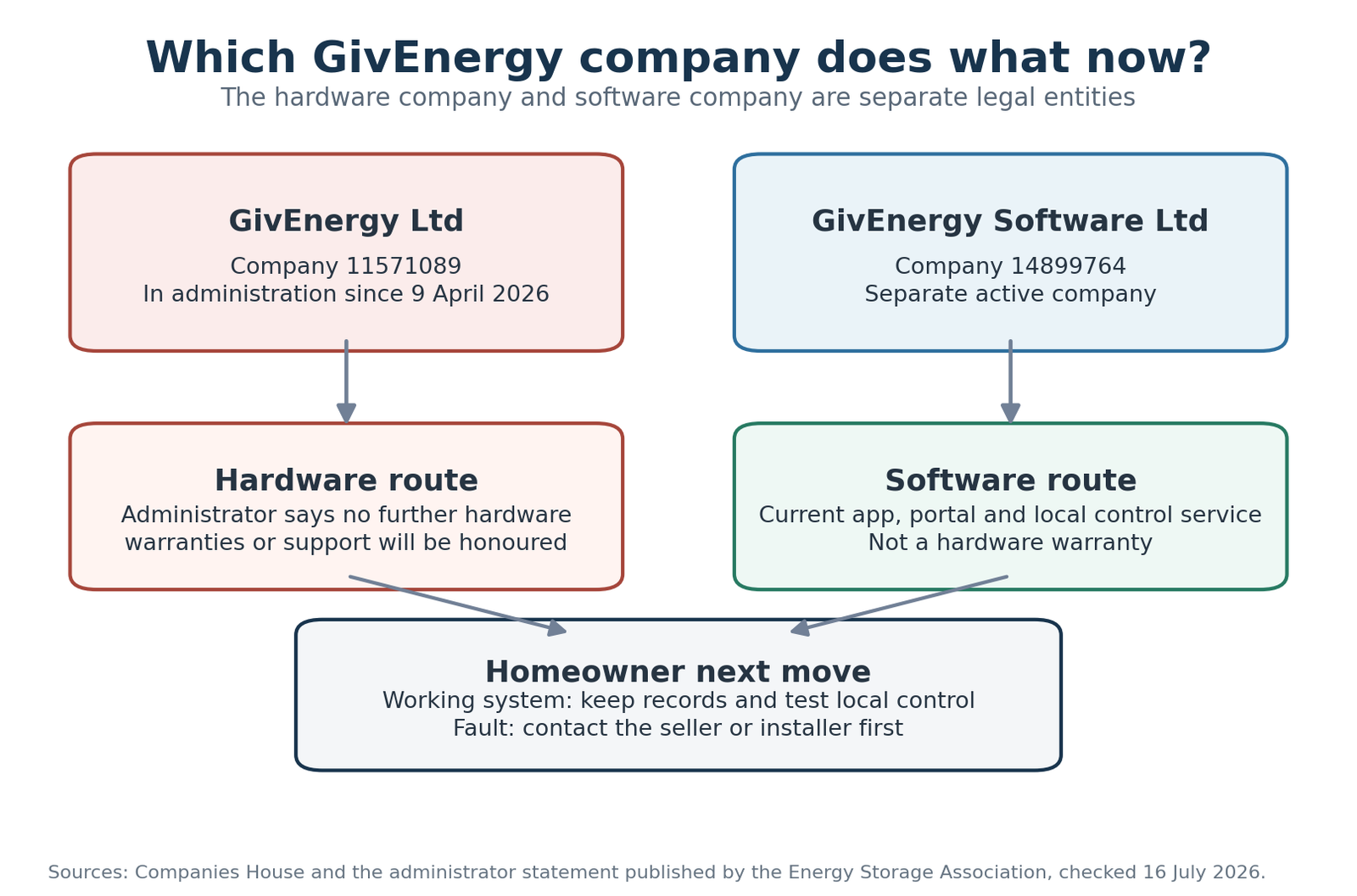
For a new installation, I would choose the Sunsynk. GivEnergy Ltd entered administration on 9 April 2026 and ceased trading. Its administrator said on 15 April that GivEnergy Ltd would not honour further hardware warranties or support. GivEnergy Software Ltd remains a separate active company, but its app and software service are not a replacement hardware warranty or manufacturer fault support.
This is an exact historical comparison: the Sunsynk 5kW ECCO SYNK-5K-SG04LP1 against the GivEnergy Hybrid Inverter 5.0 Gen 3 HY 5.0. I have not owned GivEnergy equipment, so I am not presenting this as a reliability test. I am comparing the published documents with the administrative change that now matters more than the small differences on the old spec sheets.
Should a new buyer choose Sunsynk or GivEnergy?
Choose the Sunsynk for a new UK installation. The historic GivEnergy HY 5.0 was a credible 5kW low-voltage hybrid on paper, but its hardware supplier, GivEnergy Ltd, is now in administration. The administrator says it has ceased trading and will not honour further hardware warranties or support. That means I would not make unused GivEnergy hardware the default for a new purchase.
An unused GivEnergy inverter is not automatically a bad piece of hardware. It is a different risk allocation. I would only consider one if the installer or retailer puts in writing who will diagnose a fault, supply replacement equipment, pay for labour and deal with the battery and monitoring handover. A discount by itself is not that answer.
Which GivEnergy company is in administration?
GivEnergy Ltd (company number 11571089), the company named in the historic hardware warranty, is in administration. The appointment took effect on 9 April 2026. The administrator’s statement, published by the Energy Storage Association, says the company has ceased trading and that no further hardware warranties will be honoured.
GivEnergy Software Ltd is a separate active company. Its own FAQ says it continues to run the software service, but is not responsible for hardware warranties or support. That distinction matters: an app continuing to open is useful, but it does not create a manufacturer remedy when an inverter or battery fails.
How do the exact 5kW inverter models compare?
Both models are single-phase 5kW hybrid inverters for low-voltage batteries. The Sunsynk has the higher published backup figure. The GivEnergy has the wider published PV voltage window. Those are real document differences, but they are not enough to overturn the support decision for a new buyer.
| Published point | Sunsynk 5kW ECCO SYNK-5K-SG04LP1 | Historic GivEnergy Hybrid 5.0 Gen 3 HY 5.0 |
|---|---|---|
| Rated AC output | 5,000W | 5,000W |
| Battery voltage range | 40V to 60V | 45V to 58V |
| Backup output | 5,000W rated UPS power; 2x rated power for 10 seconds off-grid | 3,600W, 16A; stated 10ms automatic switching |
| PV inputs | Two MPPTs, one string each; 125V to 500V PV range | Two MPPTs, one string each; 150V to 580V PV range |
| Maximum efficiency | 97.6% | 97.6% |
| Enclosure and weight | IP65; 17.5kg | IP65; 32kg |
I would not turn battery current or PV input labels into a winner. GivEnergy’s 7.5kWp figure is stated per string, while Sunsynk labels 6.5kW as maximum DC input power. Battery power also depends on voltage, the battery BMS and the configured limits. Ask the installer to design the actual strings and selected battery, not to sell either badge from a headline number.
What do those backup and battery figures mean at home?
The Sunsynk’s published 5,000W backup rating is more headroom than the GivEnergy document’s 3,600W figure. It does not mean either inverter will automatically run a whole house during a cut. The protected circuits, battery discharge limit, changeover arrangement, earthing design and installation all decide what is actually available.
Both are low-voltage systems, but voltage range is not a compatibility list. I would ask for the exact battery model and the manufacturer-approved pairing in writing. For the wider choice, sizing and grid-connection questions, my guide to choosing an inverter and the UK inverter directory are useful starting points.
What does the missing GivEnergy hardware warranty mean?
It means a buyer should not treat the old GivEnergy warranty as current manufacturer cover. The historic warranty overview described a 12-year inverter warranty, but the administrator has since said that GivEnergy Ltd will not honour further hardware warranties. Sunsynk’s current sources conflict: its broad inverter page says 10 years as standard, while the exact SG04LP1 datasheet says five years, extended to 10 years when installed with a Sunsynk battery. Ask the supplier to identify the warranty document that applies to the exact inverter and battery on your quote. A live warranty route is still better than an old manufacturer promise that will not be honoured, but it is not a guarantee that every future claim will be accepted.
Losing the manufacturer warranty does not automatically settle every consumer-rights question. Your contract may be with the installer or retailer that supplied the system. Depending on the contract, payment method, age of the system and facts of the fault, a repair, replacement, price reduction, card claim or insurance-backed guarantee may still be relevant. This is general information, not legal advice. Keep the quote, invoice, commissioning record, warranty documents and finance paperwork, then ask the seller or installer in writing before paying for work.
The Consumer Rights Act 2015 provides remedies against the trader in qualifying cases. Citizens Advice explains why the seller, rather than the manufacturer, is often the first contact. The right remedy is fact-specific, so I would avoid anyone who promises that an installer or a card provider must pay before seeing the paperwork.
What should an existing GivEnergy owner do now?
I would not replace working GivEnergy equipment solely because GivEnergy Ltd is in administration. The Energy Storage Association’s customer FAQ says installed systems should continue to work, and the separate software company says at-home monitoring and local manual control remain available on its Standard tier. Neither statement guarantees future service, but the available evidence does not support a panic replacement.
- Download and keep your quotation, invoice, commissioning certificate, DNO paperwork, warranty documents and installer contact details.
- Check that you can use local manual control and that your installer or retailer has a current fault-reporting route.
- Record the inverter and battery model numbers, serial numbers, firmware version and current settings before any service work.
- Ask before accepting a paid repair whether the seller, installer, finance provider or an insurance-backed guarantee could be relevant.
- Do not change battery settings or electrical wiring yourself. Use a competent installer for safety-critical work.
If replacement eventually becomes necessary, it is a system redesign question, not simply a box swap. A Sunsynk is not a direct replacement for every GivEnergy inverter, battery or backup arrangement. Confirm the battery protocol, panels, metering, protected-load board, grid paperwork and commissioning responsibility before ordering anything. My Powerwall versus GivEnergy All-in-One comparison covers a different system class, not this inverter pair.
Will the GivEnergy app, schedules and API keep working?
No one can responsibly guarantee that. GivEnergy Software says its Standard tier retains at-home monitoring and local manual control, while Premium covers remote access, historic data, automation and cloud API access. It also says firmware updates are free if they are made available to it, but the future of firmware is unclear. Treat that as the current service position, not a lifetime promise.
If timed charging or tariff automation matters to your household budget, test the controls you actually use and keep a simple record of their settings. For a new Sunsynk installation, I would still ask who owns commissioning access, how firmware updates are handled and what local controls remain if the cloud service is unavailable. Cloud convenience is not the same thing as a support plan.
What should you get in writing before paying?
Put the questions below to the installer before equipment is ordered. It makes the quote comparable and prevents a model name from hiding a different battery, backup scope or support route.
- What is the full inverter model number, battery model and firmware route?
- Which circuits are backed up, at what stated power, and what extra switching or electrical work is included?
- Which current G98 or G99 evidence applies to this exact unit, and who will handle the DNO process? My DNO registration guide explains why the exact model matters.
- Who provides first-line fault diagnosis, labour and replacement equipment during the manufacturer warranty period?
- For any GivEnergy stock, will the seller or installer accept hardware warranty and repair responsibility in writing, and for how long?
- What local controls, monitoring access and tariff schedules remain available if the cloud service changes?
Frequently asked questions
Is GivEnergy still sensible for a new installation?
Not as the default choice in July 2026. GivEnergy Ltd has ceased trading and says it will not honour hardware warranties. An installer may offer unused stock with its own written responsibility, but compare that commitment with a current Sunsynk offer rather than relying on the old GivEnergy manufacturer warranty.
Does administration mean my GivEnergy system will stop working?
Administration does not by itself mean an installed system will stop. The Energy Storage Association’s customer FAQ says installed systems should continue to work. The practical concern is the loss of GivEnergy Ltd hardware support and warranty, alongside uncertainty over future firmware and cloud-dependent functions. Keep records and establish your installer support route, but do not replace functioning equipment only because of the administration.
Is a Sunsynk compatible with my GivEnergy battery?
Do not assume it is. Both systems use low-voltage batteries, but a safe working pairing needs compatible BMS communication, voltage and current limits, approved settings and a competent commissioning route. Ask the battery and inverter suppliers for confirmation for the exact models before treating a Sunsynk as a replacement.
Should I replace a working GivEnergy inverter now?
Usually, no. A working system still has value, and replacement introduces cost and compatibility work. Make a calm record of its configuration and support contacts, then plan around a replacement only if a fault, a changed requirement or an installer assessment makes it necessary.
Administration and software facts last checked 16 July 2026. A sale of the hardware business, a new warranty provider or a material change to the software service could change this verdict, so check the linked Companies House, administrator and software sources before acting.
