
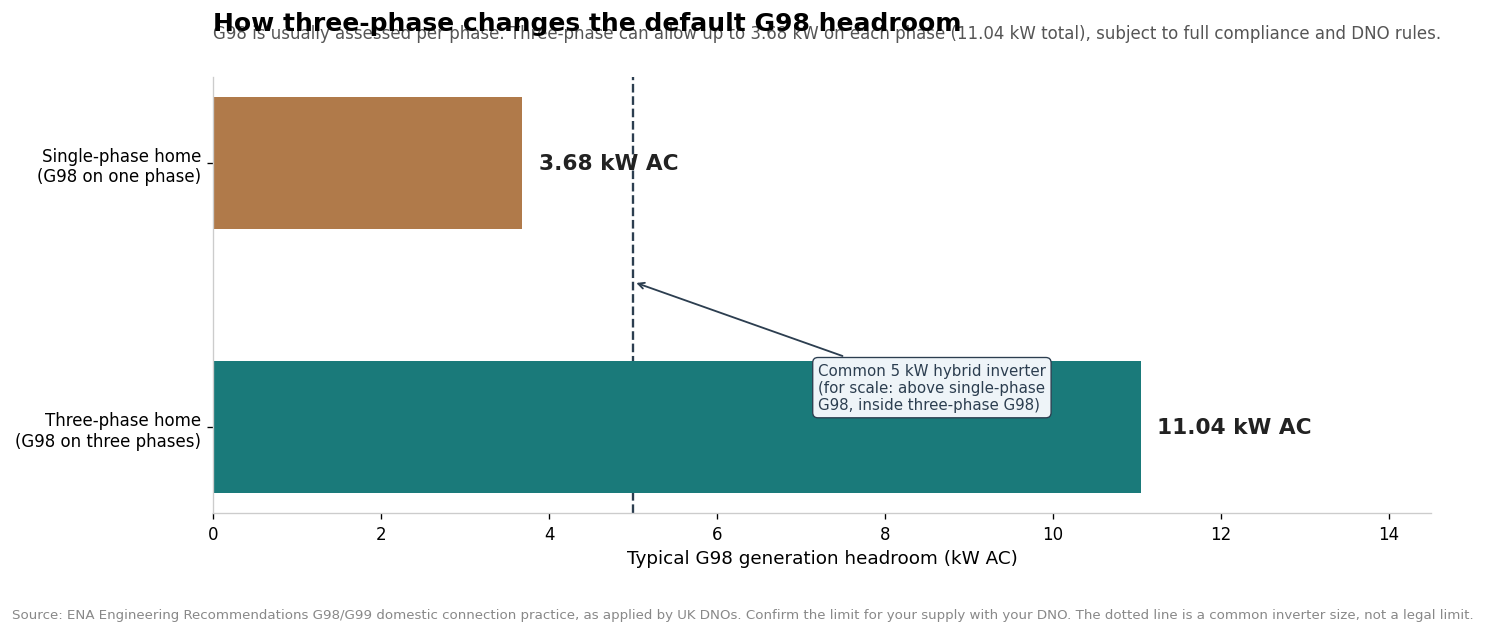
Three-phase solar in the UK can support a larger domestic inverter system because the G98 limit is 3.68kW per phase. That means 3.68kW on a single-phase supply, but up to 11.04kW across three phases, at 3.68kW on each phase. Most homes are single phase, so check your supply before planning around the higher figure.
Three phase does not remove the grid-connection rules. Your inverter still needs the correct ENA type-test record, anti-islanding protection and DNO notification. If the proposed capacity or arrangement falls outside G98, you need G99 approval before connecting it.
What does three-phase solar mean in a UK home?
Three-phase solar means the inverter feeds a home with three live phases rather than one. It is still an ordinary domestic grid-connected solar system. The practical difference is that generation and larger electrical loads can be spread across the phases instead of passing through a single phase.
Most UK homes have a single-phase electricity supply. That is normally enough for household appliances, a modest solar array and many EV chargers. Some larger homes, rural properties and homes with several high-power electrical loads already have three phase, but you cannot tell from the outside, and a large rural house can still be single phase.
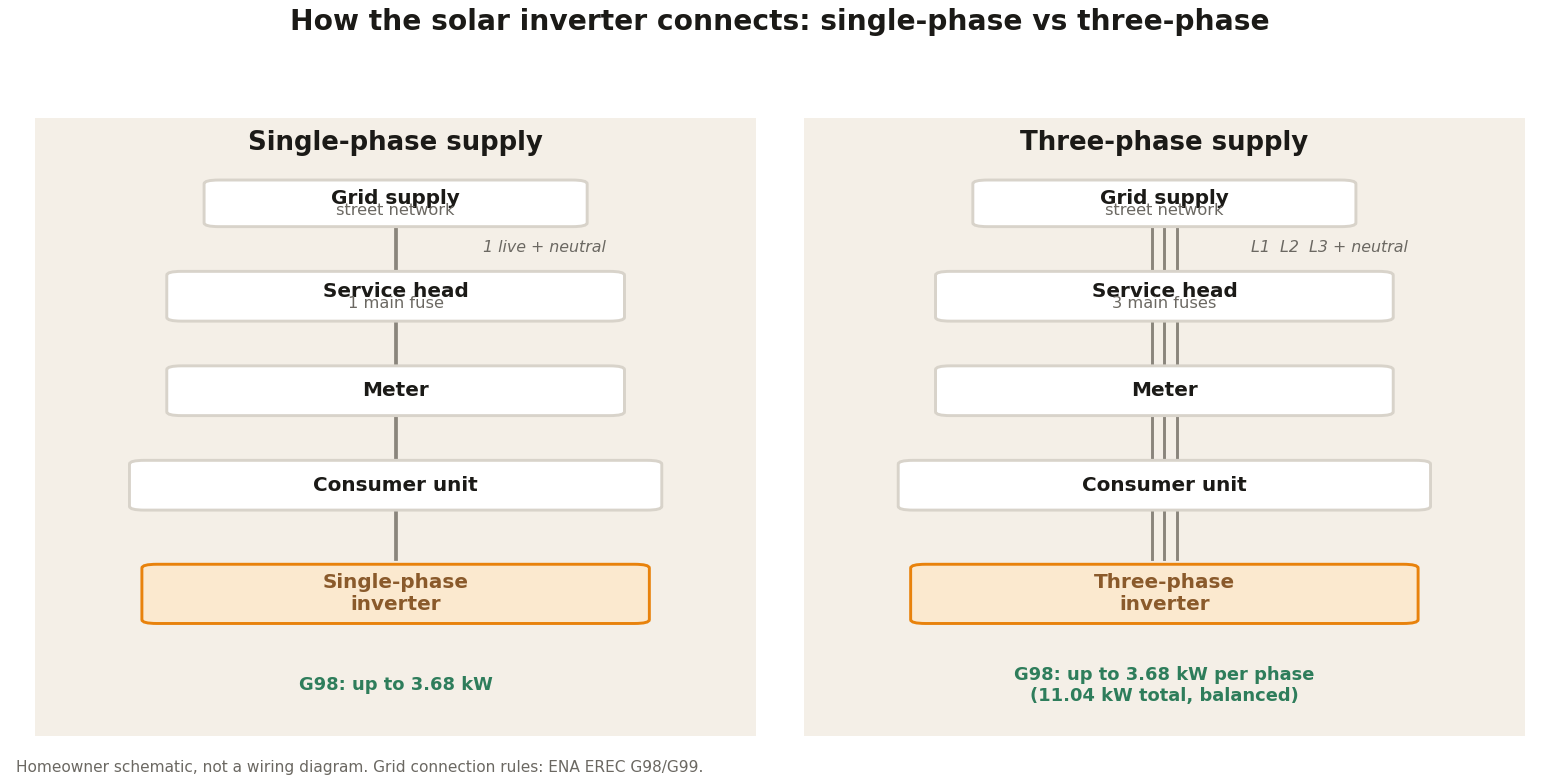
A three-phase supply brings three live conductors into the property. A true three-phase solar inverter connects across all three and distributes its AC output between them. With separate single-phase inverters, each inverter connects to its assigned phase.
How do you know whether your home has three phase?
Start at the electricity meter and main service fuse, without removing covers or touching sealed equipment. A single-phase service head usually has one main fuse. A three-phase arrangement commonly has three fuses or a larger service head with three incoming phases. If it is unclear, ask your DNO to confirm it.
The service head is usually near the meter. It belongs to the network operator, so do not open it. Labels such as L1, L2 and L3, three main fuses, or multiple substantial meter tails are useful clues, but old installations and partially used three-phase supplies can look less obvious.
Your electricity bill identifies the supplier, not necessarily the technical details of the connection. Use the Energy Networks Association postcode checker to find your DNO, then send the DNO a clear photograph of the meter and service head if requested. An electrician can also identify the supply while assessing the consumer unit.
If you currently have single phase, moving to three phase is a separate network alteration. It may involve a new service cable, meter work and changes to the consumer unit. I would get a written quotation from the DNO before designing a solar system that depends on the upgrade.
How does three phase change the G98 and G99 limits?
G98 covers qualifying generation up to 16A, normally stated as 3.68kW, per phase. On single phase, that gives one 3.68kW allowance. Across three phases, the theoretical total is 3 × 3.68kW, or 11.04kW, provided the Registered Capacity stays within 16A (3.68kW) on every phase and the installation meets the other G98 requirements.
| Domestic supply | G98 limit | Typical inverter arrangement | Practical consequence |
|---|---|---|---|
| Single phase | 3.68kW on the phase | One single-phase inverter | More than 3.68kW normally moves the proposal into G99 |
| Three phase | 3.68kW per phase, up to 11.04kW in total | One three-phase inverter, or an agreed inverter arrangement across all three phases | A larger domestic system may remain within G98 |
If you need the connection paperwork path rather than the theory, UK Power Networks publishes distributed generation guidance and handles G98/G99 queries through its generation team (UK Power Networks generation connections). Your DNO may differ if you are not on their network.
The limit applies to the registered generating capacity connected at the property, not separately to every new inverter. Existing solar, batteries capable of exporting and additional generation must be included when the connection route is assessed. This cumulative point is why adding a second inverter pushed my own expanded system from G98 to G99.
G98 is commonly described as connect and notify because a qualifying installation can normally be commissioned before the DNO is notified, with the notification submitted within 28 days. Multiple generators or a more complicated arrangement may require a different process, so confirm the route with your DNO before buying equipment.
Once the proposal exceeds 3.68kW on any phase, or does not meet the other G98 conditions, it falls under G99. That means applying to the DNO and receiving permission before the system is connected. My homeowner’s guide to DNO registration explains the documents and sequence.
Which inverter do you need for three-phase solar?
The cleanest option is normally a true three-phase inverter sized for the array and accepted for UK grid connection. Another possible design uses three single-phase inverters, with one connected to each phase. Either arrangement needs suitable protection, anti-islanding, DNO paperwork and an installer who understands phase allocation.
Manufacturers distinguish these products clearly. For example, Fronius lists its Primo GEN24 as single phase and its Symo GEN24 as three phase, while Solis has separate domestic single-phase and three-phase hybrid ranges. Check the exact model number and its ENA type-test record rather than relying on a product-family name.
A true three-phase inverter is usually simpler to document and naturally spreads its output across the phases. It also avoids having three separate inverter controls and monitoring systems. The trade-off is that three-phase models may have different battery compatibility, backup behaviour, minimum string voltages and available power ratings.
Three single-phase inverters can suit a roof split into distinct arrays or a staged installation. However, the DNO needs to accept the complete arrangement, and each phase must remain within its agreed capacity. Losing one inverter also leaves the generation unbalanced until the fault is repaired.
Do not confuse an export limit with inverter capacity. A larger inverter restricted by a G100 export-limitation scheme will usually still follow a G99 connection route unless its certified registered capacity is genuinely reduced. The DNO considers what the installed equipment can generate, not only the export setting selected in an app.
Before choosing, compare the AC phase arrangement, registered capacity, MPPT voltage range and battery support. The guides to choosing an inverter and how solar inverters work explain those specifications. If you plan to fit more panel capacity than the inverter’s AC rating, also check the manufacturer’s limits and my guide to overpaneling.
When is three-phase solar worth considering?
Three phase is worth considering when the house can use a genuinely large array and has substantial electrical demand, such as a heat pump, one or more EVs and high daytime consumption. It is less compelling when the roof, budget or annual electricity use only supports a conventional 3.68kW inverter.
The first question is whether you already have three phase. If you do, using it can make a larger solar design easier to accommodate and lets the installer distribute generation and loads more evenly. That does not guarantee G98 acceptance or a particular export allowance, because the local network still sets what can be connected.
If you have single phase, compare the cost and disruption of a supply upgrade with a G99 application for a larger single-phase inverter. In many homes, G99 approval is the more direct route. A three-phase upgrade starts to make sense when it also solves a wider capacity problem created by an EV charger, heat pump or other large load.
Solar generation and household demand will not always match phase by phase. A suitable smart meter normally records the net energy across the supply for billing, but equipment behaviour and export controls vary. Ask the installer to show how the proposed inverter, meter and export-limitation equipment measure all three phases.
So, do you need three phase?
Confirm the supply first, then design the array and choose the connection route. Ask the DNO whether the property is single or three phase, total every existing and proposed source of generation, and obtain written acceptance where G99 applies. Only then should you commit to a particular inverter.
- Photograph the meter and sealed service head without opening either.
- Ask your DNO to confirm the number of phases and the connection route.
- Add together the registered capacity of existing solar, storage and proposed inverters on each phase.
- Check the exact inverter model in the ENA Connect Direct database and read its manufacturer datasheet.
- Get the G99 decision before installation if any phase exceeds the G98 limit or the arrangement does not qualify for G98.
If you are still deciding what size and type of system suits the house, begin with Start Here. Three phase is worth it when it removes a real constraint, such as a large array, a heat pump, or two EV chargers. If it does not remove one, a G99 application on your existing single-phase supply is usually the cheaper answer.
