Yes, you can run two separate solar systems on one UK property. That might be two arrays through a single inverter, or two inverters working side by side. The important point is that your Distribution Network Operator (DNO) assesses the total inverter capacity connected at the premises, not each system in isolation. If their combined capacity exceeds 3.68kW on a single-phase supply, you will normally need G99 approval before connecting the additional capacity.
This is a conventional grid-connected arrangement. Both inverters ultimately feed the same consumer unit, electricity meter and grid connection. A small plug-in or balcony solar system raises some different installation questions, so I treat that as a special case rather than a shortcut around the normal connection process.
Are two separate solar systems allowed on one UK property?
Yes, there is no general rule limiting a home to one solar array or one inverter. Two systems are legitimate when they are correctly designed, electrically connected and declared to the DNO. The second installation does not become invisible because it has different panels, a different installer or its own inverter.
A common example is an existing MCS-certified roof installation followed by a DIY array on a garage or extension. Another is a house with panels on two roof planes that suit different inverters. My own expansion needed a second inverter because the original inverter had no spare MPPT input for another string.
The physical layout can vary, but the grid sees the property as one generating site:
Each array feeds its own inverter, both inverter outputs land in the same consumer unit, and everything then passes through the one boundary meter to the grid.
How does the DNO assess two solar systems under G98 and G99?
The DNO adds together the registered AC capacity of every generating unit that can operate in parallel with its network. On a single-phase supply, ENA Engineering Recommendation G98 covers up to 16A per phase, normally stated as 3.68kW. Above that combined capacity, the new arrangement normally requires G99 prior approval.
| Site arrangement | Combined AC capacity | Usual connection route |
|---|---|---|
| One 3.68kW inverter | 3.68kW single-phase | G98 notification after installation |
| Two 1.8kW inverters | 3.6kW single-phase | G98 may apply, subject to compliant equipment and the full site details |
| Existing 3.68kW plus new 2kW inverter | 5.68kW single-phase | G99 application and approval before connection |
| Generation balanced across three phases | Up to 11.04kW total at 16A per phase | G98 may apply if all requirements are met |
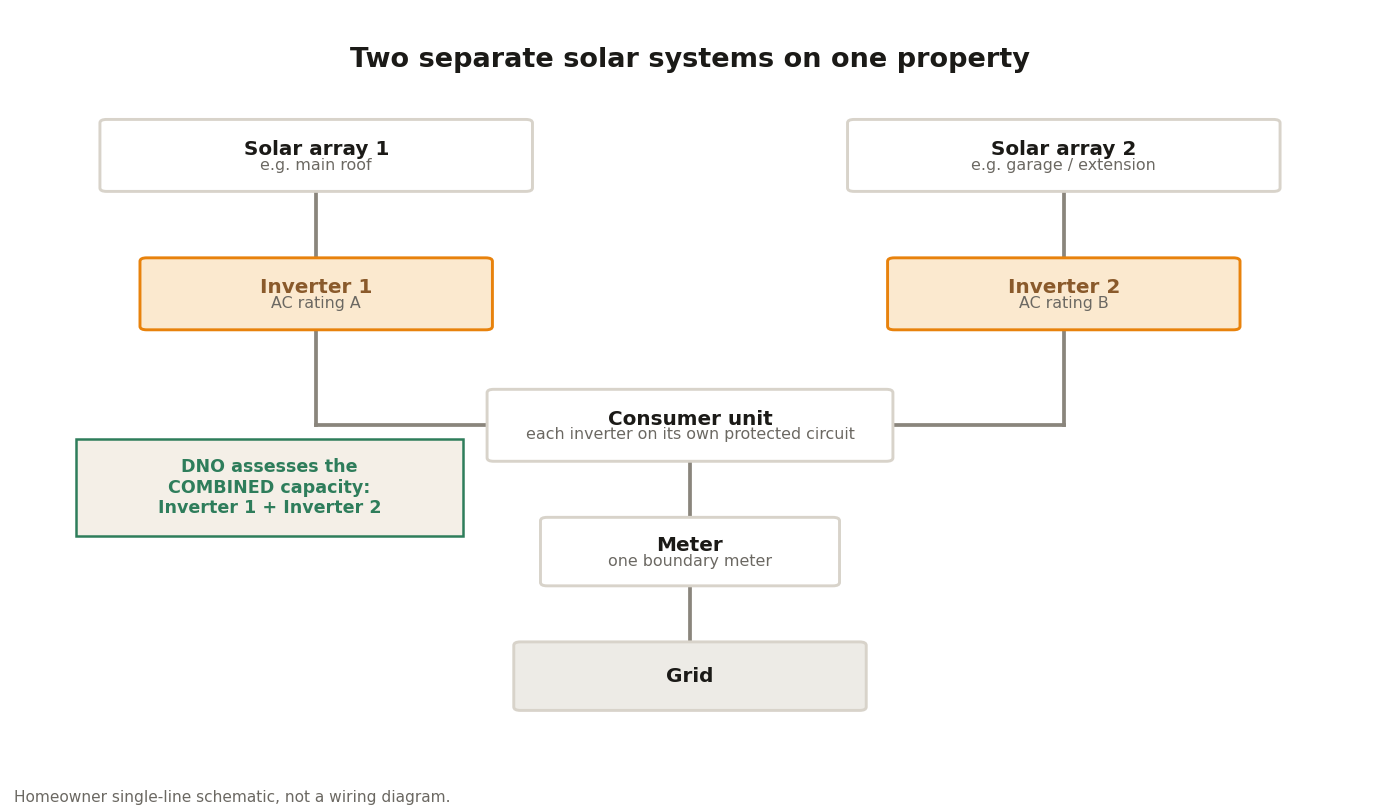
For example, two separate 2kW inverters do not create two G98 allowances. They give the property 4kW of installed inverter capacity. You cannot notify each one separately as though the other did not exist.
Export limiting can sometimes let a larger installation connect without exporting its full rated output, but it does not make the generating units disappear from the application. The DNO needs the inverter details, protection settings, export limitation scheme and a single-line diagram. My G98 to G99 upgrade shows how adding a second inverter changed the connection route, while the homeowner’s guide to DNO registration covers the forms and process.
Should you use one inverter or two?
Use one inverter when it has enough suitable MPPT inputs, voltage range and current capacity for both arrays. Use two when the arrays are electrically mismatched, widely separated, installed at different times or need independent control. Neither layout is automatically better. The roof, cable routes and existing equipment decide it.
One multi-MPPT inverter is usually the cleaner arrangement for two roof planes. Each MPPT can track an array with a different orientation without forcing both strings to operate at the same point. The inverter selection guide explains these input limits, and my solar inverter guide covers what the inverter actually does.
Two inverters make sense when you want to leave a working installation alone. Replacing a sound 3.68kW inverter simply to add a garage array can waste equipment and disturb its warranty. A second inverter also lets each array use hardware suited to its panel count and orientation.
The trade-off is more AC protection, isolation, monitoring and paperwork. Your electrician must confirm that the consumer unit, circuits and connection arrangement are suitable. If the aim is simply to fit more panel capacity behind an existing inverter, check whether careful overpaneling would meet the objective without another grid-connected inverter.
How do metering and export work with two systems?
Both systems normally sit behind the same electricity boundary meter. The meter records the net flow between your home and the grid, regardless of which inverter produced the electricity. If the arrays generate 5kW while the house uses 2kW, the meter sees roughly 3kW of export.
You may have separate generation meters or inverter monitoring for each system. Those are useful for checking performance, but they are not the same as the smart or export meter used by your supplier. A dual-system installation should not be described to an export supplier as only the original array.
Export payments depend on the supplier’s tariff and evidence requirements. Smart Export Guarantee rates vary by supplier and tariff, with offers commonly around 5p to 15p per kWh rather than one fixed national rate. SEG eligibility requires certification through MCS or an accredited equivalent scheme such as Flexi-Orb, and suppliers set their own application checks and tariff terms. Ofgem requires SEG licensees to offer an eligible tariff, but suppliers set their own rates and application checks.
At the current price-cap average electricity rate of 26.11p/kWh (1 July to 30 September 2026, Direct Debit), using a solar kWh in the house is usually worth more than exporting it for 5p to 15p. A battery can absorb surplus from either inverter if the system is designed for that job, but compatibility and power-flow control need checking before purchase.
Can an MCS installation and a DIY solar system coexist?
Yes. You can retain an existing MCS-certified installation and add a separate DIY system. The original certificate still describes the installation it covered, not the later addition. Keep the designs, inverter certificates, commissioning records and DNO correspondence separate so nobody mistakes the combined site for one wholly MCS-certified system.
Tell the DNO about the existing system when applying for the expansion. Give the capacity and model of every inverter, including battery inverters capable of operating in parallel with the grid. The DNO can then assess the actual maximum site capacity and any export limitation.
Before relying on export income, ask the intended SEG supplier how it treats a mixed MCS and non-MCS site. Get the answer in writing. The later addition needs its own certification through MCS or an accredited equivalent scheme if you want it counted in a SEG application, because the original certificate covers only the installation it describes. Acceptance of a mixed site is not automatic, so confirm the required evidence before relying on export income.
When does having two separate systems make practical sense?
Two systems make sense when the second array solves a real constraint: no spare inverter input, a new roof becoming available, different string requirements or a desire to preserve a working certified installation. They make less sense when one correctly sized inverter could handle both arrays with fewer components and simpler monitoring.
- Expanding onto a garage or extension: the cable route and panel count may favour a small local inverter.
- Using two roof orientations: separate MPPTs or inverters allow each array to track its own sunlight profile.
- Keeping an existing MCS system intact: the second installation can be documented as a separate expansion.
- Adding capacity in stages: you can retain equipment that still works instead of rebuilding the first system.
If you are planning the whole installation from scratch, compare the two-system design with one larger inverter before buying anything. A typical two-bedroom south-facing system guide shows how roof area, household demand and battery size affect the sensible design.
What should you do next?
Start by writing down the AC rating and exact model of every existing inverter. Add the proposed inverter capacity, then treat that number as the site’s total generation capacity. Confirm the supply phase, existing DNO record, consumer-unit arrangement and export tariff before ordering the second system.
- Find the existing DNO acceptance or G98 notification and the original system diagram.
- Add together the rated AC capacity of all grid-connected generating units.
- Ask your DNO whether the complete proposal follows G98 or needs G99 prior approval.
- Prepare one single-line diagram showing both inverters, their protection, the consumer unit, meter and grid connection.
- Confirm the electrical design and final AC connection with a competent electrician.
- Check the export supplier’s evidence requirements for the complete installation.
If this is your first solar project, start with the home solar guide. The key is simple: design the two systems separately where that helps, but declare and assess them together at the grid connection.
