
Yes, in almost every case. An older panel pairs with a modern microinverter as long as its open-circuit voltage stays under the unit’s 60V input ceiling once corrected for a cold morning, and its short-circuit current stays inside the module limit. The other half of the job is not on the roof: the combined AC output is grid-tied generation, so an electrician has to certify and commission the new circuit.
I ran out of MPPT inputs on my Sunsynk 3.6 ECCO hybrid inverter and needed more panels to get through the winter. I solved it by adding a small string inverter onto the hybrid’s AC input, which left the two original DC strings completely untouched. Microinverters do the same job one panel at a time, so the question of whether you can add them to older solar panels almost always comes down to two numbers on the old panel and a lawful AC connection.
Can I add microinverters to older solar panels?
The question has two readings, and the answer is yes to both. You can fit a microinverter under each of your existing older panels, which retires the old string inverter and gives every module its own AC output. Or you can leave the old array alone and give new panels their own microinverters. Both routes feed the AC side, so neither one re-engineers the original DC string.
Neither version is a plug-and-play job. Each old panel has to pass a cold-weather voltage and current check against the microinverter datasheet, and the combined AC output becomes grid-tied generation. A competent solar electrician has to verify isolation, the exact connector make and type, earthing and bonding, AC protection, cable sizing and voltage rise, then commission the system. In England the new AC circuit is normally notifiable work under Building Regulations Part P, and if your total generation crosses the DNO threshold you need written permission before you connect.
Settle one thing before you touch anything. If your older system earns a Feed-in Tariff, tell your FiT licensee before you modify it. Ofgem’s rules require you to notify the licensee of any change to the installed capacity, and capacity added to a system commissioned on or after 15 January 2016 does not earn FiT, so agree how the extra panels are metered before the work starts.
If you already have older panels on a string or hybrid inverter, microinverters are usually the cleanest way to expand without rewiring that existing system. Compare the three main routes below, then use the decision checklist to see which fits your roof and hardware. For inverter type trade-offs see the choosing a solar inverter guide. If you still have spare MPPT headroom, also read the overpaneling guide before you buy more inverters.
| Route | What it does | Best when | Main constraint |
|---|---|---|---|
| Micro add-on | New panels each get a microinverter; AC joins the house or hybrid AC input | You already have an older existing system, mixed orientations, or no spare MPPT | Consumer unit capacity, aggregate generation against the G98/G99 threshold, compatible hybrid AC port if charging a battery |
| Second string | New panels form another DC string on a spare MPPT | Your hybrid or string inverter still has a free MPPT and matching voltage window | String design, direction match, and inverter DC limits (see overpaneling) |
| Hybrid replace | Swap the main inverter for a larger hybrid with more MPPTs or AC ports | You want a single control point, more battery power, and a clean long-term layout | Higher cost, DNO redesign, and rewiring of the existing system |
Microinverter retrofit decision checklist
Work through each step in order. Open a step only when the previous answer still points to a micro add-on.
Step 1. What do you already have?
If you already have an older existing system on a string or hybrid inverter and only need a few extra panels, a microinverter retrofit is usually the lowest-disruption path. If the whole inverter is failing or undersized for battery plans, score hybrid replace higher.
Step 2. Is there a spare MPPT for a second string?
Yes and the new panels face a similar direction: a second DC string is often cheaper per watt. No spare MPPT, different orientation, or partial shade on the new array: stay with micro add-on or a small AC-coupled string inverter.
Step 3. Consumer unit and isolation
Confirm free ways, isolation, and cable routes for the new AC circuit with your electrician. Microinverters still need a lawful, certified AC connection; they are not a plug-and-forget bypass of electrical rules.
Step 4. G98 or G99 total capacity
Grid connection goes by the aggregate registered capacity of every generator at the property, per phase. Above 16A per phase, which is 3.68kW on a 230V single-phase supply, you need a G99 application and written DNO permission before you connect, not just a notification.
Step 5. Battery charging from the new panels
If you want the retrofit to charge a home battery, the hybrid must accept AC-coupled generation on its generator or AC input and be configured for it. Otherwise the new panels mainly offset daytime loads on the AC side only.
Can you fit microinverters to your existing older panels?
Usually yes, but you check the old panel, you do not assume it. A microinverter pairs with an older module only when the panel’s open-circuit voltage stays under the unit’s input ceiling at the coldest temperature your roof sees, and its short-circuit current stays within the module limit. Run the exact panel through the Enphase compatibility calculator and read its datasheet rather than trusting the cell count.
The work itself is not a weekend job you sign off yourself. An electrician disconnects the old panels from the string inverter, fits one microinverter under each module using the matching connector type, and lands the combined AC output at the consumer unit or a hybrid inverter’s AC input. Enphase requires qualified personnel and identical connector make and type, not just a generic MC4, and the electrician has to size the AC circuit, set its protection, check voltage rise and commission the units through the Enphase Installer App. Commissioning needs that installer account and an IQ Gateway, which is part of why a retrofit normally goes through an installer rather than the homeowner alone.
Retrofitting microinverters onto panels that already work pays off in three situations:
- Your string inverter has failed and you would be buying a replacement anyway.
- One or more panels sit in shade that drags the whole string down, and you want each panel to produce independently.
- You want per-panel monitoring to spot a failing or underperforming module.
If the string inverter is healthy and nothing shades the array, the payback on giving every working panel its own inverter is thin.
The stronger case for microinverters is mixing old and new panels of different wattages on the same AC circuit. A string forces every panel to run at the current of the weakest one, so a 250W panel from 2015 would hold back a 450W panel bought today. Each microinverter runs its own panel, so the old and new modules each reach their own maximum with no current matching between them.
Before you buy, take the old panel’s label figures to the datasheet. Open-circuit voltage (Voc) has to stay under the microinverter’s input ceiling, and because Voc rises as the panel gets colder, use the cold-weather figure, not the label value. A rough rule is to multiply label Voc by about 1.1 for a UK winter morning, though the panel datasheet gives the exact temperature coefficient. A 60-cell panel near 38V label Voc keeps plenty of margin under a 60V ceiling, but an older 72-cell panel around 45 to 46V can climb close to it once corrected, so that is exactly the case to check rather than assume. Short-circuit current (Isc) has to sit within the module limit, and the connectors have to match the microinverter’s type.
Why adding more panels can be challenging
Adding panels runs into three practical limits.
- Space for panels: your roof can only fit so many safely.
- You have maxed out your inverter’s capacity to take more PV.
- You have no spare MPPTs: there is roof space, but the new panels face a different direction and want their own string.
These constraints bite hardest on a small upgrade of one or two panels. A sunny patch on a wall can pull in useful winter energy, and a shed or garage roof is another common spot, but neither fits neatly onto a full string.
Panel connection strategies may help in a few cases
Changing how the panels are wired helps only in limited scenarios. For the full picture on sizing panels beyond your inverter’s rating, read our overpaneling guide. Connecting panels in parallel or in parallel strings can work around inverter voltage limits, but it does nothing for a maxed-out inverter or a missing MPPT.
Expand with microinverters
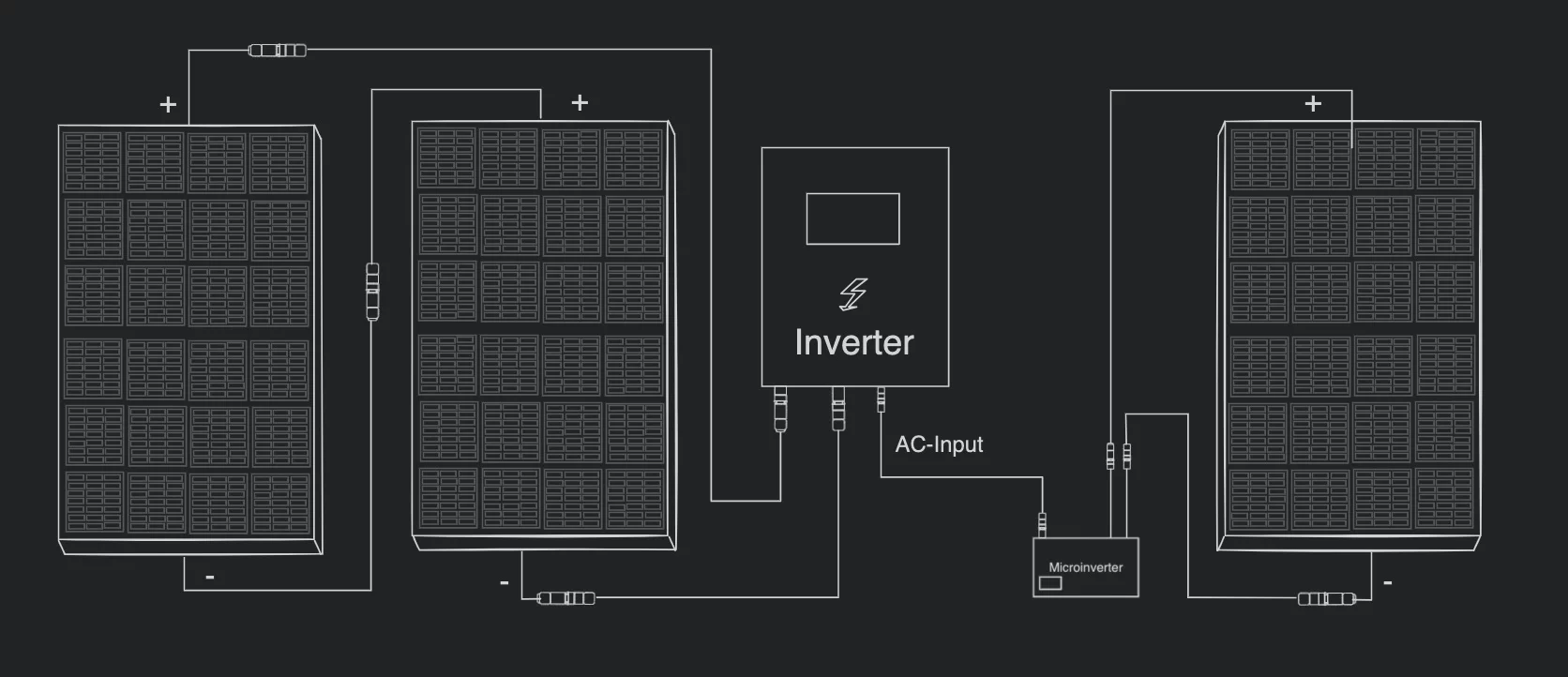
Microinverters answer all three constraints. Each one takes the DC from a single panel and converts it straight to AC. Instead of sending that AC into the house, you can feed it into a hybrid inverter’s AC input. Only some hybrid inverters accept AC-coupled external sources such as microinverters or string inverters, so this depends on your specific model.
Reliability and shade behaviour
Because each microinverter runs one panel, a fault or a shadow on a single module does not drag down the whole string the way it can on a series array. That per-panel independence is the real reason to consider them on a mixed or partly shaded roof: each panel finds its own maximum power point, and the monitoring shows you which module is underperforming.
Enphase backs the IQ8 range with a limited warranty of up to 25 years when an internet-connected IQ Gateway stays installed, against the 10 to 12 years typical for a string inverter. I have not found an independent, like-for-like UK field failure comparison of microinverters against string inverters that I can cite cleanly, so treat reliability as a warranty and design argument rather than a single headline percentage.
Enphase IQ8 model comparison
The Enphase IQ8 range is widely stocked in the UK through mainstream solar distributors, which makes it the default microinverter most installers will quote. The three models sold here are the IQ8MC, IQ8AC and IQ8HC, and they differ mainly in output power and the panel wattage they suit. APsystems and Hoymiles also sell microinverters in the UK and can be cheaper, but Enphase has the longest UK track record and the most developed monitoring, so it is the range worth pricing against first.
The IQ8 can run in a grid-forming mode during a power cut, but in the UK that outage backup only works when the system also includes an IQ Battery 5P and an IQ System Controller 3. A panels-only retrofit does not give you backup, so treat outage running as a separate battery project, not a side effect of adding microinverters.
For more detail on how microinverters compare to other panel-level options, see our guide to power optimisers.
| Model | Peak power | Max AC output | Max input Voc | MPP range | Suits |
|---|---|---|---|---|---|
| IQ8MC | 325 W | 330 VA | 60 V | 25-45 V | 54 and 60-cell, mid-power 72-cell |
| IQ8AC | 360 W | 366 VA | 60 V | 28-45 V | Higher-power modules |
| IQ8HC | 380 W | 384 VA | 60 V | 29.5-45 V | 400W+ premium panels |
Read the two power figures separately. The watt column is the rated real power the unit puts out; the VA column is its maximum apparent power. All three share a 60V maximum input voltage, an 18V start voltage, a 25A maximum short-circuit input current at the inverter, and a separate 20A limit on the short-circuit current (Isc) of any module you pair with them. Those two current numbers are different things: 25A is what the inverter input can survive, 20A is the most a connected panel is allowed to push.
Per-unit prices have sat roughly between £120 and £165 in the UK, though Enphase publishes no UK list price and distributor pricing moves, so treat that as an indicative band to check rather than a quote. The per-unit figure is not the whole cost either. A retrofit of eight older panels needs eight microinverters, so £960 to £1,320 in inverters, plus one IQ Gateway for commissioning and monitoring, plus the electrician’s time to remove the old inverter, fit the units, wire and certify the new AC circuit and handle the DNO paperwork. Against that, a single small AC-coupled string inverter that keeps your existing panels on one MPPT can cost a few hundred pounds fitted, which is the route I took. Microinverters earn their extra cost when the array is shaded, mixes panel wattages, or you want per-panel monitoring, and less so when the old string is healthy and unshaded.
Microinverters alongside a hybrid inverter
When your existing strings occupy all of the MPPTs on your inverter, you can expand on the AC side instead. Bringing the AC output from microinverters into a hybrid inverter’s generator or auxiliary AC input has one real benefit: you can charge the battery from it. That is a different setting from charging from the grid, and configured correctly it means the battery only takes energy your panels made, not imported units.
If you are still deciding on your main inverter, see our guide to choosing a solar inverter and the broader solar inverter overview.
Here is a video where I explain how I applied the same AC-coupling principle, in my case with a small string inverter rather than microinverters.
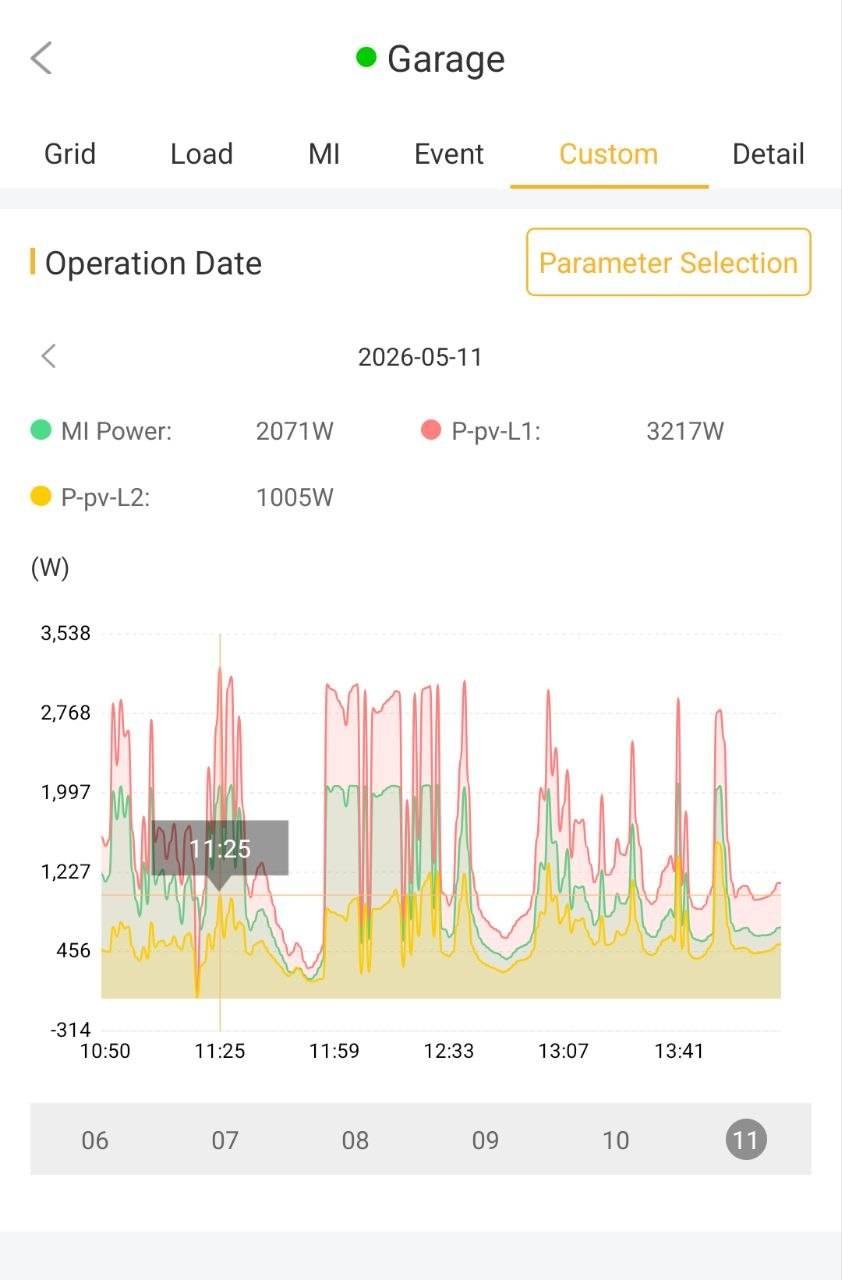
This is what the setup looks like in production. On a sunny but cold May day, around 5 to 8°C, the Sunsynk 3.6 was processing 6,293W of solar at once: 2,071W from the extra string via the small string inverter on the MI input, plus 3,217W on PV L1 and 1,005W on PV L2. The hybrid still had headroom to push roughly 1kW into the battery on top of running the house.
The same picture would hold with microinverters instead of a string inverter on that third array, because the Sunsynk treats both as AC input on the same port. The point is that the extra panels keep producing independently of the two main MPPT strings, and everything funnels back through the hybrid so the battery still benefits.
Configure your Sunsynk hybrid inverter to work with microinverters
On a Sunsynk 3.6 ECCO, the AC-input configuration lives in the inverter’s menus and the user manual describes it directly, which is why I use it as the worked example here.
There is a dedicated menu screen for microinverters, and it also covers string inverters. You reach it from the Aux Load section.
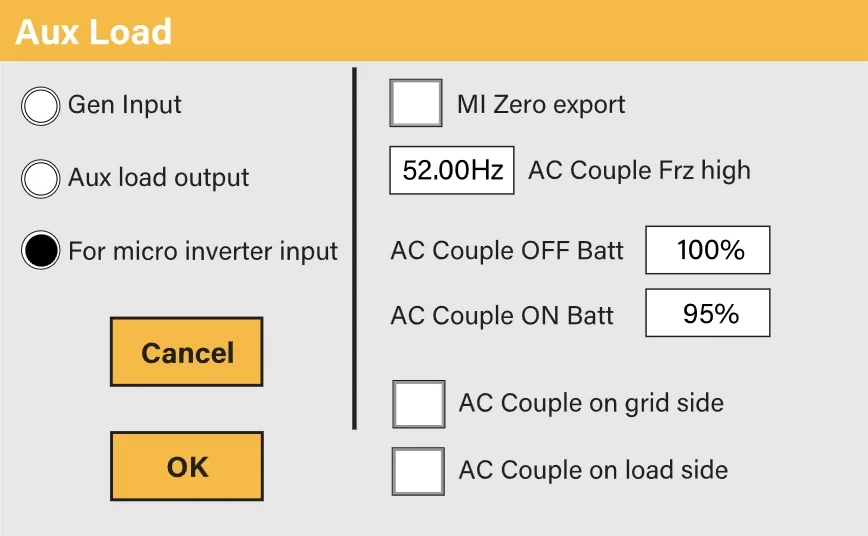
Bringing AC from an auxiliary inverter into the Sunsynk lets you use that AC to charge the batteries as well as supply the house.
I hit one gotcha configuring my Sunsynk 3.6 ECCO with AC input. To let the battery charge from the full AC input, once your DC wiring is correct, the Grid Charge setting in the battery-charge menu has to be high enough. Dividing the AC source power by the voltage gives a rough current, for example 800W/230V=3.5A, so I set Grid Charge to 4A. That value worked on my model and firmware, but it is only an estimate of AC current, not a number to copy blind. Check it against your own Sunsynk model and manual and confirm it at commissioning, because Grid Charge behaviour varies between models and firmware versions.
Examples of hybrid inverters that support AC input from microinverters
Sunsynk stands out here: its inverters accept AC input from microinverters or string inverters, generators and wind turbines, and the user manual describes how to configure each. You can read my review of the Sunsynk 3.6 ECCO I own for the detail.
I checked a few other hybrids against their manuals and a UK retailer’s listings on City Plumbing. Treat the table below as a snapshot of what those manuals mention, not an approval list.
| Brand and model | Supports generator input | Mentions microinverters in the manual |
|---|---|---|
| Sunsynk 3.6 ECCO | Yes | Yes |
| Alpha SMILE | Yes | No |
| Goodwe GW6000 | Signal only | No |
| Solax | No | No |
| Solis | Yes | No |
A generator or AC input existing in the manual does not by itself mean the inverter is signed off for grid-tied AC-coupled PV, or for charging its battery from that input, and the exact behaviour depends on the specific model number and firmware. Confirm your own model against its manual and with the manufacturer, and clear the arrangement with your DNO before you rely on it.
Regulations
Adding microinverters or a string inverter adds generation capacity, and the grid connection rules go by the aggregate registered capacity of everything generating at your property, per phase, not by what you actually export. Up to 16A per phase, which is 3.68kW on a 230V single-phase supply, a compliant installation connects under Engineering Recommendation G98 and you notify the DNO. Once the aggregate crosses that line you move into G99, which is a prior application: you submit it to your Distribution Network Operator (DNO) and wait for written permission before you connect. Approval is not automatic, so do not order the extra capacity on the assumption it will be granted.
My experience with adding an inverter
I have a Sunsynk 3.6 ECCO. I expanded my solar capacity by adding a Growatt 2kW string inverter, connected to the AC input port of the Sunsynk using the method described above. I then applied for G99 with my DNO and received written permission to connect.
In hindsight
Instead of a 3.6kW inverter, I should have chosen the larger 5.5kW Sunsynk and applied for G99 from the start. When I built my system in 2023, the G99 route looked riskier, and with no experience at the time staying within G98 seemed easier. Keeping it easy led me to the smaller inverter.
I ended up applying for G99 anyway, but with a more complicated design than it would have been had I planned for it upfront.
My reason for expansion
Why more panels? For the winter days. My panels are split into two strings facing east and west. The west-facing string sits in uniform shadow from a nearby building for five months of the year, so I am building an east-facing gazebo and mounting panels on its roof.
Conclusion
Using microinverters to add a few panels to a constrained array is a sound route, especially on a shaded or mixed roof, and cleaner still if your hybrid inverter accepts AC input. Two things decide whether you can just get on with it: whether each old panel passes its cold-weather voltage and current check, and whether your aggregate generation stays under 3.68kW per phase. Cross that line and you apply for G99 and wait for the DNO’s written permission before connecting. For the ROI on the extra capacity, see are solar panels worth it.
