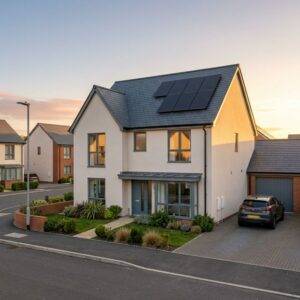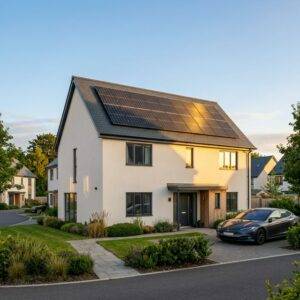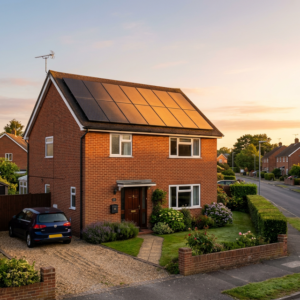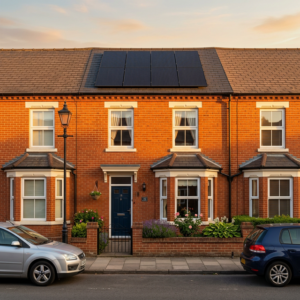
You have a 3-bedroom house with a north-facing roof. A north-facing roof generates roughly 55% of what south-facing produces. The economics are marginal for small systems. Every panel must earn its place. Export income is negligible — this system must be sized purely for self-consumption.
Home solar energy systems can be a worthwhile investment, but they are not all made equal. Factors like panel orientation and the angle at which they meet the sun make a real difference. In this series I will explore the advantages and disadvantages of each roof direction and help you select the right system for a North-Facing roof (compare with the 2-bed south-facing guide to see the contrast).
What This Roof Must Optimise For
- Self-consumption over export. You generate less than a south-facing home. Every kWh you use directly saves 27.69p. Every kWh you export earns 5p. The gap is massive. Size the system so you consume as much as possible.
- Aggressive overpanelling. In UK conditions with a north-facing roof, you will rarely clip. The extra panels pay for themselves in shoulder-hour generation (early morning, late afternoon, winter). Target 130-150% of the inverter AC rating.
- Choose a hybrid inverter. Even if you skip the battery on day one, a hybrid inverter costs only £200-300 more than a pure string inverter and lets you add a battery later without replacing any hardware.
Opportunities
If you have high consumption (heat pump, EV), even 55% yield can offset meaningful grid purchases. The key is sizing the system to never export — consume everything you generate.
Your 3-Bed Consumption Profile
Low to Mid Consumption: 2,900 kWh/year
A 3-bedroom household on gas central heating with standard appliances uses around 2,900 kWh of electricity per year, based on Ofgem Typical Domestic Consumption Values. That is roughly £803 at the current price cap rate of 27.69p/kWh. Your base loads are lighting, fridge/freezer, cooking, washing, and entertainment. Most demand concentrates in the morning (7-9am) and evening (5-9pm), with a dip during the day unless someone works from home.
At this consumption level, a north-facing roof generates less than it ideally needs to offset your bill. The payback is still positive but longer than better-oriented roofs.
If your consumption is on the lower end (under 2,500 kWh/year), consider whether a smaller system with fewer panels might offer a better return per panel.
High Consumption: 6,500+ kWh/year
If you run a heat pump, charge an EV at home, or both, your annual consumption jumps to 6,500 kWh or more. A heat pump adds 3,000-5,000 kWh/year depending on your home’s insulation. An EV adds 2,000-3,500 kWh depending on mileage. Your annual bill could hit £1800+.
At this consumption level, your daytime base load is higher, often 40-50% of daily demand. The heat pump cycles throughout the day, the hot water tank heats, and these loads overlap with whatever generation your north-facing panels produce. This is actually good news for solar because you will self-consume a much higher proportion of what you generate.
You need massive overpanelling (150% minimum) to get any useful power in spring/autumn.
Budget Option
Solar Energy Concepts System Rating
System Specification
Inverter: Solis 3.6kW 5G EH1 (£575)
- AC output: 3.6kW (G98 compliant, notification only)
- 2 independent MPPTs, 1 string each
- Max DC input: 600V / 15A per MPPT / 5.7kW total
- MPPT range: 90-520V
- Hybrid design allows battery addition later without replacing the inverter
Overpanelling target: 150% of the 3.6kW AC rating = 5460W DC. In UK conditions with a north-facing roof, you will rarely clip. The extra panels pay for themselves in shoulder-hour generation (early morning, late afternoon, winter).
Panel Options
| Strategy | Panels | Total DC | Overpanel % | String Check |
|---|---|---|---|---|
| Best value | LONGi Hi-MO X6 455W × 12 (6 + 6) | 5460W | 150% | Yes (Isc 14.79A < 15A limit) |
| Smallest footprint | Aiko Neostar 490W × 11 (6 + 5) | 5390W | – | Yes (Isc 14.93A < 15A limit) |
Battery
At high consumption, generation is fully self-consumed without storage. At low-mid, the summer surplus would benefit from a battery, but on a north roof the annual payback on storage alone is 9-11 years. The hybrid inverter lets you add a Fogstar 5.12kWh later when consumption justifies it.
Total system cost:
- DIY: £1,700-2,400
- Installed: £4,000-5,000
DIY Feasibility
A 3.6kW system is one of the most DIY-friendly setups. Hybrid inverter with 2 MPPTs is slightly more complex but still very DIY-friendly. Battery can be added later without changing the inverter. At 3.6kW AC output, it falls under the G98 threshold (3.68kW), which means you only need to notify your DNO, not apply for permission. The notification is a simple online form and takes 5 minutes. Most DNOs process it automatically.
You can mount the panels, run the DC cabling (see the panel wiring guide), and install the inverter yourself. You will need a qualified electrician to make the final AC connection to your consumer unit (Part P of building regulations). Budget £150-300 for this. No MCS certification is needed for the install itself, though you will not be eligible for SEG export payments without MCS. For a system sized for self-consumption, losing SEG income is negligible.
Expected Performance
| Metric | Low-Mid (2,900 kWh) | High (6,500 kWh) |
|---|---|---|
| Annual yield | 3,067 kWh | |
| Self-consumption (with no battery) | 40% (1,230 kWh) | 83% (2,551 kWh) |
| Export | 60% (1,837 kWh) | 17% (516 kWh) |
| Grid savings | £341/year | £706/year |
| Export income (SEG 5p) | £92/year | £26/year |
| Total annual saving | £433/year | £732/year |
Premium Option
Solar Energy Concepts System Rating
System Specification
Inverter: GivEnergy 5.0kW Hybrid Gen3 (£1,164)
- AC output: 5.0kW (requires G99 application, not just notification)
- 2 independent MPPTs, 1 string each
- Max DC input: 580V / 15A per MPPT / 7.5kW total
- MPPT range: 120-550V
- Hybrid design allows battery addition later without replacing the inverter
Overpanelling target: 150% of the 5.0kW AC rating = 7280W DC. In UK conditions with a north-facing roof, you will rarely clip. The extra panels pay for themselves in shoulder-hour generation (early morning, late afternoon, winter).
Panel Options
| Strategy | Panels | Total DC | Overpanel % | String Check |
|---|---|---|---|---|
| Best value | LONGi Hi-MO X6 455W × 16 (8 + 8) | 7280W | 150% | Yes (313V within 120-550V MPPT, Isc 14.79A < 15A) |
| Smallest footprint | Aiko Neostar 490W × 15 (8 + 7) | 7350W | – | Yes (328V/287V within 120-550V MPPT, Isc 14.93A < 15A) |
Battery
Fogstar FE48-16 (16kWh) (16.1 kWh usable, £1,999)
On a north-facing roof, the battery does double duty: capturing summer surplus and enabling winter tariff arbitrage. The 16.1kWh capacity exceeds the 11.9kWh target (150% of 7.9kWh daily avg) to provide headroom for cold snaps when the heat pump runs continuously overnight.
Total system cost:
- DIY: £4,400-6,100
- MCS installed: £8,500-10,500
G99 and MCS
At 5.0kW AC output, this system exceeds the G98 threshold of 3.68kW. You must apply for G99 permission from your DNO before connecting. This is a formal application, not a notification. Most DNOs approve residential G99 within 45 days, but some regions (notably SSEN in Scotland and parts of Southern England) can take longer if the local grid is constrained.
MCS certification is recommended for the premium option because: (a) you qualify for SEG export payments, which become meaningful at this generation level, (b) the battery enables time-of-use tariff strategies that require a certified installation for some suppliers, and (c) it protects your home insurance and property value.
When This Makes Sense vs Overkill
Worth it if: You have a heat pump or EV charging at home, or you plan to add one within 2-3 years. At high consumption, the premium system self-consumes 97% of its output and the 16.1kWh battery enables Octopus Go arbitrage in winter when solar output drops.
Overkill if: You are a low-consumption household with no plans to electrify heating or transport. The budget system already delivers a decent return. The extra cost for the premium setup takes longer to pay back at low consumption, and battery degradation becomes a factor over that timeframe.
Expected Performance
| Metric | Low-Mid (2,900 kWh) | High (6,500 kWh) |
|---|---|---|
| Annual yield | 4,090 kWh | |
| Self-consumption (with 16.1 kWh battery) | 60% (2,440 kWh) | 97% (3,981 kWh) |
| Export | 40% (1,650 kWh) | 3% (108 kWh) |
| Grid savings | £676/year | £1,102/year |
| Export income (SEG 5p) | £82/year | £5/year |
| Total annual saving | £758/year | £1,107/year |
Tariff Strategy and DNO Notes
Budget option: A flat-rate tariff works fine. Your savings come from self-consumption. If you add a battery later, Octopus Go becomes worthwhile for overnight charging at 7.5p/kWh.
Premium option: Octopus Go is the natural fit. Charge your battery overnight at 7.5p/kWh and discharge during the evening peak at 27.69p. In summer, solar handles the charging. In winter, cheap off-peak grid power fills the battery instead.
DNO Region Considerations
North roofs almost never export enough to bother a DNO.
G98 (budget, 3.6kW): Notification-only. All DNOs process this within days. No practical regional variation.
G99 (premium, 5.0kW): Application required. Turnaround varies by DNO:
- UKPN (London, South East, East): Generally fast, 20-30 working days
- WPD / National Grid ED (Midlands, South West, Wales): Moderate, 30-45 days
- NPG (North East, Yorkshire): Generally fast, 20-30 days
- SSEN (Scotland, parts of South): Can be slow, 45-60+ days. Known for grid constraint issues in rural areas
- ENW (North West): Moderate, 30-45 days
If you are in an SSEN area and planning a 5kW system, submit your G99 application early. Do not wait until the panels arrive.
ROI Comparison
| Budget DIY | Budget Installed | Premium DIY | Premium MCS | |
|---|---|---|---|---|
| Low-Mid Consumption (2,900 kWh/year) | ||||
| Upfront cost | £2,050 | £4,500 | £5,250 | £9,500 |
| Annual saving | £433 | £433 | £758 | £758 |
| Payback | 4.7 years | 10.4 years | 6.9 years | 12.5 years |
| 25-year return | £10,825 | £10,825 | £18,950 | £18,950 |
| High Consumption (6,500 kWh/year) | ||||
| Upfront cost | £2,050 | £4,500 | £5,250 | £9,500 |
| Annual saving | £732 | £732 | £1,107 | £1,107 |
| Payback | 2.8 years | 6.1 years | 4.7 years | 8.6 years |
| 25-year return | £18,300 | £18,300 | £27,675 | £27,675 |
Assumes flat electricity rate of 27.69p/kWh, SEG at 5p/kWh, no energy inflation, and 0.5% annual panel degradation. Real returns are likely higher as energy prices tend to rise over 25 years.
Generation Yield Source
All yield estimates in this guide are derived from PVGIS (Photovoltaic Geographical Information System), the European Commission’s free solar radiation database. PVGIS uses satellite-measured irradiance data and is the standard reference for solar yield calculations across Europe.
Simulation Parameters
| Parameter | Value |
|---|---|
| Location | 52.308°N, -0.717°W (Central England reference) |
| Roof slope | 28° |
| System loss | 14% |
| Database | PVGIS-SARAH3 |
Yield by Roof Face
| System | Face | PVGIS Aspect | E_y (kWh/kWp/yr) | DC Capacity | Annual Yield |
|---|---|---|---|---|---|
| Budget | North | 180° | 588.12 kWh/kWp | 5.46 kWp | 3,067 kWh |
| Premium | North | 180° | 588.12 kWh/kWp | 7.28 kWp | 4,090 kWh |
Clipping factor applied: 0.96 (accounts for inverter limiting when DC input exceeds AC capacity).
Total annual yield after clipping: 3,067 kWh
You can verify these figures yourself using the PVGIS interactive tool. Enter your postcode for location-specific results.