
The UK has published its interim product specification for plug-in solar. The consultation closed 30 June 2026, the government responded on 16 July, and the enabling law comes into force on 27 August 2026. The spec sets out the output limit, the panel size, the plug, and the shut-off behaviour a kit will need before it can legally go into a UK socket. Plug-in solar, also called balcony solar, is already legal and registered in more than a dozen European countries, and Germany alone has over 1.2 million systems signed up with its grid regulator. I went through what each country actually requires, then compared it against the UK’s own published proposal, and the two line up closely.
The short version: every country that made plug-in solar work did three things, an official safety standard for the kit, one simple registration step, and (mostly) a legal right for renters to fit one. Germany did all three, took nine years to get there, and now has over a million systems running. The UK has published an interim product spec that covers the first of those, and it lands almost exactly where Germany did: an 800 VA inverter limit and up to 2,000 W of panels. The consultation closed 30 June 2026 and the government confirmed the limits unchanged in its 16 July response; the law comes into force on 27 August 2026. Before publishing the spec, DESNZ commissioned a 96-page independent electrical safety study specifically to verify that UK ring-final circuits – which differ from the European radial circuits the German standard was designed for – are safe at 800 VA export levels. The study found all six tested devices showed the core signs of safe operation, though all six exceeded a radio-interference (EMC) limit at full power, so it recommended a controlled rollout rather than a blank certificate of safety.
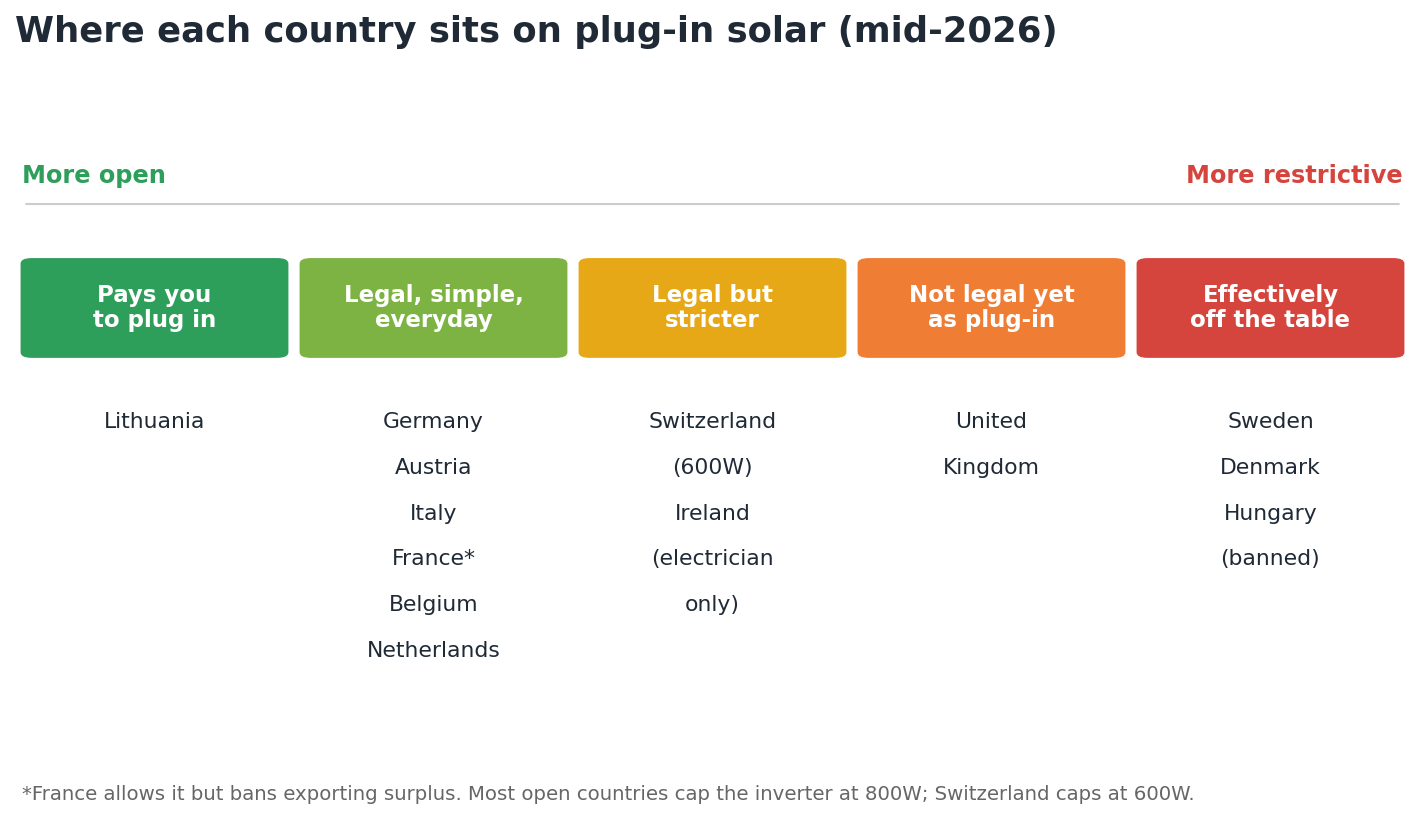
Germany wrote the playbook
Germany is the reason plug-in solar is a real category at all. It has the scale, the longest track record, and the most complete set of rules, so it’s the obvious country to start with.
The output cap is 800 watts. That’s not the panel size. It’s what the inverter is allowed to push into your house wiring. On a normal household socket, the standard caps total panel size at around 960 watts, so a bit of panel headroom under that limit, a 1,000-watt or 1,200-watt array feeding an inverter electronically capped to 800 watts out, is fine and common, because panels rarely hit their rated output anyway. Go well above that, and you need the dedicated-socket route instead (more on that below).
The cap moved up from 600 watts to 800 watts in 2024, which tells you these limits aren’t fixed forever. They get revisited as the safety case improves.
Getting a proper product standard took nine years of argument between manufacturers, electrical bodies, and regulators. It finally landed in December 2025. Before that, kits were sold and plugged in across Germany for years without one, on the strength of general electrical safety rules and a lot of informal tolerance.
The standard, now that it exists, sets out what a kit has to do to be sold and connected safely. For a normal household socket, that’s panels up to roughly 960 watts with the right safety features built in. If you install a dedicated socket just for the kit, you can run more panel, up to about 2,000 watts. Either way, the inverter still clips its output to 800 watts.
The point of the standard isn’t to raise the power limit; it’s to make sure the safety features (the ones that stop you backfeeding a dead grid, for instance) are actually built into the kit rather than assumed.
Registration is one online form, on a national register run by the Bundesnetzagentur, the grid regulator. Until 2024 you also had to notify your local network operator separately. That second step is gone. One form, one place, done.
What surprised me: Germany didn’t bother banning old analogue meters that spin backwards when you export power. The rule lets them keep spinning backwards, lawfully, until the network gets round to swapping them out.
That’s a small amount of free electricity for whoever has an old meter, accepted on purpose rather than making every household wait for a meter upgrade before they’re allowed to generate their own power. Germany chose speed of adoption over precise billing accuracy.
Since October 2024, a tenant’s request to fit balcony solar sits in the same protected category as a request to fit an EV charger. The landlord must show the request is unreasonable before refusing it, rather than the tenant having to argue their way into permission. That flips the default. If you rent in Germany, putting a panel on your balcony rail is now closer to a right than a favour.
Put it together and you get the scale: over 1.2 million systems registered with the Bundesnetzagentur by the end of 2025. Informal estimates run higher, because plenty of kits went up before registration was simple and never got logged, but the regulator’s own count is already past a million.
That number needs context. Collectively those systems add up to something like 1.2 to 1.3 gigawatts of capacity, less than a single decent-sized offshore wind farm. This isn’t really a generation story. It’s a grassroots one: a million-plus households taking a small bite out of their own electricity bill, one balcony at a time.
The kit itself is VAT-free in Germany. Some local councils added cash grants on top, Berlin had one running until early 2026 when it ended, and that pattern repeats around the country: grants come and go depending on the council’s budget that year. Don’t bank on a grant existing by the time you’d use it. The VAT relief is the steadier incentive.
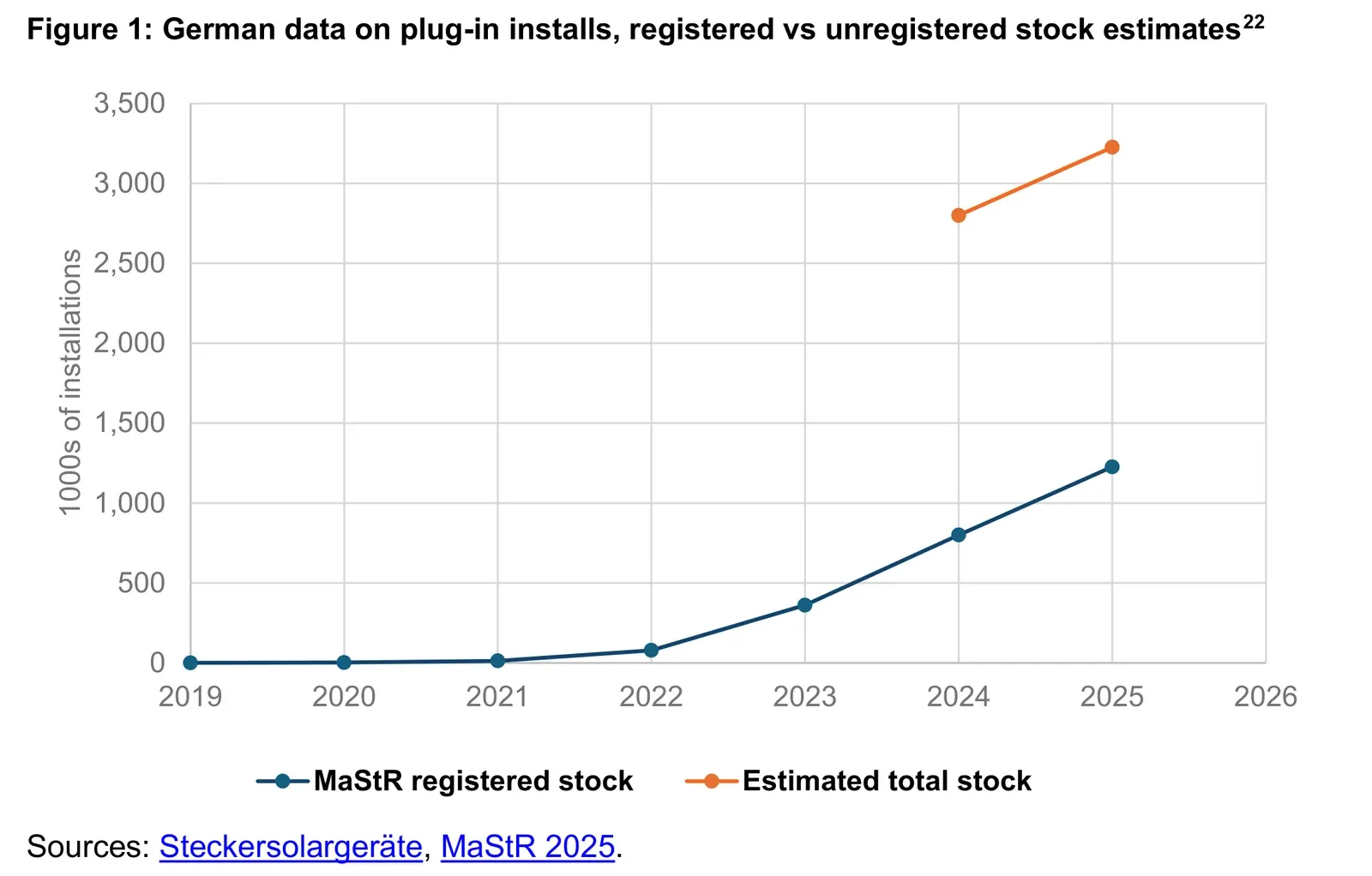
The gap between the two lines is the point: Germany’s environment agency estimates close to 3 million systems were running by the end of 2024, while only about 0.8 million were registered. Cheap kits plus a registration step people skip is exactly the mess the UK’s simpler proposal is trying to avoid.
The rest of Europe took the same idea in different directions
Once you look past Germany, the pattern holds but the details vary in ways that matter if you’re comparing countries, or trying to guess what the UK will copy.
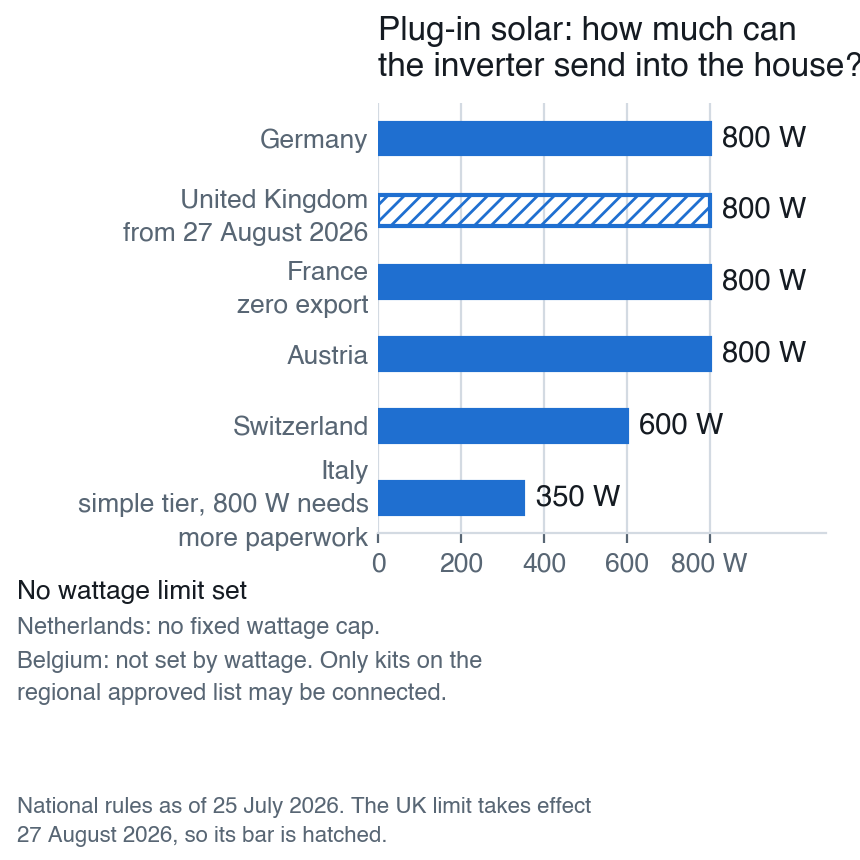
| Country | Inverter output limit | How you register it | The catch or quirk |
|---|---|---|---|
| Germany | 800W | One online form to the Bundesnetzagentur | Old meters can legally spin backwards until replaced |
| France | 800W | Free online declaration to the grid operator, approved if they don’t object | Surplus must not be exported, it’s curtailed rather than sold back |
| Belgium | Set by the approved-product list, not a single wattage figure | Notify your regional grid operator | Only kits on the official approved list can legally be connected |
| Netherlands | No fixed wattage cap | Register with your grid operator (joint national portal) | Reported to need its own dedicated circuit rather than any socket, though I could not re-confirm that requirement in July 2026 |
| Italy | About 350W self-install; up to 800W with more paperwork | One free standard form to your distributor, plant goes on a national register | You waive payment for anything you export; condo needs notice, not a vote |
| Austria | 800W | Register online, give the network two weeks notice before switching on | Treated legally as a household appliance, not a power station |
| Switzerland | 600W | Notify your utility first, then self-install | Must be a genuine 600W unit, not a bigger one throttled down |
A few of these are worth pulling out, because they’re not just smaller variations on Germany, they’re genuinely different bets.
France set the same 800 watt limit as Germany, with paperwork just as light, a free online declaration with tacit approval if the grid operator doesn’t respond. But France attaches a condition Germany doesn’t: you have to formally commit to not exporting a single watt back to the grid.
Any surplus your panel makes beyond what your home is using at that instant has to be curtailed, not exported and not sold back. The inverter limits or dumps the excess rather than pushing it onto the grid. It dodges metering and payment complexity, but a French balcony system does a different job to a German one: self-consumption only, with surplus capped rather than banked.
Belgium, where Flanders led the way in April 2025 (Brussels and Wallonia run their own, stricter timelines), works on an approved-product model rather than a wattage limit you size your own kit against. The regulator keeps a list of kits that have been checked and cleared. Off that list, you can’t legally plug it in, regardless of how safe it might actually be.
It’s a stricter gate than Germany’s approach, where any manufacturer can self-certify against a published spec. Belgium pre-approves specific products instead, and the rules differ a little between Flanders and Wallonia too.
Switzerland chose a lower limit, 600 watts, deliberately below the 800 watt figure most European countries settled on, and it’s strict about it: the unit has to be a genuine 600 watt inverter, not a bigger inverter electronically capped down, which Germany explicitly allows. Export earns a token amount, not a real tariff, so the financial case leans almost entirely on self-consumption, same as France, just without France’s formal no-export promise.
Swiss tenants are often told they need their landlord’s permission, and that is narrower than it sounds. An installation that sits within the balcony parapet needs no consent. It is only a fixed installation, or one that hangs outside the parapet, that needs the landlord to agree. If you rent in Switzerland, how you mount the panel decides whether you have to ask at all.
Lithuania is the standout at the generous end. Rather than just permitting balcony solar, the government pays you to install one, a flat subsidy of around 200 euros for a typical 0.8kW kit, and you’re allowed to install first and notify afterwards rather than waiting for approval. Lithuania pays you to plug in. It’s the cleanest possible signal that a government has decided the safety case is settled and the only remaining job is to get adoption up.
Then there’s the other end of the spectrum, which matters just as much for reading the UK’s position. Sweden and Denmark’s safety authorities have looked at feeding power through an ordinary wall socket and concluded it can’t be made safe enough, full stop. In both countries, balcony solar is only legal if it’s hardwired in by a licensed electrician, which isn’t really “plug-in” solar any more, it’s just a small fixed installation.
Hungary went further still: building regulations effectively banned panels mounted on balconies from 2025, allowing only panels properly integrated into the building’s facade. That’s a stricter line than any of the other countries here.
Ireland takes a more cautious route: balcony solar there is legal only with a registered electrician, formal grid approval, and a smart meter already fitted. DIY socket connection is explicitly not allowed, though Ireland’s minister has signalled some openness to revisiting that.
A handful of smaller examples round out the picture. Slovenia caps at 600 watts with a fixed 14-day notice period. Poland keeps a low limit but still routes you through the full microinstallation process (notify the grid operator, swap the meter, amend your contract), so a low wattage cap doesn’t automatically mean light admin.
Spain’s broader self-consumption reform happens to make balcony kits easier to install too, through simpler condo-consent rules. Greece is the fastest mover I’ve seen, it passed enabling legislation in about a month in 2026, with a notify-only digital platform expected to follow, which shows how quickly this can move once a government decides to act.
What every country that made it work has in common
Strip away the different wattage numbers and registration portals, and the countries where plug-in solar actually took off all did the same three things.
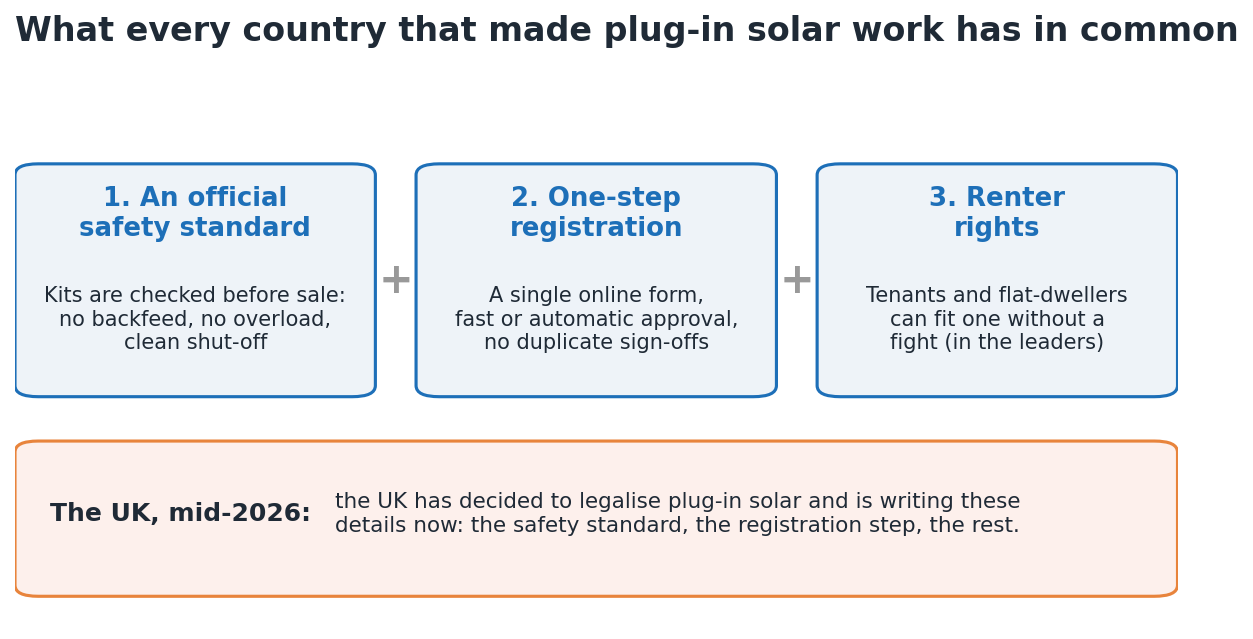
First, an official product safety standard for the kit itself, not just general wiring rules borrowed from elsewhere. Germany spent nine years getting one. Belgium does it through an approved-product list instead of a published spec, different mechanism, same job: someone independent has checked the kit won’t backfeed a dead line, won’t overload a socket, and will switch itself off cleanly if the grid goes down.
Without that, no regulator is comfortable letting it spread. Sweden and Denmark looked at feeding power through an ordinary wall socket and concluded the connection itself can’t be made safe enough, which is why both still require a hardwired, electrician-fitted installation instead.
Second, a registration step that’s genuinely simple, one form, one place, fast turnaround. Germany got there by abolishing a duplicate step. France and Italy both run free online forms with tacit or fast approval. The countries that bolt on heavier admin, multiple sign-offs, mandatory inspections, smart meter prerequisites, end up looking like Ireland: legal on paper, rare in practice, because the friction eats the appeal.
A third ingredient shows up in the leading countries, though it’s far from universal: some form of renter or co-owner right. An official safety standard and simple registration are the two things every working system has. Renter rights are the patchier add-on the strongest examples build on top. Germany’s October 2024 change put balcony solar requests in the same protected category as EV chargers. Austria has assumed a co-owner’s consent in blocks of flats since 1 September 2024, unless someone objects within a two-month window. Spain’s self-consumption reform eased the condo-consent path that balcony kits also use.
Where a country has skipped this, plug-in solar quietly becomes a homeowner-only product, even if it’s technically legal for everyone, because the renters and flat owners who’d benefit most from a cheap, removable kit are the ones who need a landlord or a building vote to say yes first.
Why German payback posts look better than UK reality
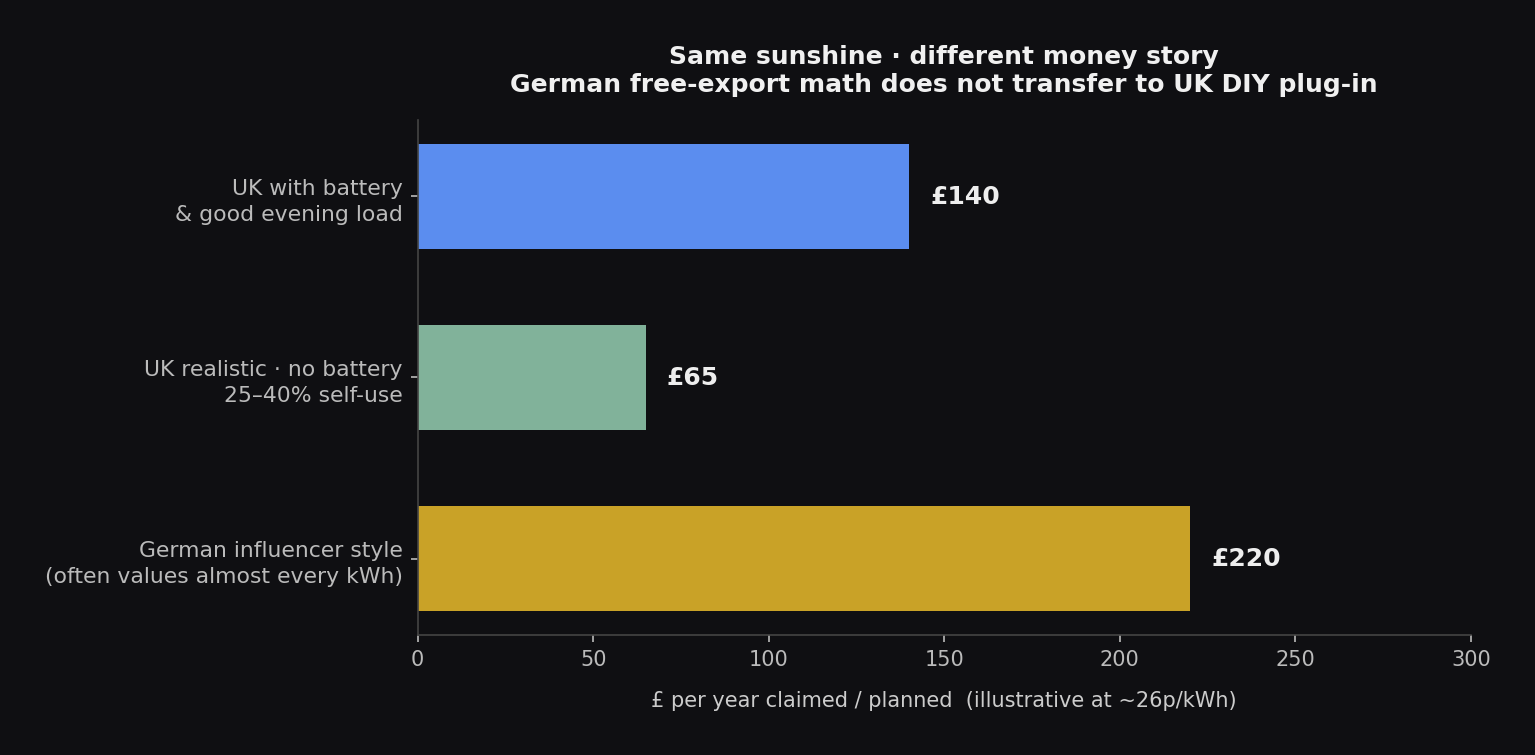
Many German balcony systems still benefit from a transitional quirk: older spinning meters that run backwards, so spare electricity effectively credits the bill at retail rates. Registering a system can trigger a meter swap that ends that freebie. Influencers who quote two-to-four year payback are often valuing almost every kilowatt-hour as saved money.
In the UK, plan for the opposite: a self-bought plug-in kit does not unlock a normal export tariff. Surplus usually goes to the grid for free. Your saving is only what you use (or store) yourself. Use German scale and product standards as a guide to what the UK is copying. Do not copy German ROI screenshots into a UK spreadsheet.
UK consequence on renters: Germany gave tenants a stronger legal path for balcony solar, and people still report landlord fights. The UK is not copying that renter right. After socket use becomes legal, leasehold, freeholder, and landlord permission can still block you. Legal to plug is not the same as allowed on the building. Get written permission before you spend.
How the UK compares
DESNZ published its interim product specification for plug-in solar on 16 June 2026, consulted on it, and finalised it on 16 July 2026 alongside the law change (SI 2026/848), which comes into force on 27 August 2026. Until that date no kit can legally go into a UK socket, and only certified kits qualify after it. For the full picture on where the rules stand and what happens next, see the full UK rules and status guide.
UK versus Germany: the comparison
| Germany | UK (final spec, 16 July 2026) | |
|---|---|---|
| Output limit | 800 VA | 800 VA, max 3.5 A |
| Panel size limit | ~960 Wp standard socket; ~2,000 Wp dedicated socket | 2,000 W max; professional check advised above 960 W |
| Plug | Schuko (Type F) or Wieland dedicated | BS 1363, 5 A fuse, partly-insulated pins, no adaptors |
| Technical standard | DIN VDE V 0126-95 (Dec 2025) | Adapted from DIN VDE V 0126-95 for UK ring circuits |
| Product approval | CE marking + notified body testing | Manufacturer must confirm assessed compliance; an ENA register listing alone is no longer enough |
| Consumer registration | Bundesnetzagentur (MaStR), within 1 month | DNO notification required; no central consumer portal |
| Batteries | Separate product category | Explicitly excluded from plug-in solar scope |
| Renter rights | Protected since October 2024 | Landlord permission required; no automatic right in the final rules |
The numbers line up closely with Germany’s own model: an 800 VA inverter limit, up to 2,000 W of panels, and a BS 1363 plug with a 5 A fuse. These figures are now confirmed: the final specification of 16 July 2026 kept them all.
You will also need to notify your network operator (DNO) before switching on: the UK guide walks through what that involves. The spec is shaped in part by a government safety study of six plug-in kits, a finding I cover in how plug-in solar actually works.
Until 27 August 2026, the only legal way to add generation to your home wiring is a hardwired installation by a registered electrician, notified to your network operator. That applies even to a kit sold in a UK warehouse and marketed at the UK. After that date, the socket route opens only for a kit whose manufacturer can confirm it has been assessed as compliant with the specification, and on 24 July 2026 no such product exists.
FAQ
Which country has the most plug-in solar?
Germany, by a wide margin. The Bundesnetzagentur, Germany’s grid regulator, had over 1.2 million systems registered by the end of 2025. No other European country is close to that figure.
Will the UK copy Germany’s rules?
Very closely, on the numbers that matter most. The UK’s final specification sets an 800 VA inverter limit and up to 2,000 W of panels, which is Germany’s model almost exactly. What it does not settle is renter rights; the specification allows one device per circuit, but grid-connection rules keep it at one per household until G98 is amended. For the current status and what happens next, see the UK plug-in solar guide.
Where to go next
If you’re ready to buy once UK rules land, the UK buying checklist covers what to look for on any kit sold here. If you want the current legal status and the rules the UK is finalising, the UK plug-in solar guide has the detail. Either way, nothing goes into a UK socket legally before 27 August 2026, and a hardwired installation by a registered electrician remains the only lawful route until then.
