
Heat vs irradiance, first screen: solar panels need light, not heat. Stronger summer sun raises generation; hotter cells reduce efficiency at roughly 0.26-0.30% per °C above 25°C. Those two effects travel together in UK summers, which is why people mix them up. Summer still wins on total kWh because daylight hours and irradiance dominate the heat penalty.
I have metered my own UK system for 16 months. The data matches the datasheet physics: cold bright days can beat hot bright days at the same irradiance, and May can out-generate a hotter July. For the seasonal shape of yield, see solar panel output by month in the UK.
Do solar panels work better in heat or cold?
At the same level of sunlight, solar panels work better when they are cold, because heat reduces their output. Every panel loses roughly 0.26 to 0.30% of its power for each degree its cells sit above 25°C, so a hot day quietly dents performance, it never boosts it. Summer still produces the most electricity, but that is down to longer days and stronger sun, not the heat itself.
This trips people up because two things happen at once every UK summer: irradiance goes up and temperature goes up. They rise together, the heat is a side effect of the stronger sun, so they are linked, but they pull output in opposite directions. The sun gets stronger because the days are longer and the angle is more direct. Cells get hotter as a side effect of sitting in that stronger sun. Inside the panel, more heat means more electron jitter in the silicon, which lowers the voltage the cell can produce at a given current. Less voltage, less power, even with identical light hitting the panel.
Every panel datasheet states this as a temperature coefficient of Pmax, expressed as a percentage loss per °C above 25°C. It’s not a marketing number. It’s measured in a lab and it’s one of the most useful specs on the sheet if you’re comparing panels. Check the coefficient before you check the wattage badge: a 440W panel with a worse coefficient can lose more ground on a hot day than a 420W panel with a better one.
How much output do solar panels lose in the heat?
Here’s the bit that actually matters: how much power you lose on a hot day, in real numbers, not just the direction of travel.
Start with the nameplate rating. The Standard Test Conditions (STC) figure on every panel’s spec sheet, the “400W” or “440W” you see advertised, is measured at exactly 25°C cell temperature and 1000 W/m² of light. That’s a lab condition. Real panels sitting on a real UK roof almost never run at 25°C when the sun is actually strong enough to produce serious power. They run hotter, sometimes a lot hotter, so the nameplate number is a ceiling you rarely touch in practice rather than a number you should expect to see on your inverter display.
Manufacturers also publish a more realistic figure called NOCT (Nominal Operating Cell Temperature), sometimes labelled NMOT. This is the cell temperature the panel reaches at 800 W/m² irradiance, 20°C ambient air temperature, and light wind. It’s a field-realistic reference point, not a second power rating, and for the panels I’ve reviewed it lands between 42°C and 45°C. That’s already about 20°C above the 25°C STC test condition, before you even add a proper hot day on top of it.
You can’t measure cell temperature directly, but you can estimate it for any given day with a standard PV engineering method (Duffie and Beckman). Run it for a genuinely hot UK summer day: 28°C ambient, 900 W/m² irradiance, NOCT of 45°C. That gives a cell temperature of about 56°C, which is 31°C above the 25°C STC reference. At a typical modern temperature coefficient of 0.28% per °C, that works out to roughly 8.7% below nameplate. That 8.7% is the heat component alone, the loss from temperature against the 25°C nameplate condition, not your total real-world shortfall. Call it an 8-10% dip on the hottest days the UK actually produces, not the wipeout people sometimes assume. It’s a real loss, but it’s a dent, not damage. (If you want to run it yourself, the standard estimate is ambient temperature plus (NOCT minus 20) divided by 800, times the irradiance.)
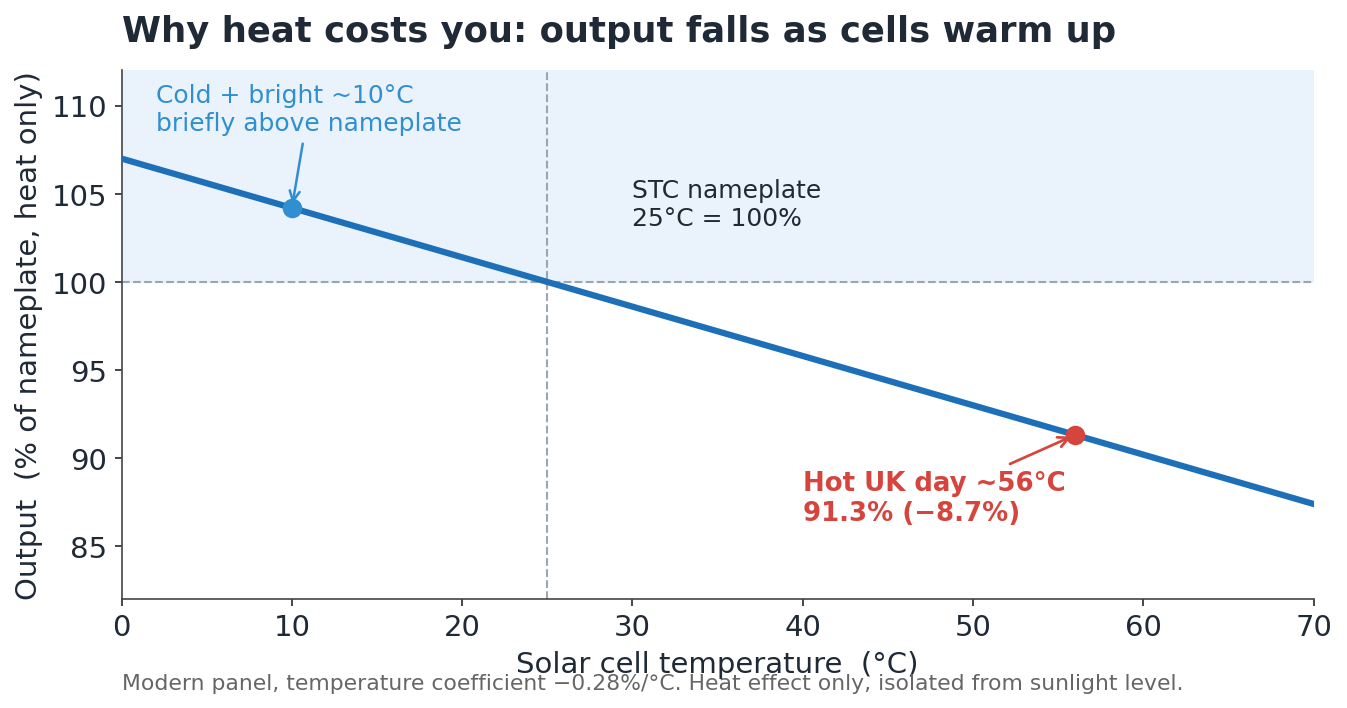
Older PERC-generation panels with weaker coefficients (closer to 0.34-0.40% per °C) would lose proportionally more on the same hot day, which is one more reason newer panel chemistry has crept toward smaller coefficients generation over generation.
| Panel | Temp. coefficient (Pmax) | NOCT |
|---|---|---|
| LONGi Hi-MO X10 | 0.26% per °C | 45°C |
| LONGi Hi-MO X6 Max | 0.28% per °C | 45°C |
| DMEGC | 0.29% per °C | 42°C |
| Viridian Clearline Fusion (in-roof) | 0.29% per °C | 42°C |
| JA Solar Deep Blue 4.0 Pro | 0.30% per °C | 45°C |
The spread between the best and worst panel here is small, around 0.04% per °C, but it adds up over 25 years of summers. It’s worth a glance at the datasheet, not a reason to obsess.
Why is summer still the best season for solar?
If heat costs you 8-10% on the hottest days, why does every solar yield chart show summer as the clear winner? Because the heat penalty is small and the irradiance gain is not. Month-by-month UK numbers: solar panel output by month UK.
PVGIS (the EU Joint Research Centre’s solar database, the standard reference tool for European PV yield estimates) models a typical London system at 35° tilt, south-facing, like this across the year:
| Month | Estimated yield (kWh/kWp) |
|---|---|
| July | ~120 |
| June | ~119 |
| May | ~117 |
| August | ~107 |
| January | ~40 |
| December | ~35 |
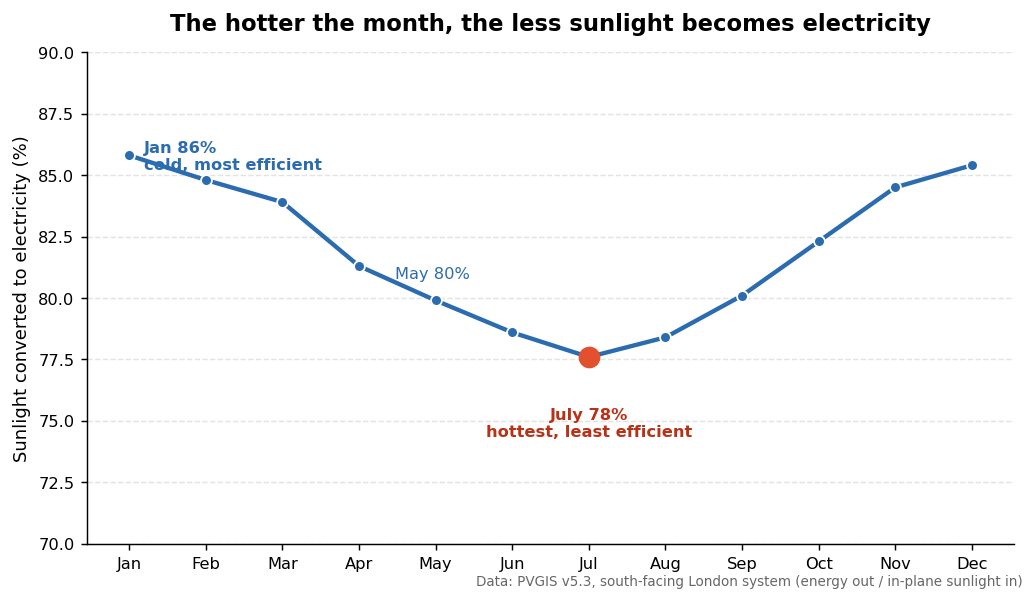
That summer to winter swing is almost pure daylight, not temperature: in July the UK gets close to 16-17 hours of sun riding high, in January under 8 hours with it barely clearing the rooftops. The heat shows up in a sharper comparison. Put May next to July. July’s panels catch about 6% more sunlight than May’s (159 versus 149 kWh per m² of in-plane sun), yet they deliver only about 3% more electricity (123 versus 120 kWh per kWp). That missing slice is the heat tax: July’s cells run hotter, so they convert less of what lands on them. It’s why the chart below dips to its lowest point in July, the hottest month is also the least efficient one of the year.
That’s the physics. My own metering says the same thing: in 2025 my best generation month was May, not July.
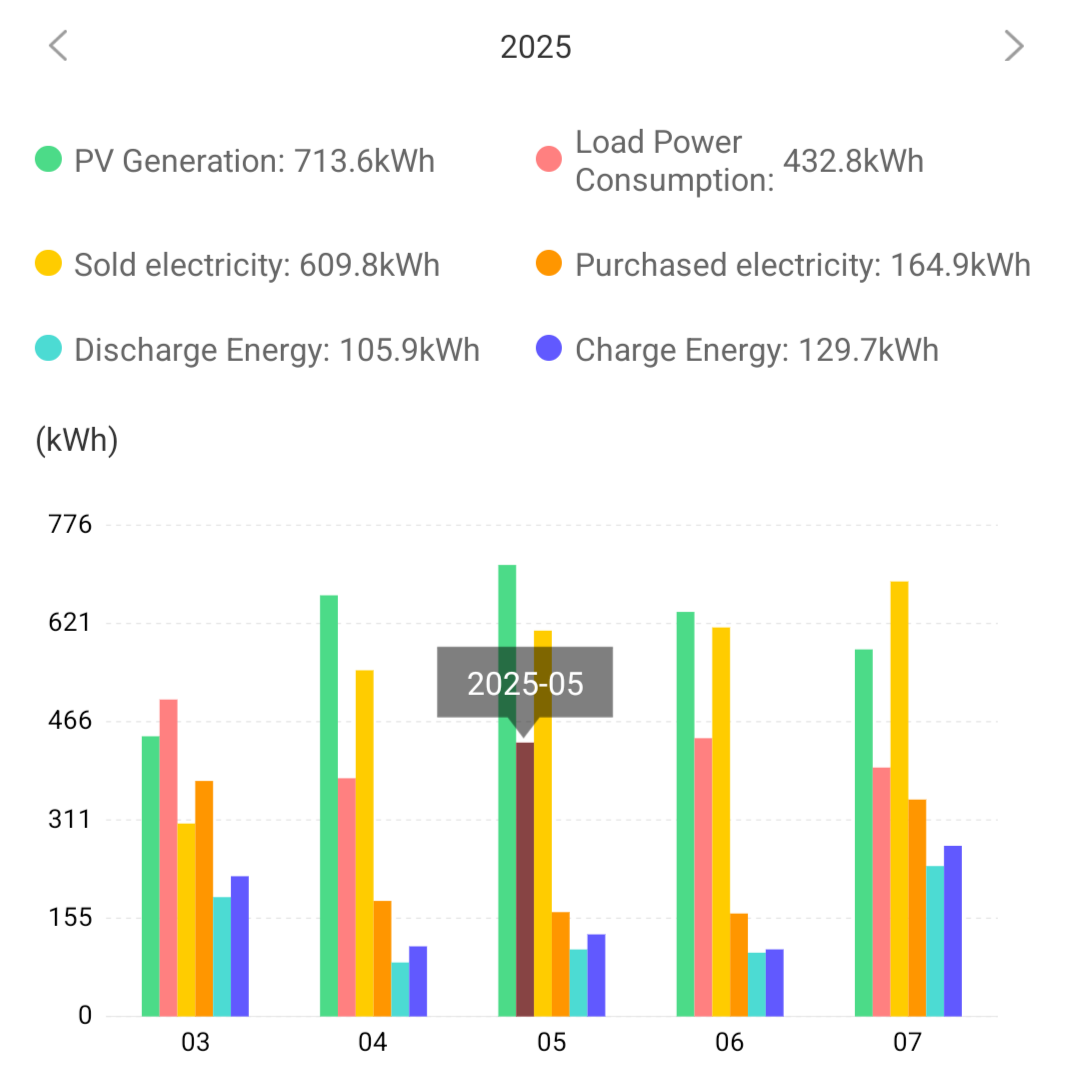
This is the bit that confuses people who’ve heard “panels hate heat” and conclude solar must be a summer-only technology that struggles in a hot country and thrives in a cold one. Wrong axis: solar chases light, and the UK gets most of its light in summer for reasons that have nothing to do with the thermometer. The heat tax rides along on those long summer days, but it never sets the size of the harvest.
What are the best conditions for solar panels?
The best conditions for a solar panel are cold and bright at the same time: strong sun, low cell temperature. The temperature coefficient cuts both ways. Below 25°C cell temperature, a panel can produce slightly more than its nameplate rating, not less, because the same physics that costs you power when cells run hot hands a small amount back when they run cool.
I’ve seen this directly on my own system. The single best instantaneous output I recorded across 16 months didn’t come on a heatwave day in July. It came on a clear, cold morning in early May, ambient temperature around 5-8°C, bright unbroken sun, no haze. Cold cells, full light, nothing in the way. That’s the combination that produces a panel’s genuine best moments, not the hottest day of the year.
That cold-and-clear “bonus” is something I’ve seen on my own meter, and something other owners report too, roughly 5-10% over nameplate. One honest caveat: clearing nameplate at all needs the irradiance near or above 1000 W/m², not just cold cells. Cold on its own doesn’t push you past the rating; cold plus near-peak sun does. Treat the range as illustrative rather than a guarantee: your own bonus depends on your panel’s coefficient, your irradiance that day, and how cold your roof actually gets versus the air temperature reported nearby.
None of this means you should wish for winter. A cold, bright day in May still has far more daylight hours behind it than a cold, bright day in December, so the May spike sits on top of a much bigger base than a December one ever could.
Do roof-mounted panels overheat?
Roof-mounted panels don’t overheat in any damaging sense, UK panels are nowhere near their thermal limits, but how they’re mounted does change how much of that ordinary heat penalty you actually feel.
Standard rack-mounted panels sit a few centimetres above the roof on rails, with an air gap underneath. That gap lets air move behind the panel and carry heat away by convection, which keeps cell temperature closer to ambient than it would otherwise be. In-roof (BIPV, building-integrated) systems like flush in-roof tiles sit directly in the roof plane with no gap behind them, so they lose that convective cooling and tend to run hotter for the same irradiance and ambient temperature. It’s a real, measurable, ongoing efficiency cost, not a safety issue.
In-roof systems are still a sound choice. Plenty of homeowners pick them for the look, for conservation area rules, or for a flush, integrated finish, and that trade-off is worth making with eyes open. The air gap is just one more factor alongside aesthetics and planning constraints, not a reason to rule a mounting style out.
Are in-roof solar panels a fire risk?
The honest answer first: PV fires are rare, and the ones that do happen are almost always electrical, not panels igniting because they got hot in the sun. The BRE National Solar Centre’s national study (Fire and Solar PV Systems, 2017, for what was then BEIS) counted fewer than 60 incidents across roughly a million UK installations, and the main culprits were DC isolators, DC connectors and poor installation workmanship causing electrical arc faults. The ordinary operating heat we’ve been talking about, panels at 50-70°C, does not start a fire. Good installation is the real control, on any mounting style.
Where in-roof (building-integrated) mounting actually matters is the consequence if a fault does start a fire, not the chance of one starting. The Health and Safety Executive’s 2025 roof-fire experiments (an interim update, so treat these as early findings) found that in-roof systems let fire spread further and were harder to put out than rack-mounted ones. The sealed cavity behind an in-roof array shields the fire from firefighters’ water and adds fuel in the form of battens and membranes, whereas on rack-mounted systems the air gap and the aluminium rails actually slowed the spread. So this is about how a fire behaves once started, not in-roof panels being more likely to catch light, and certainly not panels self-igniting from the sun. Fires are rare either way; the mounting choice changes the worst case, not the odds.
Do solar inverters overheat in summer?
It’s not just the panels that feel the heat. The inverter does too, and in some installs it’s the bigger summer constraint of the two. The panels can be churning out current happily while the inverter, the box that turns their DC into the AC your house uses, quietly pulls its own output back to protect itself. Where you put that box matters as much as which panels you buy.
Most string and hybrid inverters run at full rated output up to roughly 40-45°C ambient air temperature, then start to derate above that, deliberately reducing output to keep their internals inside a safe band. My own unit is a Sunsynk 3.6 ECCO hybrid, wall-mounted in an outdoor garage with the clearances the manual specifies above and around it. It’s a compact wall unit whose built-in cooling is modest and convection-dependent, rated to keep working up to 60°C ambient with output derating that begins above 45°C. In a cool, airy spot that is plenty. Mine is not in a cool airy spot.
Here’s where most people misread their own kit. I keep an external fan running underneath mine through summer and it still climbs past 55°C on a hot day. That looks alarming next to the 45°C derating threshold, but the two aren’t the same measurement, so don’t compare them. My 55°C is a heatsink reading, and a heatsink is built to run well above the air around it. That’s how it sheds heat. A heatsink in the mid-50s°C isn’t a problem on its own.
What actually flags a heat problem is one of two things:
- Midday clipping: a flat, lower-than-expected ceiling on a bright hot day, when the panels could clearly deliver more.
- A logged over-temperature fault.
Watch the output curve and the fault log, not the raw temperature number. Even then, clipping on its own isn’t proof of heat. A flat ceiling can also come from a full battery, an export or grid-voltage limit, or DC/AC oversizing, where your array is bigger than the inverter’s AC rating. Before you blame heat, compare your midday output against what the panels should be making for that day’s sunlight.
The reason my fan helps but hits a ceiling is worth understanding, because it points at the real fix. A passively cooled unit sheds heat by convection into the air right around it. In a sealed, windowless garage that air warms up over a sunny day and climbs above the outdoor temperature, so the whole room becomes a hot box. A fan underneath moves heat off the unit faster, but it’s stirring air that’s already warm, recirculating the same heat.
What actually moves the needle is swapping the room’s air for cooler outside air: a vent, an extractor fan, or shade on the building itself. Meeting the datasheet clearances doesn’t save you here, because clearances only guarantee airflow if the surrounding air stays in the rated range. Clear space around a box sitting in 50°C air is still a box in 50°C air.
Even when today’s output still looks fine, a chronically hot location is a slow tax on the inverter’s service life. The electrolytic capacitors inside age by the standard Arrhenius “10-degree rule”: their working life roughly halves for every 10°C hotter they run above their rated condition (capacitor-industry data, such as Chemi-Con’s). That’s why bothering with cooling is sound even before you ever see clipping. You’re not chasing a few percent today, you’re buying years at the back end. If your inverter lives somewhere that bakes, treat ventilation and shade as part of the install, not an afterthought.
What this means for your UK solar system
The UK’s all-time record is 40.3°C, recorded at Coningsby on 19 July 2022 (Met Office), and the Met Office itself described that event as “virtually impossible” without human-caused warming. That is not normal UK solar weather. A typical hot UK summer day sits in the high 20s°C, not the 40s. Run the same cell-temperature formula at 40°C ambient and you’d see a far bigger dent, but that’s a once-in-a-generation outlier, not a planning assumption.
Two things are easy to mix up here, so keep them separate. Heat loss is instant, reversible, and daily: the panel loses a few percent at 2pm on a hot Tuesday and gets it straight back once the cells cool in the evening. Degradation is a completely different process: the slow, permanent decline in a panel’s maximum output over its lifetime, typically quoted by manufacturers at around 0.4% per year, that comes from UV exposure and material ageing over decades, not from any single hot afternoon. A hot week does not “wear out” your panels. It just trims that week’s output a little.
Practically, this changes nothing about whether you should go solar in the UK, and very little about how you should run a system you already have. A short checklist covers it:
- Don’t expect nameplate wattage on the hottest day; that’s by design, not a fault.
- If output dips in a heatwave, check it recovers as the day cools, it will.
- When choosing panels, read the temperature coefficient alongside the wattage (0.26% versus 0.40% per °C is small per degree but compounds across hundreds of warm days a year).
- Give the inverter a cool, ventilated home; a hot cupboard quietly costs you output and inverter life.
- Batteries care about heat more than panels do, so keep lithium storage out of a baking garage too.
Across a full UK year the heat penalty costs only a low single-digit percentage of total generation, because the hottest hours are a small slice of the year.
FAQ: solar panels and heat
Do solar panels stop working in extreme heat?
No. Output drops by single-digit percentages on hot days; panels don’t shut down from UK heat. Most panels are rated to keep operating safely up to 85°C cell temperature, well above anything a UK roof produces.
Is it bad for solar panels to get too hot?
Heat costs you output while it’s hot, but it isn’t damaging your panels at UK temperatures. The instant power loss is not the same thing as long-term degradation, which is a separate, much slower process measured in decades.
Do solar panels work in winter?
Yes, and the cold cells help efficiency, but winter still produces far less total energy than summer (around 40 kWh/kWp in January versus around 120 kWh/kWp in July, PVGIS, London) because there’s so much less daylight and the sun sits low in the sky.
Can solar panels catch fire in hot weather?
UK operating heat does not ignite panels. The rare PV fires come from electrical faults (arc faults at DC isolators, connectors, or poor installation), per BRE, not from the panels getting hot in the sun.
How hot do solar panels get?
On a hot UK day cells reach roughly 50-60°C, well above the 25°C lab rating but panels are rated to operate safely to about 85°C. That’s why you lose a few percent at midday, not why they fail.
