Three types of solar inverter are available in the UK: string, hybrid, and microinverters. Each suits a different situation. This guide on choosing a solar inverter helps you pick the right one based on your roof, your budget, and whether you want a battery now or later. If you want to understand how a solar panel inverter works before diving into the comparison, our overview article covers the basics.
For most UK homes in 2026, a hybrid inverter is the best solar inverter choice. It costs only £200-300 more than a basic string inverter, supports battery storage from day one, and handles both G98 (under 3.68kW) and G99 (over 3.68kW) grid connections. Choose a string inverter only if you are certain you will never add a battery. Choose microinverters if you have complex shading or multiple roof orientations.
Find the Right Inverter For Your Home
Use this interactive infographic to find out what might be the right inverter for your home based on your needs and the characteristics of the inverter types.
Inverter Type Comparison
| Feature | String Inverter | Microinverter | Hybrid Inverter |
|---|---|---|---|
| Typical cost (4-panel system) | £300–£500 | £400–£800 | £800–£1,500 |
| Shading tolerance | Poor — whole string affected | Excellent — panel-level | Moderate — per MPPT string |
| Battery ready | No | No (needs separate inverter) | Yes — built in |
| Monitoring | System level | Panel level | System + battery |
| Expandability | Limited by string voltage | Add one panel at a time | Multiple MPPTs + AUX port |
| Best for | Simple, unshaded, budget installs | Shaded or complex roofs | Battery storage, future-proofing |
The Key Information For An Informed Decision
Beyond simply matching your panel array’s wattage, your primary considerations should revolve around operational factors such as:
- System functionality: Will you immediately or eventually want to charge a battery storage system? Do you need strict grid export limitations or off-grid (islanding) capabilities?
- Environmental and physical footprint: Inverters require significant clearance for passive cooling and usually require a sheltered or completely indoor environment.
- Load balancing: Dealing with high continuous draw loads throughout the day versus shifting loads to cheaper overnight tariffs.
Other equally important factors are your home demand, export conditions, and the size of the solar array.
Additionally, local building regulations and certification processes may apply and restrict your choice.
What is the Best Type of Inverter – Hybrid, String, or Microinverter?
While all of these topologies are capable of converting DC to AC, they handle shading, system management, and future expansion very differently.
There is no universal “best” inverter. Instead, let’s break down where each type excels, making it easy to identify the right match for your use case:
- Microinverters
- Basic string inverters
- Feature-rich hybrid invertershttps://www.youtube.com/embed/McePCl6rDi4?autoplay=0&controls=1&end=0&loop=0&mute=0&start=0
Feature-rich Hybrid Inverters
Hybrid inverters combine a standard grid-tied inverter with built-in charge controllers designed to manage deep-cycle battery storage. For UK installers asking which solar inverter handles future batteries without a retrofit, this is the answer.
For a typical UK domestic install, they act as an all-in-one control unit. Popular units range from 3.6kW to 5kW (comfortably matching DNO limits via G98) or heavier 8kW units (requiring G99 approval). In exchange for their higher upfront cost, they include:
- Advanced monitoring makes it easy to understand how the sun conditions and your home energy consumption influence each other. It also gives valuable insight into battery State Of Charge (SOC) and energy export metrics.
- Extensive customisation options allow owners to configure the inverter’s behaviour and priorities. For example, you can set the order of priorities for distributing solar energy. Typically, this looks like home consumption first, then battery charge, then grid export. This means if your solar panels produce enough energy to match your home’s consumption, you can use the excess to charge the batteries. When the batteries are charged, you can export the excess to the grid. The inverter manages all of that.
- Built-in BMS lets the inverter balance its energy allocation by supplementing its energy mix with energy from the solar panels and batteries when needed or storing excessive solar energy in the batteries directly. The inverter can also charge the batteries with power from the grid if configured to do so and also export power from the batteries to the grid. These feature are particularly useful when flexible energy tariffs are available. See this article on battery without solar panels for more details.
- Island mode (or Grid-Isolated Mode): In this mode, the inverter can operate independently of the grid, creating its own “island” of power. This can happen either when the grid is down or during intentional disconnection from the grid. The inverter ensures that the connected loads continue receiving power from the solar panels or from stored energy in batteries. In island mode, the inverter manages the isolated grid’s power quality, frequency, and voltage. Wikipedia offers a deep dive into islanding .
- Generator / AUX ports are a standout feature. These inputs can accept AC from microinverters, wind turbines, or backup diesel generators, providing immense flexibility. As the Fraunhofer Institute for Solar Energy Systems summarized regarding such multi-functional inverter topologies:
“The inputs can be connected as required to solar generators and / or batteries, so that all commonly available module and battery types… can be used. In this way, the user is able to choose the DC source flexibly, without needing complicated configuration of the inverter.”
This means if your hybrid inverter’s main solar MPPTs are full, you can smoothly expand your system by feeding AC power from roof-mounted microinverters directly into the AUX port. Furthermore, due to their robustness, such topologies easily support stand-alone (off-grid) operation.
Microinverters
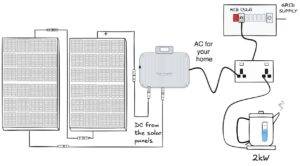
Microinverters take DC input from one or two panels. For plug-in solar, 800W microinverters are the standard — see our kit builder for all G98-confirmed models. They convert it to AC output with a voltage rating for local consumers. For example, in the UK, microinverters will output AC at 230V, and in the US, at 110V.
Here is an example of a microinverter. As you can see, its dimensions are small enough, and it comes with built-in clips that let you easily place it on the back of a solar panel.
Advantages of using microinverters:
- Complex Layouts: When solar panels in a single array cannot face the same direction, traditional wiring struggles. The Guide to the Installation of Photovoltaic Systems advises that:
“Where a system features multiple strings/arrays with significantly different orientation or inclination, the strings or arrays should be connected to an inverter with a multiple MPPT function or separate inverters should be utilised.”
In cases where strings are highly fragmented across more roof pitches than your inverter has MPPTs, microinverters bypass this limitation entirely by offering per-panel flexibility. - Shading Issues: If some panels in your array experience shading during parts of the day (due to trees, chimneys, or other obstructions), it can severely impact a traditional string. The authoritative Guide to the Installation of Photovoltaic Systems states:
“Shade makes a big impact on the performance of a PV system. Even a small degree of shading on part of an array can have a very significant impact on the overall array output.”
This is because, in a series string, a single shaded module’s reduced current can dictate the operating point of all other modules. Microinverters mitigate this problem by isolating the impact. As detailed in the NREL paper on Performance of PV Topologies under Shaded Conditions:“Module-level electronics, such as DC-DC converters and microinverters, mitigate the shading losses by isolating the shading impact to the shaded modules, allowing the unshaded modules to contribute their full power.”
- Scalability: Want to start small and expand your solar setup later? Microinverters make this easy. You can add more panels (each with its microinverter ) to the system without replacing or upgrading a central inverter. This ties in well with overpanelling strategies if you want to maximise generation from a limited roof area.
- Safety: Microinverters convert DC to AC right at the panel. This means high-voltage DC doesn’t travel across your roof, significantly reducing potential fire hazards. The Guide to the Installation of Photovoltaic Systems highlights this specific safety profile, noting that such module-level equipment:
“Connects only one module per inverter… [and] Does not exceed the voltages within the band of ELV (Not exceeding 50 V a.c. or 120 V ripple-free d.c. whether between conductors or to Earth.)”
- Monitoring: Many microinverters come with advanced monitoring capabilities. You can monitor the performance of each panel, making it easier to detect and address any issues.
- Longevity & Reliability: Microinverters often come with longer warranties than traditional string inverters (20-25 years vs. 10-15 years). According to the National Renewable Energy Laboratory’s Analysis of 100,000 solar systems:
“As has been reported before, inverters are the most common hardware problem for PV systems. The occurrences for residential systems are slightly lower than commercial- and utility-scale systems, possibly indicating more reliable inverters (microinverter or string inverters) or underreporting.”
Because microinverters decentralize the conversion process, a single unit failure only disables one panel, leaving the rest of the array operational. - Installation Simplicity & Expandability: Microinverters simplify the physical DC cable routing, which is attractive for smaller setups or DIY enthusiasts. Furthermore, their AC output can be fed directly as an additional source into the external “Generator” or “Aux” port of larger hybrid inverters. Expanding via the generator port is a highly effective way to upgrade your solar capacity when all the main DC MPPT inputs on your primary inverter are fully saturated.
 Configuring a hybrid inverter to take input from microinverters. Credit: USER MANUAL SUNSYNK-3.6K-SG01LP1 / SUNSYNK-3.6K-SG03LP1 / SUNSYNK-5K-SG01LP1 / SUNSYNK-5K-SG03LP1
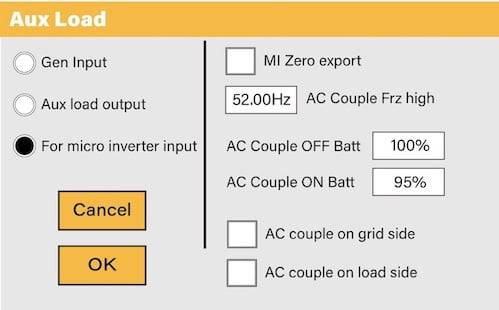 Configuring a hybrid inverter to take input from microinverters. Credit: USER MANUAL SUNSYNK-3.6K-SG01LP1 / SUNSYNK-3.6K-SG03LP1 / SUNSYNK-5K-SG01LP1 / SUNSYNK-5K-SG03LP1
When to avoid microinverters
Sometimes, you don’t need a microinverter; a simple string inverter will suffice. Another reason to avoid them is if access to the panels is difficult. For example, if you have to hire special equipment to reach your panels, you may regret placing the inverters near them in case of faults.
In order to comply with G98/G99 regulations in the UK, microinverter systems require monitoring device to commission the system. Furthermore, the monitoring device needs remain on site permanently.
Basic String Inverters
String inverters are straightforward and uncomplicated. They take various size strings of solar panels and convert DC to AC.
These inverters come in various sizes and capabilities and fit any budget and system of almost any size.
Their versatility and cost make them an indispensable building block in home solar energy systems.
To illustrate the versatility of these inverters, have a look at the string inverter product line from Growatt.
| Datasheet | MIC 750TL-X | MIC 1000TL-X | MIC 1500TL-X | MIC 2000TL-X | MIC 2500TL-X | MIC 3000TL-X | MIC 3300TL-X |
|---|---|---|---|---|---|---|---|
| Max. recommended PV power (for module STC) | 1050W | 1400W | 2100W | 2600W | 2800W | 3500W | 4290W |
| Max. DC voltage | 500V | 500V | 500V | 500V | 550V | 550V | 550V |
| Start voltage | 50V | 50V | 50V | 50V | 80V | 80V | 80V |
| Nominal voltage | 120V | 180V | 250V | 360V | 360V | 360V | 360V |
| MPP voltage range | 50V-500V | 50V-500V | 50V-500V | 50V-500V | 65V-550V | 65V-550V | 65V-550V |
If export income matters in your payback model, pair your inverter decision with the right Octopus export tariff strategy.
Source: Growatt Datasheet MIC750~3300TL-X
One of the highlights here is the low start voltage. Only 50V means you can have one or two panels and still produce AC. In contrast, many of the feature-rich hybrid inverters require at least 100V.
Of course, cost optimisation comes at the expense of some advanced features and conveniences. Some such features include advanced monitoring, complex configurations, or a built-in Battery Management System (BMS).
When Are Basic String Inverters Not For You?
Some of the lower power rating string inverters have similar ratings as microinverters. If space is an issue or you don’t have a place shielded from the elements, you are better off with a microinverter.
Additionally, if you plan to introduce batteries to your system, you should invest in a hybrid inverter straight away.
How to Select the Best Solar Inverter for UK Homes
Choosing the inverter requires careful evaluation of your requirements and constraints. It can be one of the most expensive single parts of a solar energy system. Therefore, future changes in these requirements and constraints must be considered as much as possible to predict.
Choosing an Inverter Based on Voltage
Inverters have two key voltage specifications worth noting – the start-up voltage and the maximum load voltage.
The startup voltage is the threshold that needs to be achieved by your solar array for the inverter to start producing AC. For example, if your invert’s start-up voltage is 125V and you have a string of three panels of 35V each connected in series. In optimal conditions, your solar array will reach a maximum of 105V, which is insufficient for the inverter. To rectify this, we need at least one more panel. Then, the combined voltage will be 140V, and the inverter will start producing AC.
The inverter specification lists the maximum voltage. It is essential to stay within it. The best value to aim for in the inverter specifications is the MPPT Voltage Range.

Exceeding the voltage can result in smoke or fire from your inverter. It is important to stay within the limit.
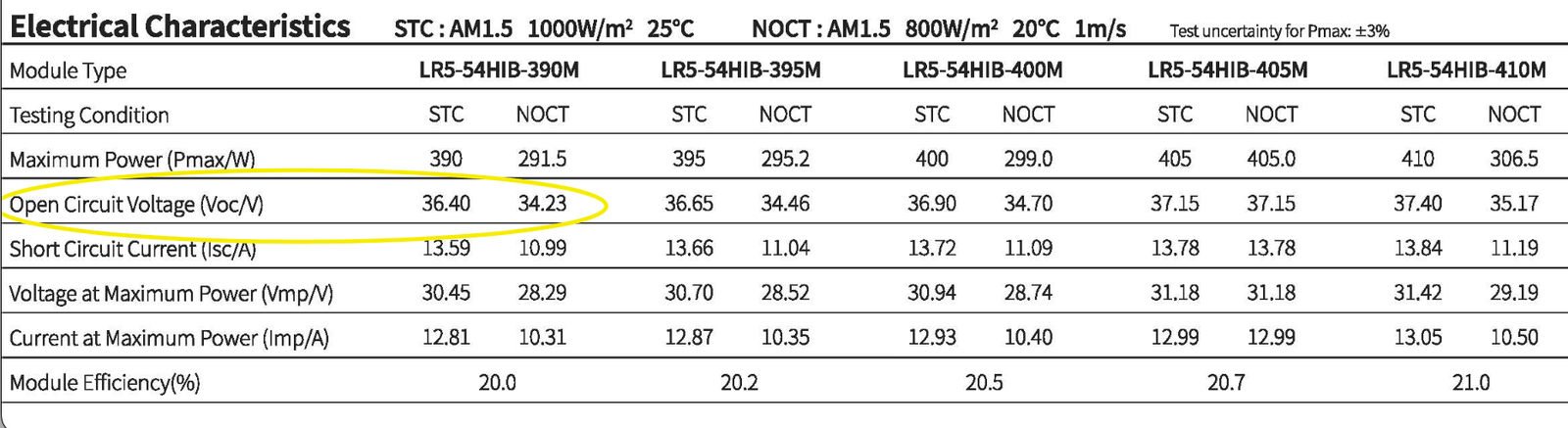
How do I Calculate the Voltage of My Array?
You need to take the technical specification of your panels and calculate the voltage based on the values there, and the size of your string and it’s connection specifics. See Solar String Expansion. Panels Connection Parallel vs Series for more details on how string voltage, current and power vary with the different connections.
What do I Choose First, the Inverter or the Panels?
The answer is it depends.
Suppose you have insufficient space for a large solar array, and your inverter’s main job will be to work with a large battery. In such a case, choose the inverter first.
On the other hand, if you are installing a large solar array or multiple string, the inverter must match that and the use cases you plan for this array.
Bear in mind that you cannot upgrade a solar inverter. Think strategically about potential future expansions, and it will pay off well.
Other Concerns When Choosing the Inverter
Except for the technical and practical aspects, there are also administrative and physical concerns.
UK Solar Inverter Regulations
In Britain, solar inverters must be registered with the local Distribution Network Operators (DNOs). DNOs are licensed companies that own and operate the network of towers, transformers, cables and meters that carry electricity from the national transmission system and distribute it throughout Britain. At the time of writing this article, DNOs can accept or refuse a request to connect a solar inverter to the grid. The process happens with notification forms G-98 and G-99. DNOs require inverters to be tested and accepted by the Energy Networks Association ENA – list of compliant devices .
When researching components for your system, always check that the inverter you picked is in the ENA list of compliant devices.
Solar Inverter Size and Space Requirements
Physical constraints such as suitable free space for your inverter can become challenging if not thought through early enough. Hybrid inverters are packed with components that generate heat or are sensitive to extreme conditions such as cold or direct sunlight.
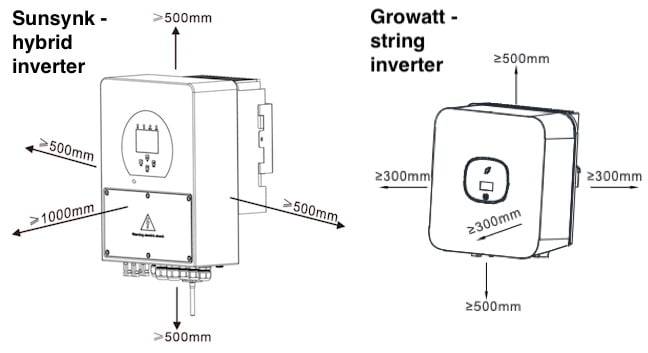
Most feature-rich hybrid inverters require a clear space of 40-50cm on each side of the inverter to ensure fresh air circulation to the cooling elements is not obstructed. Also, most cannot be installed directly outdoors without some degree of protection from the elements. Microinverters are way less demanding in that area.
Which Inverter Should I Choose?
If you are still unsure which solar inverter suits your home, run through this decision tree:
- Do you want battery storage now or in the future? Yes → Hybrid inverter.
- Is your roof heavily shaded or split across 3 or more orientations? Yes → Microinverters.
- Do you have a simple, unshaded south-facing roof and no battery plans? Yes → String inverter.
- Budget under £500? String inverter (GivEnergy Gen3 String at £530, Growatt MIN at £499).
- Budget £500-1,200? Hybrid inverter (Solis 3.6kW EH1 at £575, Fox ESS H1-5.0 at £848). These are among the best solar inverter options available for UK homeowners on a mid-range budget.
- No budget ceiling? Microinverters (Enphase IQ8HC at £156 per panel) or SolarEdge optimisers with a string inverter.
Conclusion
Choosing a solar inverter is a foundational decision that dictates your system’s capabilities for years to come. Microinverters offer panel-level optimisation and easy scalability for tricky roofs, while basic string inverters are the best choice on cost for straightforward arrays. Hybrid inverters, while costing more upfront, provide backup power features and battery integration.
Your ultimate choice must align with your immediate space constraints, power aspirations, and potential future add-ons, whilst adhering to strict local DNO regulations. Evaluate your environment carefully before pulling the trigger, and you’ll build a reliable home solar system that lasts.