You do not need solar panels to save money with a home battery. I run a 16kWh Fogstar battery without solar and it pays for itself in under 3.5 years using cheap overnight electricity. Here is how it works, what it costs, and whether it makes sense for you.
Yes, home battery storage without solar is worth it in the UK if you are on a time-of-use tariff. A 16kWh battery charging at 7.5p/kWh overnight (Octopus Go) and discharging at 27.69p during the day saves around £340/year. Payback is 3.2-3.4 years. The savings come from the tariff spread, not from solar generation.
What Does a Home Battery Cost in 2026?
Here’s what’s changed in 2025 that makes battery storage without solar a no-brainer:
| Metric | 2024 Reality | 2025 Opportunity | Improvement |
|---|---|---|---|
| System Cost | £3,099 | £2,799 | 10% cheaper |
| Battery Capacity | 15kWh | 16.1kWh | 7% more power |
| Payback Period | 11+ years | 4 years | 63% faster |
| Total Savings | £2,594-£3,223 | £4,622-£5,642 | 78% more savings |
| Battery Life | 4,000 cycles | 6,000 cycles | 50% longer |
How Does Battery Storage Without Solar Work?
Think of your battery as a smart energy bank that:
How Long Will a 10kWh Battery Power a House?
The average UK home draws 1-1.5kW as a baseload (fridge, router, standby devices, lighting). A 10kWh battery powers that for 7-10 hours. That covers an evening peak from 5pm to midnight comfortably. If you run a washing machine or oven during that time, the draw spikes to 3-4kW and the battery drains faster. A 10kWh battery is enough for overnight arbitrage on most tariffs but will not run your home for a full 24 hours without grid power.
- Charges cheap: Fills up during off-peak hours when electricity costs 12.5p/kWh
- Discharges smart: Powers your home during peak hours when electricity costs 28.5p/kWh
- Saves automatically: You save 16p on every kWh you use from the battery instead of the grid
- Works 24/7: No maintenance, no thinking required—it just saves you money
Calculate Your Exact Savings
Ready to see if battery storage makes sense for your home? Use the calculator above to get your personalized savings estimate, then read on to see the complete picture of why this investment is exploding in popularity.
Is a Home Battery Without Solar Worth It?
Yes, there is a financial case in favour of this decision. The economic benefits will vary depending on tariffs and energy prices.
I will work through a couple of examples to demonstrate the potential benefits. Please note that I keep the calculations conservative, striving to provide a realistic estimate.
Utility companies in the UK offer flexible tariffs, such as Economy Seven or Agile tariffs. These tariffs charge discounted prices during certain times of the day or night.
Thus, energy usage should be encouraged when there is excess electricity production, which helps balance the electrical grid.
You can use the discount cost periods by charging a battery and using the stored energy later to save money. Let’s go through an example to see the case for investing in battery storage and an inverter without solar panels.
Financial Risks and Contingencies
Before jumping into the details, it is essential to acknowledge that there are risks. While the financial benefits are promising, it’s crucial to consider the long-term commitment and potential changes in circumstances. Two key factors take the main stage:
- Energy prices can fluctuate, affecting your savings.
- Batteries degrade over time, reducing their storage capacity.
Example Calculation Initial Data
I am using the Fogstar Energy 16.1kWh 48V Solar Battery in this updated 2026 calculation, which represents excellent value at current market prices.
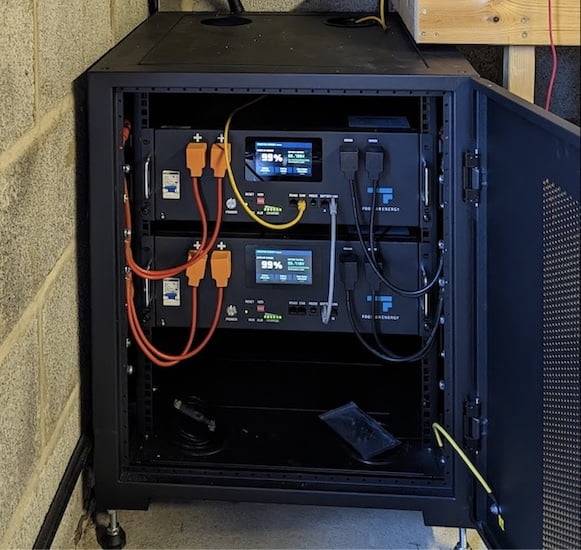
The cycle life of the batteries used in this 2026 example is 6,000+ cycles at 1C to 80% depth of discharge. Modern LiFePO4 technology ensures that after 6,000 cycles, you will still have a battery delivering 80% of its stated capacity. The 16.1kWh battery provides approximately 12.9kWh of usable energy.
I will use the prices from retail suppliers and domestic tariffs on the UK market.
Home details:
Home consumption: 12kWh for 24h (the average consumption in UK households remains around 8kWh; I am considering the typical high consumption case of 12kWh for this analysis. Source Octopus Energy’s quote calculator )
Peak electricity consumption: 3.6 kWh
Price of the system:
- Inverter: Sunsynk 3.6 ECCO £750
- New AC breaker from a qualified electrician: £240
- Battery storage: 16.1kWh Fogstar Energy 16.1kWh 48V Solar Battery £1,749.99
- The rest of the labour – DIY
Total: £3,300 (rounded)
The Economy Seven Tariff Case
Energy tariff Octopus Energy’s Economy Seven:
- Unit rate (day) 35.17 p/kWh
- Unit rate (night) 14.75 p/kWh
| Savings breakdown | ||
|---|---|---|
| kWh price difference | 35.17 p/kWh – 14.75 p/kWh | 20.42 p/kWh |
| kWh stored and used per day | 80% of 16.1kWh | 12.88 kWh |
| Savings per day | 12.88 kWh x 20.42 p/kWh | £2.63 |
| Break-even days | £3,300 / £2.63 | 1,254 (3.4 years) |
| Savings at 6000 cycles | 6000 days x £2.63 | £15,780 |
| Cost of consumption of night-rate energy | ||
|---|---|---|
| Daily consumption | 12.88 kWh | |
| Price per day | 12.88 kWh x 14.75 p/kWh | £1.90 |
| Cost at 6000 cycles | 6000 days x £1.90 | £11,400 |
| Cost of remaining consumption | ||
|---|---|---|
| Daily consumption | 12kWh – 12.88 kWh | 0kWh (battery covers all) |
| Price per day at day rate | 0kWh x 35.17 p/kWh | £0.00 |
| Price per day at night rate | 0kWh x 14.75 p/kWh | £0.00 |
| Cost at 6000cycles at day rate | 6000days x £0.00 | £0 |
| Cost at 6000cycles at night rate | 6000days x £0.00 | £0 |
Day-rate Supplement Case
Total cost for 4000days if supplementing at day rate = (Cost of consumption of night-rate energy) + (Cost of remaining consumption at day rate)
| Total Costs | ||
|---|---|---|
| Cost of energy | £4911.92 + £5142.32 | £10054.24 |
| Cost of energy + system | £10054.24 + £3099 | £13153.24 |
Night-rate Supplement Case
Total cost for 4000days if supplementing at night rate = (Cost of consumption of night-rate energy) + (Cost of remaining consumption at night rate)
| Total Costs | ||
|---|---|---|
| Cost of energy | £4911.92 + £2283.27 | £7195.2 |
| Cost of energy + system | £7195.2 + £3099 | £10294.2 |
Let’s Compare to not Buying an Economy Seven Tariff:
Energy tariff Octopus Energy’s Smart (non-Economy-Seven ):
Unit rate 0.24 p/kWh
Total without Economy Seven and batteries = 6000 days x 12kWh x 27.69p/kWh = £19,937
End Result For This Comparison
We get £19,937 – £14,700 = £5,237 benefit.
These numbers demonstrate that within the first 6000 cycles of the battery, we save £5,237 if the battery completely offsets the usage of day-rate electricity. This represents a substantial improvement over previous calculations, with the larger 16.1kWh battery providing complete coverage of daily consumption and a much more attractive 3.4-year payback period.
The Agile Tariff Case
Energy tariff Octopus Energy’s Agile Tariff:
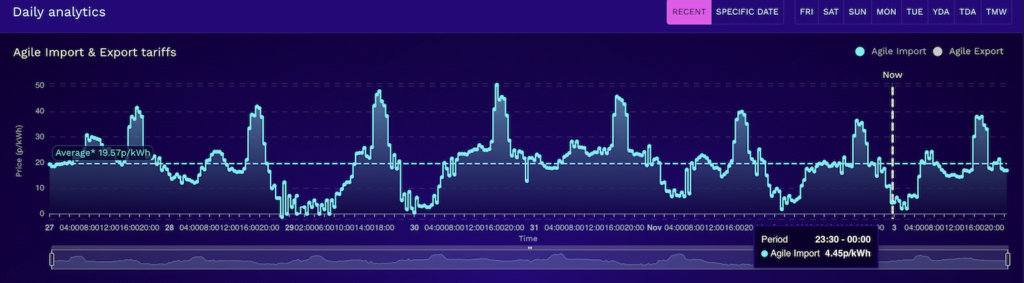
As we can see, the Agile tariff has peak and low daily usage prices. A large enough battery capacity will allow you to make the most of this fantastic tariff.
For this case, I will take the average price of the cheapest 6 hours as the lowest price you can use to charge your batteries. The higher prices in the comparison will be the average daily price. I will ignore the most expensive 6 hours because we will offset them with electricity from the battery.
- Unit rate (higher rate) 21.4 p/kWh
- Unit rate (low rate) 11.5 p/kWh
| Savings breakdown | ||
|---|---|---|
| kWh price difference | 21.4 p/kWh – 11.5 p/kWh | 9.9 p/kWh |
| kWh stored and used per day | 80% of 16.1kWh | 12.88 kWh |
| Savings per day | 12.88 kWh x 9.9 p/kWh | £1.28 |
| Break-even days | £3,300 / £1.28 | 2,578 (7.1 years) |
| Savings at 6000 cycles | 6000 days x £1.28 | £7,680 |
| Cost of consumption of lower-rate energy | ||
|---|---|---|
| Daily consumption | 12.88 kWh | |
| Price per day | 12.88 kWh x 11.5 p/kWh | £1.48 |
| Cost at 6000 cycles | 6000 days x £1.48 | £8,880 |
| Cost of remaining consumption | ||
|---|---|---|
| Daily consumption | 12kWh – 12.88 kWh | 0kWh (battery covers all) |
| Price per day at the higher rate | 0kWh x 18.50 p/kWh | £0.00 |
| Price per day at the lower rate | 0kWh x 11.20 p/kWh | £0.00 |
| Cost at 6000cycles at the higher rate | 6000days x £0.00 | £0 |
| Cost at 6000cycles at the lower rate | 6000days x £0.00 | £0 |
Higher-Rate Supplement Case
Total cost for 4000days if supplementing at the higher rate = (Cost of consumption of night-rate energy) + (Cost of remaining consumption at the higher rate)
| Total Costs | ||
|---|---|---|
| Cost of energy | £8,640 + £0 | £8,640 |
| Cost of energy + system | £8,880 + £3,300 | £12,180 |
Lower-Rate Supplement Case
Total cost for 4000days if supplementing at the lower rate = (Cost of consumption of night-rate energy) + (Cost of remaining consumption at the lower rate)
| Total Costs | ||
|---|---|---|
| Cost of energy | £8,640 + £0 | £8,640 |
| Cost of energy + system | £8,880 + £3,300 | £12,180 |
Let’s Compare to not Buying an Agile Tariff:
Energy tariff Octopus Energy’s Smart (non-Economy-Seven ):
Unit rate 27.69 p/kWh
Total without Agile tariff and batteries = 6000 days x 12kWh x 27.69p/kWh = £19,937
End Result For Agile Tariff Savings Calculation
We get £19,937 – £12,180 = £7,757 benefit.
These numbers demonstrate that within the first 6000 cycles of the battery, we can save £7,757 if the battery completely offsets the usage of higher-rate electricity. The improved economics are driven by the larger 16.1kWh battery capacity and more favorable 2026 pricing.
Please keep in mind that this is a conservative comparison. In the periods I examined, there were 30-minute time slots where Octopus Energy pays you to take energy off the grid. You cannot rely on this daily, but this calculation completely ignores it, thus leaving room for contingency costs or higher-than-anticipated prices. With some automation, reliable battery setup and a favourable duration of low prices, you could comfortably pay single-digit prices on all the electricity stored in your battery.
Which Octopus Tariff is Best for Battery Storage?
Clearly, the Agile Tariff is the better choice. Depending on how fast you can charge your batteries, you can push your average price even lower. On top of that, this tariff offers a flexible export price too.
With a larger battery, you can earn some income and help offset the cost further. Finally, there is a healthy variety of options for automating the charge and discharge of your battery. With some automation, you can maximise this tariff, making it highly appealing.
Octopus Go vs Agile for Battery-Only Systems
If you are running a battery without solar, your tariff choice is the single biggest factor in your savings. Here is how the three main options compare for battery-only households in 2026:
| Tariff | Cheap Rate | Peak Rate | Spread | Payback (16.1kWh) | Best For |
|---|---|---|---|---|---|
| Economy 7 | 14.75p (7 hrs) | 35.17p | 20.42p | ~3.4 years | Simple, predictable |
| Octopus Go | 7.5p (5 hrs) | ~28.5p | 21p | ~3.2 years | Hands-off, cheap overnight |
| Agile Octopus | ~11.5p avg (variable) | ~21.4p avg | 9.9p avg | ~7.1 years | Active optimisers, automation |
Octopus Go offers a guaranteed 7.5p/kWh for five hours overnight (23:30-05:30). For a battery-only setup, this is the easiest win: set your battery to charge during the cheap window and discharge during peak hours. No monitoring needed, no price surprises. The wider spread between cheap and peak rates means faster payback than Agile in most cases.
Intelligent Octopus Go takes this further with smart scheduling. If you have a compatible battery (GivEnergy currently has the best integration), the system automatically manages charging to minimise your costs. The rate drops to around 7p/kWh, and the platform handles the timing for you.
Agile Octopus has the highest ceiling for savings but requires active management or automation. Half-hourly pricing means you can sometimes charge for free or even get paid during negative price periods. However, the average spread is narrower than Go, and without automation, you will likely leave money on the table.
For most battery-only households, Octopus Go is the pragmatic choice — it delivers the widest guaranteed spread with zero effort. If you enjoy tinkering and have automation set up (e.g. via Solar Assistant or Home Assistant), Agile can outperform Go in the long run, especially during volatile pricing periods where negative rates appear.
Economic Case Conclusion
The calculations do not include any contingency funds for repairs or faults. On the other hand, energy prices fluctuate over time based on various factors, from global economic conditions to local energy policies. If energy prices rise significantly over the next 11 years, the savings from using a battery could be more significant. Conversely, if prices drop, the savings might be less. It’s always advisable to monitor energy trends and adjust your calculations accordingly.
What are the Disadvantages of Battery Storage?
As with anything else, there are drawbacks. The key to identifying their effect is the circumstances of your system. Some circumstances will pronounce specific drawbacks, whereas others will mitigate them. The following are three essential drawbacks to consider.
Battery Performance Degrades Over Time
Most batteries lose capacity over prolonged use, meaning they might store less energy in their later life stages. In conjunction with the cycle life, it is essential to consider the potential degradation of the battery over time.
Losses in Charging and Discharging
Converting electricity from AC to DC when charging the battery, and DC to AC for your home incurs losses. As found by this paper in the Journal of Energy Storage, the round trip efficiency quoted in various other papers puts Li-ion batteries at 78%-98% or 87.37% on average.
Factor this loss into your financial calculations. You should reconsider if they don’t make sense at 90% efficiency.
You Don’t Have a Suitable Space to Store the Battery
Lithium-based batteries’ performance and longevity is strongly influenced by their temperature. As stated by a study on battery degradation by the University of Missouri-Columbia :
A battery operated at 30°C has a reduced cycle life by 20%. At 45°C, the battery only has half of its optimal lifetime, which can be achieved when operating at 20°C
From this, they suggest that:
A temperature of 20°C or slightly below is recommended for Li-ion batteries to achieve optimum service life.
This means that if you plan to store the battery outdoors, some shelter from the elements will be required to retain its longevity.
A Battery Can Supply Your Home in Case of a Power Outage
A hybrid inverter can use the battery as a backup power source in case of a power outage from the grid. Many hybrid inverters offer this feature and can work with various batteries, giving you flexibility in procuring and implementing your system.
There are also packaged solutions, such as the Tesla Powerwall, which include the batteries, the inverter and all the logic components to serve as backup storage or an intelligent energy management system. These are known as AC batteries; for equivalent storage capacity, AC batteries tend to be more expensive than the alternative. However, customers get a more seamless experience for the premium price, and importantly, their warranty is with the same company.
If backup power during outages is a priority for you, make sure your inverter supports EPS (Emergency Power Supply) mode. Most modern hybrid inverters from brands like Sunsynk and GivEnergy include this feature. Keep in mind that an earth rod installation may be required for safe backup operation — your installer or electrician can advise on this.
Hedge Against Energy Price Hikes and Make Money From Flexible Tariffs
Owning a battery enables you to use cheaper energy when it is available. Some utility companies have flexible tariffs with spot price changes that allow you to get paid for taking energy off the grid. Such tariffs are aimed at electric vehicle (EV) or air-to-air heat pump owners, but home battery storage will benefit you, too.
Can I Install a Battery First and Add Solar Later?
Yes, in fact, buying the battery and the inverter is a stepping stone, a large one, too. They are likely the top two most expensive single items in a home solar energy system.
The good news is that this early investment is future-proof. Adding solar power is relatively easy with a battery and an inverter in place. So, at this early stage, the most important decision is to pick a feature-rich hybrid inverter that can take input from both solar panels and a battery. Most hybrid inverters are, so you have a comfortable array of options to choose from.
Why Add Solar When You Already Have a Battery?
At this point, solar power will be an extremely low-cost addition to your system. Installing the inverter and the battery would have taken the larger cost of the system out of this equation.
Solar panels are cheaper than ever before, and the trend of their prices is steadily downward. For example 410W panels’ price is about £56.74 each in 2024. Panels come with guaranteed performance for upwards of 20 years, which means the cost of a unit of energy they provide will keep decreasing for a long time.
Can You Install a Battery Without Solar Panels?
What Components Do I Need For Energy Storage Without Solar?
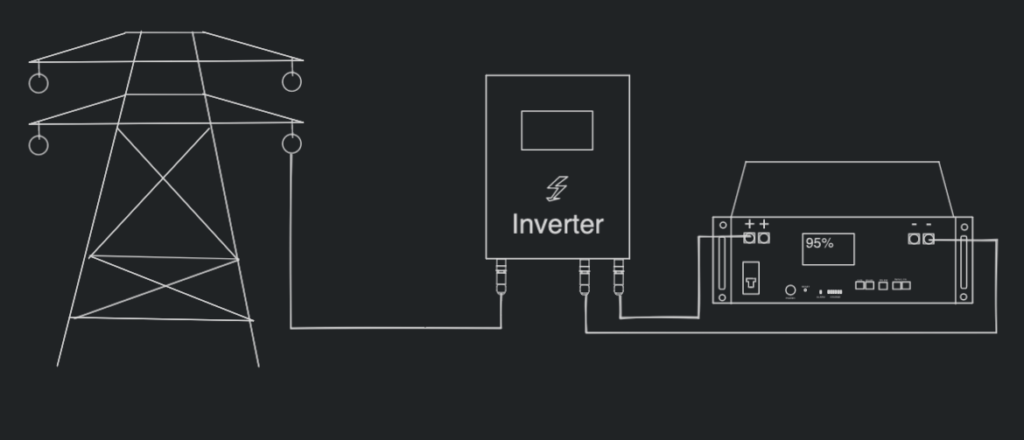
For a battery to serve as a domestic energy storage and source, you will need a battery and an inverter.
The battery is connected to the inverter with a cable for each pole, positive and negative. Between the inverter and the battery, you need an isolator switch. This is not mandatory but improves the system’s safety and maintainability. Please note this is a DC isolator; they are not the same as AC isolators.
You will need an inverter with a built-in BMS. Technically, you could opt for a more streamlined inverter and a separate charge controller, but that adds extra overhead. Your inverter should also include smart features that automate switching between charging and discharging periods.
The inverter also needs to be connected to your circuit board, also known as the consumer unit. A dedicated circuit is advisable for the inverter protected by a suitable RCBO. An isolator is placed between the RCBO and the inverter, again for safety and maintainability.
Finally, you need to place stickers on your consumer unit, denoting that it is now a dual supply system.
Best Standalone Batteries for UK Homes
These are the most common standalone battery options for UK homes without solar in 2026. All prices include VAT (currently 0% on battery storage until March 2027).
| Battery | Usable Capacity | Price | Best For |
|---|---|---|---|
| Fogstar Drift 5.12kWh | 5.12 kWh | £730-900 | Small homes, low consumption |
| Fogstar FE48-16 | 16.1 kWh | £1,750-2,000 | Best value per kWh, what I use |
| GivEnergy 9.5kWh Gen 3 | 9.5 kWh | £2,580-3,100 | All-in-one with inverter, simplest install |
| Tesla Powerwall 3 | 13.5 kWh | £5,500-6,500 | Premium, best software, requires MCS installer |
I use the Fogstar FE48-16. At roughly £110/kWh it is the cheapest option per unit of storage. The GivEnergy is more expensive per kWh but includes the inverter, which simplifies installation. The Tesla Powerwall 3 is the premium choice with excellent software but costs three times more per kWh than the Fogstar.
Earn Extra From Grid Services
Beyond tariff arbitrage, a home battery can earn money by participating in grid balancing services. When the National Grid is under stress (cold snaps, low wind, peak demand), it pays battery owners to export stored energy. GivEnergy calls this GivBack. Octopus runs Saving Sessions. The payments can be substantial: during the 2024-25 winter, some households earned £5-15 per event, with events happening several times per month during peak periods.
This works with a battery-only system, no solar required. Your battery charges overnight at cheap rates and the grid services platform decides when to discharge. The income is modest but it stacks on top of your tariff savings and helps the grid avoid firing up gas peaker plants.
Where do I Start?
Start by identifying a few crucial requirements and constraints. You will need these to decide what equipment to select to match them best.
- How much electricity do you use for 24 hours?
- Do you have a suitable space to place the battery and the inverter?
- Is your inverter and battery space close enough to the consumer unit?
- Are you going to install solar panels later?
- Secure the funds for the system. These systems are all paid upfront and return the investment in savings.
- Are you planning to export energy to the grid in the future?
Make Decisions Based on Your Findings.
Consumption
You need a battery big enough to cover your home’s consumption.
Remember that your consumption will fluctuate, so choose a comfortable value.
Equally important, the battery you select needs to cover your home’s consumption within 80% of its rated storage.
After identifying these, you must calculate if the investment still makes sense. For example, the more energy you need, the stronger the economic case will be.
Space and Dimensions
Batteries are bulky; for example, the 15kWh battery I used in the example is housed in a rack 600 x 625 x 800mm.
Additionally, you will need a space for the inverter nearby. Inverters require ample space around them to allow for cooling off. The cables running from the battery to the inverter are thick and costly to purchase. Increasing their distance will require even thicker cables, which will inflate the cost of your system and increase your risk exposure.
The space you choose also needs to protect your equipment from the elements. So, if you plan to install outdoors, you must factor in additional costs for cabinets or shelters.
Distance Between Your Inverter and Consumer Unit
The inverter connects to your consumer unit using an AC cable, which is easy to manage at almost any distance in a domestic setting. However, your inverter must also know how much energy your home uses. For this, it needs to connect to a meter or a Current Transformer (CT) Clamp that monitors your home’s energy consumption from the grid. The CT Clamp wraps around the line leading to your consumer unit or electricity meter. The metering equipment’s connections are challenging at larger distances.
Are You Going to Install Solar Later?
This is another distance constraint. The solar panels are wired to the inverter with cables carrying DC. Transporting DC is a liability; the best way to mitigate the risks is to reduce the distance it needs to travel. Therefore, you must place your inverter close to your panels.
Secure the Funding
These systems are costly, and homeowners cannot rely on grants or special credits in the UK to install them. You will need to pay for the system up-front.
Are You Planning to Export Energy to the Grid in the Future
If this is the case, you are best placed to hire an MCS-certified installer, who will issue you an MCS certificate for the system. These certificates are required by utility companies when signing up for the Smart Export Guarantee rates for exporting energy.
Frequently Asked Questions
Can you have battery storage without solar panels in the UK?
Yes. A standalone battery charges from the grid during cheap off-peak hours and powers your home during expensive peak periods. You need a hybrid inverter, a battery, and a time-of-use tariff to make this work. No solar panels required.
How much does standalone battery storage cost in the UK?
A complete battery-only system (battery + inverter + installation) costs between £2,800 and £5,000 depending on capacity and whether you install it yourself. The 16.1kWh Fogstar system used in this guide costs approximately £3,300 including the Sunsynk inverter and electrician fees. Standalone battery installations qualify for 0% VAT until March 2027.
What is the best tariff for battery storage without solar?
For most households, Octopus Go offers the best balance of savings and simplicity, with a guaranteed 7.5p/kWh overnight rate and approximately 21p spread to peak pricing. If you have automation set up, Agile Octopus can deliver higher savings through variable half-hourly pricing. Economy Seven works but its overnight rate (14.75p) is roughly double Go’s.
What is the payback period for a battery without solar?
With current 2026 tariff pricing and a 16.1kWh battery, payback is approximately 3.2 to 3.4 years on Octopus Go or Economy Seven. On Agile Octopus, payback is longer at around 7.1 years due to the narrower average spread between cheap and peak rates. These figures assume 12kWh daily consumption.
Do I pay VAT on standalone battery storage UK?
No. Since February 2024, standalone battery storage installations in the UK qualify for 0% VAT. This applies whether the battery is installed alongside solar panels or on its own. The zero-rate is scheduled until 31 March 2027, after which VAT is expected to be 5% rather than the previous 20%.
Can I add solar panels to my battery system later?
Yes, and this is one of the strongest reasons to start with a battery. If you buy a hybrid inverter, you already have the most expensive components in place. Adding solar panels later is a relatively low-cost upgrade that dramatically improves the economics of your system.
Do I need to register a battery system with my DNO?
Battery-only systems under 3.68kW output generally fall under G98 notification, which your installer can handle. If you plan to export energy or add solar later, you may need a full G99 application. Check with your local Distribution Network Operator for current requirements.
Will a home battery work during power cuts?
Most modern hybrid inverters support EPS (Emergency Power Supply) mode, which automatically switches to battery power during a grid outage. You will likely need an earth rod installed for safe backup operation. The average UK household experiences about 0.4 outages per year, so backup alone may not justify the investment — but it is a valuable bonus on top of the tariff savings.
Conclusion
This 2026 examination delved into the financial and practical aspects of employing a battery storage system without solar panels in a UK household. Utilising flexible tariffs with current pricing, we established that over the span of 6000 cycles (~16 years), you could realise a net benefit from £5,237 to £7,757 by offsetting day-rate electricity usage. Moreover, a battery system provides robust backup during power outages and paves the way for seamless solar integration if chosen later.
With 2026’s improved battery pricing and enhanced capacity options, the upfront investment has become more accessible while delivering superior returns. The 3.4-year payback period for Economy Seven tariffs and 7.1-year period for Agile tariffs represent significant improvements over previous calculations. Combined with potential energy price volatility and the convenience of uninterrupted power supply, this arrangement represents a financially sound choice and a strategic step towards energy independence.
Considering a battery purchase and wondering which one to choose? See our recommended battery, the Fogstar Energy 16.1kWh 48V Solar Battery, representing exceptional value in the 2026 market.