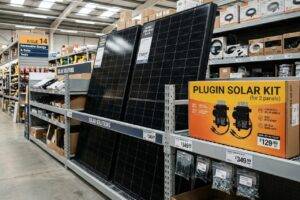
On 16 March 2026, the UK government confirmed it will legalise plug-in solar. This guide gives you the practical version: what is confirmed, what is still pending, and what to check before buying any kit.
Where things stand right now
The wattage limit has not been officially set yet in the UK. But we expect it will be 800W AC, which is the current standard in Germany. Approved products are expected in supermarkets once regulations are finalised. Buying now holds risk and opportunity. See our plug-in solar buying guide for what to check before you spend.
What Are Plug-in Solar Panels?
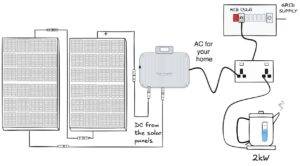
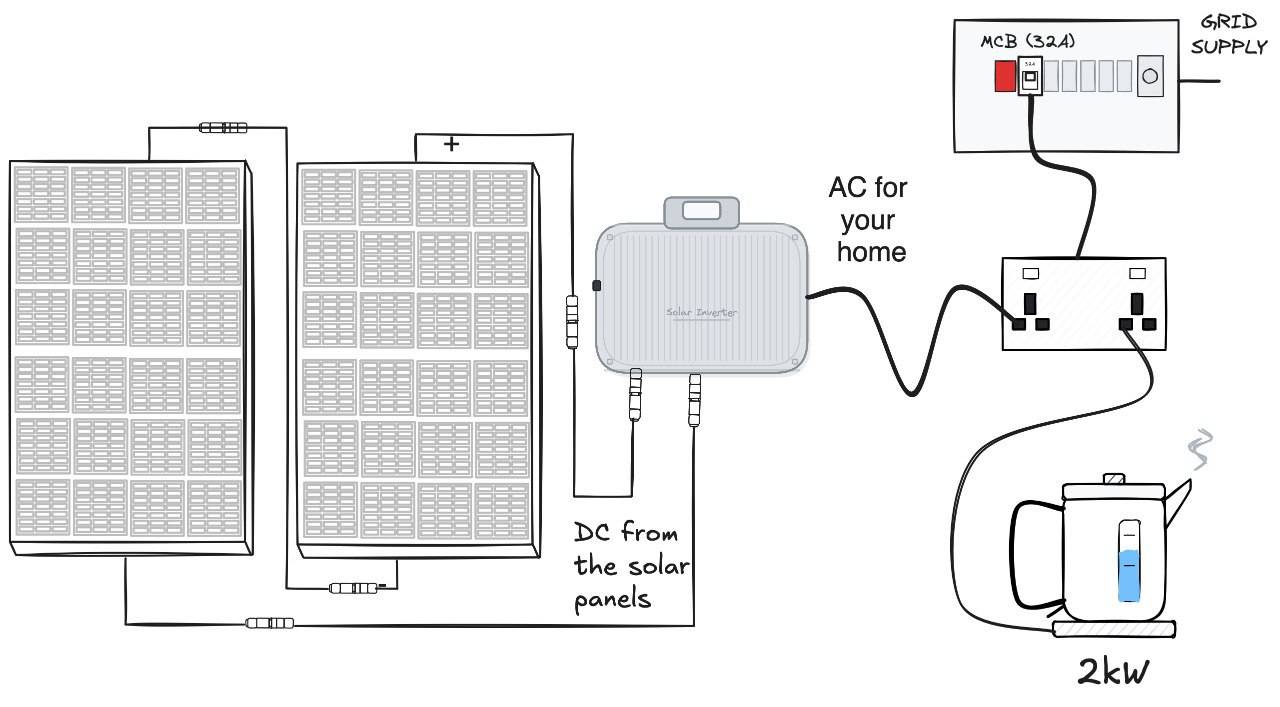
A plug-in solar system (sometimes called a balcony solar kit or Balkonkraftwerk in German) is a simple unit: one or two solar panels, a microinverter built into the cable, and a plug at the end. You set the panels up outside, point them at the sky, and plug the cable into a socket. The microinverter converts the DC electricity from the panels into AC at 230V, which feeds directly into your home circuit.
The panels used in plug-in kits are the same monocrystalline panels used on rooftops, just fewer of them. A typical 800W kit uses two panels in the 400-450W range. You can browse the full range of panels available in the UK in our solar panel directory, which lists specs, prices, and Voc/Isc values for over 70 models.
Want the simple version? Our practical guide to how plug-in solar works covers the step-by-step process, what 800W can power, and where to put the panels — without the regulatory detail.
That electricity is consumed by whatever is running in your home at the time. If you have a fridge, a TV, and a router all drawing power, the solar generation offsets a portion of that load. Your meter spins more slowly, or if generation briefly exceeds consumption, spins backwards (or on a smart meter, records a small export). You are not storing anything. There is no battery. You are simply reducing how much you pull from the grid while the sun is out.
The panels can go on a balcony rail, leaned against a garden wall, mounted on a flat roof, or propped up on a south-facing window ledge. They are designed to be portable. When you move out, you take them with you.
Across Europe, millions of these systems are already in use. Germany alone had over 800,000 registered plug-in solar installations by early 2025, rising to 1.15 million by June 2025, collectively generating over 1 GW of peak power. That is equivalent to the output of a large gas power station, built entirely by individual households buying kits from supermarkets and hardware stores. The technology is not new or experimental. What has been missing in the UK is a legal framework to use it safely with British wiring.
What Did the Government Actually Announce?
The announcement from DESNZ on 16 March 2026 confirmed two things. First, the government intends to change the regulations that currently prevent plug-in solar from being connected to the UK grid. Second, it will work “at pace” with regulators and industry to finalise the technical standards. The full statement is available at the GOV.UK energy security announcement.
What the announcement is not: a law change. The wiring regulations update (Amendment 4) is confirmed for 15 April 2026, but the product standard that will certify specific plug-in solar kits for the UK market has not yet been published. That is expected around July 2026.
The decision rests substantially on a safety study commissioned from Arceio Limited in October 2025 (contract value: £80,309, award notice). That study examined the risks of plug-in solar on UK ring-main circuits and apparently concluded the risks are manageable with appropriate product standards. The findings are expected to be published alongside or before the final regulations.
The regulatory timeline is now clear: BS 7671 Amendment 4 publishes on 15 April 2026 (confirmed by the IET and BSI on 15 January 2026). The BSI product standard for plug-in solar devices is expected around July 2026. That July date comes from industry bodies, not DESNZ, so treat it as a working estimate for the product standard specifically.
Plug-in solar is part of the government’s Clean Power 2030 Action Plan and Solar Roadmap, which target 47 GW of solar capacity by 2030. It will not get there alone, but removing barriers for renters and flat owners opens a market of millions of households that rooftop solar cannot reach.
Key Dates to Watch
16 March 2026. Done
Energy Secretary Ed Miliband announced the government will legalise plug-in solar. Policy intent confirmed, not a law change. GOV.UK announcement
1 April 2026. Upcoming
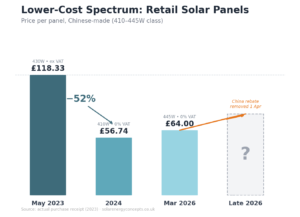
China removes the 9% VAT export rebate on solar panels. This matters for plug-in solar because the kits sold in Germany use Chinese-made panels and microinverters. When UK-certified kits hit the shelves later in 2026, they will reflect these higher input costs. Battery add-ons (like the Zendure SolarFlow) will also cost more as the rebate phases out through 2027.
15 April 2026. Confirmed, 3 weeks away
The UK wiring regulations update (BS 7671 Amendment 4) publishes. This is the rule change that makes plug-in solar legally possible. Without it, no manufacturer can certify a kit for the UK market. Here is what it changes and why it matters for you:Chapter 702 (Stationary Secondary Batteries) introduces rules for electrical energy storage systems, directly relevant to plug-in solar kits with integrated batteries like the Zendure SolarFlow or EcoFlow Stream Ultra X.Chapter 708 (generating sets) updates the rules for connecting generation equipment to domestic circuits. This is the framework that the BSI product standard for plug-in solar will reference.Amendment 4 does not legalise plug-in solar by itself. The BSI still needs to publish the product standard (expected July 2026) that defines exactly which devices are approved and how they must be tested. But without Amendment 4, there would be no regulatory basis to build on.
July 2026. Expected (industry estimate)
BSI (British Standards Institution) expected to publish the UK product standard for plug-in solar. This is the milestone that matters for consumers: once this standard is published, manufacturers can certify their products and retailers can stock them. This is when you will be able to legally buy and connect a plug-in solar kit.
15 October 2026. Scheduled
BS 7671 Amendment 4 transition period ends. After this date, all new electrical work must comply with the updated wiring regulations. For plug-in solar, this means any kit sold in the UK after October 2026 must be compatible with the Chapter 708 requirements. If you buy a kit between July and October, check that it meets Amendment 4 standards, not just the older edition.
March 2027. Scheduled
0% VAT on energy storage systems currently set to expire. If you are considering a plug-in solar kit with battery storage (like the Zendure SolarFlow or EcoFlow Stream Ultra X), buying before March 2027 saves you 20% on the battery component. No confirmation yet on whether the relief will be extended.
What the April 2026 Rule Change Means for You
On 15 April 2026, the UK wiring regulations get their biggest update in years (BS 7671 Amendment 4). This does not make plug-in solar legal on its own. you still need the product standard from BSI, expected in July. But without this update, plug-in solar could not happen at all. Here is what changed and why it matters if you are planning to buy a kit:
1. You will be able to plug solar into a socket. Today, the rules say every solar system must be hard-wired by an electrician on its own circuit. That is what makes plug-in solar illegal right now. The April update introduces new rules (Chapter 708) for connecting small generators. including solar. alongside the grid. This is what allows BSI to approve plug-in kits for the first time.
2. Battery add-ons get proper safety rules. The best plug-in solar kits include a small battery (1-4 kWh) to store daytime generation for evening use. Until now, there were no dedicated UK wiring rules for home batteries. electricians followed manufacturer guides. The April update introduces Chapter 702, which sets clear requirements for battery protection, fire safety, and installation standards. This means certified battery kits will be safer and more consistent when they reach the shelves.
3. Registration should be simpler. Currently, connecting any generation to the grid requires an electrician to notify your local network operator (a process called G98). The expectation is that plug-in systems under 800W will get a much simpler process. potentially just an online form you fill in yourself. This has not been confirmed yet, but the regulatory framework now supports it.
4. Your kit must shut down instantly if unplugged. Any approved plug-in solar inverter will be required to cut power within 0.1 seconds of being disconnected, and the plug pins must become safe to touch within one second. This is a non-negotiable safety requirement that every certified kit will meet. It is why you should wait for UK-approved products rather than buying uncertified imports now.
5. Everything must be compliant by October. Between April and October 2026, both old and new rules are valid. After 15 October, only the new rules apply. If plug-in solar kits reach the market in July as expected, they will be built to the new standard from day one. For you as a buyer, this means any kit from a reputable retailer after July should already be fully compliant. you do not need to check this yourself. Sources: IET, Elec Training. Sources: IET Amendment 4 overview, Elec Training detailed breakdown.
Why Was Plug-in Solar Illegal in the UK?
This is not a case of bureaucratic foot-dragging. There is a genuine technical difference between UK wiring and the European systems where plug-in solar already works.
The UK uses ring-main circuits (BS 1363, 13A). A ring main connects multiple sockets in a loop back to the consumer unit. That design means multiple high-draw appliances can all sit on the same circuit. In continental Europe, radial circuits (Schuko, 16A) run from consumer unit to a single socket group. The stacking risk is lower.
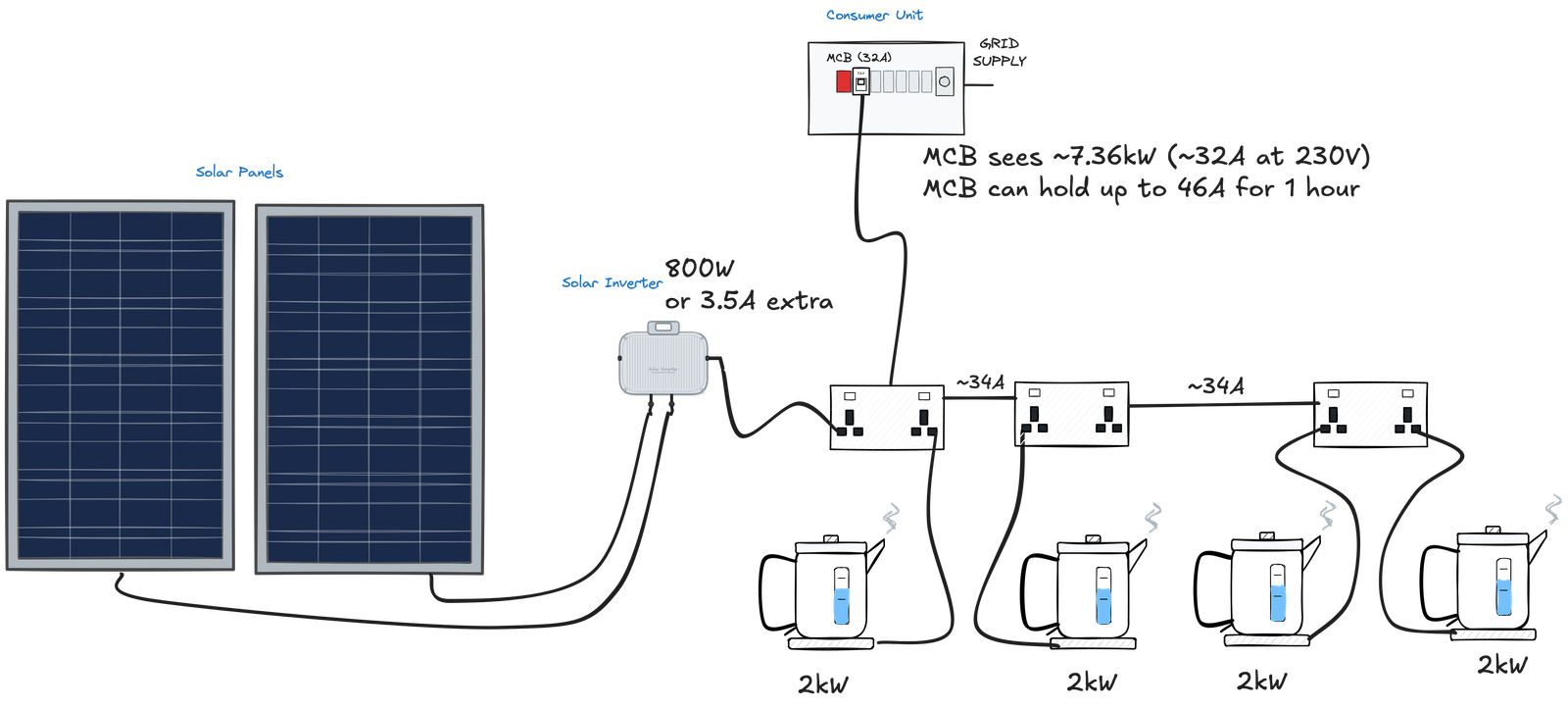
When you plug a solar inverter into a ring-main socket, it feeds electricity back into that circuit. If several high-load appliances are also connected on the same ring, and the inverter is also generating, the combined current can approach or exceed the circuit breaker rating. The risk is not dramatic in normal use, but it is real.
A second issue is protection devices. Older UK properties often have Type AC RCDs (residual current devices) in their consumer units. These can struggle to detect DC fault components, which microinverters can introduce onto the circuit. More modern Type A or Type F RCDs handle this correctly. Many UK homes, particularly those built or last rewired before the 2000s, may not have the right type fitted.
A third concern is anti-islanding. If there is a grid outage and a line worker is repairing the cable outside your house, your solar inverter must not continue feeding electricity into the line. Modern microinverters have anti-islanding protection built in. The concern was that cheap imported units sold without UK certification might not comply.
BS 7671 (the IET Wiring Regulations), Section 712, requires all photovoltaic systems to be hard-wired on a dedicated circuit, not plugged into an existing socket. That requirement is what makes current plug-in solar systems non-compliant. The forthcoming regulation change will either create a defined exception to Section 712 or introduce a new product standard that permits a specific class of low-power plug-in inverters to operate safely within existing UK circuits.
The concern often raised is called breaker masking. Your ring main is protected by a 32A MCB at the consumer unit. If a plug-in solar panel injects current into the circuit through a socket, appliances on that circuit draw from both the grid and the solar panel. The MCB only sees the grid current.So how much headroom is there? Under BS EN 60898, a 32A MCB will not trip until it reaches 1.45 times its rated current: 46.4A. Below that, the device is designed to carry the load safely. A typical worst case on a ring circuit might be four kettles running simultaneously (4 x 2kW = 8kW, roughly 34A from the grid) plus 3.5A from an 800W solar panel. Total cable current: 37.5A. The MCB is still well within its operating range at 46.4A.The ring itself splits the current between two legs, so each conductor carries roughly 17-19A against a 27A rating for 2.5mm cable. There is comfortable headroom.
The real risk is not the solar panel. It is pre-existing installation faults. If one leg of the ring is disconnected (a broken ring, which is a common but invisible fault in older homes), all current flows through a single conductor. In that scenario, 37.5A on a single 27A-rated cable is a genuine overload. But that fault exists whether or not you have solar. The plug-in panel makes it slightly worse, not causes it.Similarly, a spur off the ring (a single run of 2.5mm cable feeding one socket) has tighter margins than the ring itself. If your solar panel is plugged into a spur that also feeds a high-draw appliance, the headroom shrinks.The honest summary: plug-in solar slightly reduces the safety margin that protects you from installation faults you might not know about. On a properly installed ring circuit with no faults, 800W of solar injection is well within spec
Is Balcony Solar the Same as Plug-in Solar?
Balcony solar and plug-in solar are the same technology. In Germany and much of Europe, the term Balkonkraftwerk (balcony power plant) is standard because apartment dwellers mount panels on balcony rails. In the UK, the term plug-in solar is more common because installations typically go on garden walls, sheds, garages, and flat roofs rather than balconies. The regulations, hardware, and limits are identical. If you have seen “balcony solar” kits on Amazon or eBay, they are plug-in solar systems and will be subject to the same UK rules covered in this article.
How Much Will Plug-in Solar Cost?
UK kit pricing has not been set yet, because no products are certified for the UK market. German prices are the best reference point available. In Germany, a basic 800W kit (two panels, microinverter, cable) costs EUR 250-350 (roughly GBP 210-300). Kits with battery storage range from EUR 700-1,500 (GBP 590-1,260). UK pricing will depend on the regulations and any UK-specific certification requirements. If you want to see what a kit costs right now using components already available from UK suppliers, try our interactive kit builder — it only shows G98-verified inverters.
Annual generation depends heavily on placement. A south-facing balcony at a 30-35 degree tilt in central England will produce around 650-700 kWh per year, based on PVGIS data for that orientation. A less ideal placement, such as east-facing or a shallow angle, could produce 400-500 kWh. For context on how much tilt angle affects output, see our guide on solar panel tilt and orientation.
At the current Ofgem rate of 27.69p/kWh (January 2026 price cap), 650 kWh of self-consumed generation saves around £180 per year. That gives a payback period of roughly 3-6 years, depending on system cost and how much of the generation you actually use. That stacks up well against the economics of a full roof system for someone who cannot access their roof.
| Factor | Plug-in Solar (800W) | DIY Roof System (3.6kW) |
|---|---|---|
| Cost | GBP 210-300 (no battery); GBP 590-1,260 (with battery) | £2,000-5,000 |
| Annual generation | ~650 kWh | ~3,500 kWh |
| Annual savings (at 27.69p/kWh) | ~£180 | ~£900 |
| Payback period | 3-6 years | 3-5 years |
| Installation | Plug into socket | Mount on roof, wire to consumer unit |
| Electrician needed | No (once legal) | Yes (Part P AC connection) |
| DNO notification | TBC (likely simplified) | G98 required |
| Can renters use it? | Yes | Usually no |
For anyone who already has roof access and can install a full system, the numbers above show that a roof-mounted array generates far more electricity per pound spent. But plug-in solar fills a gap that a roof system never could: it works for people who rent, live in flats, or have no practical way to mount panels permanently. For them, the comparison is not plug-in solar versus a roof system. It is plug-in solar versus nothing.
Plug-in Solar Savings Calculator
Estimate your annual savings with different panel configurations up to 2kWp. Based on PVGIS data for central England.
For more detail on how a full roof-mounted solar system works and what it costs, including panel selection and inverter sizing, that guide covers the full picture.
Can Renters Use Plug-in Solar?
Yes. Renters and flat owners are the primary audience the government is targeting with this policy. A plug-in solar kit does not require drilling, roof access, or structural modification. You mount panels on an existing balcony rail or prop them against a wall. It is treated more like plugging in a large appliance than making a home improvement.
The Renters’ Rights Act 2025 is relevant here. Under that legislation, landlords in England and Wales cannot “unreasonably refuse” improvements that tenants want to make to a property. A plug-in solar system with no structural impact is a strong candidate for that protection. That said, the Act was not written specifically with plug-in solar in mind, and case law has not tested this yet.
In practice, it is sensible to notify your landlord in writing before installing any system, even if you believe permission is not technically required. Keep a record of the notification. If your tenancy agreement has a specific clause about alterations, check it and get written confirmation if you are unsure.
When you move out, the panels come with you. There is no permanent installation to reinstate. That portability is one of the main practical advantages of plug-in solar over any other form of self-generation for renters.
Viable placements for renters include: a south or south-west facing balcony, a garden, a flat roof area you can access, or a south-facing wall or window ledge where panels can be propped at an angle. North-facing positions will produce too little to be worthwhile. East or west facing positions are workable but expect output at the lower end of the range.
What We Don’t Know Yet
There is a meaningful amount still to be resolved before anyone can buy and use one of these systems legally in the UK. Being clear about the gaps is important, because there are already imported kits being sold on Amazon and eBay that are technically usable but not currently legal to connect here.
- Exact date kits go on sale. The wiring regulations update is confirmed for 15 April 2026. The product standard that certifies specific kits is expected around July 2026, but BSI has not confirmed an exact date. Until the product standard publishes, no kits can legally be sold as UK-certified.
- Socket type. Whether a standard BS 1363 socket will be approved, or whether a dedicated socket type (possibly a modified Wieland or similar) will be required for safety reasons. This could affect which products can be used and whether any new socket installation is needed.
- DNO notification requirements. At 800W AC output, a plug-in system clearly falls under the G98 threshold (3.68kW, 16A per phase). Under current regulations, G98 is a ‘fit and notify within 28 days’ process. No prior approval needed. The simplified framework being developed may remove even that step, but until it is confirmed, G98 applies. The notification is a free online form that takes about 15 minutes. Your DNO depends on your postcode: UKPN for London and the South East, NGED for the West Midlands, NPG for the North East, SSEN for Scotland. See our full DNO registration guide for the step-by-step process.
- UK product certification. European CE marks and German VDE certification will not automatically be sufficient for the UK market post-Brexit. The BSI product standard (expected July 2026) will define exactly which certifications are required. Amendment 4 provides the wiring regulations framework, but the product standard is what manufacturers need to certify against before their kits can legally be sold in the UK.
- Consumer unit requirements. Older consumer units with Type AC RCDs were not designed for bidirectional power flow. A plug-in solar panel feeds DC-converted-to-AC back into the circuit, which can cause a Type AC RCD to fail to trip on a fault. Type B RCDs handle this correctly. Check your fuse box before buying anything. If you have an older split-load board (common in homes built before 2008), you may need an electrician to assess it regardless of what the plug-in regulations say.
- Older housing stock. Pre-1970s wiring in the UK varies considerably. Whether certain property types will face additional requirements or exclusions is not yet known.
Fire Safety on Balconies
Research published in February 2026 by OFR Consultants for the Building Safety Regulator found that solar panels mounted on balconies and facades create semi-enclosed spaces that trap heat. In testing, heat fluxes beneath PV arrays reached nearly 50 kW/m2, four times higher than the 12.5 kW/m2 assumed in standard UK fire tests (BS EN 13501-5). At low gap heights between the panel and the wall, flame spread accelerated by a factor of 38 compared to surfaces without panels. For balcony installations in flats, expect regulations to require non-combustible surfaces beneath panels and minimum gap heights. Source: GOV.UK fire safety report.
None of these uncertainties mean the policy will stall. But they do mean that anyone who buys a plug-in solar kit right now and plugs it in is operating outside the regulations, potentially voiding their home insurance, and taking on personal liability if something goes wrong.
Should You Buy a Plug-in Solar Panel Now?
No. Not until the regulations are in place and products certified for the UK market are on sale from established retailers.
The reason is straightforward. BS 7671 still requires all PV systems to be hard-wired on a dedicated circuit. Connecting a plug-in solar kit to a standard UK socket today is a breach of those regulations. Two practical consequences follow from that.
Insurance Risk
The real risk of connecting a plug-in solar kit today is not prosecution. It is insurance. A non-compliant electrical installation gives your home insurer grounds to decline a claim. If your house has a fire and the insurer finds an unapproved solar panel plugged into a ring main, they have a documented reason to refuse payout. This is not theoretical: insurers routinely check electrical compliance after fire or flood claims. Wait for the regulations.
Second, imported kits sold on Amazon and eBay right now are marketed for UK use but are not certified to UK or current British standards. Some have been tested and found to have safety issues, including inadequate anti-islanding protection and no proper earth connection for the panel frames. The fact that something is sold and delivered to a UK address does not make it compliant.
The sensible approach is to wait. Retailers including Aldi and Lidl are expected to stock approved plug-in solar kits once regulations are in place, based on their existing pattern of stocking these products in Germany and the Netherlands. Our buying guide covers what to expect from supermarket kits. When compliant products from recognisable retailers appear on UK shelves, that is the signal that the regulatory framework is in place.
If you are thinking about the microinverter technology involved, our article on how solar inverters work covers the principles, and adding panels with microinverters goes into more depth on how microinverter-based systems are wired and why they behave differently from string inverter setups.
How to Pick a Microinverter for Plug-in Solar
The inverter is the component that converts DC electricity from the panels into 230V AC for your home circuit. For plug-in solar, that means a microinverter built into the cable or mounted behind the panels.
The Hoymiles HMS-800W-2T is the standard choice in Germany. It has two MPPT inputs (so each panel tracks independently), 800W AC output, IP67 weatherproofing, 96.7% peak efficiency, and built-in Wi-Fi monitoring via the Hoymiles app. Retail price in Germany is roughly GBP 125-150.
| Microinverter | DC Inputs | Max Voc | Standard Setup | Overpanelled Setup |
|---|---|---|---|---|
| Hoymiles HMS-800W-2T | 2 MPPT (1 panel each) | 65V per input | 2× LONGi Hi-MO X6 455W (910Wp → 800W AC) | Not possible. 2 inputs, 1 panel each |
| EcoFlow PowerStream 800W | 2 MPPT (1 panel each) | 55V per input | 2× JA Solar 445W (890Wp → 800W AC) | Not possible. 2 inputs, 1 panel each |
| Hoymiles HMS-2000-4T | 4 MPPT (1 panel each) | 65V per input | 2× DMEGC 450W (900Wp → 800W AC) | 4× DMEGC 450W in 2 pairs (1,800Wp → 800W AC, heavy overpanel) |
A practical note on sizing: you can start small and add panels later, but it is better to get it right the first time. Two panels facing the same direction only need one MPPT input. a single-input 800W inverter does the job. Our kit builder lets you compare all G98-confirmed 800W inverters side by side. If your panels face different sides of a balcony or wall, you need a 2-input inverter so each panel tracks independently. And if you think you might expand later, buy a 4-input inverter from the start. Adding panels is cheap. Replacing an undersized inverter is not.
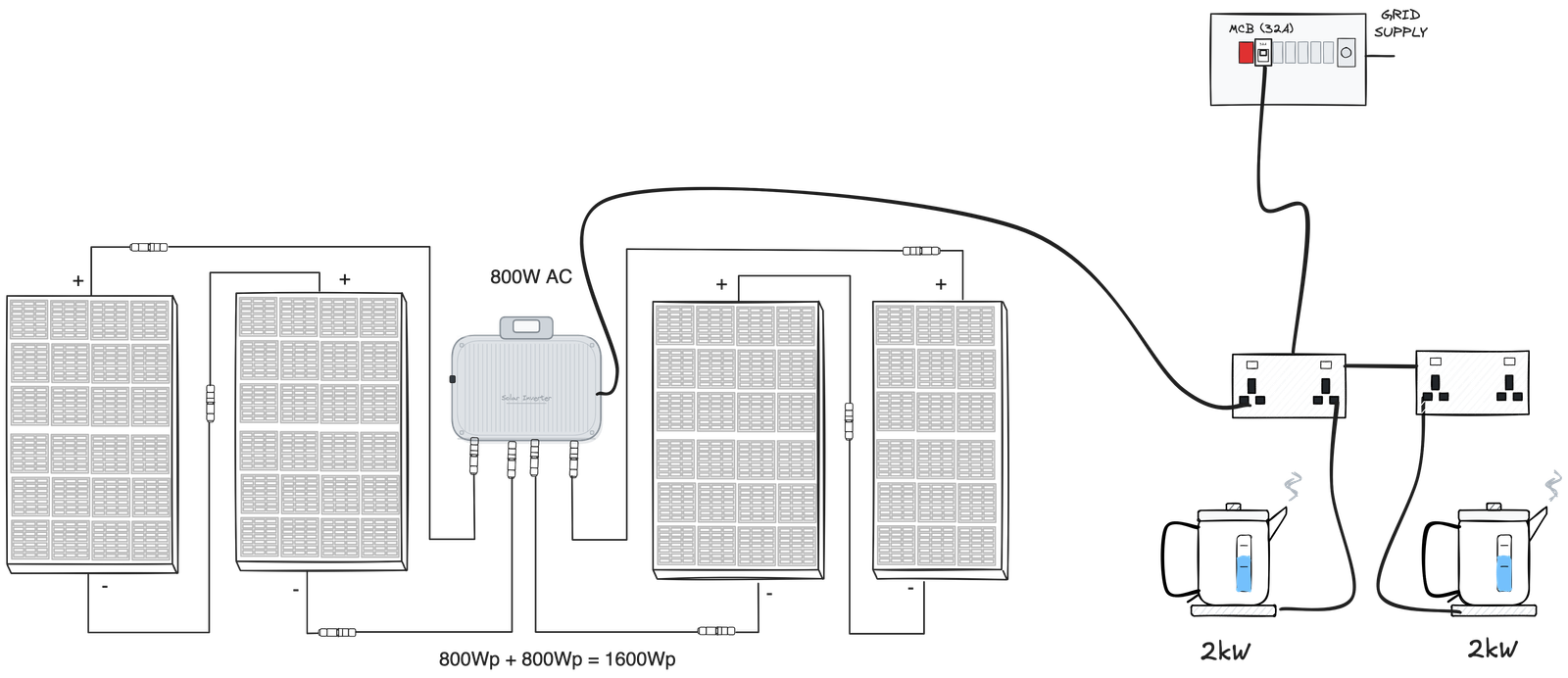
One important concept: you can connect more panel capacity than the inverter’s AC rating. Two 430W panels give you 860Wp of DC input into an 800W AC inverter. This is called overpanelling, and it is standard practice. The inverter clips any power above 800W, but clipping losses are 1-3% annually in northern Europe because the sun rarely delivers full rated output in the UK or Germany. You get more generation at dawn, dusk, and on overcast days by overpanelling, with minimal loss at peak.
Germany’s updated DIN VDE V 0126-95 norm (2024) sets the rules for what is allowed. A standard household socket (Schuko) is approved for up to 960Wp of panel input. If you want more panels (up to 2,000Wp), a Wieland safety socket is required. The inverter still caps AC output at 800W regardless of how many panels are connected. For adding panels to a microinverter system, the wiring and MPPT logic are covered in more detail in that guide.
The German VDE V 0126-95 standard requires that a plug-in inverter’s relay contacts must open within 0.1 seconds of detecting grid loss or being unplugged. Internal capacitors larger than 100 nF must discharge to below 34V within one second. This prevents the plug pins from remaining live after disconnection. Any inverter sold in the UK will need to meet an equivalent standard. The Hoymiles HMS-800W-2T and the EcoFlow Stream both meet these requirements.
The ENA Type Test Register already lists plug-in compatible inverters. The EcoFlow Stream (model EFWN511/EFWN511B, reference ECOFL/10021/V1/A1) has a G98 full type test tick, published October 2023. You can check it yourself at the ENA register. Its compliance status shows ‘further information required’ for G100 export limitation, but the G98 grid connection approval is confirmed.
How Many Plug-in Solar Panels Can I Have?
The UK has not finalised its own rules yet. If the BSI standard caps maximum DC input wattage or sets voltage limits per connection type, that will define the real ceiling. We are still waiting for the BSI product standard to confirm.
In Germany, the updated DIN VDE V 0126-95 standard allows up to 2,000Wp of panel input on a single plug-in solar system. That comfortably fits four 450W panels (1,800Wp). The inverter still caps AC output at 800W regardless of how many panels are connected.
The real constraint is your microinverter’s maximum MPPT voltage (Voc). Every panel has an open circuit voltage, and if you wire panels in series, those voltages add up. Exceed your inverter’s maximum and you risk damaging it. Here are some practical examples staying within the 2,000Wp German limit:
| Microinverter | Max MPPT Voltage | Max Power | Example Setup (within 2,000Wp) |
|---|---|---|---|
| Hoymiles HMS-800W-2T | 65V per input | 800W AC | 2x 450W panels, one per input (900Wp). Each panel Voc ~41V, well under 65V limit. |
| EcoFlow PowerStream 800W | 55V per input | 800W AC | 2x 445W panels, one per input (890Wp). Panel Voc must stay under 55V. Check the datasheet. |
| Hoymiles HMS-2000-4T | 65V per input | 2000W AC (capped to 800W by software) | 4x 450W panels, one per input (1,800Wp). Each panel Voc ~41V. Maximum generation across the day. |
The practical answer for most people: two panels is the standard starting point, four panels with a 4-input inverter is the upper end for heavy overpanelling. More panels means more generation in morning, evening, and overcast conditions, with minimal clipping loss (1-3% annually in the UK).
The diagram below shows how overpanelling works in practice:
The UK has not finalised its own rules yet. If the BSI standard caps maximum DC input wattage or sets voltage limits per connection type, that will define the real ceiling. We are still waiting for the BSI product standard to confirm.
How to Pick Solar Panels for Plug-in Solar
In UK conditions, 800W of panels on an 800W inverter will rarely produce 800W. Overcast skies, low winter sun, and morning/evening angles all reduce output well below nameplate. The practical approach is 1,200-1,600Wp of panels behind an 800W inverter. On the rare clear summer noon when the panels exceed 800W, the inverter clips the excess. The rest of the year, the extra panels produce energy that an 800W-rated array would miss entirely. From our panel directory, good candidates for a plug-in kit include the DMEGC 450W (best value at low cost per watt), the JA Solar 445W (widely available), or the LONGi Hi-MO X6 455W (strong efficiency). Two of any of these paired with an 800W microinverter gives you 890-910Wp of DC input. In Germany, 2x 430W panels (860Wp) into an 800W inverter is the standard configuration, and the new DIN VDE norm allows up to 2,000Wp with a safety plug.
What Kits Are Sold in Germany Right Now?
Germany has had legal plug-in solar since 2023, so there is a mature product range to look at as a guide to what the UK market will likely offer.
| Kit | Battery | Panel Wp | AC Output | Price (EUR) | Price (GBP approx) |
|---|---|---|---|---|---|
| Generic kit (2x 445W panels + Hoymiles HMS-800W-2T) | No | 890Wp | 800W | EUR 289-350 | GBP 243-294 |
| Zendure SolarFlow 800 Plus (panels included) | Yes (1.92kWh) | 880Wp | 800W | EUR 479-679 | GBP 403-571 |
| Zendure SolarFlow 800 Pro (panels separate) | Yes (1.92kWh, expandable to 11.5kWh) | separate | 800W | EUR 799-999 | GBP 671-839 |
| Anker SOLIX RS40P (no battery) | No | 890Wp | 800W | EUR 1,199 | GBP 1,008 |
| EcoFlow Stream Ultra X (panels separate) | Yes (3.84kWh) | separate | 800W | EUR 1,299-1,499 | GBP 1,091-1,259 |
The range is wide. A basic kit without battery costs less than GBP 300. Adding battery storage pushes the price to GBP 600-1,200 but raises self-consumption from roughly 40% to 90%, because the battery stores daytime surplus for evening use. Without a battery, any generation that exceeds your real-time consumption flows to the grid at no payment.
What About Battery Storage?
A plug-in solar kit with battery storage works differently from a basic panel-plus-inverter setup. The battery sits between the panels and the inverter (DC-coupled), or alongside it, and acts as a buffer between generation and consumption.
The system monitors your household consumption via a smart meter clamp or Wi-Fi plug. During the day, it feeds your home first and stores any excess in the battery. In the evening, it discharges through the same inverter at a rate matched to your consumption, so you draw less from the grid.
Without a battery, self-consumption is roughly 30-40% for a household away during the day. The panels generate peak power between 10am and 3pm, when no one is home to use it, and that generation goes to the grid for nothing. With a 2kWh battery, self-consumption climbs to 70-90%, because the battery captures that midday surplus and holds it for evening use.
The Zendure SolarFlow is the most popular battery hub in Germany. Its hub throttles the inverter output in real time to match your home’s actual load, so you avoid unnecessary grid export. The battery can be expanded with additional modules, which makes it a practical long-term option if you start with a small system and want to grow it later.
Whether battery storage is worth the extra cost depends on your daily consumption pattern. If you are home during the day and can use solar generation as it happens, a battery adds less value. If you are out from 8am to 6pm most days, a battery is what makes plug-in solar financially worthwhile.
Can You Earn From Exporting Plug-in Solar?
At 800W, the maths strongly favour using what you generate rather than selling it back. Every kWh you consume directly saves you 24-28p (your import rate). Every kWh you export earns 4-15p depending on your tariff. Self-consumption is worth roughly double what export pays.
Most export tariffs (Smart Export Guarantee) require MCS certification, which a plug-in system will not have. Octopus Energy is the exception: they accept non-MCS systems on some tariffs. You will also need a SMETS2 smart meter for any export payments.
For a plug-in system without battery storage, expect to self-consume 30-40% of generation if nobody is home during the day. The rest goes to the grid for little or no payment. Adding a battery pushes self-consumption to 70-90%, which is where plug-in solar starts to make real financial sense.
Are Plug-in Solar Panels Safe?
Yes, when installed within the regulations. An 800W microinverter adds less current to your ring main than a toaster. The inverter must disconnect within 0.1 seconds of detecting grid loss or being unplugged, and internal capacitors must discharge to below 34V within one second. This prevents live pins on disconnection.
The main safety considerations are:
- Ring main capacity: A 32A ring main can handle 7,360W. Adding 800W of solar uses roughly 11% of the circuit capacity. Even with other appliances running, the combined load stays well within the ring main rating.
- Overcurrent protection: The consumer unit MCB protects the circuit from the grid side. The inverter protects from the solar side. If either detects a fault, the circuit breaks.
- Socket type: The UK may require a fused connection unit instead of a standard 13A plug. This would add a dedicated fuse for the solar circuit, eliminating any risk from plug disconnection.
- Weatherproofing: Microinverters rated IP67 are designed for permanent outdoor installation. Panels and cables are UV-resistant and rated for 25+ years of exposure.
Germany has had legal plug-in solar since 2023 with over 4 million systems installed. There have been no widespread safety incidents reported. The technology is proven. The remaining question for the UK is which socket type the BSI standard will require.
My Take: Start Here, But Think Bigger
Plug-in solar is good news for the UK. Two panels, a microinverter, a plug. you are generating your own electricity and cutting your energy bill. That is powerful.
If you size it right, pair it with a decent battery like the Zendure SolarFlow, and run it alongside a smart tariff, plug-in solar can make a real dent in your electricity bill. Not life-changing money, but real, measurable savings every month.
But here is what I would say to anyone getting into this: if you try plug-in solar and you like it. and most people do. you are going to want more. You will start looking at your roof differently. You will wonder what a hybrid inverter could do. You will think about time-of-use tariffs and overnight charging.
I have been running a full solar system for years now. 7.15kWp of panels, a Sunsynk hybrid inverter, 16kWh of Fogstar battery storage. It started small and grew. That is the natural path. and a proper system with a good installer is not as expensive or complicated as people think.
My honest suggestion: plug-in solar is a brilliant first step. But if you have got roof access, think about a full solar system with a hybrid inverter and battery storage. The savings are bigger, the flexibility is on another level, and once you see what solar can do, you will want more anyway. The upgrade path from plug-in to a full system means replacing almost everything. so if you can go bigger from the start, do it.
Not sure if solar panels are worth it for your situation? That guide breaks down the real numbers. And if you are curious what a full system actually saves, here are my real payback results after years of running one.
Either way, this is great news for UK solar. The more households generating their own power, the better.
Lidl and Aldi Plug-in Solar Panels: What’s Available?
Almost certainly, once the regulations are finalised. In Germany, Lidl has sold plug-in solar kits since 2023, typically a 2-panel 800W package for EUR 199-299 (roughly GBP 170-250). Aldi Germany has run similar promotions. These kits include panels, a microinverter, cables, and a plug.
UK retailers cannot legally sell plug-in solar kits until the BSI product standard is published (expected July 2026) and BS 7671 Amendment 4 takes effect. After that, expect supermarket specials, B&Q displays, and online retailers to move fast. The German market went from niche to mass-market in under 18 months after legalisation. If you want to prepare now, read our guide to how plug-in solar works so you know what to look for when kits hit the shelves. For a full checklist and an interactive kit builder that only shows G98-verified inverters, see our plug-in solar buying guide.
Frequently Asked Questions
How do plug-in solar panels work in the UK?
A plug-in solar kit has one or two panels and a microinverter. Sunlight hits the panels, the microinverter converts DC to AC, and the electricity feeds into your home through a standard plug socket. Whatever is running in your home uses that power first instead of drawing from the grid. When the panels stop producing, your home switches back to grid power automatically. For the full technical walkthrough, read our guide to how plug-in solar works.
How many plug-in solar panels can I have?
The expected UK limit is two panels with a combined output of up to 800W AC, matching the current German standard. The exact wattage limit has not been officially confirmed yet. Once the BSI product standard is published (estimated July 2026), the cap will be clear.
Are plug-in solar panels legal in the UK?
The UK government confirmed on 16 March 2026 that plug-in solar will be legalised. The enabling regulation change takes effect in April 2026 via BS 7671 Amendment 4. However, compliant products cannot be sold until the BSI publishes the product standard, expected around July 2026. Until then, connecting a plug-in kit to the grid remains non-compliant.
Can I buy plug-in solar panels from Lidl or Aldi?
Not yet in the UK. Neither Lidl nor Aldi currently sell plug-in solar kits here. In Germany, both retailers have sold balcony solar kits for several years at competitive prices (€199–399). Once the UK product standard is finalised, UK retailers are expected to follow. Our buying guide covers what to check before purchasing any kit.
What Happens Next?
The sequence of steps between now and legal plug-in solar in UK homes runs roughly as follows.
- Arceio safety study findings published. The October 2025 Arceio study is the technical foundation for the policy. Its publication (likely alongside or before the draft regulations) will clarify the specific safety conditions that products must meet.
- Draft regulations and product standards. DESNZ, working with the IET (Institution of Engineering and Technology) and the ENA (Energy Networks Association), will produce the amended wiring regulations or a new product standard. These go through a consultation process before becoming final.
- BS 7671 Amendment 4. On 15 April 2026, the IET publishes Amendment 4 to the 18th Edition of BS 7671 (the Wiring Regulations). While this amendment focused primarily on stationary battery storage (new Chapter 702) and low-voltage generators (Chapter 708), it lays the groundwork for plug-in solar by providing a framework for distributed energy technologies in domestic settings. The transition period will run until 15 October 2026, after which all new installations must comply. Source: IET press release.
- Manufacturer and retailer preparation. Manufacturers selling in Germany and the Netherlands will adapt their products for UK certification. Retailers finalise their ranges. This takes months from when standards are confirmed.
- Products on sale. Once regulations are in force and products are certified, they appear in shops. First movers are likely the German-market kit from Aldi and Lidl, adapted for UK plugs and certification, followed by specialist solar retailers and online suppliers.
This article will be updated as each of these steps completes. The key things to watch for: the Arceio report publication, any DESNZ consultation document on amended regulations, and product announcements from UK retailers.
One factor worth watching: China’s 9% VAT export rebate on solar panels is being removed from 1 April 2026. Panel prices are already rising as a result. Battery prices will follow as the rebate phases out through 2027. If you are planning a larger rooftop system anyway, buying panels sooner rather than later may save you money. For plug-in kits specifically, the UK-certified products will reflect these higher input costs when they reach the shelves.
If you are a homeowner with roof access, none of this changes what is already available to you. A full roof-mounted system, installed by an MCS-certified installer or built DIY using certified components, is already legal, well-understood, and delivering returns at current electricity prices. Plug-in solar is not a replacement for that. It is a first step for everyone who has never had access to solar generation before.
Continue Your Plug-in Solar Journey
This hub covers the rules and timeline. These guides go deeper on specific topics:
- How Plug-in Solar Works — panels, microinverter, socket: the three components explained simply.
- Plug-in Solar Buying Guide — what to check on any kit before you buy, including German imports.
- Panel Tilt and Orientation — how angle and direction affect your output, with an interactive calculator.
- Solar Panel Prices UK 2026 — current costs, why they are rising, and the best time to buy.
- Adding Panels with Microinverters — how to expand a plug-in system or add panels to an existing roof array.