
Your council very likely runs a solar group-buying scheme: hundreds of local households register together, vetted installers compete in a reverse auction for the business, and you come out the other end with a fixed-price, MCS-certified install without cold-calling five firms yourself. iChoosr has run these group-buying auctions with more than 200 UK councils since 2015, so there’s a good chance yours is one of them. The real win isn’t even the discount, it’s the MCS certificate that comes as standard, because that’s what lets you sell your surplus power later.
Below is how the auction actually works, the realistic timeline from registration to a working system, what the discount is really worth against a benchmark quote, why the MCS angle matters more than people realise, and the full list of UK areas running a scheme, region by region. If your area is on the list, the link takes you to its page.
How the reverse auction actually works
Search “solar group buy” and your council’s name and you’ll find a friendly, local-sounding scheme: Solar Together Surrey, Switch Together Kent, Solar Together West of England. Different names, same engine. Nearly all of them are run by iChoosr, a group-buying firm that has run these auctions in the UK since 2015, trading as Solar Together and now rebranding to Switch Together. The council lends its logo and mailing list; iChoosr runs the auction and vets the installers. That’s worth knowing because it tells you what you’re actually buying: a place in a bulk order, not a bespoke design drawn up just for your roof.
- Register free. No payment, no obligation. You enter your address and roof details.
- Installers bid. iChoosr runs a reverse auction where vetted installers compete for the whole group’s business. The more households registered, the more group buying power on price.
- You get a personal recommendation. A specific system and a fixed price for your roof, based on what you entered.
- Accept or walk. You get a few weeks to decide, on a separate deadline from registration. Decline and you owe nothing.
The pitch is real: real buying power from pooled numbers, pre-vetted installers, and you’re not chasing five firms for quotes yourself. For a lot of people that hassle reduction is the whole point, and it’s a fair reason to use one.
Is your area on the list? The full UK list by region
These schemes run in rolling rounds, not continuously. A round opens, fills, installs, then closes for a while, and the windows move fast: some open for only a few weeks before the next batch of installer capacity is spoken for. The table below tells you which councils run a scheme at all, not which ones are open this week. For what’s actually live right now, use the postcode finder at switchtogether.co.uk (solartogether.co.uk redirects there) and register your interest. That puts you on the list to be told the moment your area’s next round opens, which is the only reliable way to catch the window.
As of mid-2026, rounds have kept up a steady cadence: Wokingham had a round open into early July, and the West Midlands and Wales have both run rounds earlier in the year. That’s evidence the cadence is real, not a guarantee your specific council is open today.
Solar group buying in London
| Area | Scheme |
|---|---|
| All 32 London boroughs | Solar Together London (run by the Greater London Authority) |
Solar group buying in the South East
| Area | Scheme |
|---|---|
| Surrey (county and districts) | Solar Together Surrey |
| Kent (county, districts and Medway) | Solar Together / Switch Together Kent |
| Hampshire (incl. Southampton, Eastleigh, Hart) | Solar Together Hampshire |
| East and West Sussex, Brighton and Hove | Solar Together Sussex |
| Berkshire: West Berkshire, Reading, Wokingham, Bracknell Forest, Windsor and Maidenhead | Solar Together Berkshire |
| Buckinghamshire | Solar Together / Switch Together Buckinghamshire |
| Oxfordshire | Switch Together Oxfordshire |
Solar group buying in the East of England
| Area | Scheme |
|---|---|
| Hertfordshire (county and districts) | Solar Together Hertfordshire |
| Essex | Solar Together Essex |
| Suffolk (incl. Ipswich, Babergh, Mid Suffolk) | Solar Together Suffolk |
| Norfolk (incl. Norwich, South Norfolk, Broadland, North Norfolk, King’s Lynn and West Norfolk) | Solar Together / Switch Together Norfolk |
| Cambridgeshire (incl. South Cambridgeshire) | Solar Together Cambridgeshire |
| Bedfordshire: Bedford, Central Bedfordshire, Luton | Solar Together Bedfordshire |
Solar group buying in the South West
| Area | Scheme |
|---|---|
| West of England: Bristol, Bath and North East Somerset, South Gloucestershire (plus North Somerset) | Solar Together West of England |
| Wiltshire and Swindon | Solar Together / Switch Together |
| Dorset | Switch Together Dorset |
| Devon (county and districts) | Solar Together Devon |
Solar group buying in the Midlands
| Area | Scheme |
|---|---|
| West Midlands: Solihull, Birmingham, Dudley, Sandwell, Walsall, Wolverhampton, Coventry | Solar Together / Switch Together West Midlands |
| Warwickshire | Solar Together Warwickshire |
| Worcestershire (incl. Wyre Forest) | Switch Together Worcestershire |
| Leicestershire (county and districts) | Solar Together Leicestershire |
| Lincolnshire (county) | Switch Together Lincolnshire |
Solar group buying in Yorkshire and the Humber
| Area | Scheme |
|---|---|
| West Yorkshire: Bradford, Calderdale, Kirklees, Leeds, Wakefield | Solar Together West Yorkshire |
| East Riding of Yorkshire | Solar Together |
| North East Lincolnshire (a Yorkshire and the Humber unitary, not North East England) | Solar Together |
Solar group buying in the North West
| Area | Scheme |
|---|---|
| Greater Manchester (all 10 boroughs) | Solar Together Greater Manchester |
| Liverpool City Region: Halton, Knowsley, Liverpool, Sefton, St Helens, Wirral | Solar Together Liverpool City Region |
| Cheshire East, Cheshire West and Chester, Warrington | Switch Together Cheshire and Warrington |
Solar group buying in Wales
| Area | Scheme |
|---|---|
| South East Wales: Cardiff, Blaenau Gwent, Caerphilly, Monmouthshire, Newport, Torfaen, Vale of Glamorgan | Switch Together South East Wales |
Scotland, Northern Ireland and North East England: the blank spots
If you’re in Scotland, Northern Ireland or the North East of England, there’s no council solar group buy to join. I checked. It isn’t an oversight on this page, the schemes genuinely don’t run there. What those areas have instead is grant and loan support, which can be worth more than a group discount.
- Scotland: Home Energy Scotland offers interest-free loans and grants towards solar and batteries. That’s often a better deal than a group buy, though the standard solar PV loan strand has tightened, so check what’s currently open before you bank on it.
- Northern Ireland: no group buy and no standing solar grant. Support runs through schemes like NISEP, mostly aimed at lower-income households.
- North East England: nothing found across Tyne and Wear, County Durham or Tees Valley. Your route is a direct quote, benchmarked against two or three installers.
How long does it actually take?
Budget six to nine months from registering to having a working system, not weeks. Register, then the auction runs, then you get a personalised offer, then a separate acceptance deadline (often around two weeks after registration closes), then a technical survey, then the install slot. Every step adds real calendar time, and oversubscription in a popular round pushes it further out.
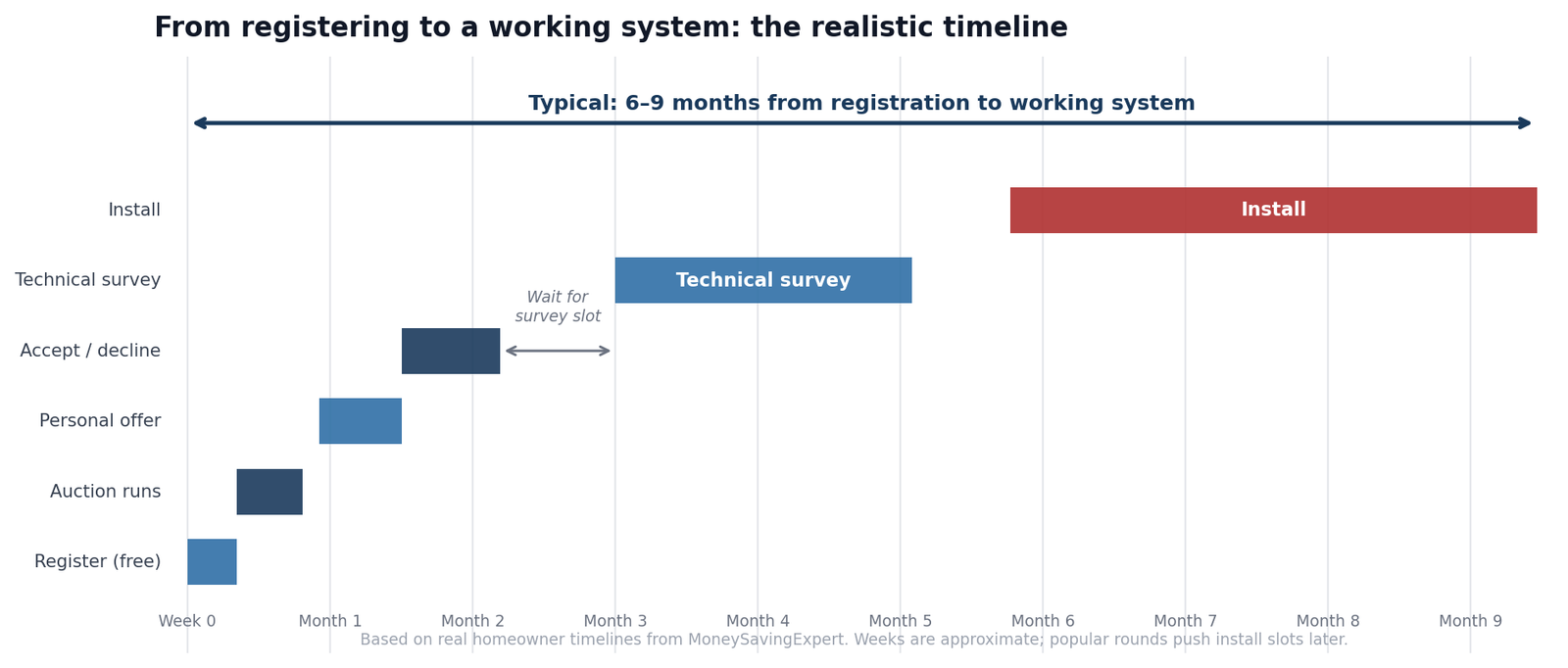
Homeowners on MoneySavingExpert have posted real timelines that make the point better than any official estimate. One Kent registrant signed up on 12 March, went through the auction on 15 March, had a personalised offer by 8 April, a technical survey on 11 August, and an install on 16 September: about six months start to finish. The delay in that case was partly down to take-up running roughly 40% higher than the scheme expected, which backed up survey and install slots. A Surrey registrant had a less typical run: originally quoted for around July, then pulled forward to January when someone else cancelled their slot. Cancellations happen, and they can work in your favour if you’re flexible on timing.
Expect a small refundable deposit, commonly around £150, to book the technical survey. That’s normal and distinct from any deposit you pay the installer once you’ve accepted the system itself.
None of that is a reason to avoid a scheme, it’s just a planning input. If you need panels up before a specific date, winter electricity prices or a house move, register as early in the round as you can and build in the slack. Six months is the middle of the range, not the worst case, and a popular round can comfortably push past nine. If you size up and go G99, the DNO approval step can itself add a few weeks on top of that.
Is it actually cheaper?
Often yes, but not always. The group price usually lands a little below a high-street quote, though it is measured against full retail list prices, not against an independent installer you have haggled down. Treat it as a solid default, then benchmark it with one independent quote before you accept. The prices people post on forums like MoneySavingExpert land all over the place, driven almost entirely by how much battery and extra kit they add on top of the panels. Your own benchmark quote is the only figure that tells you anything.
The auction price is also not automatically a good one: forum users have flagged scheme quotes that came in well above the local going rate, so being part of a bulk order doesn’t override a bad quote. UK domestic solar and battery storage is currently zero-rated for VAT until 31 March 2027, so the prices you’re quoted already include no VAT, which is part of why now is a reasonable time to buy. Councils that have run rounds have reported discounts in the rough range of 20 to 40% against list prices, varying a lot by round and region, so the only way to know where you land is to get one independent quote and compare it directly against your personalised offer before you accept.
The real advantage over DIY: you get MCS, so you can sell your power
A council group-buy install comes from an MCS-certified installer as standard, and that one certificate is what opens the door to selling your surplus electricity through the Smart Export Guarantee. Skip that certification, as a true DIY self-install does, and you’ll normally be shut out of the Smart Export Guarantee, because suppliers are not obliged to accept a system that can’t show that certification.
I went the DIY route myself and metered my own system for 16 months, so I know exactly what that trade-off costs, because I paid it. The system works. It generates exactly what I expected it to generate. But because I fitted it myself rather than through an MCS-certified installer, I can’t access the SEG export tariffs that the dozen-plus suppliers offer, names like Octopus, British Gas, E.ON Next, EDF, OVO, ScottishPower, So Energy and Utilita. MCS, or an MCS-equivalent accredited scheme, is the qualifying condition Ofgem sets for SEG eligibility. No certificate, no export payments, full stop.
A council scheme hands you that certificate without you having to chase it yourself, because the installer iChoosr vets is required to hold MCS accreditation as a condition of bidding. If selling your export matters to you at all, that’s a real, measurable advantage over self-installing. It’s the one thing my own install doesn’t have, and it’s worth more over the life of the system than the headline discount most people focus on.
I’m not saying DIY was the wrong call for me, it wasn’t, I knew the trade-off going in and I’d still do it again for the learning and the control over the spec. But I’d be lying if I said export income doesn’t sting a little every month it’s not landing in my account. If you’re weighing a group buy against doing it yourself, put the SEG access on the same side of the ledger as the discount. For most households it matters more over ten or twenty years than a few hundred pounds off the install price.
Get more out of it: more panels, a bigger battery, and go G99
The first package they put in front of you is the one they can quote and fit fastest: a set spec, a modest battery, panels on one slope. That’s fine as a starting point, but you don’t have to stop there. The standard opening offer is often modest, commonly around 8 to 10 panels with a small battery or none, which is exactly why it’s worth asking for more. Here’s where to push, and why it’s worth pushing.
- Ask for more panels than the standard quote offers. The extra capacity earns its keep in winter, when output per panel drops hard and you need the headroom most. Installers sometimes call this overpanelling: fitting more panel capacity than your inverter strictly needs on a sunny June afternoon, specifically so you claw back useful generation on the grey months that actually decide your bill.
- Size your battery for real, not for the demo install. Expanding battery storage after the fact is fiddly: you can mix and match batteries from different times, but matching age, capacity and the battery management system across units is a hassle most people would rather avoid. Decide now whether you want a bigger single battery, or even two, because retrofitting later costs more in time and money than getting it right at install.
- Remember panel prices have fallen. The panels themselves are a smaller share of total system cost than they used to be, so a few extra panels add less to the price than you’d assume, and with MCS export access in place they help pay for themselves faster.
- Size the inverter for where you’re heading, and go G99. This one is really about the inverter, not the panels. G98 is the simple notify-and-go route, broadly up to 16A or about 3.68kW of export per phase, and that ceiling is set by your inverter’s AC output, not your panel count. You can fit more panels under G98 and just export-limit the inverter to stay under the cap. The moment you want to push more power than that, though, you need a bigger inverter and the G99 route, the formal application where the DNO approves a larger connection. Here’s the part people miss: the inverter is worth sizing up even if your roof is full and you’ll never add another panel. A bigger battery wants more power to charge and discharge, and a heat pump piles on real AC load, so the peak DC to AC conversion you’ll want in a few years is bigger than the one that just covers today’s panels. If you’re already negotiating, ask for G99 and an inverter with headroom from the start, so the connection and the inverter aren’t the thing that caps you later.
The catch: the first offer is the fast one
None of the above is free for the asking. Someone I know went through the Solihull scheme and got the standard package first: a modest battery, panels on one side of the roof. Tidy, quick, cookie-cutter. They wanted more, a bigger battery and panels on both the east and west aspects, and got there after real back and forth. The installer pushed back hardest on the two-aspect roof, because fitting both sides means more time up there and more scaffolding moves than one clean run on a single slope, and deviation charges appeared that weren’t always easy to justify. They’re happy with what they ended up with, but it took pushing to get it.
There’s an authoritative reason behind that default. A Greater London Authority evaluation of its own scheme found some of the specified equipment was leaner than a typical domestic spec, which helps explain part of where the discount comes from: the standard package is genuinely built to a tighter spec, not just to a tighter price. Decide what you actually want, battery size and roof aspects included, before you register, so you’re negotiating from your own spec instead of being led to theirs.
A short risk note: protect your deposit
Group buying isn’t risk-free. Solar Streets, run by an installer called IDDEA, was the main commercial rival to council schemes and signed up town and parish councils across the South West and Oxfordshire, including Frome, Bruton, Melksham, Swanage and Didcot. In 2023 IDDEA went into administration, and householders who’d paid deposits were left trying to recover money from a company that no longer had it.
The iChoosr-run schemes are structured differently: you contract with and pay the installer directly, not a central operator sitting on a pile of deposits, so a single installer failing doesn’t take everyone else’s money down with it. That’s not a guarantee, just a better structure. Whatever route you take: check the installer is MCS certified, pay as little upfront as you can, and put any deposit on a credit card. Section 75 has conditions, but for a deposit over £100 it’s the strongest backstop you’ve got if it goes wrong.
Is Solar Together legit?
Yes. Solar Together, and its newer name Switch Together, is run by iChoosr, an established group-buying company that has worked with more than 200 UK councils since 2015. Your council endorses it but doesn’t run it. You contract directly with an installer that iChoosr has vetted and requires to hold MCS certification, not with iChoosr or the council.
Do I have to accept the offer if I register?
No. Registration is free and carries no obligation. After the auction you get a personal recommendation with a price, and you have a few weeks to accept or walk away. Decline it and you owe nothing.
Is a council solar scheme cheaper than going direct?
Usually a little below a high-street quote, but not always cheaper than an independent installer you have haggled down. The group discount is measured against full retail list prices, roughly 20 to 40% depending on round and region. Get one independent quote to benchmark before you commit.
Why isn’t my council on the list?
Either it has never run a round, or it’s between rounds. The schemes are periodic, not permanent. If you’re in Scotland, Northern Ireland or the North East of England there’s no scheme at all, so look at grants and loans instead. Otherwise, register your interest so you’re told when the next round opens.
Can I get a battery through a group buy?
Yes, most rounds now include battery storage alongside the panels. The default battery tends to be on the small side, so if you want a bigger one, say so before you accept the standard package.
Can I sell the electricity I generate?
Yes, because a council scheme install is MCS-certified, you can sign up to a Smart Export Guarantee tariff and get paid for surplus you export. A true DIY self-install without MCS or an equivalent accredited scheme cannot access SEG at all.
A council solar group buy is a genuinely good way in: a vetted, MCS-certified install at a good price, without the legwork of chasing quotes yourself. Walk in knowing your roof, your battery size and one benchmark quote, then push for the panels and battery you actually want. That’s how you get a system that pays you back for the surplus, not just the fastest one to bolt on.
