
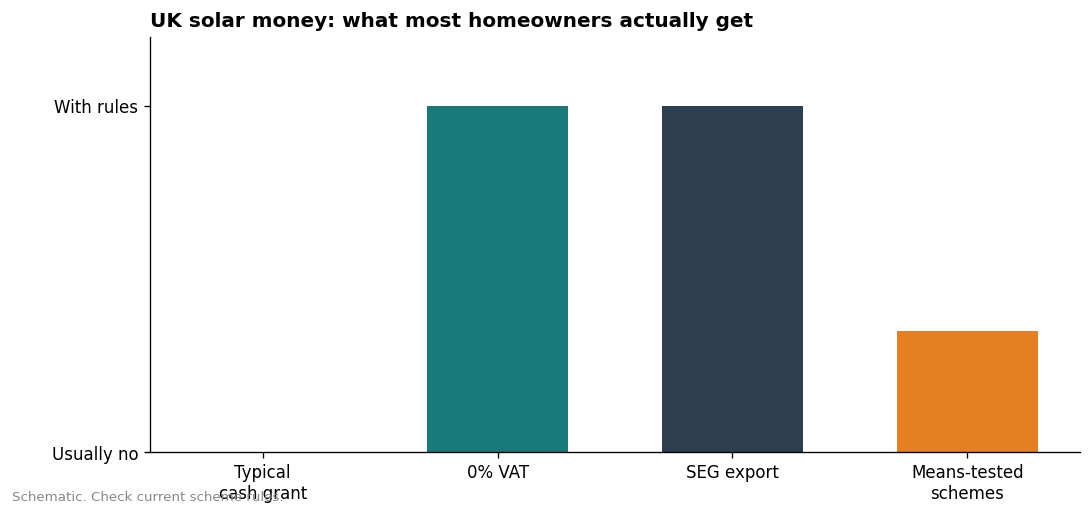
There is no universal free solar panel grant for typical UK homeowners in July 2026. Most households self-fund and use 0% VAT plus Smart Export Guarantee income. Fully funded or heavily grant-backed solar is means-tested (ECO4, Warm Homes routes, Nest in Wales) or comes via local group-buy discounts, not a national free-panels scheme.
Updated July 2026. Use the scheme table, then read the detail for anything that might apply to you.
| Scheme | What you get | Who qualifies | Typical homeowner? |
|---|---|---|---|
| 0% VAT | No VAT on qualifying residential solar and many batteries (saving ~£1,200-£1,600 on a mid-size install) | Residential supply-and-install by the same firm; runs to 31 March 2027 then expected 5% | Yes – near universal if installer applies it |
| SEG (Smart Export Guarantee) | Payment per kWh exported | Usually MCS install + smart meter + DNO approval; DIY limited (e.g. some Octopus routes) | Yes if MCS (or accepted DIY export tariff) |
| ECO4 | Can fund solar inside a wider retrofit | Benefits / fuel poverty routes; often needs electric heating or heat pump context; ends 31 Dec 2026 | No – means-tested minority |
| Warm Homes (Local Grant / Plan) | Local grant packages; future loans planned | Income/EPC and council delivery rules (England focus for Local Grant) | Only if council scheme + eligibility |
| Group buy (e.g. Solar Together) | Discounted quotes via reverse auction | Where your council runs a round; still self-funded | Sometimes – discount, not free |
In more detail: for most UK homeowners there is no cash grant for solar panels. The universal support is 0% VAT (saving roughly £1,200-£1,600, until March 2027) and Smart Export Guarantee income for the power you export. Fully funded solar only comes through means-tested schemes, ECO4, England’s Warm Homes: Local Grant, and Nest in Wales, and only if you are on a low income or benefits. Great British Energy does not fund private home solar.
Zero-Rate VAT on Solar Panels and Batteries
Since April 2022, residential solar panel installations in the UK carry 0% VAT instead of the standard 20%. The relief runs until 31 March 2027, after which it reverts to 5% (not back to 20%). Battery storage also qualifies: from 1 February 2024 the government zero-rated standalone battery storage connected to the grid, whether retrofitted to an existing solar setup or installed on its own.
For a typical 4kW system costing around £6,000 to £8,000, the VAT saving is roughly £1,200 to £1,600. That comes straight off the upfront cost with no application or means-testing required.
VAT Eligibility Conditions
- The property must be a residential dwelling (not a new build by a developer).
- The same company must supply and install the system. If you buy panels from one supplier and pay a separate installer, the labour may attract 5% VAT rather than zero.
- The relief applies to solar PV, solar thermal, battery storage, wind turbines, and heat pumps.
- There is no income threshold or means test.
This is the single biggest incentive available to all homeowners right now, regardless of income. If you are getting quotes for a system, make sure the installer is applying the zero rate correctly on their invoice.
Smart Export Guarantee (SEG)
The Smart Export Guarantee requires all licensed electricity suppliers with 150,000 or more customers to offer a tariff for small-scale renewable generators. In simple terms, your energy company pays you for every unit of electricity your solar panels export to the grid.
SEG replaced the old Feed-in Tariff (FiT) scheme, which closed to new applicants in March 2019. While SEG rates are generally lower than FiT was, the payments still make a meaningful contribution to the financial case for solar.
SEG Rates and Providers
Rates vary considerably between suppliers. As of June 2026, with the two Octopus rows re-checked on 24 July 2026, there is a wide split between basic SEG tariffs paying 3-5p per kWh and “smart” tariffs that pay several times more if you have the right setup:
| Supplier | Tariff | Rate (p/kWh) | Conditions |
| Octopus Energy | Octopus Flux | 28.6p peak export, 16:00-19:00 (London quote, 24 July 2026) | Needs solar, a home battery, an Octopus import tariff and an export MPAN. Rates vary by region, so quote your own postcode. Intelligent Octopus Flux, the version where Octopus controls the battery, is a separate tariff and is currently paused: its own page showed it as temporarily unavailable with no rates published when I checked on 24 July 2026. |
| Octopus Energy | Outgoing Octopus | 12p flat (Outgoing Fixed, July 2026 snapshot; check live rates) | Outgoing Fixed still offered as a flat rate product; confirm current p/kWh on Octopus; open to DIY and non-MCS systems |
| OVO Energy | SEG Install Exclusive | 20p flat | Must purchase system through OVO or partners |
| E.ON Next | Export Premium | 16.5-25p | Existing E.ON customers |
| EDF | Export Exclusive 12m | 24p | Existing EDF customers |
| Most suppliers | Basic SEG | 3-5p | No special requirements |
Rates change frequently, so check current offers before committing. The best rates typically require you to be on that supplier’s import tariff as well. Standard Octopus Flux, for example, needs both solar and a home battery, and pays its premium rate during the 16:00 to 19:00 peak. It is open to new sign-ups. Intelligent Octopus Flux is not, so treat the two as different products rather than two names for one tariff. Outgoing Octopus is more accessible (it accepts DIY and non-MCS systems) but its Outgoing Fixed rate was cut from 15p to 12p flat on 1 March 2026 (July 2026 snapshot; check live rates). I have covered the Octopus options in detail in my guide on exporting solar energy from a DIY system.
Export Tariffs for DIY and Non-MCS Systems
If you are planning a DIY solar installation, you will quickly find that almost every supplier requires an MCS certificate to pay you for your exported energy. Without one, the standard rule is that your surplus energy goes to the grid for free.
However, there is currently one major exception: Octopus Energy’s Outgoing Octopus tariff. As of early 2026, Octopus accepts DIY and non-MCS systems, provided you have the correct DNO approval (a G98 or G99 acceptance letter) and a working SMETS2 smart meter. Outgoing Fixed was cut from 15p to 12p flat from 1 March 2026 (July 2026 snapshot; check live Octopus rates).
To put these numbers in perspective: a typical 4kW solar system exporting around 2,000 kWh per year would earn roughly £80 on a basic 4p tariff. On a smart tariff averaging 20p per kWh, that same system earns around £400 per year. The difference is large, and it is why battery storage has become central to the financial case for solar. You can charge from the grid when rates are low (around 7p per kWh overnight) and export during the 4-7pm peak when rates are highest.
For a comparison of Octopus export tariffs specifically, see the Octopus Energy export tariffs breakdown.
SEG Eligibility
- Your system must have a maximum capacity of 5MW (not an issue for domestic installations).
- You need a SMETS2 smart meter capable of half-hourly export readings. If you still have a first-generation SMETS1 meter, ask your supplier for an upgrade.
- You must have DNO (Distribution Network Operator) approval, specifically a G98 or G99 acceptance letter confirming your system is registered to export.
- The installation must be carried out by an MCS-certified installer. Without an MCS certificate, you cannot access standard SEG payments and your surplus energy goes to the grid for free. The one exception is Octopus Energy’s Outgoing Octopus tariff, which accepts non-MCS and DIY systems (see the rates table above).
- You do not have to take your import supply from the same company that pays your SEG tariff, though the best rates often require it.
How to Apply for SEG
Timing matters, because you are typically only paid from the date your application is received, so apply on the same day your system is commissioned. The process runs like this:
- Ensure your installer hands over the MCS certificate within 10 days of commissioning.
- Get DNO approval (your installer normally submits the G98/G99 application for you).
- Confirm you have a SMETS2 smart meter installed and working.
- Apply for an Export MPAN (Meter Point Administration Number) with your chosen supplier.
- Once activated, your smart meter sends half-hourly export data automatically, with no manual readings needed.
You can check the official list of SEG licensees on the Ofgem website.
Can You Actually Get Free Solar Panels in the UK?
Search online for solar funding and you will be hit by a deluge of adverts promising “free solar panels for UK homeowners.” Let’s cut through the marketing spin: there is no universal, catch-all scheme offering free panels to everyone.
Most of those adverts are from lead-generation companies trying to capture your details. The only genuine ways to get a fully funded solar system in the UK are through specific, means-tested government schemes designed to alleviate fuel poverty. If you meet the strict criteria for the ECO4 Scheme or the Warm Homes Plan (detailed below), you can indeed get a system installed for zero cost. If your household income is above the thresholds, you will be paying for the system yourself, but you can still benefit heavily from the 0% VAT rules and export tariffs.
ECO4 Scheme
The Energy Company Obligation 4 (ECO4) scheme has run since April 2022 and was extended to 31 December 2026 (it was originally due to end in March 2026). There will be no ECO5; the Warm Homes Plan replaces the supplier-obligation model from 2027. Under ECO4, large energy suppliers fund energy efficiency and heating measures in eligible homes, and solar panels can be included as part of a whole-house retrofit.
One catch trips most people up: under ECO4, solar PV is only an eligible measure where the home is heated by electricity or a heat pump. If you have a gas boiler, ECO4 will not fund panels whatever your income, because solar has to sit inside a wider heating-led retrofit.
ECO4 funding can be substantial, potentially covering the full cost of a solar installation when combined with other measures like insulation. Support packages typically range from 7,000 to 20,000 pounds depending on what the property needs.
ECO4 Eligibility
- You must be receiving qualifying benefits such as Universal Credit, Child Tax Credits, Pension Guarantee Credit, Income Support, or similar means-tested benefits.
- Your home must have an EPC rating of D, E, F or G.
- The scheme targets fuel-poor and vulnerable households.
- Solar panels are more likely to be offered where the home already has decent insulation or the installer is including insulation as part of the same package.
ECO4 LA Flex
Even if you do not receive qualifying benefits, you may still be eligible through ECO4 LA Flex. This route allows local councils to refer households with a total household income of £31,000 or below that face fuel poverty but fall outside the standard benefit criteria. Contact your local authority to ask whether they participate in LA Flex referrals.
ECO4 closes on 31 December 2026, so if you think you qualify, act before then. There will be no ECO5: the Warm Homes Plan takes over from 2027. To start, contact your energy supplier, or your local council for the LA Flex route below.
Warm Homes: Local Grant
This is now the main route to funded solar in England. The Warm Homes: Local Grant replaced the old Home Upgrade Grant (HUG2), which closed in March 2025. It runs from April 2025 to March 2028, is backed by £500 million, and is delivered by local councils. Solar PV is explicitly an eligible measure, and a battery is funded too when it goes in alongside the panels.
Warm Homes: Local Grant Eligibility
- Your home is in England and is privately owned or privately rented (not social housing).
- Your household income is £36,000 a year or less, or someone in the home receives a means-tested benefit.
- The property has an EPC rating of D, E, F or G.
The grant covers up to £15,000 for efficiency measures (insulation, solar PV and battery) and up to £15,000 for low-carbon heating, so £30,000 in total. A solar-plus-battery package inside the scheme is typically worth £9,000 to £12,000.
One honest caveat: not every council offers solar under the scheme. Some prioritise insulation and heat pumps, and a few areas paused their portals under demand in late 2025 before reopening in 2026. Whether solar is on the menu depends on the authority running it where you live, so check your council’s Warm Homes page, or the GOV.UK Warm Homes Plan page, first.
Warm Homes Plan
The government’s Warm Homes Plan represents 15 billion pounds of public investment to upgrade up to 5 million homes by 2030. While still being rolled out, the plan includes several measures relevant to solar:
- Low-interest or zero-interest loans for solar panels and batteries, expected to launch through the Consumer Loan Scheme in April 2027 with 1.7 billion pounds of lending backed by 300 million pounds of government funding.
- Fully funded upgrades for low-income households, covering insulation, heating and solar at no cost to the homeowner.
- Future Homes Standard, expected in early 2027, which will require solar panels as standard on all new-build homes.
The Warm Homes Plan is still in its early stages. Keep an eye on government announcements for confirmation of dates and details as individual programmes within the plan open for applications.
Does Great British Energy Fund Home Solar?
No. Great British Energy does not pay for solar panels on private homes. It is a publicly owned company (at gbe.gov.uk), not a grant scheme. Its solar money goes to public buildings: by March 2026 it had put panels on 100 schools and colleges, heading for around 250 by summer, plus NHS sites. There is no application for homeowners.
Worth knowing, because the name is being used against you: a lead-generation site at greatbritishenergy.com (nothing to do with the government’s gbe.gov.uk) ranks for these searches and harvests your details with the promise of a grant that does not exist. If a page asks for your contact details to check eligibility for a Great British Energy home grant, close the tab.
Boiler Upgrade Scheme (BUS)
The Boiler Upgrade Scheme does not cover solar panels directly, but it is worth mentioning here because many homeowners combine solar with a heat pump installation. A heat pump paired with solar panels is one of the most effective ways to cut both electricity and heating bills.
BUS provides upfront capital grants deducted directly from your installer’s quote:
- £7,500 for an air source heat pump.
- £7,500 for a ground source heat pump.
- £2,500 for an air-to-air heat pump.
- £7,500 for a biomass boiler (rural properties only). From 21 July 2026, off-grid homes get an uplift to £9,000 for an air or ground source heat pump.
The budget for 2025/2026 is 295 million pounds. You need an MCS-certified installer, and the property must currently use a fossil fuel heating system (gas, oil, LPG or electric). The grant is applied at the point of installation, so you see the discount on your invoice rather than claiming it back afterwards.
Solar Together Group-Buying Schemes
Solar Together is a group-buying programme run by iChoosr in partnership with local councils across England and Wales. The idea is simple: by pooling demand from hundreds of households, the scheme negotiates lower prices through a reverse auction where pre-vetted installers compete on cost.
How Solar Together Works
- Register through your local authority’s website. Registration is free and carries no obligation.
- Auction: Once registrations close, Solar Together holds a reverse auction. Pre-vetted installers bid to offer the lowest price for the group.
- Personal offer: You receive a personalised quote based on your property. You can accept or decline with no pressure.
- Installation: If you accept, the winning installer surveys your roof and arranges installation.
Participants typically save 30 to 40 per cent compared to going it alone. The scheme is not available everywhere, so check whether your local council is taking part. Councils in areas like London boroughs, the South East, West Yorkshire and the West Midlands have run Solar Together rounds in recent years.
Local Authority Grants and Schemes
Beyond the national programmes, many local councils run their own energy efficiency grants or low-interest loan schemes. These vary widely and change frequently. Some examples:
- London boroughs have offered solar grants through the Mayor’s Solar Together programme.
- Welsh homeowners can access the Warm Homes Nest scheme, which provides free energy efficiency improvements including solar for eligible households.
- Scotland closed its standalone solar PV grant and loan to new applicants in June 2024. Home Energy Scotland now funds solar only as a hybrid PV-T (electricity plus hot water) interest-free loan up to £5,000, or as an add-on measure alongside a qualifying heat pump (heat pump grants up to £7,500, or £9,000 with the rural uplift).
- Northern Ireland has the Northern Ireland Sustainable Energy Programme (NISEP).
The best starting point is the GOV.UK energy efficiency page or calling the Energy Saving Trust helpline. They can tell you exactly what is available at your postcode.
Why MCS Certification Matters
One thread runs through nearly all of these schemes: MCS certification. The Microgeneration Certification Scheme is the UK’s quality assurance standard for renewable energy installations. To access SEG payments, the Boiler Upgrade Scheme, and most grant funding, your installation must be carried out by an MCS-certified installer.
This is worth factoring into your plans early. If you use an uncertified electrician to cut costs, you will not receive an MCS certificate number, which means your surplus energy goes to the grid for free and you cannot access any official UK scheme for funding or export tariffs. If you are considering a DIY solar installation, be aware that DIY systems generally cannot be MCS-certified. Octopus Energy’s Outgoing Octopus tariff does accept non-MCS systems, but this is the only mainstream option available.
You can search for MCS-certified installers in your area at mcscertified.com.
What Savings Can You Expect?
Putting it all together, here is a realistic picture for a typical UK household installing a 4kW solar panel system with battery storage in 2026:
| Item | Typical Value |
| System cost (panels + battery + installation) | 8,000 – 12,000 pounds |
| VAT saving (0% vs 20%) | 1,600 – 2,400 pounds |
| Annual electricity bill reduction | 300 – 600 pounds |
| Annual SEG income (exporting surplus) | 100 – 400 pounds |
| Payback period | 6 – 10 years |
The lowest barrier to entry is now plug-in solar panels. Since 27 August 2026 you can plug a listed kit into a normal socket in Great Britain, with no electrician. On 22 September 2026 listed kits started at £336 for one panel and £444 for two. There is no grant for them, and no export payment except on Octopus’s own kit.
If you qualify for ECO4 or the Warm Homes: Local Grant, the upfront cost could be cut sharply or eliminated entirely. Even without grants, the combination of VAT relief, bill savings, and export income makes the financial case strong for most homeowners. For a deeper look at the numbers, see my post on whether solar panels are worth it in 2026.
How to Apply
The application process depends on the scheme:
- VAT relief: No application needed. Your installer applies the zero rate automatically.
- SEG: Contact your chosen energy supplier and register with your MCS certificate and smart meter details.
- ECO4: Contact your energy supplier or a local ECO4 installer. You can also ask your local council about LA Flex referrals.
- Warm Homes: Local Grant: Apply through your local authority (England) if they are participating.
- BUS: Your MCS-certified installer applies on your behalf through Ofgem.
- Solar Together: Register through your local council’s Solar Together page when a round is open.
Battery Storage Incentives
Battery storage benefits from the same 0% VAT as solar panels. Beyond that, batteries open up the most lucrative export tariffs. Time-of-use tariffs like Octopus Flux let you charge your battery from the grid during cheap overnight periods and export during expensive peak hours, earning several times more than a flat-rate SEG tariff. Sign up for the standard Flux tariff, not Intelligent Flux, which Octopus had paused when I checked on 24 July 2026.
If you are weighing up whether to add a battery, I have written about battery storage without solar and the economics of different setups. The short version: batteries make the most financial sense when paired with a time-of-use tariff and solar panels together.
Frequently Asked Questions
Are there government grants for solar panels in the UK?
For most homeowners, no direct cash grant exists. The support everyone can use is 0% VAT on installation (until 31 March 2027) and Smart Export Guarantee payments for the electricity you export. Fully funded panels only come through means-tested schemes: ECO4, England’s Warm Homes: Local Grant, and Nest in Wales, and only for low-income or benefit-claiming households.
Can you get free solar panels in the UK?
Yes, but only if you qualify for a means-tested scheme. ECO4 can fund panels for benefit claimants whose home is heated by electricity or a heat pump (not gas). England’s Warm Homes: Local Grant covers solar for households on £36,000 or less with an EPC of D to G. Nest does the same in Wales. Most “free solar panel” adverts are lead-generation companies, not schemes.
Does Great British Energy give grants for home solar?
No. Great British Energy (gbe.gov.uk) is a publicly owned company, not a grant scheme, and it funds solar on schools, hospitals and other public buildings rather than private homes. A separate lead-generation site using a similar name advertises grants that do not exist, so ignore it.
Is there funding for solar panels for homeowners on a normal income?
Not as a grant. Above the means-tested thresholds you pay for the system, but you still get 0% VAT (saving £1,200 to £1,600), export income through the Smart Export Guarantee, and from 2027 a government-backed low-interest Warm Homes loan is expected to cover solar and batteries for all homeowners.
Can you still get a solar grant in Scotland?
Not for standard solar PV. Scotland closed its standalone solar grant and loan to new applicants in June 2024. Home Energy Scotland now funds solar only as a hybrid PV-T interest-free loan, or as an add-on alongside a qualifying heat pump.
Summary
The UK has a decent spread of financial support for solar in 2026. The zero-rate VAT alone saves over a thousand pounds on any residential installation, and the SEG provides ongoing income for exported electricity. For lower-income households, ECO4, the Warm Homes: Local Grant and the wider Warm Homes Plan can cover much or all of the cost.
The key practical steps are:
- Check whether you qualify for ECO4, the Warm Homes: Local Grant or local authority schemes first. Free solar is obviously the best deal.
- If you are self-funding, get quotes from MCS-certified installers and verify they are applying 0% VAT.
- Once installed, shop around for the best SEG tariff. Do not just accept your current supplier’s default rate.
- Consider a battery if you want to maximise export earnings through time-of-use tariffs.
- Watch for the Warm Homes Plan loan scheme launching in 2027 if upfront cost is a barrier.
Incentive programmes change regularly. I will update this guide as new schemes open or existing ones are extended. If you have questions about a specific scheme or your eligibility, feel free to get in touch.
